

Prohibited claims in CBD marketing refer to any assertion attributing therapeutic or health properties to a cannabidiol-based product without prior legal authorization. This framework is primarily based on European Regulation No. 1924/2006, which requires every health claim to undergo scientific validation by the EFSA (European Food Safety Authority). In France, the DGCCRF, the DGAL, and the ANSM coordinate inspections and may impose penalties for any violations. For professionals and entrepreneurs in the sector, understanding these prohibitions is not optional—it is essential for business survival.
What therapeutic claims are prohibited for CBD?
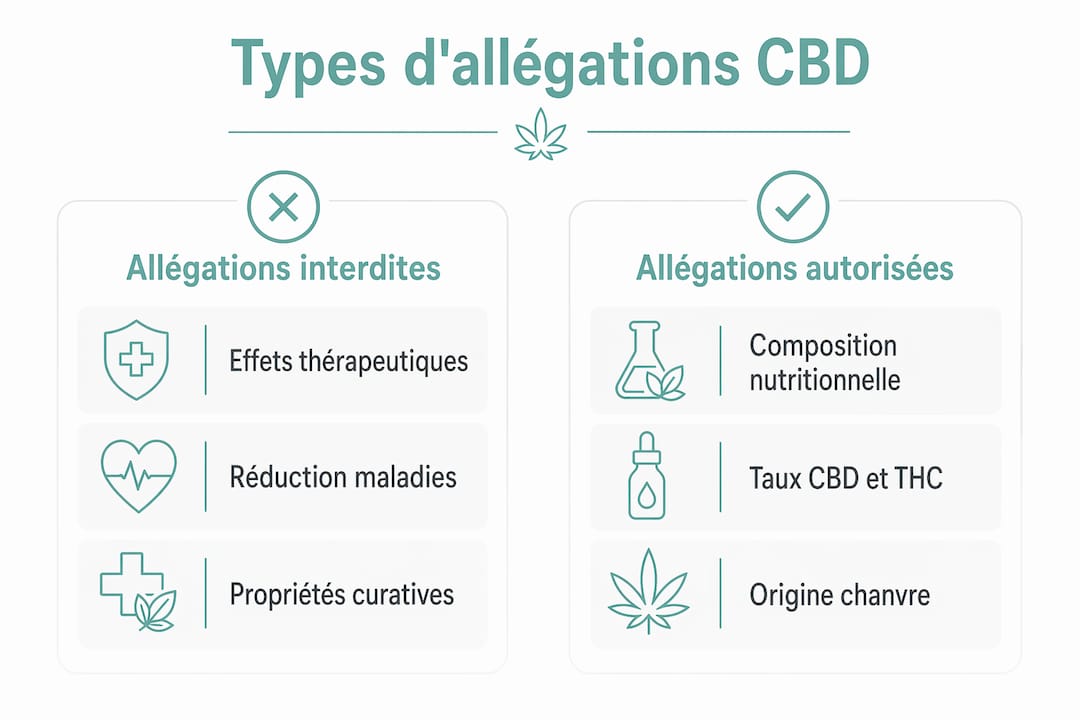
Any therapeutic or health claims made about CBD products are strictly prohibited without authorization from the EFSA. This rule stems from Regulation No. 1924/2006, which requires rigorous scientific validation before any claims regarding physiological effects may be made. However, to date, no authorization has been granted for CBD under this framework.

Expressly Prohibited Phrases
The following expressions are prohibited in all commercial communications, whether on a website, a product page, social media, or packaging:
- "Anti-stress" or "reduces stress"
- "Promotes sleep" or "helps you sleep better"
- "Anti-inflammatory" or "pain-relieving"
- "Anxiolytic" or "relieves anxiety"
- "Strengthens the immune system"
- "Improves concentration"
These statements constitute prohibited CBD claims under regulatory definitions, even when phrased in a mild or indirect manner. Writing “may help improve sleep” remains an unauthorized health claim.
The distinction between nutrition claims and health claims
A nutrition claim describes a product’s composition (“rich in omega-3,” “sugar-free”). A health claim asserts that a product has a beneficial effect on a bodily function. CBD has no health claims approved by the EFSA. Any communication that crosses this line exposes the company to immediate penalties.
Pro tip: Always replace health claims with factual product descriptions: the origin of the hemp, the extraction method, and the CBD and THC levels certified by an ISO 17025-accredited laboratory. This approach is compliant and credible.
What are the enforcement measures and penalties for noncompliance?
The DGCCRF, the DGAL, and the ANSM coordinate inspections of CBD products in France, covering labeling, claims, and THC levels. These sector-specific investigations are conducted on a regular basis and result in product recalls, formal notices, and administrative fines.
The audit process generally follows these steps:
- Inspection or report: The DGCCRF or the DGAL receives a complaint or schedules a sector-specific investigation.
- Sampling and analysis: Samples are collected to verify THC levels and labeling.
- Formal Notice: The company receives a demand to comply within a specified time frame.
- Recall via RappelConso: Non-compliant products are removed from the market and listed on the official RappelConso platform.
- Financial or criminal penalty: Depending on the severity, the fine may be accompanied by criminal charges.
Criminal Liability Related to THC Levels
The THC content must be 0.3% or less in the finished product to remain within legal limits. This threshold is verified through sampling during inspections. Any exceedance, even minimal, results in criminal reclassification as possession of a narcotic, with penalties that go far beyond mere commercial sanctions.
Key takeaway: The main reason for bank account closures among CBD businesses is the use of therapeutic claims in their communications. Terms such as “anti-stress” or “sleep aid” are strictly prohibited, even on social media or product descriptions. A closed bank account can bring a business to a standstill in a matter of days.
Advertising platforms such as Google Ads and Meta enforce rules that are even more restrictive than French law. They systematically reject CBD ads, regardless of whether the product complies with regulations. This reality forces professionals to completely rethink their visibility strategy.
How can you adapt your marketing communications to ensure compliance?
The safest approach for CBD professionals is based on fact-based communication that highlights product certification and traceability, without making any therapeutic or health claims. This approach protects the company and builds customer trust.
Permitted Language vs. Prohibited Language
| Type of communication | Prohibited example | Valid example |
|---|---|---|
| Product Sheet | "Reduces anxiety naturally" | « Huile de CBD à spectre large, taux CBD : 10 %, THC < 0,3 % » |
| Social Media | "Helps You Sleep Better" | "Organic hemp extract, grown in France" |
| Packaging | "Guaranteed soothing effect" | "Contains cannabidiol (CBD). For adults only." |
| Blog / Content | "Natural Stress Relief" | "CBD: Composition, Extraction, and Regulatory Framework" |
Mandatory legal disclosures on packaging must include the CBD content, a THC content of less than 0.3%, a statement that the product is for adults only, and a disclaimer that no therapeutic advice is provided. The packaging must be neutral, with no visuals or slogans suggesting a medical effect.
Alternative Communication Strategies
Content marketing, search engine optimization (SEO), and email marketing are the most effective channels for the CBD industry. A blog post about CBD regulations in France attracts a targeted audience without violating advertising rules. Organic social media remains an option as long as no health claims are made.
A Certificate of Analysis (CoA) issued by an ISO 17025-accredited laboratory is the most credible communication tool available. It verifies compliance with THC levels and the origin of the hemp. Publishing this document on the product page is a better alternative to making any claims about the product’s effects.
Pro tip: Create a dedicated page on your website to showcase your CoAs and certifications. This transparency in documentation is viewed positively by regulatory authorities and reassures professional buyers.
What impact will the 2026 regulations have on CBD edibles?
CBD food products without European Novel Food authorization have been banned from sale since May 2026. This ban specifically targets ingestible oils, gummies, beverages, and capsules. Recalls are being carried out systematically through RappelConso.
What This Means in Practice for Professionals
- Catalog to be audited immediately: Any edible product without a validated Novel Food dossier must be removed from sale.
- Labeling to be reviewed: Authorized information is limited to ingredients, origin, and precautions for use.
- Inventory management: Products that have been withdrawn from the market can no longer be sold legally, even at a discount.
- 20% VAT: As of April 2026, all CBD products are subject to the standard VAT rate, with stricter enforcement.
- Mandatory regulatory monitoring: Updates from the DGAL and the DGCCRF may change the conditions for placing products on the market without much advance notice.
French authorities now use the concept of an “acute reference dose” to assess risks associated with consumption. A product whose dosage exceeds this threshold may be removed from the market, even if its THC content complies with regulations on paper. This approach significantly broadens the scope of controls on edibles.
Marketing for topical products (balms, creams) remains more flexible, provided that no therapeutic claims are made. A CBD balm can be marketed as a “hemp extract-based skincare product” without violating regulations, provided that the labeling remains neutral and factual.
A commitment to active regulatory monitoring is essential for anticipating inspections and adapting business practices in real time.
Key Points
Compliance in CBD communications relies on the complete elimination of health claims and a commitment to transparency in documentation, particularly through the ISO 17025 certificate of analysis.
| Point | Details |
|---|---|
| Prohibited Claims | Any reference to therapeutic or health effects is prohibited without EFSA authorization. |
| Criminal Liability for THC | A THC level exceeding 0.3% results in the offense being reclassified as possession of a narcotic. |
| Edible Products and Novel Foods | Oils and gummies that do not have Novel Food authorization have been prohibited from sale since May 2026. |
| Compliant Communication | Highlighting the source, the extraction method, and the CoA takes precedence over any claims regarding effectiveness. |
| Advertising platforms | Google Ads and Meta ban CBD ads; SEO and organic content are viable alternatives. |
What I've Learned from Observing the Industry's Most Costly Mistakes
After years of tracking regulatory developments in the CBD market in France, one thing is clear: the majority of business closures in this sector are not due to product issues. They stem from communication problems.
The most common mistake is to believe that a euphemistic phrase will go unnoticed. Phrases like “may help promote relaxation” or “supports natural sleep” are disguised health claims. The DGCCRF identifies them with ease. Banks do too, and they close accounts even before legal proceedings are initiated.
What strikes me is that the professionals who are most successful don’t try to circumvent the rules. They build their communication strategy entirely around traceability and certification. They publish their certificates of analysis (CoAs), detail their extraction methods, and explain the origin of their hemp. This approach is not only compliant; it’s also more effective commercially in the long run.
CBD regulations in 2026 are stricter than in 2023. They will likely be even stricter in 2027. Professionals who invest now in factual, well-documented communication are building a sustainable position. Those who continue to make unsubstantiated claims are putting their business at existential risk. To sell CBD legally, transparency is not a competitive advantage—it’s the bare minimum requirement.
— Steven
Compliant CBD products, free of prohibited claims
Choosing CBD products that are already compliant with regulations greatly simplifies the management of your marketing communications. Pure-extract-cbd offers a complete line of products made from organic hemp, accompanied by certificates of analysis issued by ISO 17025-accredited laboratories.
Every Pure-extract-cbd product has a THC content of less than 0.3%, full traceability, and neutral labeling that complies with DGCCRF requirements. Professionals and retailers will find this product line to be a solid foundation for developing factual marketing communications free of legal risk.The broad-spectrum CBD/CBG oil and CBD flowers available in the online store meet the regulatory standards in effect as of 2026.
Frequently Asked Questions
What is a prohibited claim in CBD advertising?
A prohibited claim is any statement attributing a therapeutic or health benefit to a CBD product without authorization from the EFSA, in accordance with European Regulation No. 1924/2006. Common examples include “anti-stress,” “promotes sleep,” or “relieves pain.”
Which authorities regulate CBD claims in France?
The DGCCRF, the DGAL, and the ANSM coordinate inspections of the labeling, claims, and THC levels of CBD products. These investigations may result in product recalls, formal notices, and fines.
Will CBD oils still be legal to sell in 2026?
CBD oils intended for ingestion that do not have European Novel Food authorization have been banned from sale since May 2026. Only products with a validated Novel Food application may be legally sold in France.
How can you talk about CBD without breaking the law?
Communications must be limited to factual information: the origin of the hemp, the extraction method, and the CBD and THC levels certified by an ISO 17025-accredited CoA. Any claims regarding physiological or therapeutic effects are prohibited.
What are the consequences of exceeding the permitted THC level?
A THC content exceeding 0.3% in the finished product results in the offense being reclassified as possession of a controlled substance, exposing the person responsible to criminal prosecution that goes far beyond mere commercial or administrative penalties.



