
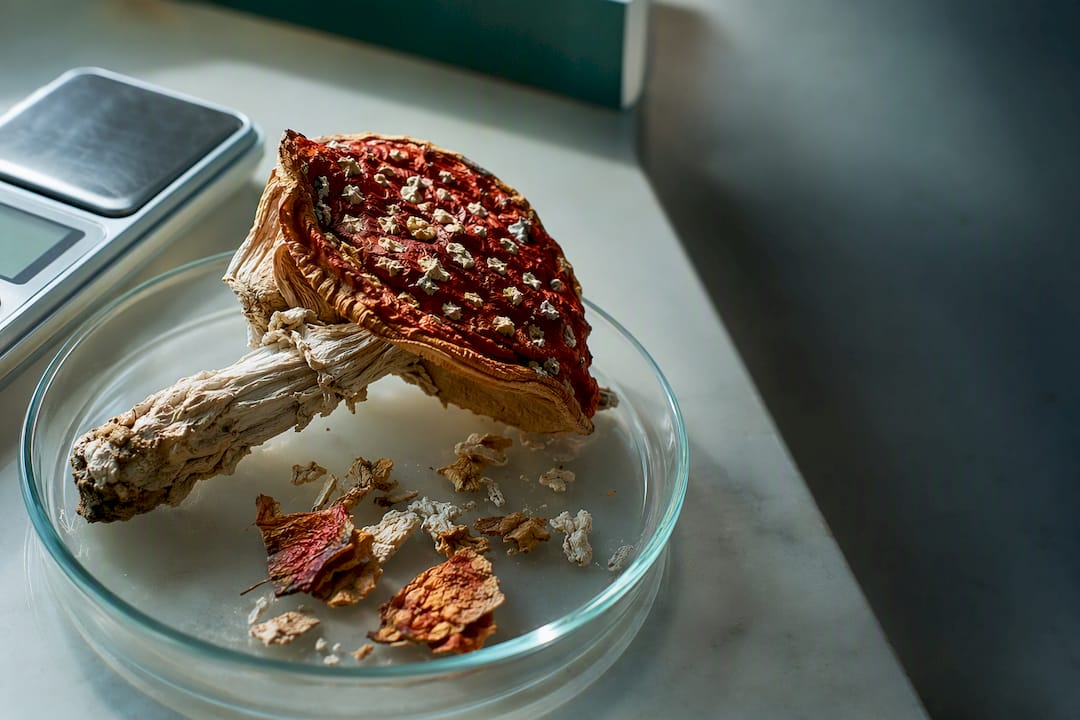
A microdose of Amanita muscaria refers to an amount below the threshold for noticeable psychoactive effects, typically a small amount of properly prepared dried mushroom. The claimed benefits (calmness, sleep, concentration) are based almost entirely on anecdotal evidence, not on controlled clinical trials. The main risk stems from improper preparation: without sufficient conversion of ibotenate to muscimol, the margin between a safe dose and a toxic dose becomes dangerously narrow. Seeking medical advice and using laboratory-tested products remain the only reasonable approach.
In short:
- The variability in muscimol content within a single batch of Amanita muscaria makes any dose less than 1 gram risky without laboratory analysis.
- The ideal preparation involves drying the mushroom at a low temperature to promote the conversion to muscimol, but this cannot be confirmed without testing; the absence of a COA increases the risk.
- No clinical trials have confirmed the benefits of microdosing Amanita, and most of the evidence is based on self-reported accounts, which are often biased or contradictory.
- Using this product without a specific analysis certificate significantly increases the risk of serious toxic effects or dangerous interactions with other central nervous system depressants.
- Extreme caution is required, particularly in cases of pregnancy, a history of seizures, current use of sedatives, or recent alcohol consumption.
Table of Contents
- Active Compounds and Mechanism of Action: Muscimol vs. Ibotinate
- What does a microdose of Amanita muscaria actually entail?
- How do you prepare Amanita to reduce ibotenate?
- What are the documented clinical risks associated with Amanita?
- What do studies on Amanita microdosing actually say?
- How do you read a certificate of analysis before buying Amanita?
- What protocol should be followed to minimize the risks of a trial?
- Why Transparency in Laboratory Testing Matters So Much
- Perspective: Between Legitimate Curiosity and Non-Negotiable Caution
- Pure Extract CBD and the Safety Criteria That Really Matter
- Sources
Active Compounds and Mechanism of Action: Muscimol vs. Ibotinate
Amanita muscaria owes its effects to two molecules with opposite profiles. Ibotenic acid is the native compound found in the fresh mushroom: it is a neurotoxic precursor, structurally similar to glutamate, which can cause nausea, confusion, and motor instability at high doses. Muscimol, on the other hand, is formed by the decarboxylation of ibotenate when exposed to heat or prolonged drying. It is this second molecule that produces the desired effects in microdoses: mild sedation, muscle relaxation, and sometimes a sensation of mental clarity.
The pharmacological difference between the two is what makes Amanita so unique compared to psilocybin mushrooms. Muscimol acts as a GABA-A receptor agonist, the same system targeted by benzodiazepines and alcohol. It therefore produces a rather calming and central nervous system-depressant effect, in contrast to the serotonergic action (5-HT2A receptors) of psilocybin, which generates more stimulating or hallucinogenic effects. This effect on GABA-A also explains why combining Amanita with other central nervous system depressants increases respiratory risk, a point discussed in more detail below.
In practical terms, chemical conversion changes everything:
- Fresh or poorly dried mushrooms: high concentration of ibotenate, increased risk of nausea and delirium.
- Mushrooms that have been properly dried or lightly heated: partial conversion to muscimol, resulting in a profile closer to the desired effect.
- Prolonged drying at low temperatures: this results in the most complete conversion, but it is never total and cannot be guaranteed without laboratory analysis.
- No drying at all: to be avoided—this is the preparation that poses the highest toxicological risk.
No traditional method can determine the exact muscimol-to-ibotenate ratio without laboratory testing. It is precisely this chemical uncertainty that distinguishes Amanita from other, better-characterized substances, and that justifies a cautious approach at every stage, from preparation to dosing.
What does a microdose of Amanita muscaria actually entail?
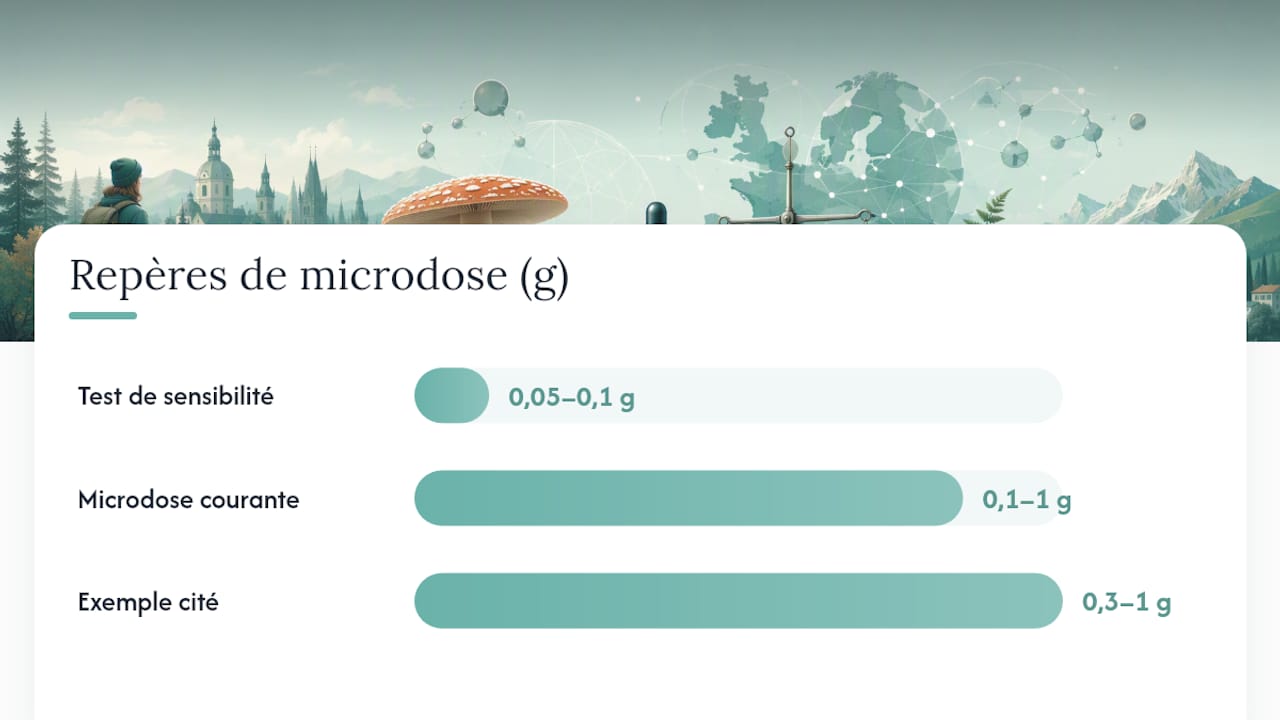
A microdose is defined as an amount below the threshold of sensory perception: no euphoria, no visual disturbances, and ideally no effects noticeable in daily life. The guidelines most commonly cited in self-experimentation protocols place the individual sensitivity test between 0.05 g and 0.1 g of dried mushrooms, and the microdose itself between 0.1 g and 1 g, depending on tolerance and the potency of the batch.
The key figure: 0.01% to 0.02%. This is the range of muscimol content relative to dry weight estimated by a retrospective study on the psycholytic dosage of Amanita muscaria. Based on this, a microdose of 0.3 g to 1 g of dried mushroom would correspond to approximately 1 to 2 mg of active muscimol—a range that seems comfortable on paper but breaks down as soon as the potency of the specimen varies.
However, it varies greatly. Two mushrooms picked just a few meters apart, under different soil and light conditions, may contain muscimol concentrations that differ by several multiples for the same weight. This natural biological variability, which is specific to wild mushrooms, makes it risky to increase the dose without prior standardization.
A few practical guidelines emerge from the risk-reduction protocols:
- The sensitivity threshold is generally well below the dose required to produce a perceptible effect.
- The time it takes for the effects to set in ranges from 30 minutes to more than two hours, depending on the form consumed and whether the stomach is full or empty.
- The same batch can produce different results from one week to the next if the source of the fungus changes.
- Without a COA (certificate of analysis) specifying the milligrams of muscimol per serving, no dosage can be considered reliable.
“Sub-perceptual” does not mean “risk-free.” It is precisely because the intended effect is subtle that users tend to underestimate the margin of error and repeat doses that, when added together, exceed the threshold without them immediately realizing it.
How do you prepare Amanita to reduce ibotenate?
The preparation process almost entirely determines the safety profile of an Amanita microdose. Drying at a low temperature—typically between 40 °C and 60 °C over several days—promotes the gradual decarboxylation of ibotenic acid into muscimol. Drying too quickly or at too high a temperature can destroy some of the muscimol itself, while insufficient drying leaves a significant proportion of ibotenate intact, which increases the risk of nausea, dizziness, and confusion.
Three formats dominate the market, and each has its trade-offs:
- Pre-measured capsules: These offer the highest level of precision because the amount of powder is consistent from one dose to the next, provided that the manufacturer provides a COA indicating the actual muscimol content per capsule.
- Herbal tea: gentler on the digestive system and generally faster-acting, but the actual amount absorbed depends on the steeping time and water temperature, which introduces variability that is difficult to control at home.
- Tincture (liquid extract): The dropper allows for fine adjustments, which are useful for refining a sensitivity test, but this assumes that the initial concentration has been verified in the laboratory; otherwise, the accuracy of the dosage is unreliable.
There are several signs that a product has been improperly prepared: a pungent or musty odor, unusual discoloration, a complete lack of documentation regarding its origin or drying method, and, of course, the absence of any certificate of analysis. A batch for which the seller cannot specify how it was dried or for how long should never be consumed, regardless of the form in which it is offered.
Pro tip: Before making any purchase, always ask for the COA for the specific lot you’re considering buying—not a generic COA from the supplier. The levels vary from lot to lot, sometimes significantly.
What are the documented clinical risks associated with Amanita?
Published case reports paint a more alarming picture than the mushroom’s “natural” appearance might suggest. Cases of hospital admissions related to the consumption of Amanita muscaria describe symptoms ranging from acute confusion and delirium to coma in the most severe cases, often following the ingestion of fresh or improperly prepared mushrooms. While these cases remain rare in absolute terms, their severity warrants systematic caution.
The problem is worsening due to the sale of mislabeled products. An analysis reported by The Conversation notes an increase in calls to poison control centers and visits to emergency rooms related to gum and edible mushroom products sold without reliable content testing.
The European report on new psychoactive substances notes an increase in the availability of unregulated products and explicitly calls for greater vigilance and quality testing of such products.
The most dangerous interaction involves other central nervous system depressants. Because muscimol acts on GABA-A receptors, combining Amanita with alcohol, benzodiazepines, or other sleeping pills can potentiate sedation to the point of posing a risk of respiratory depression—a mechanism documented in the European report on psychoactive substances.
Certain situations call for complete abstinence, not just caution:
- Pregnancy and breastfeeding: due to a lack of safety data.
- Epilepsy or a history of seizures, due to its effect on the GABAergic system.
- Current treatment with benzodiazepines, opioids, or any other sedative.
- Recent or concurrent alcohol use.
If you experience any side effects, even mild ones (excessive drowsiness, confusion, persistent nausea), you should stop taking the medication immediately and seek medical advice, without waiting for the symptoms to worsen.
What do studies on Amanita microdosing actually say?
No randomized Phase 2 or 3 clinical trials have evaluated microdosing of Amanita muscaria in humans. This observation, underscored by published case reports on emerging risks associated with Amanita, fundamentally changes the interpretation of everything circulating on the subject: what is sometimes presented as “proven benefits” is in fact based on self-reported surveys, retrospective studies, and clinical case series—not on blinded comparative trials.
The Harvard Health article on the popularity of microdosing highlights a clear disconnect between public enthusiasm and the available scientific evidence—a disconnect that poses real risks when mislabeled products circulate unchecked.
Several biases further undermine the existing body of evidence:
- Self-reported surveys suffer from selection bias: people who feel they have benefited are more likely to respond and talk about it.
- Some case series published on this topic were authored by individuals with a commercial interest in the sale of Amanita-based products, which creates a conflict of interest that is rarely explicitly disclosed.
- The absence of a placebo group in self-experimentation protocols makes it impossible to distinguish a genuine pharmacological effect from a placebo effect.
- Variations in content between specimens make it virtually impossible to replicate the same protocol from one study to the next.
In practical terms, this means that none of the benefits reported today—whether related to sleep, anxiety, or concentration—can be attributed with certainty to muscimol rather than to a placebo effect or reporting bias. Scientific caution remains warranted, regardless of any individual experiences reported.
How do you read a certificate of analysis before buying Amanita?
A reliable certificate of analysis (COA) is the only objective guarantee of the actual composition of a batch of Amanita. Without it, any dosage remains a rough estimate—and sometimes a dangerous guess.
A usable COA must include, at a minimum:
- The muscimol content per serving, expressed in milligrams, not just as an overall percentage of the product.
- The residual ibotenic acid content per serving, to assess the quality of the conversion during drying.
- Test results for heavy metals (lead, cadmium, arsenic, mercury), since mushrooms are natural bioaccumulators that are particularly sensitive to soil pollution.
- A microbiological test (for mold, yeast, and pathogenic bacteria) is essential for any dried product stored under conditions that can sometimes be humid.
- The test date and lot number that correspond exactly to the product purchased, not to a generic supplier reference.
A product derived from wild-harvested sources without traceability, sold “in bulk” without a lot number or test date, must always be rejected. The practical guide on microdosing Amanita muscaria specifically recommends considering only batches that have an up-to-date COA and have been tested for heavy metals before any trial, no matter how small.
Pro Tip: Keep a copy of the COA for each batch you purchase, along with the date of purchase. If an unusual reaction occurs, this document is the first piece of information you should provide to a healthcare professional.
What protocol should be followed to minimize the risks of a trial?
For those who decide to experiment anyway, a structured protocol reduces some of the risk, though it never eliminates it completely, since the variability of the product remains beyond control.
The approach generally followed in risk reduction guides for Amanita microdosing includes the following steps:
- Start with a very low dose, in the range of 0.05 g to 0.1 g, on a day when you have no important commitments scheduled.
- Wait at least 48 hours, noting every symptom—even minor ones—in a dated journal.
- If there is no noticeable reaction, increase the dose very gradually toward the microdose range, without ever exceeding 1 g without prior medical advice.
- Space out doses by several days; never use continuously every day for several weeks.
- Stop the trial several weeks after a few cycles to see if any perceived effect actually persists when the medication is not taken.
Certain precautions apply throughout the protocol:
- Never combine this medication with alcohol, even in small amounts.
- Stop use immediately if you experience unusual drowsiness, severe dizziness, or persistent nausea.
- Never follow a protocol found online without adapting it to your own batch and your own health condition.
- Consult a doctor before any trial if you are currently taking any medication.
The tracking journal, though often overlooked, remains the most useful tool: it reveals whether a perceived effect is actually related to taking the supplement or simply to normal daily fluctuations.
Why Transparency in Laboratory Testing Matters So Much
The credibility of an Amanita-based product is judged based on verifiable criteria, not on marketing claims. Pure-extract-cbd applies the same transparency requirements to the cannabinoid-based products it sells as those described in the quality control checklists mentioned above: independent laboratory testing, accessible documentation, and batch traceability.
This rigor is based on several concrete pillars:
- Independent laboratory analyses for each product, with results available for review.
- Clear documentation regarding the origin and legal compliance of products in France and Europe.
- A customer service team that can answer questions about a product's exact ingredients before purchase.
- A focus on safety, rather than merely on the promise of effectiveness.
This standard of care is meaningful only when accompanied by this essential caveat: none of the information in this article is a substitute for individualized medical advice, particularly for anyone undergoing treatment, who is pregnant, who is breastfeeding, or who has a neurological condition.
Perspective: Between Legitimate Curiosity and Non-Negotiable Caution
The curiosity surrounding microdosing of Amanita muscaria is by no means irrational: the chemistry of muscimol is real, as is its effect on GABA-A receptors. What is missing is clinical evidence that this effect produces a net and reproducible benefit in humans at microdoses. A cautious trial is justified only if three conditions are met: a product accompanied by a complete and recent COA, the absence of any medical contraindications, and prior medical consultation in case of doubt. Outside of this framework, it is best to abstain entirely, especially in cases of pregnancy, epilepsy, or ongoing treatment with sedatives. The margin between a microdose and an active dose remains too narrow to improvise.
— Steven
Pure Extract CBD and the Safety Criteria That Really Matter
Are you looking for an alternative to the uncertainties surrounding Amanita dosing? Pure-extract-cbd applies the same rigorous standards described above to the cannabinoids it sells: systematic independent laboratory testing, complete batch traceability, and total transparency regarding composition—with no gray areas regarding heavy metals or microbiology.

Unlike an Amanita product sold without a verifiable certificate, every item in the store comes with documentation that you can review before purchasing. For stress or sleep management based on more robust clinical data, Northern Light CBD flower exemplifies this approach: known composition, better-documented effects, and no risky chemical conversions to manage on your own. You can also browse the entire catalog of tested products to compare options based on your specific needs and check the certificates of analysis directly before placing an order.
Sources
To verify or explore the topics discussed in greater depth, several primary sources are worth reading directly:
- Emerging Risks of Amanita muscaria: Case Reports on Rising Consumption and Health Risks
- Psycholytic dosing or “microdosing” of Amanita muscaria — a retrospective case study
- European Drug Report — New Psychoactive Substances (2024)
- The Popularity of Microdosing Psychedelics — Harvard Health Blog
- Microdosing Amanita muscaria for Health and Longevity – A Review of the Evidence
This article is intended to provide general information and is not a substitute for the advice of a qualified healthcare professional. Consult a qualified healthcare professional about your specific situation before taking any action based on this content.



