
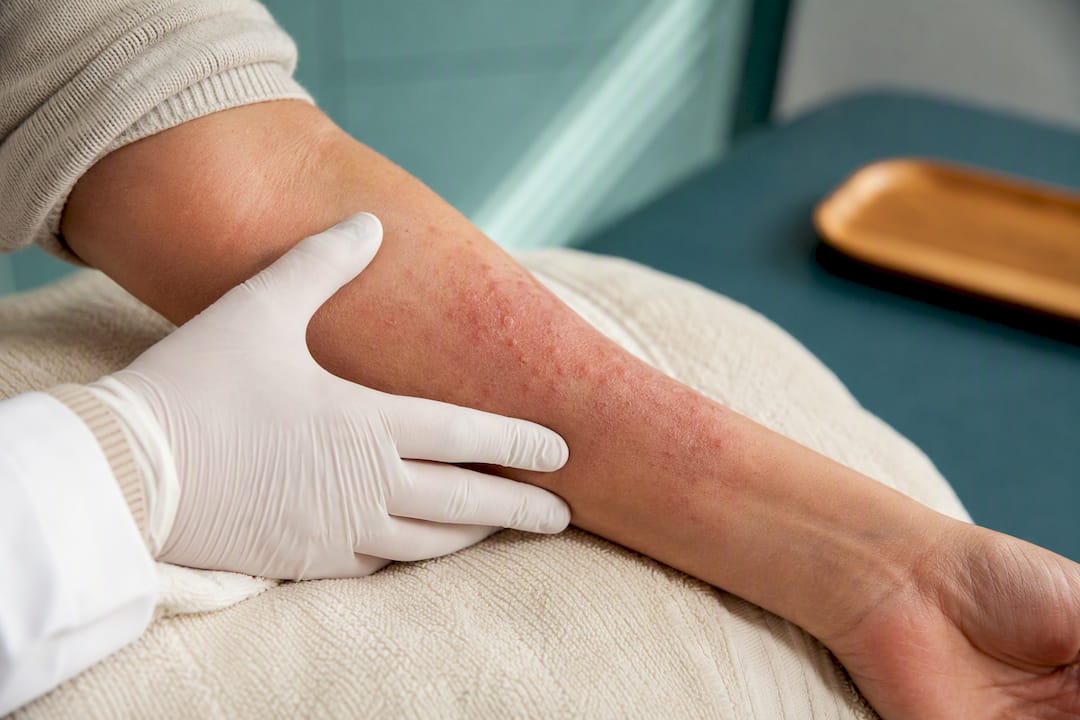
Topical CBD can soothe the itching and redness associated with eczema through its effect on the skin’s endocannabinoid system, but clinical evidence in humans remains limited to small-scale studies. Topical forms, such as creams or gels, are best suited for this purpose. Consider CBD as a complementary treatment, and never as a substitute for prescribed dermatological treatment.
In short:
- Clinical studies on the effectiveness of topical CBD for eczema are still limited, with findings primarily based on observations of small sample sizes.
- Evidence of a significant reduction in symptoms in humans remains preliminary, although improvements in the POEM score are encouraging.
- The cream or gel form is recommended for topical use; be sure to perform a patch test first and avoid infected or broken skin.
- CBD primarily acts on the CB2 receptors in the skin's endocannabinoid system, which may reduce inflammation and soothe nerve endings.
- Caution is warranted, as there is still a lack of robust evidence and large-scale trials, and CBD alone should not be used as a substitute for medical treatment.
Table of Contents
- The Mechanism: How CBD Affects the Skin and Inflammation
- Clinical Evidence and Limitations: What the Studies Really Show
- How to Use CBD for Eczema: Forms, Application, and Best Practices
- Precautions and Side Effects You Should Be Aware Of
- Choosing a CBD cream or skincare product suitable for atopic skin
- Editorial Perspective: CBD—A Complementary Therapy, Not a Substitute Treatment
- Pure Extract CBD: Topical Formulas Tested for Sensitive Skin
- Sources
The Mechanism: How CBD Affects the Skin and Inflammation
The skin has its own endocannabinoid system, with CB1 and CB2 receptors present on keratinocytes, skin immune cells, and sensory nerve endings. When CBD binds to these receptors or modulates their activity, it influences the production of pro-inflammatory mediators such as IL-6, IL-8, and TNF-α—molecules directly involved in eczema flare-ups. This interaction may partly explain why some users report less redness and itching after application.
Research conducted on skin cells in the laboratory shows that cannabidiol modulates these inflammatory pathways without completely blocking them. A family of related molecules, N-acylethanolamines such as PEA (palmitoylethanolamide), has been the subject of more robust trials and shows encouraging results regarding skin hydration and itch relief, which supports the hypothesis of a class effect on these skin receptors of the endocannabinoid system.
Three factors have caught the researchers' attention:
- Action on CB2 receptors, which are found primarily on immune cells in the skin, appears to reduce the release of inflammatory cytokines.
- In vitro studies suggest a soothing effect on the nerve endings responsible for the sensation of itching.
- CBD does not act alone: its chemical structure, which is similar to that of PEA, suggests shared mechanisms that have not yet been fully mapped in humans.
These avenues remain promising, but they are based largely on laboratory observations, not on large-scale clinical trials. The logical next step for any serious reader is to examine what human studies have actually measured.
Clinical Evidence and Limitations: What the Studies Really Show
Human data exist, but the volume is still limited. An observational study followed patients with eczema who applied a CBD gel, showing a marked decrease in the POEM score (a standard patient-reported indicator of eczema severity), from an average of 16 to 8.1—a difference considered statistically significant according to published data on cannabinoids and skin diseases.
An improvement in the POEM score of about half was observed in a small observational study—an encouraging finding, but one that requires confirmation through larger randomized trials.
An Italian clinical trial involving approximately fifty participants tested an ointment combining CBD and CBG for four weeks. The results show a reduction in symptoms and no major adverse effects reported during the study, suggesting that the combination of multiple cannabinoids may enhance the soothing effect observed with CBD alone, according to this study on CBD and CBG for eczema.
Furthermore, randomized controlled trials of PEA-enriched emollients have demonstrated a significant improvement in skin hydration and a reduction in erythema, scaling, and pruritus compared to a control group. These trials are better structured than those directly involving CBD, which calls for caution in their interpretation:
- Studies on pure CBD remain largely observational, without a rigorous control group.
- The sample sizes are small, often ranging from 30 to 60 participants.
- Related molecules such as PEA have more robust evidence supporting them, suggesting that CBD is following a similar scientific trajectory, though it has not yet reached that point.
Caution is still warranted: CBD shows real potential on paper, but the literature still lacks large-scale trials to establish proven efficacy in the strict clinical sense.
How to Use CBD for Eczema: Forms, Application, and Best Practices
Topical formulations (cream, ointment, gel) remain the most suitable for eczema, as they act locally without passing through the digestive system or being metabolized by the liver. CBD oil, often thought of as intended for oral use, can also be applied topically, but its oily texture is less suitable for weeping or very sensitive areas. Gel, which is lighter, is sometimes preferred for use on the face or in skin folds.
Here's a simple way to test a product without risking making a flare-up worse:
- Perform a patch test first. Apply a small amount to the inside of your wrist and wait 24 to 48 hours to make sure there is no reaction.
- Clean and dry the skin before application. Clean skin promotes absorption and reduces the risk of irritation caused by other residues.
- Apply a thin layer once or twice a day. There’s no need to use more: a generous layer won’t speed up the results and increases the risk of a greasy feeling or clogged pores.
- Avoid infected, weeping, or open areas of skin. CBD has no recognized antibiotic properties, and applying it to an open wound may delay appropriate medical treatment.
- Reassess after one to two weeks. Itch relief may sometimes occur within a few days, but a reliable assessment of the effect requires regular use over this period.
Pro tip: Before you start, rate the severity of your symptoms (itching, redness, dryness) on a scale of 1 to 10. This simple personal tracking will help you objectively assess whether the product is making a difference, rather than relying on a momentary impression.
If symptoms worsen, if the skin becomes hot or oozes, or if a fever develops, stop using the product and consult a doctor. For more information on how to use CBD oil, our guide details dosages and precautions based on the form you choose.
Precautions and Side Effects You Should Be Aware Of
Topical CBD is generally well tolerated, but certain reactions warrant special attention before any prolonged use.
- Redness that worsens after application, rather than subsiding, often indicates an intolerance to an excipient (fragrance, alcohol, preservative) rather than to the CBD itself.
- Drug interactions mainly involve oral use: CBD can alter the hepatic metabolism of certain medications. When used topically, CBD barely crosses the skin barrier into the systemic circulation, which reduces this risk without eliminating it entirely.
- Caution is advised when using this product on children: it is best to consult a pediatrician or dermatologist before use, as there is insufficient specific data on this population.
- During pregnancy and breastfeeding, the lack of reliable data makes it advisable to avoid CBD, including topical use, unless otherwise advised by a healthcare professional.
- People who are immunocompromised or undergoing intensive dermatological treatment (with corticosteroids or immunosuppressants) should consult their doctor before using a CBD-based product.
Patient resources specializing in eczema rightly point out that topical CBD can provide real relief, but that it should never replace medical advice when dealing with a severe or infected flare-up. For a broader overview of possible side effects, our page dedicated to CBD side effects is a helpful read before getting started.
Choosing a CBD cream or skincare product suitable for atopic skin
The formulation often matters more than the concentration listed on the label. A cream that’s high in CBD but packed with fragrances or alcohol can irritate already sensitive skin, whereas a simple, well-balanced formula will yield better results over time—a finding supported by several specialized reviews of CBD creams for eczema.
Before making a purchase, always check the following:
- The CBD concentration in milligrams, clearly stated, rather than a vague reference to the “presence of CBD.”
- The product’s spectrum (broad-spectrum or isolate) and the absence of detectable THC, a requirement under France’s regulatory framework for hemp-based products.
- The availability of a certificate of analysis (COA) issued by an independent laboratory, confirming the actual cannabinoid content and the absence of contaminants.
- A short list of ingredients, featuring recognized soothing active ingredients such as colloidal oats, aloe vera, and shea butter, rather than a long list of additives.
A reliable certificate of analysis includes the test date, the issuing laboratory, and a breakdown of each cannabinoid. If a seller cannot provide this upon request, it’s a red flag that should be taken seriously. To clarify technical terms (full-spectrum, isolate, mg/ml), our CBD glossary offers simple guidelines to help you make an informed purchase.
Editorial Perspective: CBD—A Complementary Therapy, Not a Substitute Treatment
CBD is not a substitute for prescribed emollients or long-term topical treatments for eczema. Its real benefit lies in providing relief: less itching on a daily basis and slightly more comfortable skin—without claiming to cure a chronic inflammatory condition. Consulting with a dermatologist remains the best way to incorporate a CBD-based product into your routine without risking an interaction with existing treatments. Transparency regarding laboratory testing, meanwhile, is not just a marketing gimmick: it’s what distinguishes a reputable product from a mere fad.
— Steven
Pure Extract CBD: Topical Formulas Tested for Sensitive Skin
Pure-extract-cbd offers a range of CBD products whose compliance and quality are verified by independent laboratory testing—a key consideration when looking for skincare suitable for atopic skin. Each product page lists the ingredients and allows you to verify the absence of detectable THC before purchasing.

If you’re unsure which form to choose or whether a product is compatible with a current dermatological treatment, the Pure-extract-cbd team is available to answer your questions before you place your order. You can browse our entire product lineup right now to compare the available formulas and find the one that fits your skincare routine.
This article is intended to provide general information and is not a substitute for the advice of a qualified healthcare professional. Consult a qualified healthcare professional about your specific situation before taking any action based on this content.
Sources
- Cannabinoids and Their Receptors in Skin Diseases – PMC
- Get the Facts: CBD | National Eczema Association
- CBD Cream for Eczema: Comparison, Effectiveness, and Reviews 2026
- Legifrance — Regulations on Hemp Products



