

CBD sold in France is subject to consumer protection laws, which impose a set of specific obligations on sellers: a maximum THC content of 0.3% in the finished product, compliant labeling, a ban on any therapeutic claims, and documented traceability by batch. These rules are enforced by three competent authorities: the DGCCRF (General Directorate for Competition, Consumer Affairs, and Fraud Control), the DGAL (General Directorate for Food), and the ANSM (National Agency for Medicines and Health Products Safety). Understanding this legal framework is an absolute prerequisite for selling CBD in France without risking criminal penalties.
What are the legal requirements regarding the composition and testing of CBD products?
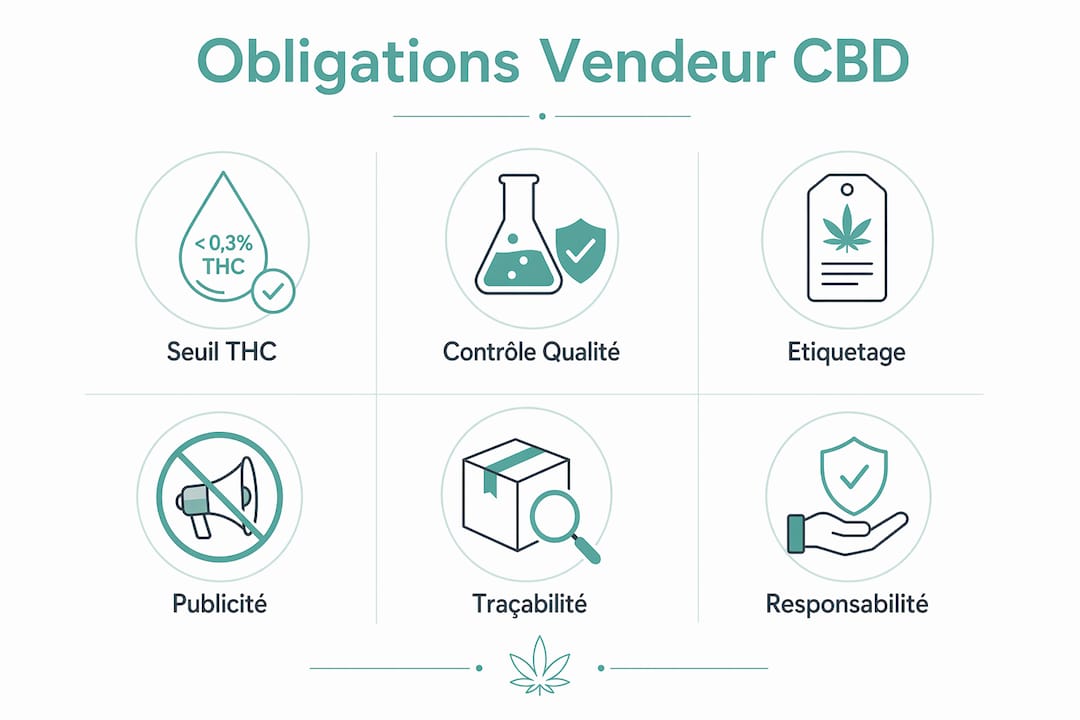
The legal THC threshold of 0.3% in the finished product is the fundamental rule of law governing CBD in France. Any violation of this threshold exposes the seller to immediate market withdrawal, consumer recalls, and criminal prosecution. The DGAL and the DGCCRF are conducting enhanced inspections to verify compliance among products on store shelves.
The authorized hemp varieties are those listed in the European catalog of certified varieties. A seller who sources from a supplier using uncertified varieties takes on a direct risk, even if the measured THC level remains below the legal threshold. Variety compliance and chemical compliance are two distinct and cumulative requirements.
The certificate of analysis is the cornerstone of the inspection process.The absence of a certificate issued in the name of the specific batch is considered equivalent to a complete lack of proof of compliance, which results in seizures and penalties. Each certificate must explicitly link a specific batch to the products currently for sale.
Key points to check for each batch of CBD product:
- THC content measured in the finished product (not in the raw material)
- The lot number is clearly indicated on the certificate
- Accredited laboratory that performed the analysis
- Analysis date consistent with the date of sale
- Hemp variety used, from the certified European catalog
Pro tip: Keep your certificates of analysis for at least five years. In the event of an unannounced inspection by the DGCCRF, immediately producing these documents is the only way to avoid a preventive seizure.
What restrictions apply to the labeling and advertising of CBD products?

Clear labeling—including the exact CBD concentration, THC content, contact information for the person responsible for placing the product on the market, and usage warnings—is a legal requirement during inspections. Proper labeling protects the seller and reassures consumers about the product’s quality. Failing to include this information may result in a violation of the Consumer Code.
Required information that must appear on the label of a CBD product:
- Exact CBD concentration (in mg or as a percentage)
- THC content of 0.3% or less
- Full contact information for the person responsible for placing the product on the market
- Standard warning: “Keep out of reach of children”
- Notice prohibiting sales to minors
- Lot number for traceability
Any therapeutic or medical claims are strictly prohibited on CBD products, under penalty of prosecution for false advertising. Marketing is limited to cosmetic or general wellness properties, without any health claims. This rule applies to labels, online product descriptions, social media, and print materials alike.
Communications about CBD must also avoid any reference to psychoactive use. Advertising targeting minors is prohibited, and any content that encourages consumption is banned. A seller who describes their product as “relaxing” or “soothing” remains within the permitted limits; a seller who promises relief from anxiety or pain crosses the legal line.
Pro tip: Have your product descriptions and marketing content reviewed by a specialized attorney before publication. Ambiguous wording on an e-commerce site is enough to trigger an investigation by the DGCCRF.
How do the regulations apply depending on the type of CBD product?
Each category of CBD products is subject to specific rules. The diversity of CBD products creates a varied regulatory framework in which flowers, oils, cosmetics, and e-liquids are not subject to the same regulations. A seller who markets multiple categories must understand each of these regulatory frameworks separately.
| Product Category | Applicable Regulations | Status in 2026 |
|---|---|---|
| CBD flowers | Decree of December 30, 2021, European Variety Catalog | Permitted under certain conditions |
| Oral oils | Novel Food Regulation (EC) No. 258/97 | Subject to prior authorization |
| Cosmetics | Cosmetics Regulation (EC) No. 1223/2009 | Approved with a safety dossier |
| E-liquids | Tobacco Products Directive 2014/40/EU, national regulations | Permitted under certain conditions |
| Foodstuffs | Novel Food, no authorization granted | Banned since 2026 |
CBD-based food products have been banned in France since 2026 due to the lack of Novel Food authorization. This ban applies to dietary supplements, confectionery, beverages, and any product intended for ingestion for nutritional purposes. Retailers who were selling these products had to gradually remove them from the market under pressure from stricter inspections.
CBD-based cosmetics remain permitted, provided they comply with the European Cosmetics Regulation (EC) No. 1223/2009. This regulation requires a product information file, a safety assessment conducted by a qualified professional, and a notification submitted through the CPNP (Cosmetic Products Notification Portal). Oral oils, on the other hand, fall under the Novel Food category and require prior authorization from the European Food Safety Authority (EFSA).
What are the traceability requirements and the seller's liability for CBD products?
Traceability is a legal requirement, not merely a best practice. A CBD seller must retain all evidence of its products’ compliance, from the supplier to the end consumer. This chain of documentation is the only effective safeguard in the event of an inspection or dispute.
Documents that must be retained:
- Certificates of analysis issued in the recipient's name for each lot (accredited laboratory)
- Purchase invoices from suppliers, with lot numbers
- Delivery slips used to trace the supply chain
- Supplier Declarations of Conformity
- Record of any recalls or product withdrawals
Although the AFNOR SPEC 903 standard is not mandatory, it is recommended to ensure the traceability of hemp from cultivation through to sale. Adhering to this standard enhances the seller’s credibility with authorities and consumers. It serves as a foundational framework for organizing the internal processes of a CBD business.
The criminal risk is real and well-documented. Products with a THC content exceeding 0.3% expose the seller to prosecution for drug trafficking, with penalties of up to 10 years in prison and a fine of 7.5 million euros. Criminal reclassification is a direct consequence of chemical noncompliance, even if unintentional.
It is essential to purchase professional liability insurance tailored to the CBD sales business. This insurance covers damages caused to third parties in the event of a non-compliant product and protects the business owner’s personal assets. Some specialized insurers offer policies that account for the specific characteristics of the cannabinoid industry.
How can you ensure that your CBD sales business is compliant and sustainable?
Choosing certified suppliers is the first critical decision for a CBD seller. A reputable supplier consistently provides certificates of analysis for each batch, declarations of varietal compliance, and detailed invoices. Verifying these documents before each order is a non-negotiable procedure. To understand who can legally sell CBD in France, the conditions for entering the industry are also clearly defined.
CBD regulations change regularly. Court rulings, ministerial decrees, and the positions taken by health authorities alter the applicable framework without systematic prior notice. A seller who does not keep up with these changes runs the risk of selling a product that has become noncompliant between inspections.
Pro Tip: Subscribe to the official publications of the DGCCRF and the ANSM. These agencies regularly publish updates on products recalled from the market and new regulatory requirements. It’s a free and reliable way to stay informed.
Successfully handling an unannounced inspection depends on the immediate availability of documents. Organize your records by batch and by supplier, with quick access to certificates of analysis. A vendor who can produce all of its documentation in less than 30 minutes during an inspection demonstrates a strong commitment to compliance and significantly reduces the risk of penalties.
Key Points
To operate legally, CBD sellers in France must comply with the 0.3% THC limit, labeling requirements, the ban on therapeutic claims, and documented traceability by batch.
| Point | Details |
|---|---|
| THC threshold of 0.3% | Any chemical noncompliance exposes the seller to immediate criminal prosecution. |
| Certificates of Analysis by Lot | Each batch must be accompanied by a certificate issued in the recipient's name by an accredited laboratory. |
| Ban on Medical Claims | No therapeutic claims are permitted on the label or online. |
| Prohibited Food Items | CBD-infused food products have been removed from the market since 2026 due to the lack of Novel Food authorization. |
| Document Traceability | Invoices, delivery slips, and certificates must be retained and made available during inspections. |
What I've Observed in the Field After Years in the CBD Industry
Most CBD sellers who find themselves in trouble with the authorities are not acting in bad faith. They are entrepreneurs who underestimated the complexity of the sector’s regulatory requirements. They purchased products in good faith, without verifying that the certificates of analysis were indeed issued in their name and linked to each specific batch. This error, which may seem merely administrative, can lead to the complete seizure of their inventory.
What strikes me is that CBD regulations in France are actually quite straightforward. The problem isn’t that the texts are obscure; it’s that they’re scattered across various sources. The requirements stem from the Consumer Code, the Public Health Code, the European Novel Food Regulation, and national case law. A seller who consults only a single source is bound to miss part of the applicable framework.
Adopting the AFNOR SPEC 903 standard—even on a voluntary basis—truly changes the way a CBD business operates. It streamlines processes, fosters a culture of traceability, and sends a strong message to authorities during inspections. Retailers who have adopted it report a more positive relationship with DGCCRF inspectors.
My most practical advice: treat each batch of product as a separate legal file. Certificate of analysis, supplier invoice, delivery slip, declaration of varietal conformity. Adopting this documentation practice from the very beginning prevents the vast majority of crisis situations. The future of the CBD market in France belongs to sellers who have established this level of rigor before inspections become even stricter.
— Steven
Pure-extract-cbd: Compliant Products for Peace of Mind When Selling
Selling CBD in France requires products whose compliance can be verified at every stage. Pure-extract-cbd offers a selection of oils, flowers, and resins derived from organic hemp, accompanied by certificates of analysis for each batch that guarantee a THC content of less than 0.3%.
Sellers and resellers who source their products from Pure-extract-cbd have access to traceable documentation that meets the requirements of the DGCCRF.The 5% broad-spectrum CBD oil andthe 20% CBD/CBG oil are among the most popular products among industry professionals. Each product comes with its own compliance documentation, ready to be presented during an inspection.
Frequently Asked Questions
What is the legal THC limit for selling CBD in France?
The maximum permitted THC content in the finished product is 0.3%. Any violation of this limit will result in the product being removed from the market and may subject the seller to criminal prosecution.
Will CBD-infused food products be allowed in France in 2026?
No. CBD-based food products have been banned in France since 2026, as the EFSA has not granted Novel Food authorization. Sellers must have removed them from their catalogs.
What information must be included on the label of a CBD product?
The label must indicate the CBD concentration, the THC content, the contact information for the person responsible for placing the product on the market, the lot number, and a warning prohibiting sales to minors.
Can a CBD seller promise that its products have therapeutic effects?
No. Any medical or therapeutic claims are strictly prohibited and constitute a violation of the Consumer Code, which is punishable by legal action for false advertising.
What is the AFNOR SPEC 903 standard, and is it mandatory?
The AFNOR SPEC 903 standard is a set of best practices for hemp traceability. It is not mandatory, but adopting it enhances the seller’s credibility during government inspections.



