
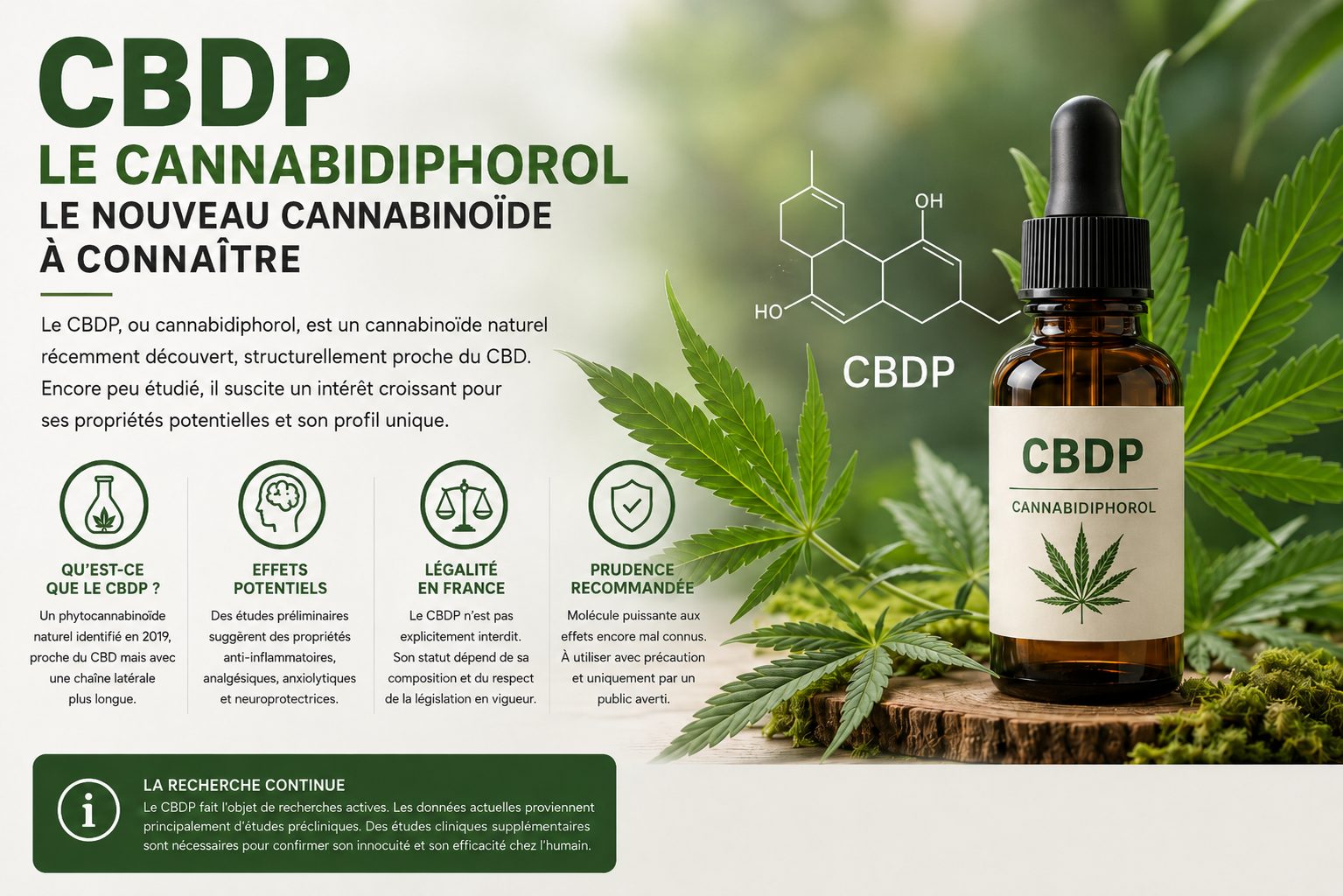
CBDP, or cannabidiphorol, is one of the new cannabinoids that are attracting increasing attention from the hemp industry, analytical laboratories, and consumers eager to understand the rapidly evolving market. Its name is mentioned alongside other, better-known molecules such as CBD, CBG, CBN, THCP, and H4CBD. However, unlike traditional cannabidiol, CBDP remains a poorly studied compound that is misunderstood by the general public and sometimes presented in an overly simplified manner.
On paper, CBDP is a natural phytocannabinoid—that is, a compound that can be found in the Cannabis sativa L. plant. It is chemically similar to CBD but differs from it in that it has a longer side chain. This structural difference is significant because, in some cannabinoids, the length of the alkyl chain can influence how they interact with various biological receptors. It is this point in particular that has sparked researchers’ interest since CBDP was identified as a naturally occurring compound in 2019.
The text provided rightly points out that CBDP was long considered a synthetic compound before being identified as a natural phytocannabinoid, and that it is often compared to CBD, THC, and THCP. It also discusses potential effects, including anti-inflammatory, analgesic, anxiolytic, and neuroprotective properties, while acknowledging that the studies remain preliminary.
CBDP: Scientific Definition of Cannabidiphorol
CBDP is the heptyl analog of CBD. This means it has a molecular structure very similar to that of cannabidiol, but with a side chain composed of seven carbon atoms instead of the five found in standard CBD. This change may seem minor, but in cannabinoid pharmacology, even small structural variations can sometimes alter a molecule’s affinity for certain receptors or enzymes.
CBDP was isolated and characterized in a major scientific publication in 2019—the same study that also described THCP, another rare cannabinoid that has attracted a great deal of interest. In that study, researchers reported for the first time the isolation and complete characterization of two heptylic homologs of CBD and Δ9-THC: CBDP and THCP.
However, it is important to note one key distinction: just because a molecule is identified in the plant does not mean it is naturally present in large quantities. Available research indicates that CBDP has been detected in trace amounts in certain cannabis samples, which explains why commercial products containing CBDP may require highly specific extraction, isolation, or processing methods. A recent publication also notes that the natural distribution of CBDP and its biosynthetic prevalence still need to be better documented.
Why is CBDP compared to CBD?
HBP is often compared to CBD for one simple reason: their molecular structures are similar. Both belong to the cannabidiol family of cannabinoids. CBD is now much better known, more thoroughly studied, and more widely used in the wellness industry. It is known for its lack of psychoactive effects comparable to those of THC and is the subject of a much more extensive body of scientific literature.
CBDP, on the other hand, is much more recent in modern research. Its profile therefore cannot be presented as simply a “stronger” version of CBD. This idea is common in marketing materials, but it is scientifically simplistic. A molecule may be structurally similar to another without producing exactly the same effects, having the same level of safety, or acting on the same biological targets with the same intensity.
Available in vitro studies show that CBDP exhibits specific biological interactions, but these data are insufficient to accurately predict its effects in humans. A study published in 2024 comparing CBD and CBDP on various receptors indicates that CBDP has a distinct pharmacological profile, including interactions with certain cannabinoid and non-cannabinoid receptors; however, these results should be interpreted as laboratory data, not as definitive clinical evidence.
Simply put, CBD is a well-established, well-studied, and well-documented cannabinoid. CBDP is an emerging cannabinoid that shows scientific promise but has not yet been studied extensively enough to be described with certainty.
CBD, the endocannabinoid system, and CB1/CB2 receptors
To understand the scientific interest surrounding CBD, we need to look at the endocannabinoid system. This biological system plays a role in numerous processes: pain perception, inflammation, mood, sleep, appetite, memory, stress response, and the body’s overall balance. It relies in particular on receptors, the best-known of which are the CB1 and CB2 receptors.
CB1 receptors are primarily found in the central nervous system, although they also exist elsewhere in the body. CB2 receptors are more closely associated with the immune system and inflammatory responses. THC is known to strongly activate CB1 receptors, which explains its psychotropic effects. CBD, on the other hand, does not act as a potent direct CB1 agonist and has a more complex mechanism of action.
Research on CBDP remains limited. Hypotheses about its potential effects stem in part from its structural similarity to CBD and its longer side chain. However, it would be unwise to claim that it acts “ten times as strongly” on CB1 and CB2 receptors in humans. The available data are still primarily preclinical or in vitro, which means they do not allow for conclusions about reliable, measurable, and reproducible effects in consumers.
This distinction is essential for producing reliable content: CBD deserves researchers’ attention, but it should not be presented as a miracle molecule or one that is fully understood.
What are the potential effects of CBDP?
The effects of CBDP are currently one of the most controversial topics. Many online sources attribute relaxing, anxiolytic, analgesic, anti-inflammatory, or neuroprotective effects to it. Some even suggest that it produces more intense sensations than CBD. However, caution is warranted: most of these claims are based on extrapolations, preliminary observations, or comparisons with other cannabinoids.
From a scientific standpoint, it is more accurate to speak of areas of research rather than established effects. The available research suggests that CBDP may have interesting interactions with several biological systems, but robust clinical studies in humans are still needed to confirm its efficacy, dosage, tolerability, drug interactions, and safety profile.
The main areas of focus that are generally discussed include:
Modulation of inflammation. Like CBD, CBDP could be studied for its potential role in certain inflammatory mechanisms. However, it cannot be presented as a proven anti-inflammatory agent.
Pain perception. Certain cannabinoids may influence pathways involved in pain. CBDP could therefore be of interest for preclinical research on analgesia, but no definitive medical conclusions can be drawn at this stage.
Anxiety and mood. Interactions with certain non-cannabinoid receptors, particularly serotonergic receptors, are discussed in the literature on cannabinoids. However, this does not support the claim that CBDP treats anxiety.
Neuroprotection. The neuroprotective potential of several cannabinoids is often cited, but again, this is an area of research, not therapeutic evidence applicable to consumers.
The entourage effect. CBDP could theoretically interact with other compounds in hemp, but the entourage effect remains difficult to measure precisely and depends heavily on the actual composition of the product.
It is therefore best to keep one simple idea in mind: CBD is a scientifically interesting molecule, but there is still insufficient research to describe its effects with certainty.
Is CBD psychoactive?
The question of whether CBDP is psychoactive comes up often, as it is sometimes described as a cannabinoid that is “more potent” than CBD. It is important to distinguish between several concepts here.
A psychoactive compound is a substance capable of influencing brain function, mood, perception, or alertness. THC is psychoactive and psychotropic because it can alter perception, induce a feeling of euphoria, impair reflexes, and cause adverse effects. CBD, on the other hand, is not considered psychotropic in the same way as THC: it does not cause a comparable high and does not produce the same type of euphoric effect.
For CBDP, human data are too limited to clearly establish its psychoactive profile. Describing it as “non-psychoactive” would therefore be too categorical. Describing it as “equivalent to THC” would also be an overstatement. The most rigorous statement is that its profile of effects in humans remains poorly documented, and that any newly identified cannabinoid molecule should be approached with caution, especially when it is concentrated, isolated, or combined with other compounds.
This caution is all the more important given that French health authorities have stepped up their monitoring of new cannabinoids appearing on the market, particularly due to reports of adverse effects associated with certain products containing synthetic cannabinoids or poorly regulated molecules. In particular, the ANSM has classified several cannabinoids as controlled substances effective June 3, 2024, including H4-CBD, H2-CBD, HHCPO, THCP, and THCA, due to health risks and the potential for addiction.
CBDP vs. CBD: What Are the Key Differences?
The difference between CBD and CBDP lies primarily in their structure. CBD has a pentyl side chain, while CBDP has a heptyl side chain. This difference explains its name and its scientific significance.
But the most significant difference for consumers lies in the level of available knowledge. CBD has a much longer track record. It is well known to the general public, has been studied for a long time, is regulated in many countries, and is incorporated into products whose traceability can be verified through laboratory testing.
CBDP, on the other hand, remains a rare cannabinoid. It was only recently identified in nature, human data on it are limited, and its actual profile depends heavily on the product’s quality, composition, purity, and the possible presence of other cannabinoids.
So we can summarize it this way:
CBD is the leading cannabinoid in the wellness market, with a known non-psychoactive profile and clearer regulations.
CBDP is an emerging cannabinoid that is chemically similar to CBD but has not yet been extensively studied and is much more difficult to evaluate scientifically.
This distinction is essential for avoiding marketing oversimplifications.
CBD vs. THC: Beware of Misleading Comparisons
Comparing CBD to THC can help clarify certain differences, but this comparison must be approached with caution. THC is the primary psychoactive compound in cannabis. It is classified as a narcotic in France when it exceeds the permitted limits, and it is responsible for the intoxicating effects sought in recreational cannabis.
CBD, on the other hand, is not THC. Its structure is different, its mechanism of action appears to be different, and its scientific status is not comparable. It should therefore not be equated directly with THC, nor should it be claimed that it produces the same effects. However, it must be acknowledged that new concentrated cannabinoids raise safety concerns when they are poorly documented, improperly dosed, or insufficiently analyzed.
In 2020, in the Kanavape case, the Court of Justice of the European Union ruled that CBD should not be treated as a narcotic based on the available knowledge regarding its effects. However, this decision applies to CBD and does not automatically extend to all emerging cannabinoids that have been marketed since then.
CBDP vs. THCP: Two Compounds Discovered in the Same Context
CBDP and THCP are often mentioned together because they were identified in the same scientific context. Both are heptyl homologs—that is, molecules with a side chain of seven carbon atoms. THCP is the homolog of THC, while CBDP is the homolog of CBD.
This similarity in their discovery does not mean that their effects are identical. THCP has attracted particular attention due to its high affinity for the CB1 receptor, as observed in vitro. CBDP, on the other hand, appears to be much more closely aligned with the pharmacological mechanism of CBD, even though its profile remains distinct.
Under French regulations, THCP is one of the cannabinoids subject to the bans announced by the ANSM in 2024. CBDP is not mentioned in the same way in the ANSM press release reviewed, but this does not automatically imply that it is generally and permanently authorized. The status of a molecule may depend on its structure, origin, production method, concentration, commercial presentation, claimed use, and changes to regulatory lists.
Is CBD legal in France?
The legal status of CBDP must be approached with greater caution than that of conventional CBD. In France, products containing CBD may be exempt from the general ban on narcotics if they comply with the conditions set forth in the decree of December 30, 2021, including the use of authorized varieties of Cannabis sativa L. and a THC content of 0.3% or less.
In 2022, the Council of State also overturned the blanket ban on the sale of low-THC hemp flowers and leaves, ruling, in particular, that CBD could not be classified as a narcotic since it does not produce psychotropic effects comparable to those of THC.
However, these points mainly pertain to CBD and low-THC hemp. When it comes to CBDP, the situation is more technical. At this time, it is best to avoid stating that “CBDP is completely legal in France” without a specific legal analysis. A safer way to phrase this would be:
“CBDP is not currently as clearly regulated as conventional CBD. Before any product is marketed or formulated, its status must be verified in light of applicable French laws, ANSM decisions, its method of production, its purity, its THC content, and the complete composition of the finished product.”
Why Laboratory Tests Are Essential
With emerging cannabinoids, traceability is becoming essential. A product advertised as containing CBDP should ideally be accompanied by independent test results specifying:
the exact CBD content;
the THC content;
the possible presence of other cannabinoids;
the absence of contaminants;
the absence of residual solvents;
microbiological compliance;
the stability of the finished product.
This requirement is not merely commercial; it addresses a public health issue. French authorities have already issued warnings about products marketed as containing CBD but with compositions that differ from those listed, sometimes with THC levels exceeding the legal threshold or containing synthetic cannabinoids.
For a consumer, a laboratory analysis is therefore not just a technical document. It is a verification tool. It makes it possible to distinguish a tested product from an untested one, especially in a market where new molecules are appearing rapidly.
CBD and Safety: Important Precautions to Keep in Mind
Since there is limited information available on CBDP, precautions must be stricter than those for conventional CBD. It should not be presented as a medical solution, a treatment, or a validated therapeutic alternative. People currently undergoing medical treatment, pregnant or breastfeeding women, and individuals with neurological, cardiovascular, or psychiatric conditions should seek medical advice before any exposure to cannabinoids.
It is also important to note that cannabinoids can interact with certain medications, particularly through liver enzymes involved in the metabolism of many substances. Even when a product contains no more THC than the legal limit, caution is still advised.
Finally, any substance that may impair alertness must be considered incompatible with driving, operating machinery, or situations requiring sustained attention. In France, driving after using substances that may impair alertness exposes individuals to significant legal and safety risks, particularly if THC is detected.
Does CBD have a future in cannabinoid research?
CBDP perfectly illustrates the current state of cannabis science. For a long time, attention was focused on THC and CBD. Today, researchers are increasingly interested in rare cannabinoids, natural analogs, terpenes, flavonoids, and the interactions between compounds.
This trend does not mean that every new molecule will become a major ingredient on the market. Some will remain the subject of research. Others may come to be better understood over time. Still others may be subject to strict regulations if they pose risks or if their production methods raise health concerns.
CBD therefore warrants a balanced approach. It should neither be ignored nor overestimated. It has genuine scientific value, but its commercial use must remain cautious as long as human data remains limited.
Key Takeaways About CBDP
CBDP, or cannabidiphorol, is a rare cannabinoid identified as a natural phytocannabinoid in 2019. It is similar to CBD but has a longer side chain, which could influence certain biological interactions.
Unlike CBD, it has not been extensively studied. The effects attributed to it should therefore be presented as areas for further research, not as established facts. The available data are primarily preclinical or derived from in vitro studies, which calls for great caution in their interpretation.
From a legal standpoint, the regulatory framework for traditional CBD should not be confused with that for emerging cannabinoids. CBD is subject to a more clearly defined regulatory framework in France, under strict conditions, including compliance with the 0.3% THC threshold. CBDP, on the other hand, requires specific regulatory review before it can be placed on the market or promoted commercially.



