For wellness purposes, we recommend CBG during the day to promote mental clarity and help manage mild anxiety, and CBN in the evening as an occasional aid to sleep. These two cannabinoids affect the body differently, but human evidence remains limited at this stage. Always check the quality of the product and consult a healthcare professional if you are currently undergoing treatment.
In short:
- A randomized trial involving 34 participants found that approximately 20 mg of CBG was associated with a subjective reduction in anxiety, without any notable cognitive impairment.
- A trial of CBN, at doses ranging from 25 to 100 mg, improved sleep scores, with results comparable to those of 4 mg of melatonin.
- Data on pain remain primarily preclinical, while human trials of the two compounds are too limited to support a standard medical recommendation.
- Before purchasing, check for an independent certificate of analysis specific to that batch, and consult a healthcare professional if you are taking any medications, as interactions are still possible.
Table of Contents
- What is CBG, and what is CBN?
- Comparison of Effects by Use: Energy, Anxiety, Pain, Sleep
- Dosage, Dosage Forms, and Limitations of Practical Application
- Security, Interactions, and Quality Criteria to Verify
- What the studies from 2024 to 2026 show
- Our Position on the Daily Use of CBG and CBN
- Where to Find Lab-Tested CBG and CBN Products
- Frequently Asked Questions
- Sources
What is CBG, and what is CBN?
Cannabigerol, or CBG, plays a unique role in the hemp plant: it acts as a biochemical precursor to most other cannabinoids, including CBD and THC. Its acid form, CBGA, gradually converts into other molecules as the plant matures, which explains why CBG is present in relatively small amounts in harvested hemp.
Cannabinol, or CBN, follows the opposite path. It does not occur naturally in significant quantities in the fresh plant; rather, it results from the gradual breakdown of THC due to oxidation, light, and time. An aged or improperly stored hemp flower therefore contains more CBN than a freshly harvested one.
These two molecules interact with the endocannabinoid system, but not in the same way:
- CBG binds moderately to CB1 and CB2 receptors and also appears to interact with 5-HT1A receptors, which are involved in mood regulation.
- CBN exhibits a stronger affinity for the CB1 receptor, which may explain its reputation for having a calming effect, although the exact mechanisms remain to be determined.
- Neither of them produces a psychoactive effect comparable to that of THC, even at high doses.
This difference in origin and biological target forms the basis for their distinct uses, which we detail in the following section.
Comparison of Effects by Use: Energy, Anxiety, Pain, Sleep
The choice between CBG and CBN depends primarily on your intended purpose and the time of day. CBG is generally associated with a more stimulating and clarifying effect, while CBN is sought after for its more soothing effect in the evening.
As for CBG, a randomized, double-blind trial conducted in 2024 observed a subjective reduction in anxiety among participants who received approximately 20 mg of CBG orally, with no notable cognitive impairment measured in the study. This crossover study involved 34 participants and remains, to date, one of the few human trials available on this isolated cannabinoid.
A recent study measured an anxiolytic effect of CBG at a dose of approximately 20 mg, as observed in a randomized trial; however, this remains a preliminary finding rather than established evidence on a large scale.
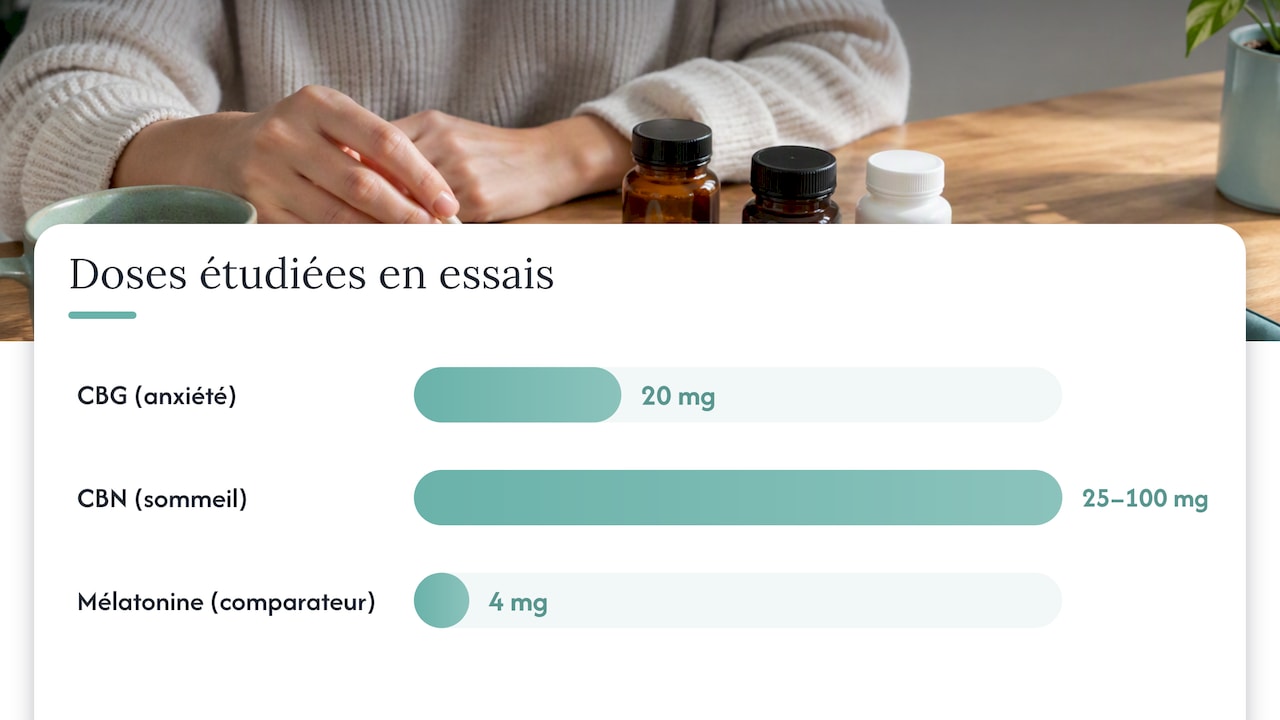
As for CBN, a more recent controlled trial using softgels containing doses ranging from 25 to 100 mg showed an improvement in the sleep disturbance score compared to placebo, with results comparable to those of a group receiving 4 mg of melatonin.
Here are some guidelines to help you make a choice:
- CBG is suitable for daytime use to help with concentration or to alleviate mild, temporary anxiety.
- CBN is increasingly being used as part of an evening routine, in addition to good sleep hygiene.
- The evidence regarding pain remains largely preclinical for both compounds, with few robust human trials published to date.
- People who are sensitive to cannabinoids should start with very low doses, regardless of which option they choose.
These figures are for reference only: the available studies are based on small samples and specific formulations, which are rarely identical to the products sold in stores.
Dosage, Dosage Forms, and Limitations of Practical Application
The doses studied in research do not always correspond to those in consumer products. In the CBG trial, the effective dose tested was around 20 mg per dose, while the CBN trials explored a wider range, from 25 to 100 mg per softgel. These differences make it difficult to draw any direct comparisons between a commercial product and laboratory protocols.
The form of the product also influences absorption. A pure isolate, such as a high-concentration CBG isolate, provides a precise and measurable dose, but lacks the entourage effect provided by the other compounds in hemp. A full-spectrum extract, on the other hand, combines several cannabinoids and terpenes, which can modulate the perceived effect without making it possible to predict its intensity with certainty.
A few practical tips before you get started:
- Start with the lowest dose listed on the label and see how you tolerate it over several days.
- Always check the product's certificate of analysis to verify the actual concentration of cannabinoids.
- Increase the amount gradually if necessary, without exceeding the amounts recommended by the manufacturer.
- Keep track of the effects you experience depending on when you take it—in the morning or at night—so you can adjust your routine.
Pro tip: Always choose a product that comes with a recent certificate of analysis rather than one with a stated concentration but no independent verification.
Security, Interactions, and Quality Criteria to Verify
French health authorities have reported a surge in reports related to mislabeled cannabinoid-based products.ANSES has documented an increase in cases of poisoning associated with products containing synthetic cannabinoids or THC levels exceeding the legal threshold of 0.3 percent, often without the labeling clearly informing consumers of this fact.
Health authorities have observed an increase in cases of poisoning linked to mislabeled CBD products, according to an alert from ANSES, underscoring the importance of choosing reliable sources.
CBG and CBN, like other cannabinoids, are metabolized in part by liver enzymes of the CYP450 group—the same pathways involved in the metabolism of many medications. Interactions are still possible, particularly with medications that have a narrow therapeutic index, which is why it is important to seek medical advice before combining them.
Before making a purchase, there are a few things you should check:
- The presence of a certificate of analysis (COA) issued by an independent laboratory, dated, and specific to the purchased lot.
- The source of the hemp, ideally from a controlled European crop.
- The absence of undeclared additives or synthetic cannabinoids not listed on the label.
- Whether the THC level complies with the regulations in effect in your country of residence.
These precautions apply to both CBG and CBN, and more broadly to any cannabinoid-based product purchased online.
What the studies from 2024 to 2026 show
The current state of research calls for caution in drawing conclusions, despite encouraging signs. A systematic review on cannabinoids and sleep, including 14 preclinical studies and 12 clinical studies, concluded that the available data remain insufficient to recommend these substances for widespread use in the treatment of sleep disorders, due to a moderate to high risk of bias in the majority of the studies analyzed.
With specific regard to CBN, a narrative review published in 2021 highlighted that the clinical literature on its sedative effect remains outdated and limited, with no robust trials demonstrating that it induces sleep on its own. Our article on CBN and sleep explores this distinction between popular belief and scientific evidence in greater detail.
Key takeaways from this research period:
- Studies on CBG remain rare, but the anxiolytic effect observed in 2024 warrants replication on a larger scale.
- Trials of CBN softgels have shown positive results on certain sleep measures, though they do not confirm a universal mechanism.
- Neither of the two molecules currently has a sufficient level of evidence to support a standardized clinical recommendation.
Our Position on the Daily Use of CBG and CBN
We believe that the choice between CBG and CBN should be based on the desired outcome rather than a passing trend: CBG to support an active day, and CBN for an evening routine, without expecting guaranteed results. The scientific evidence, while promising, remains too limited to suggest a consistent effect.
We always recommend choosing lab-tested products—such as a high-concentration CBG isolate or a low-dose CBN oil—rather than products without an available certificate of analysis. If you are currently taking medication, consulting a healthcare professional remains the best way to ensure your safety.
— Steven
Where to Find Lab-Tested CBG and CBN Products
At Pure Extract CBD, every product in our catalog—from CBG extracts to CBN oils—comes with an independent certificate of analysis, allowing you to verify the actual concentration before purchasing rather than relying solely on the label.

- A high-concentration CBG isolate for targeted daytime use is available.
- A 5% CBN oil is intended for use as part of an evening routine, in measured doses.
- Delivery can be fast and discreet, with customer service available to answer questions about dosage.
Before placing an order, please take the time to review the certificate of analysis for the product you are interested in from our complete catalog.
This article is intended to provide general information and is not a substitute for the advice of a qualified healthcare professional. Consult a qualified healthcare professional about your specific situation before taking any action based on this content.
Frequently Asked Questions
Is CBG stronger than CBD?
CBG is not “stronger” than CBD in the strict sense: the two molecules act on somewhat different targets within the endocannabinoid system. CBG is distinguished primarily by its interaction with 5-HT1A receptors, which may explain why some users perceive its effects as more clarifying.
What are the effects of CBN?
CBN is primarily associated with a calming effect when used as part of an evening routine, but the clinical literature on this specific point remains outdated and limited, according to a 2021 narrative review. However, a more recent trial using softgels dosed at 25 to 100 mg showed an improvement in the sleep disturbance score compared with a placebo.
What is the difference between CBG and CBN?
CBG is a natural precursor found in hemp that transforms into other cannabinoids as the plant grows, while CBN results from the breakdown of THC over time and through oxidation. Their effects also differ: CBG is generally associated with daytime use, while CBN is associated with an evening routine.
What are the effects of CBG?
A randomized trial conducted in 2024 observed a subjective reduction in anxiety among participants who received approximately 20 mg of CBG, with no notable cognitive impairment noted in the study. These results are preliminary and are based on a small sample of 34 people.
Sources
- Cannabinoid Therapies for the Management of Sleep Disorders: A Systematic Review of Preclinical and Clinical Studies
- Cannabinol and Sleep: Separating Fact from Fiction
- Acute Effects of CBG on Anxiety, Stress, and Mood (Double-Blind Randomized Trial)
- Randomized trial of TruCBN™ softgels for sleep (25–100 mg)
- ANSES – Increase in Cases of Poisoning Linked to CBD-Based Products