
CBN is primarily seen as a way to stay asleep and calm nighttime restlessness, rather than as a means to help you fall asleep. However, clinical evidence specifically isolating its effects remains limited, with most data coming from multi-cannabinoid combinations or animal models. Before making it part of your evening routine, it’s best to be aware of its potential interactions, particularly with certain medications.
In short:
- CBN appears to primarily reduce nighttime awakenings and prolong periods of deep sleep, rather than speed up the process of falling asleep.
- Only the CUPID trial will be able to provide solid conclusions about the effectiveness of CBN for insomnia, but its results are not yet available.
- Most human studies on CBN involve formulations that combine several cannabinoids, which makes it difficult to isolate its specific effects.
- Caution is advised, as CBN may cause residual drowsiness or dizziness and may interact with certain medications.
- Product traceability, along with a reliable certificate of analysis, remains the most important criterion before any use.
Table of Contents
- What is CBN, and how does it differ from CBD and THC?
- How CBN Might Affect Sleep: Plausible Mechanisms
- What do studies on CBN and sleep actually say?
- CBN, CBD, or melatonin: How do you choose based on your sleep problem?
- How to Read a Label and Calculate Your CBN Dose
- Side Effects, Drug Interactions, and Precautions You Should Know
- How to Test for CBN at Home Without Putting Yourself at Risk
- What Pure Extract CBD Guarantees Regarding the Quality of Its Products
- What really stands out to me from this report on the CBN
- Where to find CBN that has been tested and is transparent about its composition
- Sources
What is CBN, and how does it differ from CBD and THC?
CBN, or cannabinol, is virtually absent from the fresh plant. It is formed through the oxidation of THC: under the influence of light, air, and time, the molecule gradually transforms into CBN, which explains its higher concentration in aged or improperly stored cannabis. This conversion mechanism makes CBN unique among commercially available cannabinoids, most of which are extracted directly from the plant.
Unlike THC, CBN has only a very mild psychoactive effect at typical doses. Nor does it share the profile of CBD, which primarily acts on anxiety and inflammation without any noticeable effect on direct drowsiness. CBN occupies an intermediate position: less psychoactive than THC, but with a sedative effect that CBD does not exhibit to the same degree.
CBN is available in several forms on the market:
- Sublingual oils, often combined with CBD or relaxing terpenes.
- Fixed-dose capsules, convenient for regular and measured use.
- Flavored gum, which takes longer to work but is easy to incorporate into an evening routine.
Each of these formats affects the speed and duration of the effect, which is something to keep in mind before choosing a format.
How CBN Might Affect Sleep: Plausible Mechanisms
CBN is thought to interact with the CB1 and CB2 receptors of the endocannabinoid system, a signaling network involved in regulating stress, pain, and sleep-wake cycles. This interaction may modulate the release of certain neurotransmitters associated with neural excitation, which would partly explain the calming effect reported by some users.
The most widely studied hypothesis concerns WASO, or the time spent awake after falling asleep. Rather than speeding up the onset of sleep, CBN appears to primarily reduce nighttime awakenings and prolong periods of deep sleep, or NREM sleep. Preclinical data from Long Evans rats showed an increase in the proportion of NREM sleep following administration of isolated CBN—an interesting finding, but one that does not automatically translate to humans.
Another factor deserves attention: the so-called “entourage effect.” Many products combine CBN with terpenes such as myrcene or linalool, as well as small traces of CBD or THC. This combination could amplify the overall relaxing effect, which complicates the task for researchers seeking to isolate the exact contribution of CBN alone. It is precisely this difficulty that makes targeted clinical studies, such as the CUPID protocol, particularly valuable for future research.
What do studies on CBN and sleep actually say?
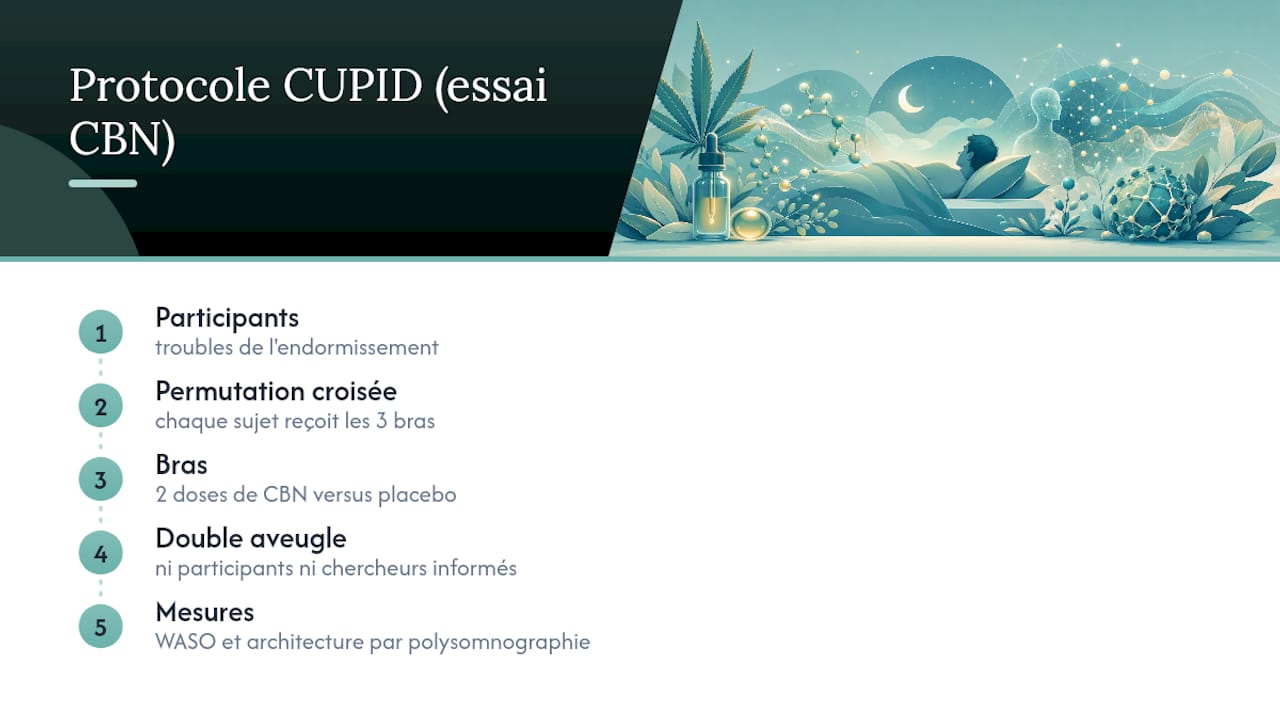
CBN for insomnia is the subject of a landmark clinical trial: the CUPID trial (NCT05344170). This randomized, double-blind, three-arm crossover trial is testing two doses against a placebo in people with difficulty falling asleep. The goal is to precisely measure the effect on WASO and sleep architecture using polysomnography, a tool that is far more reliable than the subjective questionnaires typically used in studies of natural sleep supplements.
This is still an ongoing trial; it is not yet established evidence. The CUPID protocol remains a feasibility study, which means that its final results will not yet allow us to conclude that CBN has broad clinical efficacy, but will lay a solid methodological foundation for larger trials.
The vast majority of published human studies on the effects of CBN actually test formulations that combine CBN, CBD, and sometimes trace amounts of THC. This makes it very difficult to attribute a specific effect to CBN alone, a recurring methodological problem in this field. Usage surveys show that many consumers report using CBN primarily to help them sleep, but these self-reported accounts are no substitute for a controlled trial.
The pragmatic conclusion is therefore nuanced: the preclinical data and mechanistic hypotheses are consistent, but the isolated human evidence remains insufficient to present CBN as an established treatment for insomnia. It is a promising avenue of research, but not yet a scientific certainty.
CBN, CBD, or melatonin: How do you choose based on your sleep problem?
The choice depends primarily on the main symptom. Melatonin affects the body’s internal clock: it is particularly helpful for jet lag, shift work, or a disrupted sleep-wake cycle. Its use is also regulated, andthe ANSM regularly issues reminders regarding the regulatory framework applicable to products containing it.
CBN, on the other hand, is thought to be more effective at maintaining sleep and reducing nighttime mental ruminations than at promoting rapid sleep onset. CBD, meanwhile, primarily addresses daytime anxiety and promotes general relaxation, making it a complement rather than a substitute.
-
Difficulty falling asleep at the desired time: melatonin remains the best-documented option.
-
Frequent awakenings in the middle of the night: CBN for sleep is often the preferred choice for this specific issue.
-
Anxiety that prevents you from relaxing before bedtime: CBD offers additional benefits.
-
Combining the two issues: Some formulations combine CBN with a low dose of melatonin—an approach that should be tried with caution and for a short period of time.
How to Read a Label and Calculate Your CBN Dose
The method of absorption makes all the difference. Oil taken under the tongue enters the bloodstream directly, with effects noticeable within 15 to 45 minutes. A capsule or gummy, which must be digested, often takes 45 to 90 minutes to take effect, but the effects generally last longer.
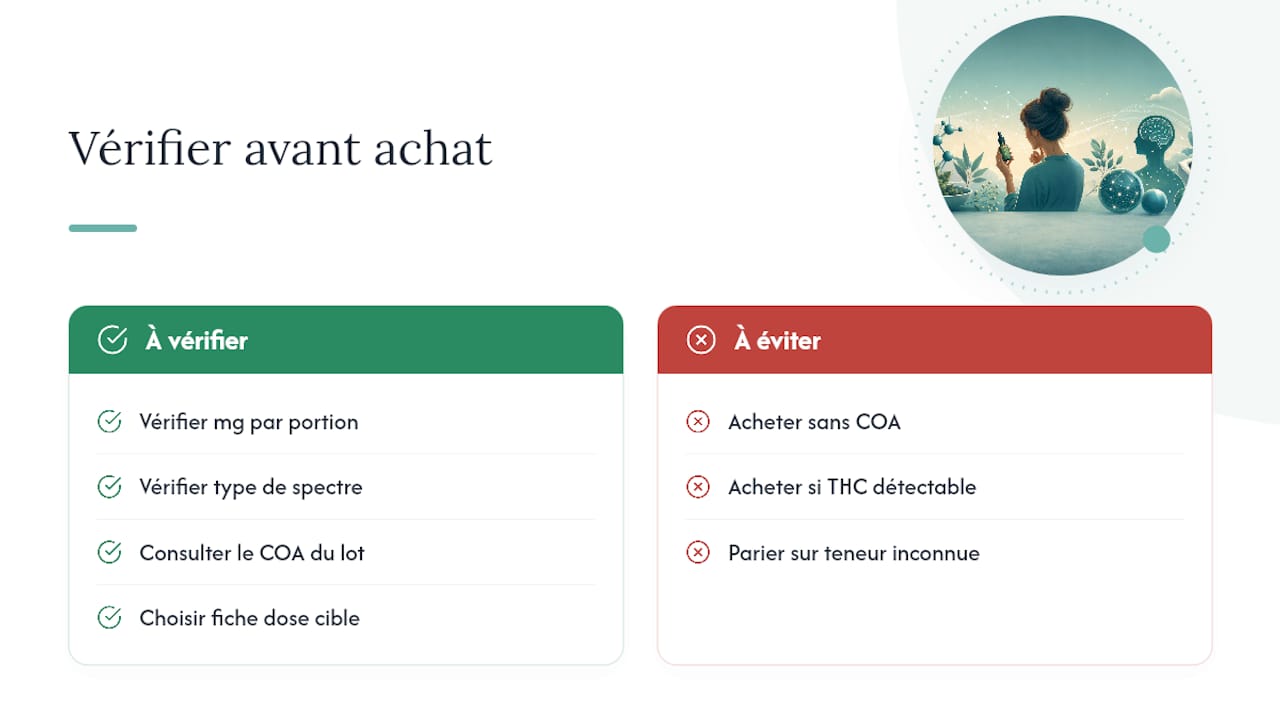
- Check the number of milligrams of CBN per serving listed on the label, not just the total amount in the bottle.
- Divide this number by the number of drops or doses per bottle to determine the exact amount per dose.
- Always check the certificate of analysis (COA) provided by the seller, which confirms the actual content and the absence of contaminants.
- Identify the type of extract: an isolate contains only CBN; a broad-spectrum extract excludes THC; a full-spectrum extract retains legal traces of THC.
The ranges observed on the market range from 2.5 to 5 mg for initial doses, up to 10 to 20 mg for routine use, with doses above 20 mg reserved for specific cases.
Side Effects, Drug Interactions, and Precautions You Should Know
At high doses, CBN may cause residual drowsiness the next day, mild dizziness, or a feeling of heaviness upon waking. These effects are generally mild, but they are reason enough never to drive after taking it for the first time until you know how your body reacts to it.
CBN is metabolized by the liver via cytochrome P450 enzymes, the same pathway as many common medications. There is therefore a risk of interaction with anticoagulants, certain antiepileptic drugs, and sedatives, which may alter their efficacy or toxicity. Caution is also advised during pregnancy, breastfeeding, and while driving; in some cases, prior medical consultation may be necessary.
Pro tip: Always keep the certificate of analysis for the product you’re testing, and make a note in a notebook of any medications you’re taking at the same time. If an unexpected reaction occurs, these two pieces of information will help a healthcare professional quickly understand the situation.
How to Test for CBN at Home Without Putting Yourself at Risk
Taking a gradual approach helps avoid unpleasant surprises and allows you to honestly assess whether CBN is right for your body.
- Take the dose 30 to 90 minutes before your usual bedtime to allow time for sublingual or digestive absorption.
- Start with 2.5 or 5 mg, then increase in 5-mg increments only if the effect is still insufficient after several nights.
- Test it over a period of 7 to 14 nights, noting each morning how long it took you to fall asleep, how many times you woke up during the night, and the subjective quality of your sleep.
- Stop use immediately if you experience severe daytime drowsiness, persistent dizziness, or any unusual reaction, and consult a healthcare professional if necessary.
This simple protocol replicates, on a small scale, the rigorous monitoring approach used in clinical trials such as CUPID.
What Pure Extract CBD Guarantees Regarding the Quality of Its Products
Pure-extract-cbd relies on independent laboratory analyses for each product, with accessible certificates of analysis detailing the actual cannabinoid content and the absence of contaminants. The products are made from organic hemp and comply with current legal requirements in France and Europe—a non-negotiable requirement for a cannabinoid that is still poorly documented clinically.
To further explore the comparison with CBD, two resources detail CBD’s effect on falling asleep and its impact on nighttime rest, which are useful for situating CBN within a broader sleep strategy.
What really stands out to me from this report on the CBN
The discussion surrounding CBN for sleep suffers from an all-too-convenient oversimplification: it’s often referred to as a more potent form of melatonin, even though its mechanism of action appears to be different. Melatonin regulates the body’s internal clock, while CBN is thought to help calm a restless night. Confusing the two means using the right product for the wrong problem.
The real weakness of this topic isn’t the lack of a plausible mechanism, but the lack of studies that isolate CBN on its own. The CUPID protocol deserves credit for finally addressing this question properly, using objective tools like polysomnography rather than subjective feelings. Until these results are published, I believe CBN deserves to be explored with curiosity, but should never be presented as a validated solution.
What should take precedence over any dosage is the product’s traceability: a clear certificate of analysis carries more weight than any marketing claim about its supposed effectiveness.
— Steven
Where to find CBN that has been tested and is transparent about its composition
Oils, capsules, and flowers are available, with some batches backed by independent laboratory analysis and, in some cases, a certificate of analysis that can be viewed before purchase. This transparency is particularly important for a cannabinoid like CBN, where the actual milligram content and the absence of detectable THC make all the difference between a reliable product and a mere gamble.

On a product page, there are three key details to check before finalizing your order: the mg content per serving, the type of spectrum used (isolate, broad-spectrum, or full-spectrum), and whether there’s a direct link to the COA for that specific batch. For a guided first try, the CBD oil consumption guide explains the sublingual method applicable to CBN, while the selection of sleep products features items designed for restless nights.
To get started, browse the complete Pure-extract-cbd catalog and find the product sheet that matches your target dosage before placing your order.
This article is intended to provide general information and is not a substitute for the advice of a qualified healthcare professional. Consult a qualified healthcare professional about your specific situation before taking any action based on this content.
Sources
- Effects of Cannabinol (CBN; 30 and 300 mg) on Sleep and Next-Day Function in Insomnia Disorder (“CUPID” Study): Protocol for a Randomized, Double-Blind, Placebo-Controlled, Crossover, Three-Arm, Proof-of-Concept Trial
- CBN (cannabinol): Effects, Dosage, and Safety | Azarius
- ANSM — Regulatory Framework for Melatonin