
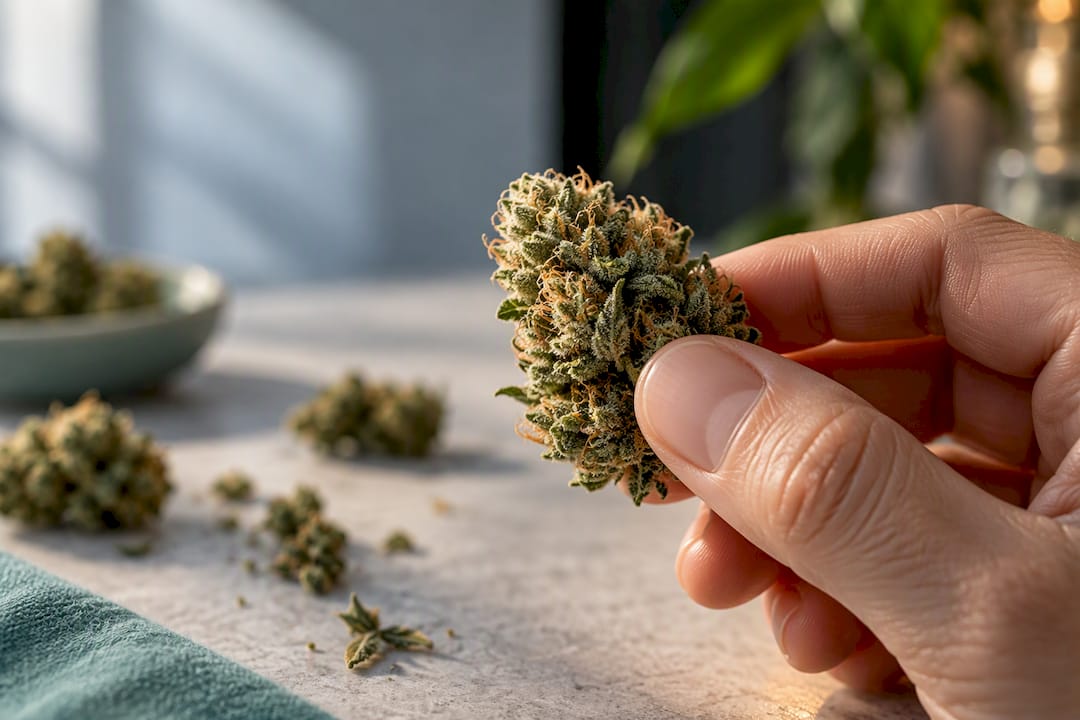
To choose high-quality CBD flower, first ask for a certificate of analysis (COA) confirming a THC content of less than 0.3% and the absence of pesticides, heavy metals, or residual solvents. Next, check the appearance: visible trichomes, a texture that is neither dry nor damp, and no signs of mold. A distinct aroma consistent with the advertised strain completes this inspection. When purchasing online, always ask for the lot number corresponding to the COA provided.
In short:
- Verification of the certificate of analysis must confirm a THC content of less than 0.3% and the absence of pesticides, heavy metals, or residual solvents.
- Shiny trichomes, a texture that is neither dry nor damp, and a scent consistent with the strain’s genetics are indicators of visual and olfactory quality.
- Opt for indoor or greenhouse cultivation to ensure more consistent flavor, and avoid poorly stored flowers, which quickly lose their potency.
- Verify that the COA laboratory is independent and that the product complies with European regulations to ensure legality and compliance.
- Always compare the price per gram, request a recent COA, and don’t believe any therapeutic claims, because no medical claims are permitted for CBD outside the pharmaceutical system.
Table of Contents
- Key Criteria for Evaluating the Quality of a CBD Flower
- How to Identify a Flower by Sight and Smell: A Practical Checklist
- Indoors, in a greenhouse, outdoors: Which growing method is best?
- Genetics and Terpenes: Pairing Aroma with Use
- Origin, Traceability, and Compliance: How to Read a Certificate of Analysis (COA) and Verify Legality
- Storage and Formats: Preserving Flavor and Potency
- Price and Value for Money: How to Break Down the Cost
- Shopping Tips and Pitfalls to Avoid
- Expert insights and practical resources available at Pure Extract CBD
- Extraction Methods and Their Impact on Flower Quality
- Expected effects based on the varieties and their uses
- Legal Regulations Governing the Sale and Consumption of CBD Flowers
- The Author's Perspective: A Simple Method for Your First Flower
- Find tested and traceable flowers at Pure Extract CBD
- Sources
- Frequently Asked Questions
Key Criteria for Evaluating the Quality of a CBD Flower
A reliable certificate of analysis includes several specific details: the CBD content, the THC content, test results for contaminants, a lot number, and the name of the laboratory that performed the tests. These details are not mere administrative formalities. The CBD content indicates the product’s actual concentration, while the THC threshold directly determines its legality: in France, only flowers with a THC content below 0.3% may be sold—a point that specialized guides recommend checking systematically before any purchase.
Contaminants pose another challenge, one that is often less obvious to an uninformed buyer. Pesticides and heavy metals sometimes originate from the soil or from treatments applied during cultivation, and residual solvents are primarily found in products that have undergone chemical extraction.
Here are a few tips for evaluating a flower before you buy it:
- Verify that the COA lists an independent laboratory that is separate from the manufacturer.
- Verify that the displayed THC level remains within the legal limit.
- Make sure the tests cover pesticides, heavy metals, and, if applicable, residual solvents.
- Compare loose flower and pre-rolls: the loose format allows for better traceability because it does not involve mixing with other ingredients.
A pre-roll format can make consumption easier, but it can sometimes make it harder to verify the exact origin of the flowers used.
How to Identify a Flower by Sight and Smell: A Practical Checklist
Visual and olfactory inspection remains the quickest way to assess a flower, whether in a store or when receiving a package. The trichomes—those tiny crystals covering the flower—should appear shiny and dense: they indicate a harvest at peak ripeness and generally a higher concentration of cannabinoids. A slightly sticky texture, without excess moisture, is also a good sign.
Conversely, certain signs should serve as an immediate warning:
- A musty, damp-hay, or distinctly chemical odor, which often indicates improper drying.
- White or grayish spots on the surface, characteristic of mold growth.
- An excessive proportion of stems and leaves relative to the usable floral material.
- A dull or uniformly brown color is a sign of an old or poorly preserved flower.
None of these colors is in itself a guarantee of superior quality; they simply reflect the plant's genetic profile.
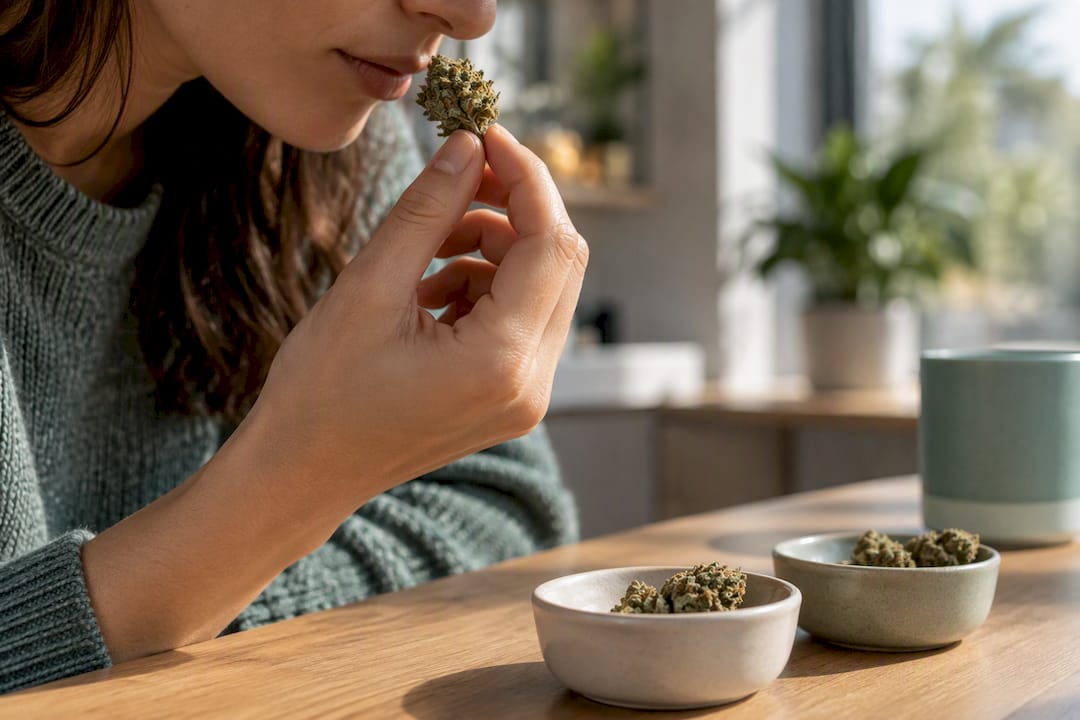
Pro tip: Always smell a small amount before buying, and, if possible, compare several batches side by side: your sense of smell can often detect differences that the eye alone cannot perceive.
Indoors, in a greenhouse, outdoors: Which growing method is best?
The growing method directly influences the flower’s aroma, consistency, and final price. Indoor cultivation offers the greatest control over light, temperature, and humidity, which better preserves the flower’s original aromatic profile. This level of control is generally reflected in a higher price.
Greenhouse cultivation often offers an attractive balance between quality and cost, with less variability than in open-field cultivation while still partially benefiting from natural light. Outdoor cultivation, on the other hand, generally yields the lowest prices but is accompanied by greater variability from one batch to the next and increased exposure to atmospheric contaminants, as highlighted by specialized analyses on the traceability of CBD flowers.
Here are a few guidelines to help you make your choice:
- Opt for indoor growing if aromatic intensity and consistency are your top priorities.
- Choose the greenhouse for a good balance between affordability and consistent quality.
- Choose the outdoor option if price is your top priority and you're willing to accept greater variability among the lots.
- Always ask the seller about the growing method: this information should be listed on the product page.
Genetics and Terpenes: Pairing Aroma with Use
CBD flowers are generally divided into three main genetic families: sativa, indica, and hybrid. Sativa-dominant strains are often associated with daytime use, indicas with evening relaxation, and hybrids combine both profiles depending on their composition. These distinctions are primarily descriptive and do not guarantee any specific effect, as perception varies greatly from person to person.
Terpenes play a central role in the aromatic profile of each strain. Myrcene evokes earthy and musky notes, limonene brings a citrusy freshness, pinene is reminiscent of conifer resin, and caryophyllene stands out with spicy, peppery accents.
- To start, choose a strain with a simple terpene profile and a moderate CBD content.
- For more experienced users, explore hybrid strains with complex flavor profiles.
- Choose based on the time of day you have in mind rather than on promises of results.
- Never confuse a pleasant flavor profile with a therapeutic guarantee: no CBD flower can legally claim to have a specific medical effect.
Origin, Traceability, and Compliance: How to Read a Certificate of Analysis (COA) and Verify Legality
Verifying the origin of a CBD flower involves ensuring that the cultivated variety is listed in the European catalog of authorized hemp varieties. This listing determines the legality of the cultivation itself, prior to sale. A complete and reliable COA must specify the CBD content, the THC content, the results of contaminant tests, a specific lot number, and the name of the independent laboratory that performed the analysis, as recommended by specialized buying guides.
Requiring a public COA for each batch remains the most reliable way to weed out non-compliant products; a reputable seller always makes these documents readily available (AnanHaze).
The ANSM reminds the public that no therapeutic claims may legally be made for CBD products sold in stores, and highlights the risk of interactions with certain medications. The WHO report on the chemistry of CBD also specifies that this cannabinoid is generally not classified as a narcotic, which distinguishes its regulatory framework from that of THC-based extracts or preparations.
Things to check every time before making a purchase:
- The COA specifies a laboratory separate from the producer.
- The cultivated variety is listed in the European catalog.
- No therapeutic claims are included on the product information sheet.
- The seller agrees to provide the COA upon request, without hesitation.
To gain a deeper understanding of the legal distinctions between CBD and THC, a detailed article on these scientific and legal differences provides further insight.
Storage and Formats: Preserving Flavor and Potency
A flower that is not stored properly quickly loses its aroma and potency, regardless of its initial quality. Ideal storage combines a cool temperature, moderate humidity, and protection from direct light: an airtight jar placed in a dark spot remains the simplest and most effective solution.
- Choose an opaque glass jar or an opaque, airtight bag.
- Watch for signs of spoilage: loss of flavor, a crumbly texture, or, conversely, a texture that’s too dry.
- Buy small quantities so you can try several varieties without risking prolonged spoilage.
- Avoid grinding the flower too long before consumption; grinding accelerates the loss of volatile terpenes.
Price and Value for Money: How to Break Down the Cost
A detailed analysis of CBD flower prices provides a better understanding of how these factors combine to determine the final price displayed in stores.
A price significantly higher than the market average is often due to indoor cultivation, meticulous manual sorting, and repeated testing of each batch. Conversely, an unusually low price should raise a red flag, especially when no COA is provided.
- Always compare the price per gram rather than the price listed per container.
- Be wary of very cheap flowers that don't have a visible certificate of analysis.
- Keep in mind that a higher price often reflects stricter quality control, although this is not always the case.
- Try out a few small sizes before investing in a larger quantity.
Shopping Tips and Pitfalls to Avoid
Before confirming a purchase, a few simple checks can help you weed out most questionable products.
- Always ask to see the COA and the lot number corresponding to the flower being offered.
- Verify that the laboratory in question is indeed independent of the manufacturer or seller.
- Be wary of any health claims; the ANSM reminds consumers that these claims have no legal basis for CBD products sold outside the pharmaceutical channel.
- Ask the seller specific questions about the origin, growing methods, and the date of the most recent test.
Pro tip: If you still have doubts, request a sample from another batch of the same product and compare independent reviews before ordering a large quantity.
Expert insights and practical resources available at Pure Extract CBD
A good specialty shop relies on organic hemp and lab testing for every product in its lineup, which includes flowers, resins, and oils. This approach aims to provide easy and verifiable access to the information this guide recommends looking for.
- The complete product line—including flowers and resins, oils, and extracts—is available on the Pure Extract CBD store.
- An internal guide to the best CBD flowers details the selection criteria applied to each product.
- An article on visual and olfactory inspection complements the practical guidelines presented above.
- Customer service is generally available to provide a specific COA upon request before any purchase.
Extraction Methods and Their Impact on Flower Quality
Extraction methods primarily concern derived products, such as resins or oils, but they indirectly influence the perception of quality associated with an entire product line. The WHO report on the chemistry of CBD describes two common processes: supercritical CO₂ extraction, valued for the absence of chemical residues, and solvent extraction, known as BHO, which requires strict control of residual solvents.
For raw flowers, the issue of extraction does not arise directly, since no chemical processing takes place. It remains relevant, however, for understanding why certain extracts displayed alongside the flowers—such as resins—require additional testing. A rigorous COA for this type of product must include testing for residual solvents, in addition to standard tests for THC and contaminants.
This distinction also explains why raw flower is often easier to source than an extract: fewer processing steps mean fewer opportunities for contamination or dosing errors. For readers who are unsure whether to choose flower or an extract, a comparison of CBD flowers and oils details the respective benefits of each format depending on the intended use.
Expected effects based on the varieties and their uses
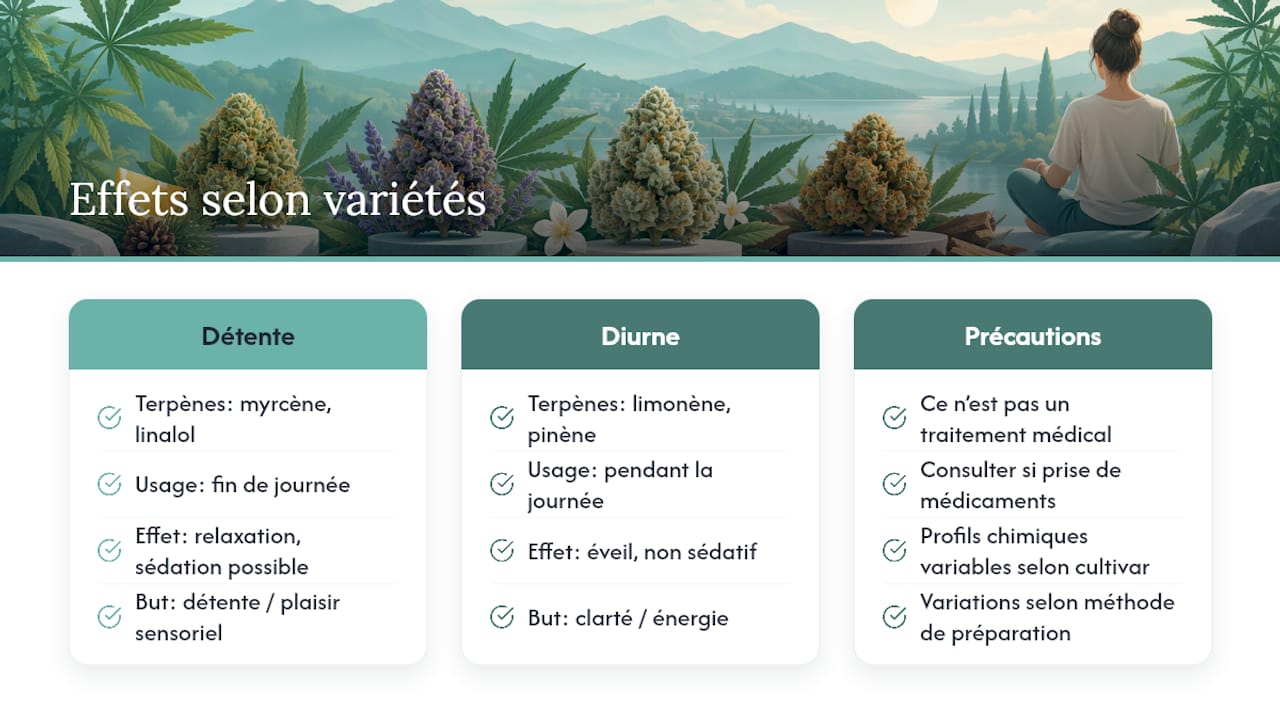
The perceived effects of a CBD flower depend on both its cannabinoid concentration and its terpene profile, but they remain fundamentally subjective and vary from person to person. Strains rich in myrcene or linalool are often sought after for relaxing use at the end of the day, while those dominated by limonene or pinene are more commonly associated with daytime use, without a pronounced sedative effect.
A clear distinction should be made between recreational use—which focuses on relaxation or sensory pleasure—and the use that some consumers describe as “well-being,” even though this does not constitute a recognized therapeutic indication. The 2018 ANSM report on the safety of cannabidiol specifically highlights the variability in chemical profiles depending on cultivars and preparation methods, which makes any generalization about expected effects unreliable.
An article on the perceived effects and benefits of CBD flowers provides further details on these nuances based on format and variety. In any case, no flower should be presented as a treatment, and anyone taking medication should consult a healthcare professional before incorporating CBD into their routine, in accordance with the ANSM’s warnings regarding drug interactions.
Legal Regulations Governing the Sale and Consumption of CBD Flowers
In France, the sale and consumption of CBD flowers are governed by a specific regulatory framework centered on THC content and the variety’s listing in the European catalog of authorized hemp seeds. A flower may only be legally sold if its THC content remains below 0.3 percent, a threshold that must be confirmed by a COA before purchase.
This framework is accompanied by a strict ban on therapeutic claims. The ANSM explicitly states that no CBD product sold outside the regulated pharmaceutical channel may claim to have a specific medical effect, regardless of the quality of the flower or the seller’s reputation. This rule applies to both raw flowers and processed products.
For buyers who wish to learn more about this framework, one article detailing the regulatory limits surrounding psychoactive cannabinoids and another explaining why it’s best to avoid medical claims provide useful insights. Caution is also advised for people taking medication, as the ANSM’s guidance on this matter applies to all CBD products, including flower.
The Author's Perspective: A Simple Method for Your First Flower
For your first purchase, it’s best to choose a small amount of a mild variety—grown indoors or in a greenhouse—so you can calmly assess how it makes you feel. Try it, note the aroma and how it makes you feel, and then compare it with a second batch before placing a larger order. If you’re taking medication, consult a healthcare professional before incorporating CBD into your routine.
— Steven
Find tested and traceable flowers at Pure Extract CBD
Finding a reliable CBD flower often comes down to finding a seller who provides transparent information rather than searching for the perfect flower. Pure Extract CBD builds its product line—including flowers, resins, oils, and CBD and CBG extracts—around organic hemp and systematic laboratory testing, with discreet packaging and fast delivery.

- See the product page for Northern Light small buds CBD flower for a specific example of a tested product.
- See the entire selection on the full catalog page.
- Please contact customer service directly to request the COA for your batch before confirming your order.
For a first try without making too big a commitment, start with a small size and compare it to your usual standards before considering a larger quantity.
Sources
For more information on the chemistry and regulations surrounding CBD, several official documents provide additional insight to this guide.
- Mixing CBD with Medications: It’s Never Harmless — ANSM
- WHO Expert Committee on Drug Dependence — Technical Report
- How to Choose Your CBD Flower in 2026: A Complete Guide — AnanHaze
This article is intended to provide general information and is not a substitute for the advice of a qualified healthcare professional. Consult a qualified healthcare professional about your specific situation before taking any action based on this content.
Frequently Asked Questions
Why shouldn't you smoke CBD flowers?
Smoking exposes the respiratory tract to combustion byproducts that offer no benefits and can irritate the lungs, regardless of the intended effects of CBD itself. Low-temperature vaporization or other methods of consumption avoid this combustion and are often preferred for this reason.
What are the best CBD flowers?
There is no single variety that is universally superior: the best flower depends on the desired terpene profile, the preferred cultivation method, and the desired CBD content. An internal guide detailing the selection criteria helps compare options based on these criteria rather than on a fixed hierarchy.
What's the best website to buy CBD flowers?
The best seller is one that provides a COA for each batch, clearly states the origin and cultivation method, and is transparent about the tests performed. Pure Extract CBD applies these principles across its entire line of flowers and resins.
Which CBD product is best for neck pain?
No CBD product may legally be marketed as a treatment for neck pain; the ANSM reminds the public that no therapeutic claims are permitted for these products sold outside the pharmaceutical channel. In cases of persistent pain, consulting a healthcare professional remains the appropriate course of action, particularly if medication is already being taken.



