
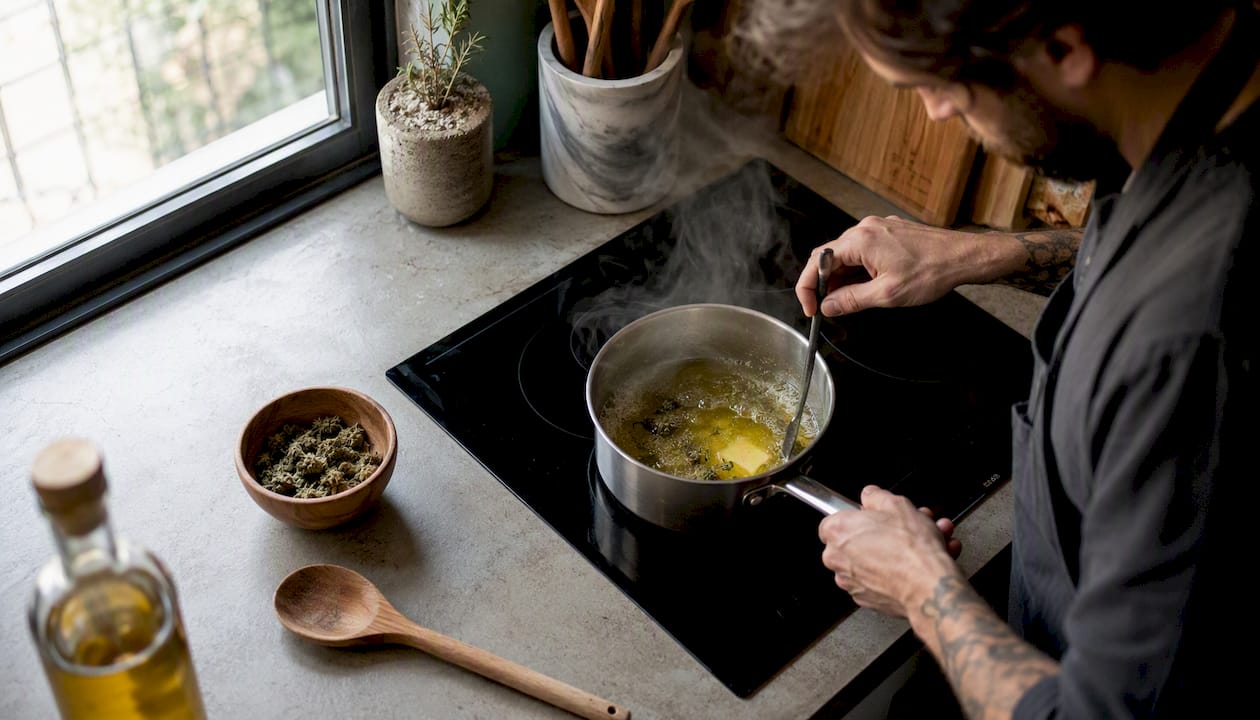
Yes, cooking with CBD is entirely possible, provided you follow three basic rules: choose the right form of CBD, control the heat, and use a lipid carrier. CBD is a fat-soluble molecule, which means it is much better absorbed and has greater bioavailability in fats than in water. Before preparing any dish, make sure your product has a certificate of analysis (COA) issued by an independent laboratory and that its THC content complies with the current legal limit, which can be found on Legifrance. Pure-extract-cbd offers a range of lab-tested flowers, oils, and resins specifically suited for culinary use.
Immediate steps to take before you begin:
- Vérifier l’étiquette et le COA du produit (taux de CBD, THC < seuil légal, absence de métaux lourds).
- It is better to infuse the flavor into a fat (butter, coconut oil, olive oil) rather than adding it directly to hot dough.
- Always inform guests that the dish contains CBD.
- Start with small doses (5–10 mg per serving) and wait for the effects to kick in before having another serving.
Pro tip: First, prepare an infused butter or oil at a low temperature (60–80 °C) rather than adding the CBD oil directly to hot dough. This step preserves the active ingredients and ensures even distribution throughout the recipe.
Key Points
Cooking safely with CBD hinges on three non-negotiable principles: choosing a lab-tested product with a COA, controlling the infusion temperature (60–80 °C), and calculating the dosage in milligrams per serving before serving.
| Point | Details |
|---|---|
| Choosing the Right Shape | Cold-press oil, isolate for precision, and infused butter for CBD baked goods. |
| Decarboxylate the flowers | 110–120 °C for 30–45 minutes in the oven before any lipid infusion. |
| Controlling the Temperature | Do not exceed 160 °C during extended cooking to preserve the active ingredients. |
| Measure per serving | Beginners: 5–10 mg per serving; moderate use: 10–25 mg per serving. |
| Inform and Protect | Warn each guest; never serve to minors; consult a doctor if you are currently undergoing treatment. |
| Pure CBD Extract | A selection of lab-tested flowers, oils, and resins with COAs, suitable for food use. |
Table of Contents
- Which form of CBD should you choose for cooking?
- How do you decarboxylate flowers and infuse CBD into butter or oil?
- How can you preserve CBD during cooking?
- Dosage, Interactions, and Precautions
- Easy Recipe Ideas with CBD
- How can you check the quality of a CBD product before cooking?
- Storage, Shelf Life, and Labeling of CBD Products
- What the Publishing Experience Teaches Us About CBD Cooking
- Pure-extract-cbd: Lab-tested products for cooking with confidence
- Sources
Which form of CBD should you choose for cooking?
The choice of shape determines both the preparation method and the final result.
- CBD oil: Precise dosing thanks to the graduated dropper; can be added immediately to cold or lukewarm preparations. Ideal for salad dressings, smoothies, and glazes. Its limitation: Prolonged exposure to heat breaks down the active ingredients, making it less suitable for slow cooking. To learn more about how to use it, see the CBD oil user guide.
- CBD flowers: They have a rich flavor profile but require decarboxylation to activate the CBD. Once decarboxylated, they are infused into a fat to produce butter or a concentrated oil. Pure-extract-cbd’s Northern Light small buds are particularly well-suited for this method.
- Resin (hash): More concentrated and aromatically potent than flowers, it melts directly into a hot lipid. Accurate dosing can be tricky: start with very small amounts.
- Isolate/crystals: the most neutral-tasting form and the easiest to measure precisely. Crystals dissolve easily in fats and allow for control down to the milligram. Perfect for CBD baking, where consistent portion sizes are a priority. See the guide on CBD crystals for details on how to incorporate them.
Pro tip: For successful CBD baked goods, isolate is the most reliable option: it doesn’t alter the color or taste of the mixture, and its precise milligram-level dosage ensures consistent concentration across all servings.
How do you decarboxylate flowers and infuse CBD into butter or oil?
Decarboxylation is the chemical process that converts CBDA (the inactive acid form) into active CBD. Without it, infusing flowers into a fat remains largely ineffective. According to a standard technical analysis, decarboxylation occurs at around 110–120 °C for 30 to 45 minutes, and low-temperature lipid infusion maximizes extraction without degrading the terpenes.
Steps for Decarboxylation in an Oven
- Preheat the oven to 110–115 °C (convection).
- Finely crumble the flowers onto a baking sheet lined with parchment paper, spreading them out in an even layer.
- Bake for 35–40 minutes, turning the flowers halfway through baking for even cooking.
- Let it cool completely before steeping.
Method for Infusing Butter or Oil
- Melt the butter (or heat the oil) in a heavy-bottomed saucepan over very low heat, aiming for 60–70 °C. A kitchen thermometer is essential.
- Add the decarboxylated flowers and maintain this temperature for 45 to 60 minutes, stirring regularly.
- Strain through cheesecloth or a fine coffee filter to remove any plant matter.
- Pour into an opaque, airtight container and refrigerate immediately.
To calculate the final concentration, divide the total amount of CBD in the flowers used (listed on the COA, in mg) by the volume or weight of the resulting butter or oil. This gives you an mg/g or mg/ml ratio that you can use to calculate the mg per serving in each recipe.
| Step | Recommended temperature | Duration |
|---|---|---|
| Oven Decarboxylation | 110–120 °C | 30–45 min |
| Lipid infusion (butter/oil) | 60–80 °C | 45–60 min |
| Store in the refrigerator | 4 °C | Up to 2 weeks |
Checklist for Making Perfect Infused Butter:
- A kitchen thermometer used at every step.
- Flowers finely crumbled and spread in an even layer for decarboxylation.
- The brewing temperature is kept below 80 °C at all times.
- Careful filtering to remove plant debris.
- An opaque, airtight container for storage.
How can you preserve CBD during cooking?
CBD begins to degrade significantly between 160 °C and 180 °C, according to the chef’s technical analysis. In practice, there’s one simple rule: do not subject CBD to prolonged cooking at temperatures above 160 °C. Quick recipes (cookies, pancakes, and sauces added at the end) are therefore much more suitable than braising or long baking times in the oven.
Practical strategies to limit degradation:
- Two-step cooking: Sear or cook the dish without CBD, then stir in the infused butter or oil at the end, off the heat or over low heat.
- Add as an emulsion or glaze: mix the CBD oil into a salad dressing or a cold glaze applied after baking.
- Opt for quick recipes: cookies and brownies (baked at 160–170 °C for a short time) retain some of their active ingredients if the infused butter is prepared properly in advance.
- Avoid deep-fryers and stir-frying over high heat: temperatures consistently exceed 180 °C.
Regarding the choice of fats: butter and coconut oil, which are higher in saturated fatty acids, bind CBD more effectively than light vegetable oils. Extra-virgin olive oil remains a good compromise for cold or warm savory dishes, with a compatible flavor profile. The endocannabinoid system partly explains why the oral bioavailability of CBD depends directly on this lipid carrier.
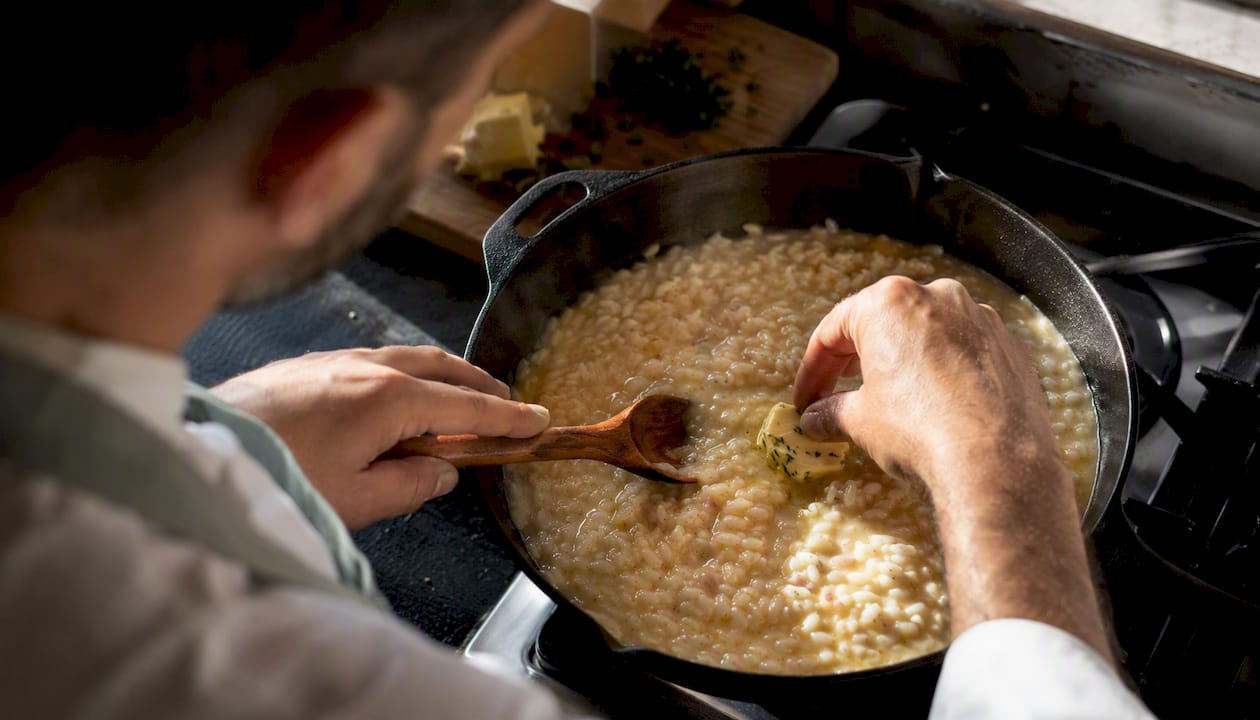
Pro tip: For hot savory dishes (mashed potatoes, sauces, risotto), stir in the infused butter at the very end of cooking, off the heat, just as you would when making a classic butter sauce. This keeps the active ingredients and flavors intact.
Dosage, Interactions, and Precautions
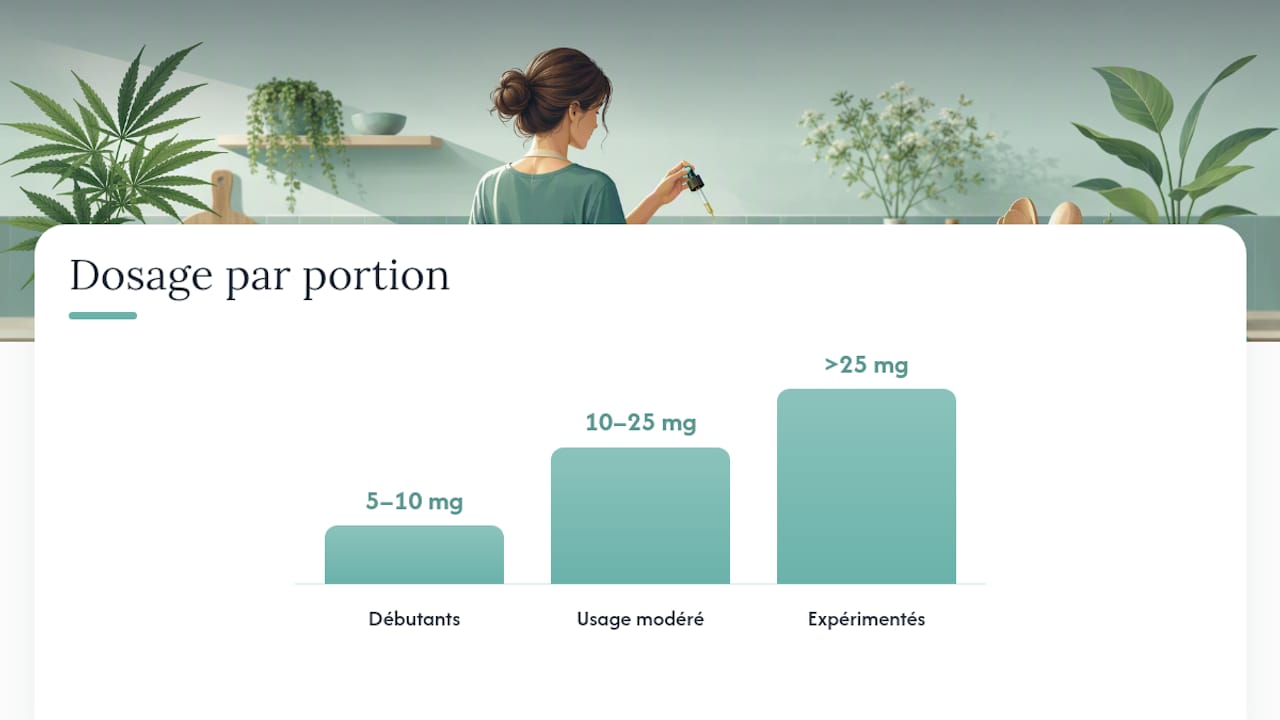
Dosing per serving is the most critical aspect of CBD cooking. General guidelines for CBD baking suggest: 5–10 mg per serving for beginners, 10–25 mg for moderate use. For doses exceeding 25 mg per serving, prior experience is necessary.
Principles to be applied consistently:
- Calculate the mg per serving based on the concentration of your infused butter or oil before cooking.
- Never combine multiple forms of CBD (oil + infused butter + isolate) on the same day without adjusting the doses accordingly.
- Wait at least 1 to 2 hours after ingestion before consuming another serving: the effects of infused foods take longer to kick in than those of sublingual oil and may last for several hours.
Regarding drug interactions: CBD may interact with certain medications metabolized by CYP450 liver enzymes. Anyone currently taking medication should consult a healthcare professional before incorporating CBD into their diet. To understand the limitations of health claims in France, the Pure-extract-cbd article on medical claims to avoid provides useful insight.
Essential practical requirements:
- Check the product's legal compliance via Legifrance and read the COA before making any purchase.
- Inform every guest that the dish contains CBD, without exception.
- Never give CBD products to minors.
- Keep these products out of the reach of children and pets.
Pro tip: Serve pre-measured individual portions (small glasses, measuring spoons, individual muffins) rather than a dish to share freely. This is the only way to ensure that each guest receives exactly the intended dose.
Easy Recipe Ideas with CBD
These five recipes cover the main methods of incorporation. For each one, the recommended form of CBD and the dosage per serving are specified. Informing guests remains a requirement for all of them.
-
Morning smoothie: Add 5–10 mg of CBD oil directly to the blender along with the fruit, plant-based milk, and a spoonful of almond butter (the fat improves absorption). Blend without heating. Recommended form: CBD oil. Dosage: 5–10 mg per serving.
-
Soft cookies: Make infused butter and use it in place of regular butter in the recipe. Bake at a maximum of 160–165 °C for no more than 12–15 minutes. Calculate the mg/serving by dividing the total amount of CBD in the butter by the number of cookies. Recommended form: infused butter. Dosage: 10–15 mg/serving for moderate use.
-
CBD Salad Dressing: Emulsify 10 ml of CBD oil with balsamic vinegar, mustard, and olive oil. No heat required; optimal bioavailability thanks to the lipids in the olive oil. Recommended form: CBD oil. Dosage: 5–10 mg per serving.
-
Crêpes or pancakes: Mix the isolate directly into the cold batter (before cooking) by first dissolving it in warm, melted butter, or add the infused butter as a finishing touch to the hot crêpes after they’ve been removed from the heat. Dissolving it in the butter beforehand ensures even distribution. Recommended form: isolate or infused butter. Dosage: 5–10 mg per serving.
-
Mashed potatoes or savory sauce: Whip the mashed potatoes with the infused butter off the heat, just as you would with classic mashed potatoes. For a sauce, stir in the infused oil or butter at the end over low heat. Recommended form: infused butter. Dosage: 10–20 mg per serving, depending on the concentration.
For more recipes using crystals, Pure-extract-cbd offers a DIY guide featuring CBD crystals that can be used directly in cooking.
How can you check the quality of a CBD product before cooking?
Product quality determines both the safety and effectiveness of the preparation. There are several indicators that help identify a reliable product.
Signs of trust to look for:
- COA (Certificate of Analysis): Issued by an accredited independent laboratory, it confirms the exact CBD content, the THC level (below the legal threshold), and the absence of pesticides, heavy metals, and microbiological contaminants.
- Hemp origin: Give preference to products made from European organic hemp with documented traceability.
- "For food use" label: Avoid e-liquids, cosmetics, and products not intended for ingestion, even if they contain CBD.
- Complete labeling: CBD concentration per unit, manufacturing lot, expiration date.
👉 Avoid products that do not have a certificate of analysis (COA) available, do not indicate their origin, or are sold without clear labeling: these omissions make it impossible to calculate a reliable dosage.
Pure-extract-cbd provides certificates of analysis for its entire product line, which consists of products made from organic hemp. The Northern Light small buds and resins available on Pure-extract-cbd come with their respective COAs, allowing you to accurately calculate the concentration before brewing.
Storage, Shelf Life, and Labeling of CBD Products
Properly prepared infused butter will keep in the refrigerator for up to two weeks in an opaque, airtight container. An infused oil made with coconut or olive oil can last slightly longer (two to three weeks in the refrigerator), provided that it was prepared under impeccable hygienic conditions. Avoid storing it in a cupboard at room temperature: heat and light accelerate the oxidation of the active ingredients.
Best Practices for Storage and Labeling:
- Portion and package immediately after preparation to prevent cross-contamination.
- Label each container with: the date of preparation, the concentration in mg/g or mg/ml, and the statement “contains CBD.”
- For events or shared meals: Prepare pre-portioned individual servings, label each serving, and inform each guest verbally before serving.
- Never store CBD products in containers that are identical to those used for conventional products without distinctive labeling.
What the Publishing Experience Teaches Us About CBD Cooking
CBD cooking is generating growing enthusiasm, but most online guides make the same mistake: they present decarboxylation and infusion as optional or interchangeable steps. This is not the case. Without first decarboxylating the flowers, the infusion produces an aromatic but largely inactive butter. Without a lipid carrier, CBD oil added directly to an aqueous mixture disperses poorly and makes per-serving dosing unpredictable.
Another common blind spot concerns dosage. Many recipes specify a number of drops without indicating the concentration of the oil used, which renders the information unusable. The only rigorous approach is to calculate dosage in milligrams per serving, based on the product’s COA. This is precisely why the quality and analytical transparency of the product you purchase are not just minor details: they are a prerequisite for any serious CBD cooking.
For both novice and experienced cooks, Pure-extract-cbd is a solid choice: a lab-tested product line, accessible COAs, and products suitable for culinary use. The technical articles on the site provide in-depth information on infusion methods and the potential benefits of CBD for those who want to learn more.
Pure-extract-cbd: Lab-tested products for cooking with confidence

All of the techniques described in this guide are based on one prerequisite: having a product whose CBD concentration has been certified by an independent laboratory. Without a reliable COA, calculating the mg per serving becomes an estimate, and the safety of guests cannot be guaranteed.
Pure-extract-cbd offers a complete range of flowers, oils, and resins made from organic hemp, all accompanied by their certificates of analysis. The flowers are suitable for decarboxylation and infusions; the oils are ideal for cold preparations and finishing touches. We offer shipping throughout France, with customer service available to help you find the product best suited to your culinary needs. To get started, browse our selection of top-rated products and choose the one that best fits your recipe.
This content is provided for general informational purposes only and does not constitute medical advice. Consult a healthcare professional with any questions regarding your personal situation, and check with official sources for current regulations.
This article is intended to provide general information and is not a substitute for the advice of a qualified healthcare professional. Consult a qualified healthcare professional about your specific situation before taking any action based on this content.
Sources
- Legifrance
- Cooking with CBD Without Destroying the Active Ingredients: A Technical Guide for Chefs
- How to Cook with CBD
- CBD in Baking: Tips, Recipes, and Easy Dosage



