
HHCPO (hexahydrocannabiphorol acetate) is a semisynthetic cannabinoid obtained by acetylation of a derivative of HHC or HHCP, with potentially potent psychoactive effects. No long-term clinical studies have confirmed its safety in humans, and toxicologists urge caution regarding this type of laboratory-modified molecule.
In short:
- The production of HHCPO involves a complex chemical acetylation reaction, which carries a high risk of residues and impurities if not carefully controlled.
- There are no long-term clinical trials on the toxicity of HHCPO, which increases the risk of addiction and serious psychiatric effects.
- HHCPO may be more potent than delta-9-THC, but there are no reliable measures to accurately determine its potency.
- The legality of HHCPO varies by country, so it is important to consult official regulations before making any purchase.
- Verifying analysis certificates from independent laboratories remains essential to limit exposure to impure or incorrectly dosed products.
Table of Contents
- What does HHCPO stand for? Chemical definition and origins
- What effects can be expected from HHCPO, and how strong are they?
- How is HHCPO manufactured, and what risks does this pose?
- What are the real risks and gray areas of HHCPO?
- Is HHCPO legal? What to check before making a purchase
- Why Transparency in Laboratory Testing Makes All the Difference
- What specific steps should you take before consuming HHCPO?
- What Caution Regarding HHCPO Teaches Us About the Entire Cannabinoid Market
- Tested and compliant alternatives for greater peace of mind
- Sources
What does HHCPO stand for? Chemical definition and origins
HHCPO, sometimes written as HHCP-O, refers to an acetate ester of a hydrogenated cannabinoid: specifically, a chemist starts with HHCP (itself a long-chain analog of HHC) and attaches an acetate group to its molecular structure. This process, called acetylation, slightly modifies the original molecule without radically altering its carbon skeleton. The result is an acetylated derivative of HHCP/HHC, marketed by some manufacturers as a more stable or more potent version of its precursor.
To understand where HHCPO fits into the cannabinoid family, we need to compare it to its chemical cousins:
- HHC: hexahydrocannabinol, obtained by hydrogenating THC, considered the starting point for this entire family of semisynthetic molecules.
- HHCP: a counterpart to HHC with a longer side chain, which theoretically increases its affinity for cannabinoid receptors.
- HHCPO: the acetylated form of HHCP, which is believed to alter its bioavailability and, according to some sellers, the intensity of its effects.
- THC (delta-9): the primary psychoactive cannabinoid, naturally extracted from hemp or cannabis without undergoing acetylation.
What is sorely lacking in this processing chain is transparency regarding the actual origin of HHCPO. Unlike CBD or CBG, there is no known, significant natural pathway for the production of this molecule in the hemp plant. It is almost always produced through laboratory synthesis, which immediately raises questions about quality control.
What effects can be expected from HHCPO, and how strong are they?
In the absence of rigorous clinical trials, user reports remain the primary source of information on the effects experienced. They generally describe an experience similar to that of HHC or delta-9-THC, but with nuances that vary greatly from person to person.
- Euphoria and relaxation: a sense of well-being reported in most testimonials, comparable to a classic cannabis high.
- Sensory changes: altered perception of time; visual or auditory effects that are amplified depending on the dose.
- Significant sedation: At higher doses, many users describe a heavier, more drowsy effect than that of pure HHC.
- Anxiety or discomfort: A significant subgroup reports episodes of anxiety, particularly when inhaling high concentrations.
What we really know about the potency of HHCPO: Available qualitative comparisons suggest that HHC-O and HHCP are at least as potent as, and sometimes more potent than, delta-9-THC, but there are no reliable quantitative data to establish a precise potency scale for HHCPO specifically.
The time it takes for effects to appear depends largely on the method of consumption. When taken orally (oil, capsule, edibles), it generally takes some time for the body to feel anything, and the effects can last for several hours. When inhaled, the effect is almost immediate but wears off more quickly. Specialized reports highlight the lack of established dosage guidelines for this compound, making any estimate of a “safe” dose purely speculative.
How is HHCPO manufactured, and what risks does this pose?
The production of HHCPO involves a chemical acetylation reaction applied to HHCP or HHC, carried out under laboratory conditions that vary greatly from one producer to another. This process is by no means trivial: it involves solvents, catalysts, and purification steps that, if not properly controlled, leave residues in the final product.
- Residual solvents and impurities vary depending on the manufacturer's standards.
- Lack of a single industry standard for the acetylation of cannabinoids.
- Increased risk of thermal degradation when heating acetate esters.
- The need for systematic quality control to detect these discrepancies.
The most concerning issue relates to heating. Acetate esters such as HHC-O can produce toxic degradation compounds during vaporization, such as ketene, a gas known for its irritating effects on the respiratory tract. HHCPO, which belongs to the same chemical family of acetates, potentially poses a similar risk when vaporized at high temperatures.
Pro tip: Never judge an HHCPO-based product by its marketing label. Always request a certificate of analysis (COA) from an independent laboratory, which must specify the exact molecule tested and confirm the absence of detectable residual solvents.
Specialized sources confirm that purity levels and the presence of impurities vary significantly depending on the producer, which is a strong argument for conducting a systematic check before making any purchase.
What are the real risks and gray areas of HHCPO?
Perhaps the greatest danger of HHCPO is not what we know, but what we do not yet know. No long-term clinical studies exist on this specific compound in humans, which prevents any serious assessment of its chronic toxicity, its actual addictive potential, or its interactions with other substances.
- There are no published longitudinal clinical trials on HHCPO.
- Reports of psychiatric side effects and addiction in the specialized press.
- Documented respiratory hazard associated with heated acetates, due to the formation of ketene.
- Increased vulnerability among people with a history of psychiatric or cardiovascular conditions.
Toxicology experts are warning about the lack of long-term clinical studies and the risk of addiction and serious psychiatric effects associated with semi-synthetic cannabinoids such as HHCPO—a concern widely shared in the specialized health press.
This caution is in line with broader warnings issued by public health agencies regarding all synthetic cannabinoids, accidental exposure to which poses a documented toxicological risk. Minors, pregnant women, and individuals with preexisting psychiatric disorders should completely refrain from experimenting with this type of compound, given the lack of reassuring data.
Is HHCPO legal? What to check before making a purchase
The legal status of semisynthetic cannabinoids is evolving rapidly and varies by jurisdiction, particularly with regard to the concept of “Total THC,” which sometimes includes hydrogenated or acetylated derivatives in the calculation of the permitted threshold.
- The regulatory framework for HHCPO remains uncertain in several European countries.
- Commercial availability never guarantees legal compliance.
- National health authorities publish lists of controlled substances that should be reviewed regularly.
- The consequences of illegal possession or sale can be serious, depending on the jurisdiction.
Before making any purchase, it’s best to consult your country’s official resources and our page on regulations governing legal psychoactive cannabinoids to determine exactly where the line between legal and illegal lies.
Why Transparency in Laboratory Testing Makes All the Difference
The lack of scientific data on HHCPO makes transparency on the part of sellers all the more crucial. Some shops base their product listings on independent laboratory analyses that verify compliance and the absence of contaminants before any product goes on sale. While this rigorous approach does not transform an uncertain compound into a risk-free product, it does reduce a very real risk: that of impurities and mislabeling.
The site’s educational blog, which features comparisons such as THCP vs. HHC and an analysis of 10-OH-HHC, has the same goal: to provide readers with the chemical insights they need to understand what they’re buying, rather than being subjected to vague marketing rhetoric.
What specific steps should you take before consuming HHCPO?
Here are the steps you should take to minimize risks if you are still considering this type of product:
- Request a certificate of analysis (COA) that explicitly states the presence of HHCPO and the absence of detectable residual solvents.
- Avoid inhaling heated acetate compounds; opt for oral consumption if you choose to use them.
- Start with the lowest dose and wait at least two hours before taking another dose, since there are no reliable dosage guidelines.
- Watch for warning signs: intense anxiety, palpitations, confusion, and stop using it immediately if any of these occur.
Pro tip: If you experience an unusual reaction after consuming a synthetic cannabinoid, contact a poison control center or see a doctor immediately. Keep the product packaging; it will help identify the substance if necessary.
What Caution Regarding HHCPO Teaches Us About the Entire Cannabinoid Market
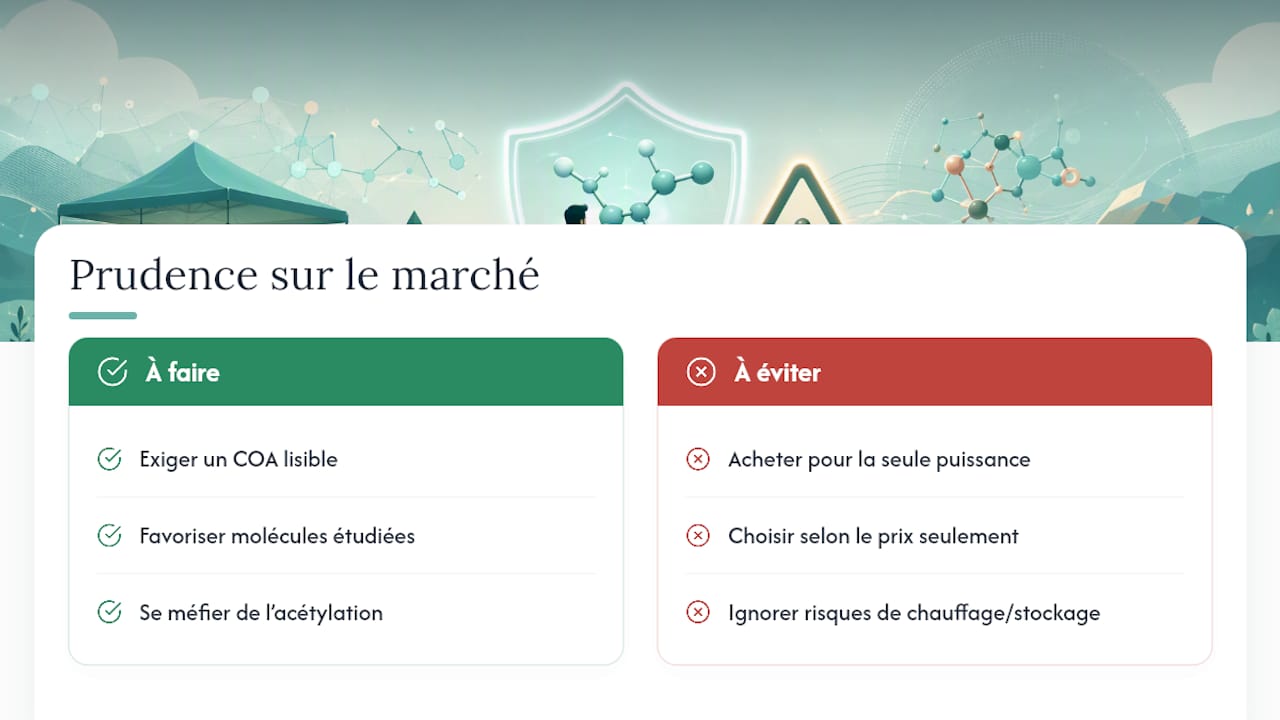
The most useful lesson from HHCPO isn’t specific to this molecule: it concerns how the market for synthetic cannabinoids is advancing faster than scientific research. Each new generation of molecules (HHC, then HHCP, then HHCPO) hits the market before anyone has had time to seriously assess their long-term effects. Conventional wisdom often limits itself to comparing the perceived potency to that of THC, ignoring the more fundamental question: what does this compound do once it is heated, digested, or stored in the body?
In my view, the real cause for concern is not the intensity of the effect reported by users, but the very nature of the acetylation process, which introduces a poorly documented chemical instability. The cautious reader should prioritize the clarity of the certificate of analysis over any considerations of potency or price. This approach, more than any dosage recommendation, remains the best protection available today.
— Steven
Tested and compliant alternatives for greater peace of mind
Given the uncertainty surrounding HHCPO, some suppliers are offering an alternative: legal cannabinoids that have been tested by an independent laboratory, with a composition that is known before purchase—not discovered afterward. Some products come with a certificate of analysis guaranteeing compliance and the absence of contaminants, which radically changes the equation compared to a synthetic compound that is still poorly documented.

For a relaxing experience without the chemical uncertainties associated with HHCPO, Northern Light small buds CBD flower offers a natural, lab-tested profile. If you’d rather avoid inhalation, our guide to using CBD oil details the safest methods. Explore our entire product catalog to compare options that are compliant and legal in France and throughout Europe, and make an informed choice.
This article is intended to provide general information and is not a substitute for the advice of a qualified healthcare professional. Consult a qualified healthcare professional about your specific situation before taking any action based on this content.
Sources
- Beware of “fake” CBD: HHC, HHC-PO… these synthetic molecules can be addictive and turn you into a “zombie” – Doctissimo
- Synthetic Cannabinoids: The Danger of Accidental Exposure – INSPQ
- HHCPO: Effects & Science – Discover the Truth!



