
STV-10, also known as Sativanol, is a semi-synthetic neo-cannabinoid derived from CBD through controlled chemical modification. Produced from industrial hemp that complies with the European THC threshold of less than 0.3%, it occupies an ambiguous legal position in France and Europe as of 2026. Its profile of moderate psychotropic effects clearly distinguishes it from traditional CBD, without, however, placing it in the category of classic narcotics. Understanding STV-10 therefore requires an understanding of its chemistry, its reported effects, and the contours of a rapidly evolving regulatory framework.
What is the chemical nature of STV-10, and what effects does it have?
STV-10 is a semi-synthetic neo-cannabinoid obtained through the chemical modification of natural CBD. This molecular transformation gives it greater potency than traditional CBD, with psychotropic effects described as moderate. It acts on the endocannabinoid system, the network of CB1 and CB2 receptors found in the brain and the human body.
Effects reported by people who use STV-10 include:
- A pronounced sense of physical relaxation
- Relative mental clarity, without the strong sedative effects associated with traditional THC
- A soothing effect on stress and muscle tension
- A mild euphoria, less intense than that produced by delta-9-THC
These effects are primarily documented through anecdotal reports rather than controlled clinical studies. Scientific research on STV-10 remains very limited. To date, no study published in a peer-reviewed journal has validated its therapeutic properties or its long-term safety profile.
Compared to CBD, STV-10 has a stronger affinity for CB1 receptors, which explains its moderate psychotropic effects. Compared to THC, its effects are significantly less intense and shorter-lasting. Compared to other neo-cannabinoids such as THV-N10, STV-10 shares a semi-synthetic origin but differs in its specific molecular structure and effect profile.

Pro tip: Be wary of marketing descriptions that present STV-10 as a validated therapeutic substitute. To date, this compound has not been granted marketing authorization as a drug.
What is the legal framework for the STV-10 in France and Europe?
The STV-10 is marketed in compliance with European industrial hemp regulations, with a THC content of less than 0.3%. This compliance formally distinguishes it from traditional narcotics. However, its status remains a legal “gray area” acknowledged by the health authorities themselves.
| Criteria | Status of the STV-10 in 2026 |
|---|---|
| THC Content | Less than 0.3%: in compliance with European law |
| List of Narcotics (France) | Not explicitly listed as of today |
| ANSM Oversight | Under review; not prohibited but not approved |
| Novel Food Regulation (EU) | May be applicable depending on the product's form |
| Therapeutic claims | Prohibited without marketing authorization |
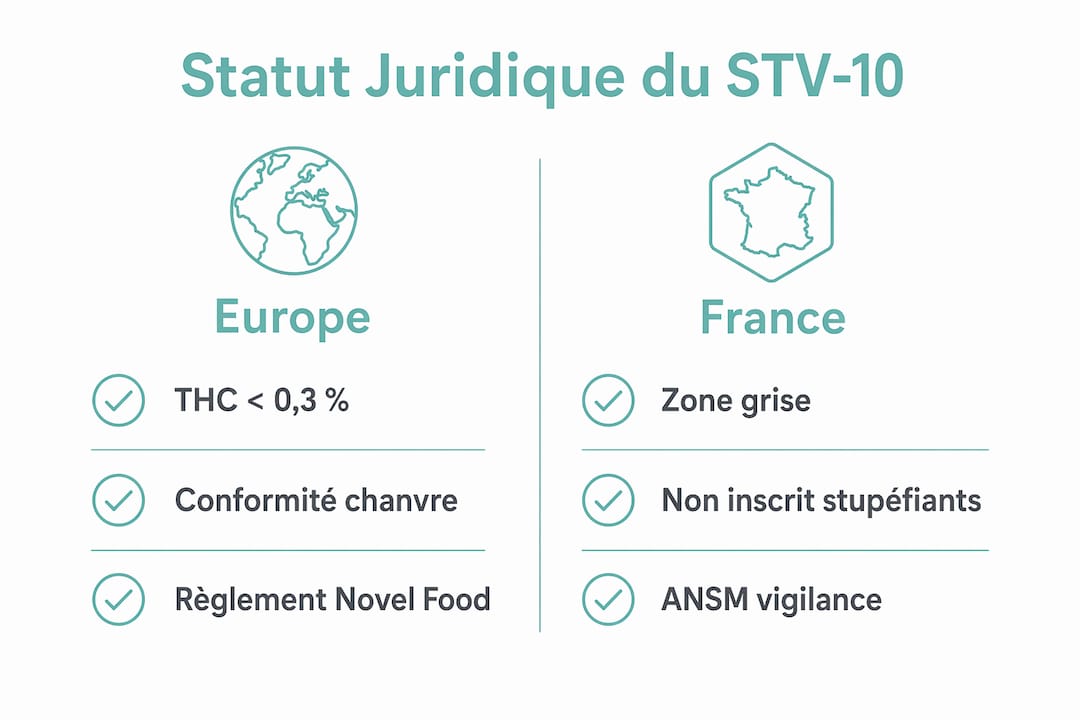
The French National Agency for Medicines and Health Products Safety (ANSM) has classified several neo-cannabinoids, such as HHC and THCP, as controlled substances between 2024 and 2026. STV-10 is not yet explicitly banned, but the absence of a ban does not constitute authorization. The French list of narcotics is updated several times a year, and ministerial decrees can change the status of a compound without a transition period.
At the European level, the Novel Food Regulation requires certain hemp extracts to undergo a prior authorization procedure. Depending on the form in which STV-10 is marketed (extract, oil, infused flower), this regulation may apply. European health authorities are actively monitoring these new compounds.
The regulation of legal psychoactive cannabinoids in France is a good example of this instability: what is tolerated today may be banned tomorrow without warning.
Pro tip: Before buying or selling any products containing STV-10, check the date the legal information was last updated. A decision by the ANSM published in the Official Journal could make a product illegal overnight.
How does STV-10 differ from other neo-cannabinoids?
STV-10 belongs to a family of semi-synthetic molecules that share a common origin: natural CBD from hemp. But each neo-cannabinoid has a distinct chemical structure, its own profile of effects, and a different legal status. Confusing these molecules is a common—and potentially costly—mistake.
Here are the key distinctions to keep in mind:
- Traditional CBD: a natural, non-psychoactive molecule that is legal and well-documented scientifically. CBD remains legal in France provided that the THC content is less than 0.3% and that the product is derived from a variety listed in the European catalog.
- HHC (hexahydrocannabinol): a semi-synthetic neo-cannabinoid classified as a narcotic in France since 2023. Its ban illustrates how quickly a previously tolerated substance can become illegal.
- THCP: a cannabinoid with high affinity for CB1 receptors, banned in France. Its potency is significantly greater than that of STV-10.
- THV-N10: another semi-synthetic neo-cannabinoid, often compared to STV-10 because of its moderate effects and its status as a substance that is not yet banned.
- STV-10: semisynthetic, moderate psychotropic effects, not listed as a controlled substance in 2026, but under active regulatory oversight.
The reason why certain neo-cannabinoids are banned while STV-10 remains tolerated comes down to two factors. First, chemical structure: molecules with a very high affinity for CB1 receptors are the primary target of regulatory authorities. Second, the timing of reports: the ANSM often acts in response to public health alerts or reports of misuse. STV-10 has not yet generated such reports on a large scale, but this does not preclude future regulatory action.
For those who want to understand the differences between CBD and THC, this chemical distinction is the essential starting point for placing STV-10 within the cannabinoid spectrum.
How do I use the STV-10 safely?
Safe use of the STV-10 is based on four non-negotiable principles. Each one mitigates a specific risk, whether it is related to health, legal issues, or product quality.
-
Require a certificate of analysis (COA). Products containing STV-10 must be accompanied by a COA issued by an independent laboratory. This document confirms the THC content, the identity of the compound, and the absence of contaminants. Without a COA, the product’s legal compliance cannot be verified.
-
Start with low doses. STV-10 is more potent than CBD. A dose suitable for an experienced CBD user may produce unexpected effects in a beginner. Gradually increasing the dose allows you to assess your individual tolerance without the risk of an excessive reaction.
-
Check for drug interactions. STV-10 affects the endocannabinoid system and may interact with certain medications metabolized by the liver, particularly via cytochrome P450. Anyone currently taking medication should consult a healthcare professional before using this type of product.
-
Monitor regulatory developments. The legal status of neo-cannabinoids in Europe is volatile. Bans may be imposed without a transition period. Regularly checking updates from the ANSM and the Official Journal is a basic precaution for any buyer or reseller.
-
Choose transparent suppliers. Full traceability, compliance with THC limits, and the absence of unsubstantiated therapeutic claims are the three criteria that distinguish a reputable supplier from an opportunistic player. A supplier that does not publish its COAs or makes unauthorized health claims poses a real risk.
Pro tip: The fact that STV-10 is currently legal does not guarantee its long-term safety. Each neo-cannabinoid warrants an individual assessment, regardless of its current legal status.
Key Points
STV-10 is a semi-synthetic neo-cannabinoid that is legally tolerated as of 2026, but whose regulatory status remains uncertain and whose long-term effects have not yet been scientifically documented.
| Point | Details |
|---|---|
| Chemical origin | A semi-synthetic derivative of CBD, more potent than its natural precursor. |
| Legal Status in 2026 | Not listed as a controlled substance, but under active monitoring by the ANSM. |
| Differences from HHC and THCP | These molecules are banned in France; STV-10 remains permitted for the time being. |
| Standard Precautions | Require a Certificate of Analysis (COA), start with a low dose, and monitor regulatory developments. |
| Main Risk | A ban may be imposed without prior notice, as was the case with HHC between 2024 and 2026. |
My Perspective on the Future of the STV-10
What strikes me most about the STV-10 case is how quickly the market is outpacing regulation. Industry professionals know this: a substance can go from being “tolerated” to being classified as a “narcotic” in a matter of weeks, without consumers being informed in time.
I regularly see people buying STV-10-based products under the assumption that the current legal status is a lasting guarantee. This is the main mistake to avoid. The HHC precedent speaks for itself: banned in France after a period of unrestricted sale, it left retailers with unsellable inventory and consumers in a state of legal uncertainty.
The STV-10 does indeed have potential in the legal market, provided that clear guidelines are established. Semisynthetic compounds derived from hemp represent a promising avenue for wellness applications, but they require rigorous safety studies and complete transparency in the supply chain. Without these, consumer confidence erodes, and authorities take a harder line as a precaution.
My advice to anyone interested in STV-10: Choose suppliers who publish their laboratory analyses, who do not make any unvalidated therapeutic claims, and who update their legal information regularly. Caution is not an obstacle to scientific curiosity. It’s what allows you to stay on the right side of the law while exploring what these new molecules have to offer.
— Steven
Pure-extract-cbd: Compliant Products for Informed Consumption
Pure-extract-cbd offers a selection of CBD-based products derived from organic hemp, all of which comply with European legal standards and contain less than 0.3% THC. Each product is accompanied by its laboratory test results, which are available directly on the website. This transparency provides a concrete response to the risks discussed in this article: verifiable traceability, documented compliance, and no unauthorized therapeutic claims.
For those seeking a well-researched and legally sound alternative, Pure-extract-cbd’s Northern Light CBD flower is a popular choice, prized for its soothing effects and certified compliance. The full product line includes flowers, oils, and resins, with customer service available to answer questions about ingredients and usage.
Frequently Asked Questions
What exactly is the STV-10?
STV-10, or Sativanol, is a semi-synthetic neo-cannabinoid derived from CBD through chemical modification. It has moderate psychotropic effects and is derived from industrial hemp that complies with the European THC threshold of less than 0.3%.
Will the STV-10 be legal in France in 2026?
STV-10 is not included on the French list of controlled substances in 2026. Its status remains a legal “gray area”: tolerated but not explicitly authorized, and subject to prohibition without prior notice by ministerial order.
What are the effects of STV-10?
Reported effects include physical relaxation, mild euphoria, and stress relief. These effects are more intense than those of CBD but less pronounced than those of conventional THC. To date, no controlled clinical studies have confirmed these effects.
How can you tell the difference between STV-10, HHC, and THCP?
HHC and THCP have been classified as controlled substances in France since 2024–2026. STV-10 differs in its chemical structure and has a lower affinity for CB1 receptors. This chemical difference explains why its legal status is still tolerated, but the situation may change rapidly.
What should you check before buying a product containing STV-10?
Request a certificate of analysis (COA) issued by an independent laboratory, confirming the THC content and the identity of the compound. Also verify that the supplier does not make any unauthorized therapeutic claims and that its legal information is up to date.



