THCA is not automatically legal in France: it all depends on the total THC content in the finished product, which must not exceed 0.30%. This threshold applies to the sum of delta-9 THC and convertible THCA, calculated according to a specific formula established by regulation. Before making any purchase, always request a certificate of analysis (COA) issued by an accredited laboratory, clearly stating the method used.
In short:
- The legal compliance of a THCA-based product in France depends on adherence to the 0.30% threshold for total THC, which includes the conversion of THCA according to a specific formula.
- The HPLC analytical method is preferred because, unlike GC, it does not decarboxylate THCA, which allows for a reliable estimate of potential THC content.
- Checking the date of the most recent COA, the separation of delta-9-THC and THCA, as well as the laboratory’s origin and accreditation, is essential to ensuring the product’s legality.
- Lab-tested CBD oils and resins offer greater legal certainty compared to THCA-rich flowers, which carry the risk of exceeding the legal threshold.
- Transparency on the part of the seller—particularly through accessible, dated certificates of authenticity—is becoming a key criterion for identifying a reliable supplier in a market that is still evolving.
Table of Contents
- Legal THCA in France: What You Need to Know About the Regulatory Framework
- What Is THCA and Why Is Its Conversion Important?
- HPLC or GC: How Laboratories Calculate Total THC
- What are the legal risks in the event of noncompliance?
- How to Verify That a THCA Product Complies with the Law
- What alternatives should be prioritized to stay within the law?
- What a Transparent COA Reveals About a Seller’s Reliability
- Where Is THCA Regulation Headed in France?
- Pure-extract-cbd: An Approach Based on Transparency in Testing
- Official resources to check for yourself
- Why the confusion surrounding THCA will continue for a while
- Sources
Legal THCA in France: What You Need to Know About the Regulatory Framework
The legality of THCA in France is based on a specific provision: the decree governing the cultivation, importation, and use of industrial hemp sets the maximum total THC threshold at 0.30% for any hemp-derived product sold within the country. This figure alone determines compliance, far more so than the chemical nature of the molecule itself.
In practical terms, a product with a high THCA content is not prohibited in and of itself. It is this nuance that many sellers overlook, whether intentionally or not.
The National Agency for Medicines Safety has recently revised its position on this issue. In May 2024, the agency announced that several cannabinoids had been added to the list of controlled substances, which caused some confusion among industry professionals. A month later, in June 2024, the ANSM clarified its position: THCA is still included in the calculation of total THC rather than being banned in and of itself. This clarification reassured part of the industry, while maintaining heightened vigilance regarding measured levels.
Three factors currently determine the practical compliance of a THCA-based product in France:
- Compliance with the 0.30% threshold for total THC in the finished product, not in the raw plant prior to processing.
- The mandatory inclusion of converted THCA in this calculation, using the regulatory formula.
- The requirement that the seller demonstrate this compliance through a dated and methodologically reliable laboratory analysis.
This legal framework explains why two flowers that look identical can have completely different legal statuses. It all comes down to the analysis report, not the product’s appearance.
What Is THCA and Why Is Its Conversion Important?
THCA, or tetrahydrocannabinolic acid, is the chemical precursor to THC. It forms naturally in the trichomes of the cannabis and hemp plants, before any processing takes place. In this raw form, it is not psychoactive: its molecular structure, hindered by a carboxyl group, prevents it from binding effectively to the cannabinoid receptors in the nervous system.
Everything changes with decarboxylation. This chemical process removes the carboxyl group when heated, converting THCA into active delta-9-THC. A study published on PubMed details this conversion mechanism and the conditions that accelerate it.
Decarboxylation can occur in several ways:
- Through direct heating during the combustion, vaporization, or cooking of a product.
- Through prolonged exposure to light or high ambient temperatures, a slower but very real process.
- Even in the case of certain laboratory analytical methods, this complicates the interpretation of the raw results.
In the plant, THCA serves as a chemical reserve: it is the form in which the cannabinoid is stored prior to use. This distinction between the stored molecule and the active molecule is precisely what makes the issue legally complex, since a product may have a very low delta-9 THC content in its raw state while still having a high potential for conversion.
HPLC or GC: How Laboratories Calculate Total THC
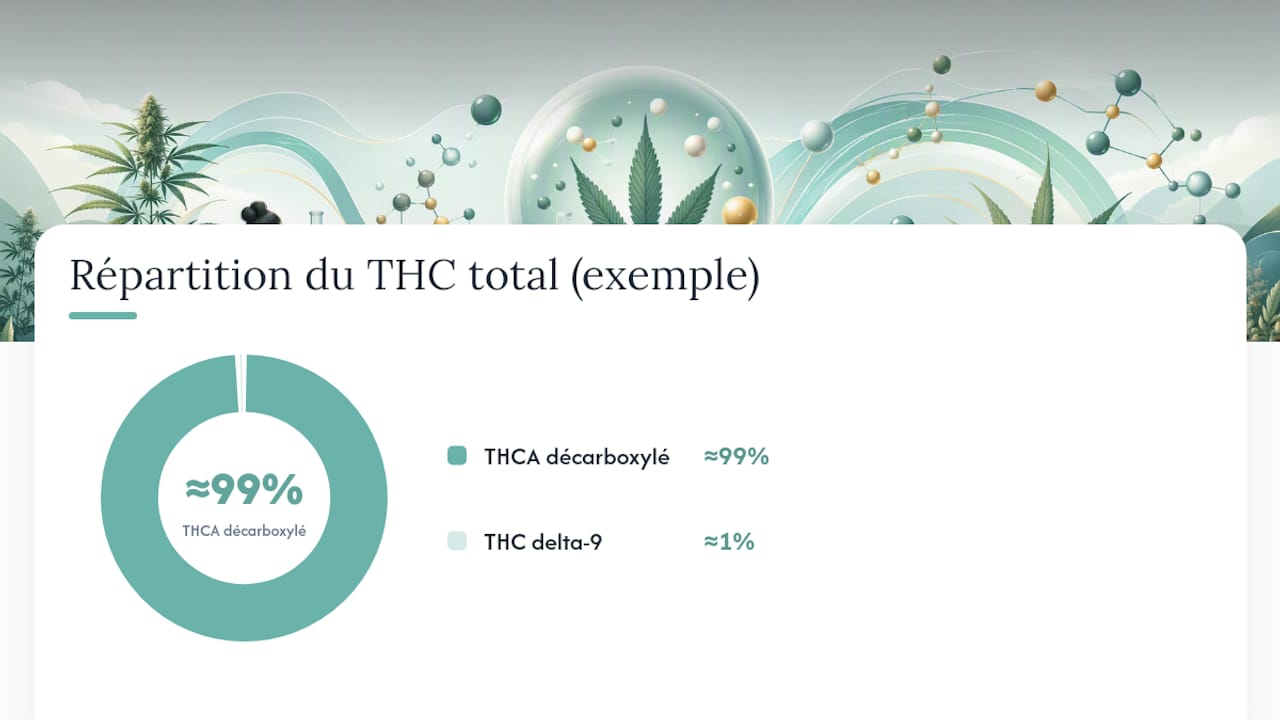
The analytical method used to test a product drastically changes the result shown on the certificate of analysis. High-performance liquid chromatography, or HPLC, operates at room temperature and clearly separates THCA from delta-9-THC without converting them. Gas chromatography (GC) heats the sample during analysis, which decarboxylates some of the THCA and can skew the measurement of the actual THC present at the start. This difference in methodology explains why two laboratories may report different results for the same sample.
The key figure to remember: 0.877. This is the conversion factor applied to the THCA level to estimate its psychoactive potential once decarboxylated. The official formula used to calculate total THC is as follows: Total THC = delta-9 THC + (THCA × 0.877). Test reports apply this factor to express a product’s potential delta-9-THC content, regardless of the analytical method used.
This approach has very concrete consequences:
- A flower containing 0.10% delta-9 THC but 15% THCA far exceeds the legal threshold once the calculation is applied (15 × 0.877 = approximately 13.15% total THC).
- A COA that does not specify the analytical method or the calculation of total THC does not allow for verification of the product's actual compliance.
- HPLC remains the preferred reference method used by reputable laboratories for this type of testing.
A consumer who only reads the delta-9 THC percentage on a product label—without looking at the THCA or the overall calculation—is missing the most important information. This is often where the discrepancy lies between a promising raw compound and a finished product that doesn’t meet standards.
What are the legal risks in the event of noncompliance?
Several French authorities regulate cannabinoid-based products. Customs monitors import flows and may seize goods at the border if analytical documents are missing or appear insufficient. The General Directorate for Competition, Consumer Affairs, and Fraud Control (DGCCRF) oversees the domestic market by conducting inspections at retailers and verifying the accuracy of product labeling. The ANSM, for its part, maintains a supervisory role regarding the classification of substances.
According to legal documentation available on Legifrance, the consequences for a seller who markets a product exceeding the 0.30% total THC threshold can range from the seizure and removal of batches to more serious legal proceedings. For the buyer, the risk is different but real: a positive THC saliva test during a traffic stop can lead to legal consequences, even if the product consumed was presented as legal at the time of purchase.
Three precautions effectively limit this risk:
- Avoid flowers with a very high THCA content, even if the raw delta-9 THC content appears low.
- Always keep the dated certificates of analysis (COAs) for each purchase, in case of a future inspection or dispute.
- Choose products for which the total THC content is explicitly stated in the laboratory report.
How to Verify That a THCA Product Complies with the Law
Before making any purchase, a thorough review of the certificate of analysis will help you avoid the vast majority of unpleasant surprises. Here are the steps to follow:
- Check the COA date. A report that is more than a few months old may not accurately reflect the current composition of the batch being sold, since THCA continues to decarboxylate slowly over time.
- Identify the D9-THC and THCA values separately. A reliable COA lists both figures distinctly; it never provides a single, undifferentiated total value.
- Identify the analytical method used. The abbreviation "HPLC" must be clearly stated; its absence, or the mention of "GC" alone without further specification, should raise a red flag.
- Verify the laboratory’s accreditation. A laboratory accredited by Cofrac or an equivalent body offers a guarantee of methodological reliability that a vendor’s in-house lab does not provide.
- Look for the total THC calculation that has already been performed. A report that applies the regulatory formula itself, using the factor 0.877, greatly simplifies the verification process for the consumer.
Pro tip: Don’t just look at the percentage displayed prominently on the label. Open the full COA, find the line labeled “Total THC” or “Calculated Total THC,” and compare that value to the 0.30% threshold—not the raw THCA content, which can legally be much higher.
What alternatives should be prioritized to stay within the law?
Certain product categories offer significantly greater legal certainty than THCA-rich flowers. CBD oils, pure isolates, and resins that are routinely laboratory-tested generally have more stable total THC profiles that are easier to verify, since they are produced using standardized manufacturing processes.
- CBD oils made from European hemp often have a total THC content well below the threshold, with a comfortable safety margin.
- Testing resins on a batch-by-batch basis makes it possible to verify compliance on a product-by-product basis rather than relying on an overall average.
- Flowers with very high THCA content are, by their very nature, the products closest to the legal threshold and are therefore the most susceptible to variations between two analyses.
For peace of mind when making a purchase, always choose a seller who publishes recent Certificates of Analysis (COAs), specifies the European origin of the hemp used, and is transparent about their testing methods—rather than relying on purely marketing-oriented claims about THCA levels.
What a Transparent COA Reveals About a Seller’s Reliability
The difference between a reliable seller and one to avoid is rarely evident from the packaging. It can be found in the documentation provided. A reputable supplier provides, for each product, a recent certificate of analysis, a product sheet detailing the origin of the hemp and the lab results, as well as easy access to these documents without any complicated procedures.
There are three factors that allow for a quick assessment of this transparency:
- The availability of a COA that can be downloaded directly from the product page, without having to request it by email.
- A clear statement identifying the independent laboratory that performed the analysis, including its accreditation number, if available.
- Explanatory content that details the testing methodology rather than simply providing a marketing figure.
A seller committed to this approach to traceability publishes the laboratory test results for its product line, whether it consists of flowers, oils, or resins made from organic hemp. In the event of a roadside or customs inspection, having an accessible, dated Certificate of Analysis (COA), along with a clear product description, provides the best documentary protection for a consumer acting in good faith.
Where Is THCA Regulation Headed in France?
The legal framework for THCA is not set in stone. The ANSM’s position has already changed once in 2024, and there is no indication that it will remain stable indefinitely, particularly given the discussions taking place at the European level regarding the harmonization of THC thresholds. Reports from the European Monitoring Center for Drugs and Drug Addiction also show that approaches still vary widely among member states.
For consumers and professionals alike, the best strategy is to stay actively informed: regularly check Legifrance and ANSM press releases, and consistently choose suppliers that work with accredited laboratories capable of adapting quickly to any regulatory changes.
Pure-extract-cbd: An Approach Based on Transparency in Testing
In a market where compliance hinges on a specific number, choosing a seller that publishes its test reports rather than making mere marketing promises makes all the difference for your legal certainty. Some online stores offer a range of flowers, oils, and resins made from organic hemp, each accompanied by independent lab test reports that you can review before making a purchase.

On the product page for Northern Light small buds CBD flowers, for example, the lab results are readily available, allowing you to check the total THC content yourself before placing an order. To explore the entire lineup, the Pure Extract CBD store offers a selection of tested flowers, oils, and resins, while the guide on how to use CBD oil helps you choose a suitable format if you’d prefer to avoid THCA-rich flowers. Check out the product pages, compare the available COAs, and place your order with full knowledge of the facts.
Official resources to check for yourself
If you still have doubts about a specific product, only official sources should be relied upon. Consult Legifrance for current regulatory texts, the ANSM website for decisions regarding cannabinoids, and PubMed for scientific literature on the chemistry of THCA. A dated and detailed COA remains, as a last resort, your best evidence in the event of an inspection.
Why the confusion surrounding THCA will continue for a while
The confusion surrounding THCA isn’t going to clear up anytime soon, and it’s not just a matter of poor communication on the part of the authorities. It’s structural: consumers with no background in chemistry are being asked to understand that a non-psychoactive molecule can legally expose them to prosecution once it’s been transformed by the heat of a lighter. Few regulations require such a high level of technical understanding for an everyday purchase.
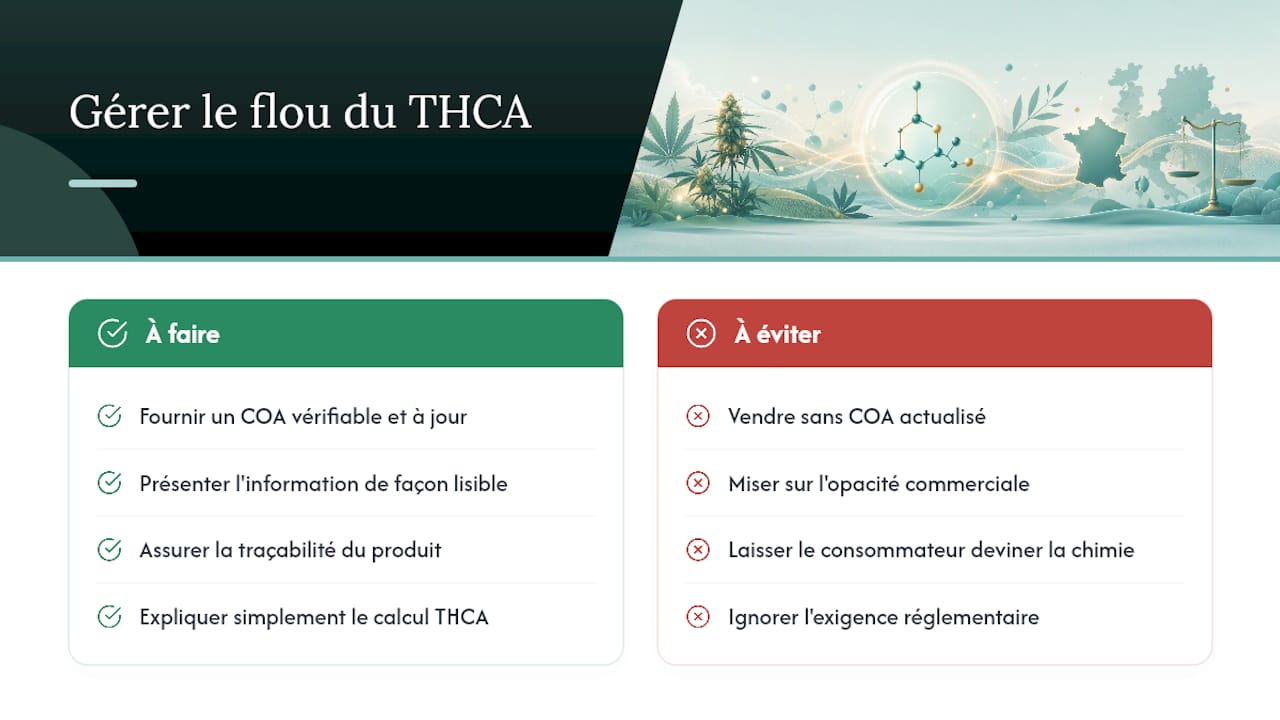
What strikes me most is the disconnect between the rigor of regulatory calculations—with their factor of 0.877, accurate to the thousandth—and the casual manner in which certain products are still sold without an up-to-date Certificate of Analysis (COA). This scientific rigor exists precisely to protect consumers, provided that the information reaches them in a readable form. A figure hidden away in a report that no one reads protects no one.
In my view, the real dividing line in this sector in the coming years will no longer be the one that distinguishes legal sellers from illegal sellers in the strict sense. It will separate those who document their products in a verifiable manner from those who rely on opacity to sell more quickly. Regulations may still evolve regarding thresholds or calculation methods. What will not change is the demand for traceability that French consumers are learning to expect.
— Steven
Sources
- Legifrance – Laws and Regulations Governing Industrial Hemp
- ANSM – The ANSM Adds New Cannabinoids to the List of Narcotics
- Cannabivo – THCA Explained: Chemistry, Decarboxylation, Testing, and the Law
- PubMed – Studies on the Chemistry of Cannabinoids