
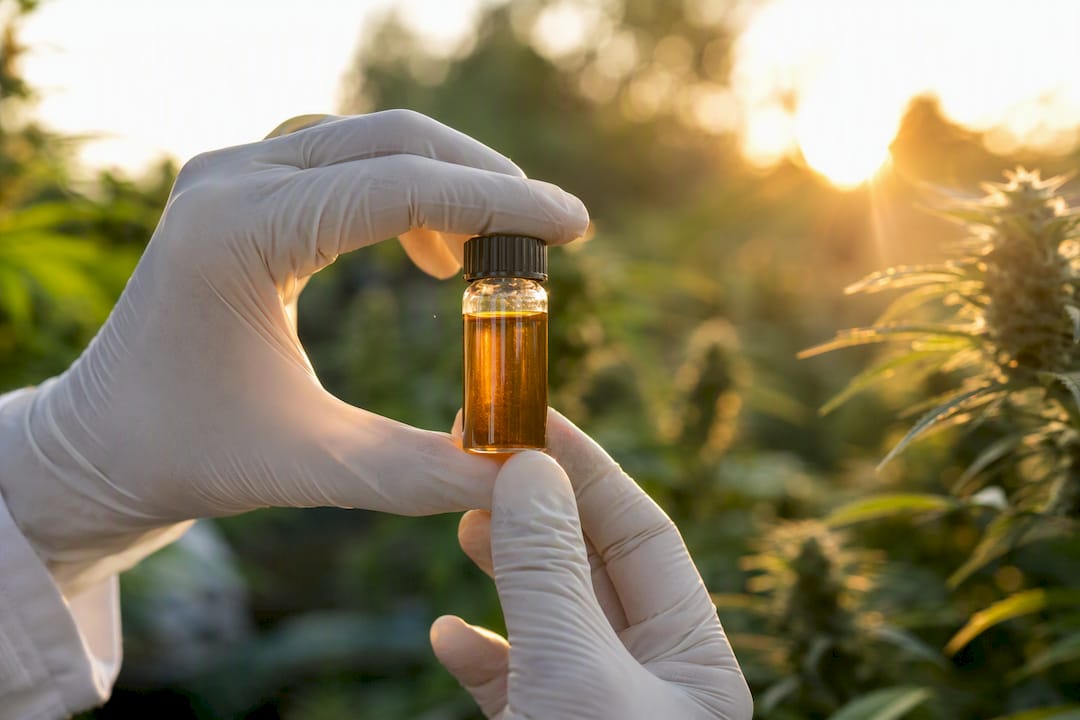
THCP produces psychoactive effects that can exceed those of conventional THC. Its binding to the CB1 receptor is significantly stronger, but that doesn’t mean every dose will be 33 times more intense: molecular affinity and perceived potency are two different things.
Here is what science has established to date:
- THCP binds to the CB1 receptor with an affinity of approximately 1.2 nM, compared with approximately 40 nM for Δ9-THC, according to measurements fromthe 2019 study published in *Scientific Reports*.
- This figure describes the binding strength to the receptor in a laboratory setting, not the intensity of the effect experienced by a person.
- Caution is still the rule: start with a very small dose, never combine THCP with alcohol or other substances, and request a certificate of analysis (COA) before making any purchase.
The key takeaway right away: a CB1 affinity that is significantly higher than that of THC does not mean the effect is 33 times stronger in humans. Absorption, metabolism, and crossing the blood-brain barrier profoundly alter the final outcome.
Key Points
In laboratory tests, THCP exhibits a significantly higher CB1 affinity than THC; however, this finding does not imply that its effect is 33 times stronger in humans, which necessitates a very low starting dose and a verified certificate of analysis.
| Point | Details |
|---|---|
| High CB1 affinity | THCP binds to CB1 with a Ki of approximately 1.2 nM, compared to ~40 nM for Δ9-THC. |
| Affinity Does Not Equal Power | The “33×” ratio describes a laboratory procedure, not the actual intensity experienced by a user. |
| High-Risk Foods | The time it takes for the effects to set in (45 minutes to two hours) increases the risk of accidental overdoses. |
| Vulnerable populations in need of protection | A history of psychosis, adolescence, and psychotropic treatments call for increased caution. |
| Require a Certificate of Analysis (COA) for each lot | Pure-extract-cbd provides detailed batch analyses for its oils and cannabinoid products, including THCP. |
This article is intended to provide general information and is not a substitute for the advice of a qualified healthcare professional. Consult a qualified healthcare professional about your specific situation before taking any action based on this content.
Table of Contents
- What Is THCP, and Why Do Its Effects Intrigue Scientists?
- What effects does THCP have, depending on the method of consumption?
- What are the risks and side effects of THCP?
- Is THCP Legal? Here's What the Current Regulations Say
- How to Identify a Reliable and Well-Documented THCP Product
- What the Science of THCP Really Teaches Us About Caution
- Where to Find Tested and Transparent THCP Products
- Sources
What Is THCP, and Why Do Its Effects Intrigue Scientists?
THCP, or tetrahydrocannabiphorol, was first isolated in 2019 by a team of Italian researchers who identified it in a cannabis strain. What sets it apart is its chemical structure: its side chain has seven carbon atoms, compared to five for Δ9-THC. This difference, which seems almost insignificant on paper, makes all the difference pharmacologically, as it improves the molecule’s fit within the CB1 receptor’s binding pocket.
The lab results are certainly noteworthy:
- A CB1 affinity of ~1.2 nM, compared to ~40 nM for conventional THC, according to the seminal study on Δ9-THCP.
- Behavioral tests in mice (the well-known “tetrad test”) show hypomotricity, analgesia, catalepsy, and a drop in body temperature at doses lower than those required for THC.
- To date, there are no robust clinical data in humans, which severely limits the scope of these findings.
These findings explain the scientific enthusiasm, but they do not yet allow us to accurately predict how the human body reacts to actual doses of THCP.
What effects does THCP have, depending on the method of consumption?
The effects reported by users are similar to those of THC, but often more intense. Several sensations are frequently mentioned in user testimonials and clinical reports:
- Marked euphoria, sometimes accompanied by a sensation of time distortion in which the minutes seem to stretch out.
- Sensory changes, including a heightened perception of colors, sounds, or textures.
- Significant drowsiness, more intense than with most CBD flowers or standard THC products.
- Increased appetite, a classic effect of potent CB1 agonists.
- Subjective time dilation, described by some users as a distortion of their awareness of the present.
The route of administration makes a world of difference. Vaping or smoking produces an almost immediate effect—within a few minutes—that peaks quickly and then wears off over one to three hours. Edibles follow a completely different pharmacokinetic profile: the onset of effects can take between 45 minutes and two hours, with a delayed peak and a total duration that often exceeds six hours. This latency explains the majority of accidental overdose cases, in which a user takes another dose thinking that the first one didn’t work.
Cases of human poisoning documented by VICE illustrate this risk: people who ingested THCP-infused edibles with incorrect dosages reported effects that were much more intense and prolonged than expected. Individual variability also plays a role: body weight, prior tolerance to cannabis, metabolism, and one’s emotional state at the time strongly influence the intensity of the experience.
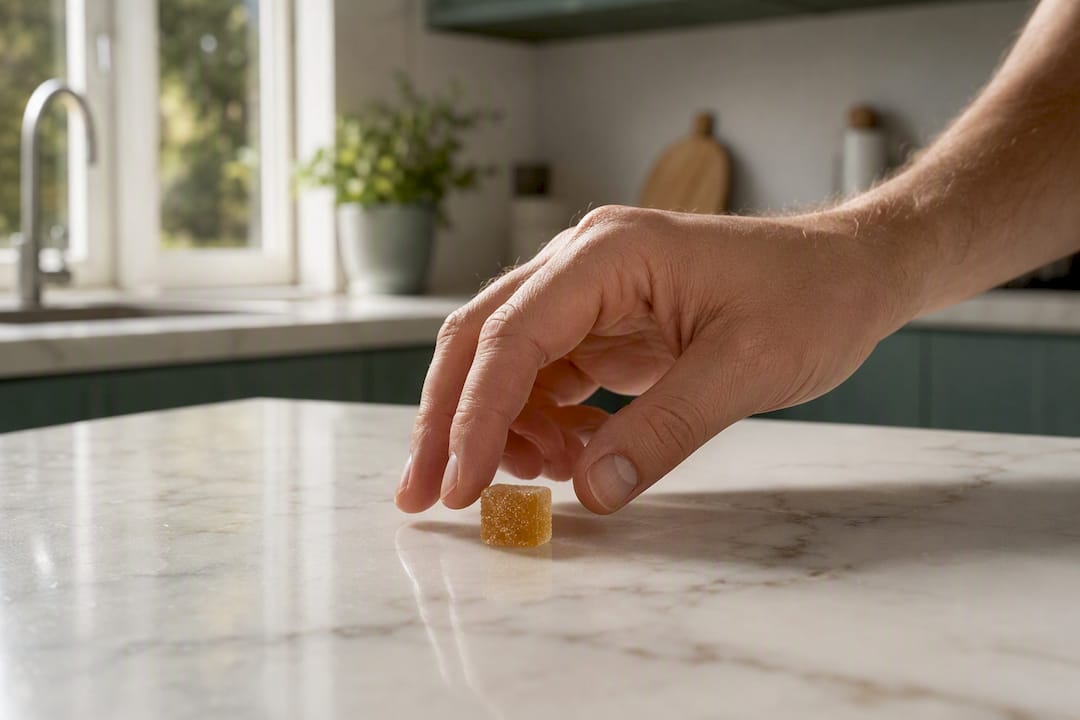
Pro tip: With a THCP-infused edible, wait at least two hours before considering another dose. The temptation to “top off” too quickly is the number one cause of bad experiences.
What are the risks and side effects of THCP?
The potency that makes THCP scientifically interesting is also what makes it a molecule that must be handled with caution. Addiction specialists have observed psychological disturbances that sometimes exceed those associated with conventional cannabis.
The most commonly reported side effects include:
- Acute anxiety, panic attacks, and feelings of derealization, particularly at high doses or in sensitive individuals.
- Increased risk of psychotic episodes in individuals with a personal or family history of psychiatric disorders.
- Tachycardia, nausea, orthostatic hypotension, and excessive sedation, which may interfere with driving or tasks requiring alertness.
Certain groups warrant heightened vigilance: adolescents, whose brains are still developing; people with a history of psychosis; and those already taking psychotropic or cardiovascular medications. Experts interviewed by AlloDocteurs note that it has a greater addictive potential than traditional cannabis, precisely because of this increased CB1 affinity.
If you experience distress after taking THCP, the basic steps are the same as for any cannabis intoxication: stay calm, stay hydrated, avoid being alone, and seek medical attention if symptoms persist or worsen—especially in cases of chest pain or severe confusion.
Is THCP Legal? Here's What the Current Regulations Say
The legal framework for emerging cannabinoids is based on a simple but fragile principle: a substance that is not explicitly classified as a narcotic may circulate in certain commercial channels until the legislature makes a decision. This gray area has already shifted for related molecules.
- HHC has been banned in France, a precedent that illustrates how quickly the status of a synthetic or semisynthetic cannabinoid can change.
- Public health organizations such asthe EMCDDA are actively monitoring these new substances and recommend a precautionary approach until more data becomes available.
- The situation remains fluid: what is permitted today may be reclassified tomorrow, without much advance notice.
Before making any purchase, check the applicable regulations and choose suppliers who can provide proof of their products’ compliance rather than relying solely on marketing claims.
How to Identify a Reliable and Well-Documented THCP Product
A reliable certificate of analysis (COA) provides three essential pieces of information: the exact THCP concentration, the complete profile of other cannabinoids present, and the absence of contaminants such as heavy metals, pesticides, or residual solvents. Without these three elements, a product’s label is of little value.
Many commercial products blend Δ8, Δ9, HHC, and THCP without specifying the actual proportion of each compound, making it impossible to estimate a reliable dose, as highlighted in VICE’s investigation into the THCP market.
Pro tip: Before making any purchase, always ask for the COA for the specific batch you’ll be receiving—not a generic COA for the product. Concentrations vary from batch to batch.
What the Science of THCP Really Teaches Us About Caution
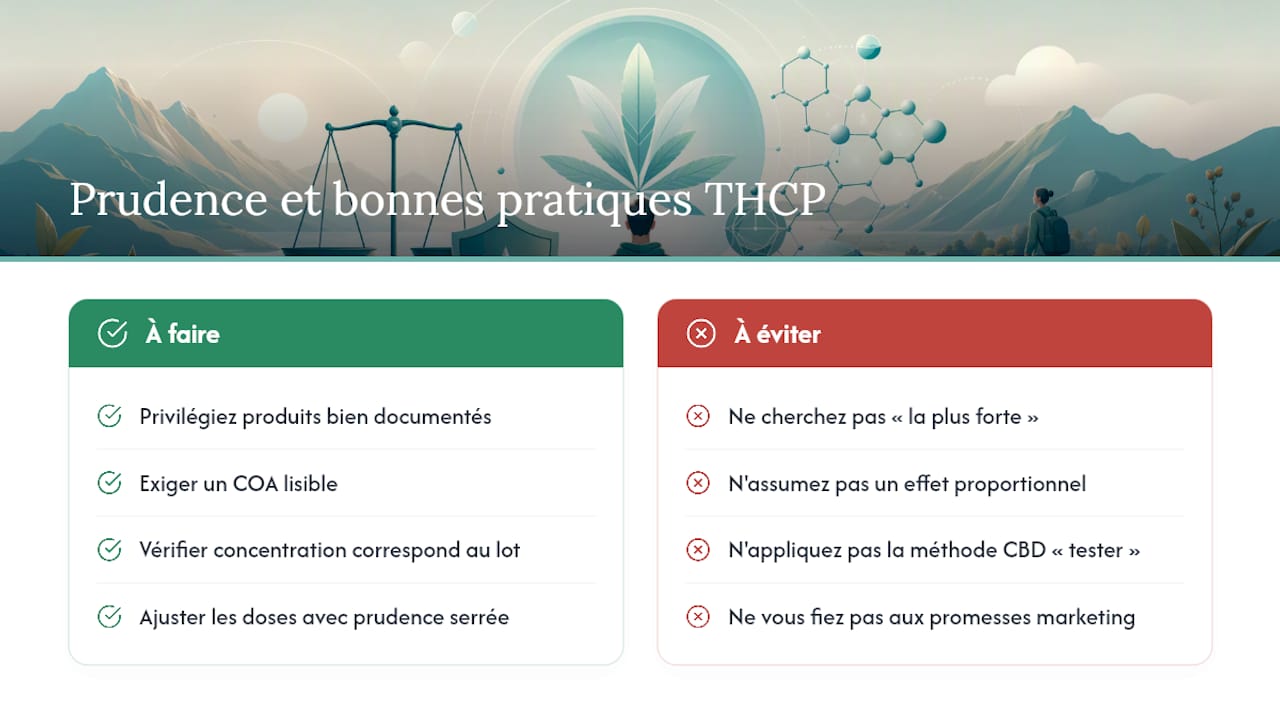
The debate surrounding THCP suffers from a oversimplification that is as frustrating as it is fascinating: turning a laboratory affinity ratio into a marketing claim of “33x potency.” This interpretation is misleading—and doubly so because it leads some consumers to underestimate a dose, assuming that the effect will simply be proportional.
What the data really show is the opposite of what marketing would have us believe: the more strongly a molecule binds to CB1, the narrower—not wider—the margin of error in dosing must be. The conventional “test and adjust” approach, which works for broad-spectrum CBD, becomes dangerous with a molecule whose affinity far exceeds that of standard THC.
The priority, therefore, is not to look for the strongest product, but for the best-documented one. A clear COA, a stated concentration that matches the batch received, and information explaining the limitations of the available data are infinitely more valuable than a label that promises extreme sensations.
Where to Find Tested and Transparent THCP Products
Finding a reliable THCP product often means navigating vague labels and unverifiable marketing claims. Pure-extract-cbd takes the opposite approach to this lack of transparency: every product in its cannabinoid line, including THCP, comes with a batch analysis report that can be viewed online, indicating the actual concentration and the absence of contaminants.

To compare cannabinoid profiles before making a choice, the product sheet forthe 5% broad-spectrum CBD/CBG oil illustrates the level of detail that a transparent supplier should always provide. If you have a question about the safety of a specific product or how to interpret a certificate of analysis, Pure-extract-cbd’s customer service team is available to answer it before you make a purchase. Review the product descriptions, compare batch analyses, and place your order only once you have the COA in hand.
Sources
- Identification of a Novel Phytocannabinoid in Cannabis sativa (2019) — Scientific Reports
- HHC Banned: What Are H4CBD and THCP? — AlloDocteurs
- What Is THCP? The Truth Behind the ‘33x Stronger Than THC’ Claim — VICE



