

No, THCP is not legal in France.The ANSM has classified it as a narcotic since June 3, 2024, along with THCA, HHCPO, and several other synthetic cannabinoids. In practice, its production, sale, possession, and use are now prohibited throughout the country, just like cannabis itself.
In short:
- The sale, possession, and use of THCP have been strictly prohibited in France since June 3, 2024, as it is classified as a narcotic.
- Reports of serious adverse effects, such as addiction or psychotic episodes, led to its ban despite the lack of robust clinical studies.
- Variations in concentration and the lack of regulation make any THCP-based product unpredictable and potentially dangerous.
- Even possessing trace amounts of THCP can result in criminal penalties, particularly if you test positive while driving, just as with cannabis.
- Only CBD-compliant products, verified by a certificate of analysis, remain authorized and safe for consumption in France.
Table of Contents
- Detailed legal status: ANSM decision and official text
- Why THCP Was Banned: Reports and Health Risks
- Practical Consequences and Penalties in France
- What Science Says About CB1 Affinity and Its Limitations
- What legal alternatives are available in France?
- What to Do in Case of Poisoning or Addiction
- Transparency and Quality Control: What Pure-extract-cbd Checks
- Why Caution Must Take Precedence Over the Pursuit of Power
- Toward Legal and Informed Consumption
- Sources
Detailed legal status: ANSM decision and official text
The decision went relatively unnoticed by the general public, but it shook up an entire commercial sector that had developed on the fringes of the traditional CBD market. The ANSM issued a statement simultaneously adding H4CBD, H2CBD, HHCPO, THCP, and THCA to the list of controlled substances, determining that these molecules posed a risk profile comparable to that of already regulated substances. This listing is not merely a recommendation: it is immediately enforceable.
The regulatory text that formalizes this classification is available on Légifrance, which details the changes made to the list of controlled substances as defined by the Public Health Code. It is this document—and not a simple press release—that serves as the official record in court or during an inspection.
In practice, the ban covers the entire product lifecycle: the production of THCP-enriched flowers or resins, their importation, their sale in physical stores or online, their mere possession by a private individual, and their consumption in any form (vaping, oil, tea). There is no threshold tolerance, as there may be for THC in legal CBD. A product containing THCP, even in trace amounts, falls under the narcotics regulations.
To verify a product’s compliance before purchasing it, the only reliable method is to review the certificate of analysis provided by the seller and compare the list of cannabinoids classified as controlled substances with the list on the label. A reputable seller should never have to dodge this question.
Why THCP Was Banned: Reports and Health Risks
The ANSM did not make this decision as a mere precaution. The classification of THCP is based on addiction surveillance reports documenting serious adverse effects, including episodes of dependence and hospitalizations related to acute crises. These field reports, collected from specialized centers, carried more weight than any marketing argument regarding the product’s “legality.”
The reported cases describe a variety of clinical presentations: severe tachycardia, paroxysmal anxiety, episodes of confusion, and even psychotic episodes in individuals with no known history of such conditions. What makes these reactions particularly difficult to anticipate is the near-total absence of controlled clinical studies on THCP in humans. The compound was brought to market before its pharmacokinetics had even been properly documented—a pattern that several scientific analyses have identified as a structural problem in the market for so-called “exotic” cannabinoids.
Added to this is an aggravating factor: the unpredictability of the products themselves. The flowers and resins sold under the name THCP often came from extraction or semi-synthesis processes that were not well standardized, with concentrations varying from one batch to the next. As a result, consumers could never know exactly what dose they were ingesting, nor what other compounds were present alongside the main molecule. This variability, combined with high pharmacological potency, largely explains the frequency of serious adverse effects observed in France as well as in other European countries that have followed a similar regulatory path.
Practical Consequences and Penalties in France
Since the ANSM’s classification, possession of THCP is legally subject to the same regulations as possession of traditional narcotics. The legal framework published on Légifrance applies without any specific distinctions: the penalty depends on the quantity, the presumed use (personal or for resale), and the circumstances of the offense, but mere possession is sufficient to constitute an offense.
THCP also poses a very real problem for drivers: it causes positive results on the saliva and blood tests used during traffic stops, just like THC. Driving after consuming it therefore carries the same penalties as driving under the influence of cannabis, including license suspension and criminal prosecution.
If you still have products purchased before the ban took effect, the best course of action is to dispose of them rather than keep them or sell them. No “grandfather clause” provides legal protection for individuals: the law applies to current possession, not to the date of purchase. To clearly distinguish what is still permitted from what is no longer allowed, the page on the differences between THC and CBD provides a useful guideline: compliant CBD remains legal; THCP is no longer legal—period.
What Science Says About CB1 Affinity and Its Limitations
THCP is of interest to researchers for one specific reason: its affinity for the CB1 receptor—the receptor that mediates a large portion of cannabis’s psychoactive effects—is significantly higher than that of THC. In vitro data show a Ki value of approximately 1.2 nanomoles for THCP, compared with approximately 40 nanomoles for THC, indicating a much stronger binding to the receptor under laboratory conditions.
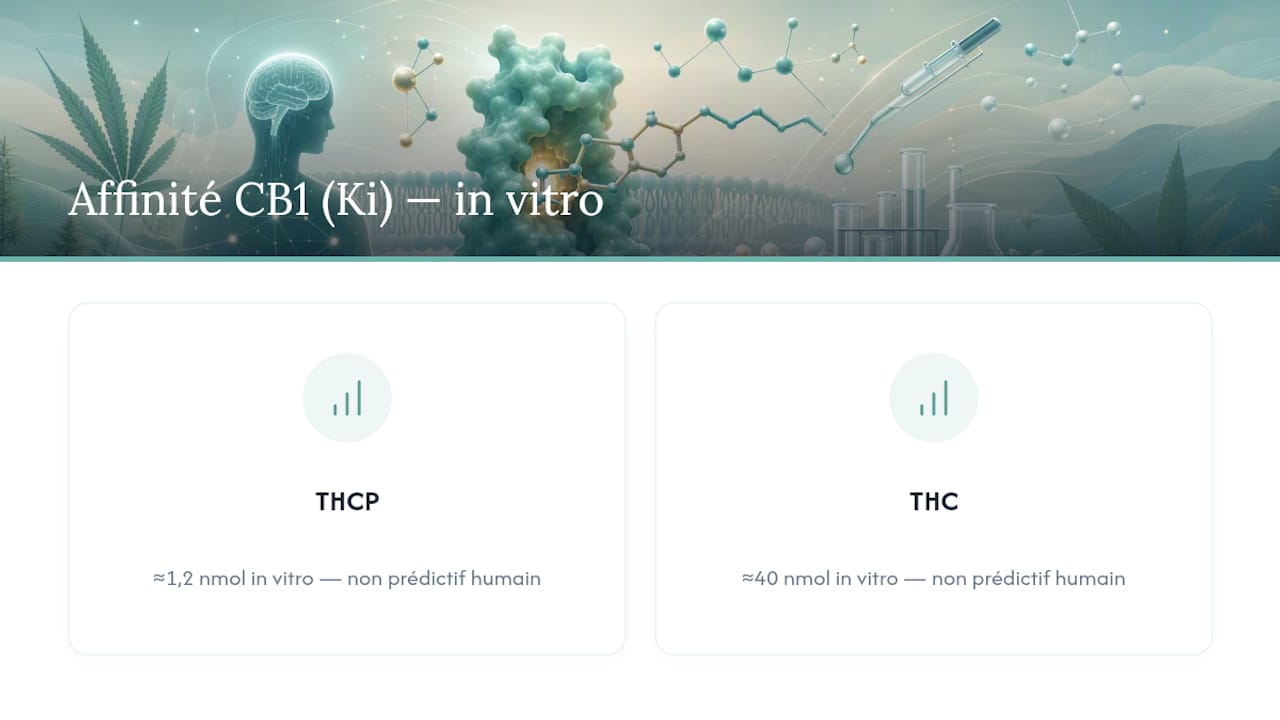
This difference partly explains why THCP has quickly gained a reputation as an “extremely potent” cannabinoid in online marketing. But a lower Ki value in a test tube does not automatically translate to an effect that is 33 times more intense in humans. Clinical pharmacology depends on many other factors: bioavailability, hepatic metabolism, crossing the blood-brain barrier, and individual tolerance. Reducing the comparison to a simple affinity ratio is an overly simplistic interpretation of laboratory data.
Preclinical animal studies confirm cannabimimetic activity observable at lower doses than those required for THC, which likely contributed to the adverse effects reported during the product’s uncontrolled commercial distribution. However, these studies remain limited in number, are often conducted on small samples, and in no way replace structured clinical trials in humans. Scientific caution therefore dictates that THCP be treated as a poorly characterized compound rather than as a “proven” cannabinoid with greater efficacy. To further explore the comparison with other recently regulated cannabinoids, the page onCB1 affinity and certificates of analysis details the nuances between THCP and THCA.
What legal alternatives are available in France?
Giving up THCP doesn’t mean giving up the desired effects. Several categories of products remain fully compliant with French regulations while offering a well-documented usage profile:
- Compliant CBD, with THC levels below the legal threshold, remains the most stable and best-documented option on the market.
- CBN, which has been less studied but is legal, is of interest to people looking for a relaxing effect in the evening.
- Products accompanied by a certificate of analysis (COA) issued by an independent third-party laboratory, which guarantees the product’s actual composition and the absence of prohibited substances.
Before making any purchase, a few simple checks can help you avoid unpleasant surprises: review the COA for the specific batch (not a generic COA posted on the website), verify that the THC content remains within legal limits, ensure the traceability of the hemp used, and be wary of any medical claims, which have no place on a wellness product.
Pro tip: On a certificate of analysis, check the date and lot number first—if they don’t exactly match the product you have in your hands, the document is worthless. Also be wary of COAs that list only CBD without detailing the minor cannabinoids—this is often a sign of an incomplete analysis. To understand how to incorporate these products into your daily routine, the page on CBD oil consumption provides practical guidelines.
What to Do in Case of Poisoning or Addiction
Severe palpitations, mental confusion, intense anxiety, or disorientation after consumption warrant a visit to the emergency room without waiting for the symptoms to worsen. A poison control center can also be contacted beforehand to assess the severity of the situation.

To report an adverse reaction related to a product, the official “Signalement” platform allows you to report the incident to health authorities—a process that directly contributes to the addiction surveillance data used by the ANSM. In the event of established addiction, your primary care physician remains your first point of contact and can refer you to an addiction treatment center or a specialized support group.
Transparency and Quality Control: What Pure-extract-cbd Checks
A legal product cannot be proven based on mere claims. We provide certificates of analysis and explanatory information on regulated cannabinoids, allowing each buyer to verify the composition for themselves before placing an order. This requirement for proof through third-party testing remains the only reliable guarantee in a market where marketing claims have often proven to be misleading.
Why Caution Must Take Precedence Over the Pursuit of Power
The quest for the “strongest” cannabinoid has almost always been followed by a ban. Be wary of marketing that touts exotic compounds with no clinical history: potency measured in the lab does not guarantee safety or predictability. Always verify a product’s compliance, and if you have any doubts about your use, talk to a healthcare professional rather than an online forum.
— Steven
Toward Legal and Informed Consumption
There is a clear difference between seeking a strong effect at any cost and choosing a product with a verifiable composition. Pure-extract-cbd offers flowers, oils, and resins, each batch of which comes with a certificate of analysis that can be viewed online, such as the Northern Light CBD flower, which is derived from organic hemp and tested by an independent laboratory.

Unlike the recently banned synthetic cannabinoids, these products comply with the legal THC threshold and are firmly within the framework of French regulations, with no gray areas or risk of sudden reclassification. To explore the entire compliant product line, visit the “All Products” page, where you can compare flowers, oils, and resins based on your needs, with a COA available for each item before you finalize your order.
Sources
To verify the information in this article for yourself: the ANSM press release specifies the classification and the health-related reasons for it; the text on Légifrance establishes the exact legal scope; the PMC study on CB1 affinity details the pharmacology of THCP; the ScienceDirect analysis documents the risks associated with recreational products; and the EMCDDA profile places cannabis in its European context.
This article is intended to provide general information and is not a substitute for the advice of a qualified healthcare professional. Consult a qualified healthcare professional about your specific situation before taking any action based on this content.
- The ANSM Adds New Cannabinoids to the List of Narcotics
- Δ9-THCP Identification and Pharmacology (PMC article)
- Légifrance — Legislation on Narcotics (May 2024)
- Δ9-THCP: Identification and Quantification in Recreational Products (ScienceDirect)



