

THCV (tetrahydrocannabivarin) shows promise in regulating appetite and carbohydrate metabolism, with robust preclinical data and some encouraging preliminary human trials. This is currently the area where the evidence is most advanced. As for other areas, particularly neuroprotective and antipsychotic properties, the data remain largely preclinical and require larger studies before any clinical conclusions can be drawn.
Key points to keep in mind before reading on:
- Appetite and metabolism: the best-documented effects, with positive results in animal models and early indications in humans.
- Level of evidence: primarily preclinical (rodents); human trials are few in number, small in scale, and should be interpreted with caution.
- Psychoactivity: low at low doses, possible at high doses—the dosage is key.
- Regulations in France: The legal framework is changing; verify compliance and certificates of analysis (COA) before making any purchase.
- Commercial products: Most contain less THCV than the doses used in clinical studies.
Table of Contents
- What is THCV, and how does it differ from THC?
- How does THCV work in the body?
- What are the main benefits of THCV that have been studied?
- Safety, Side Effects, and Contraindications
- What Do the Studies Really Say? Evidence, Limitations, and Gaps
- What is the legal status of THCV in France?
- How can you buy THCV responsibly in France?
- Key Points
- Analytical transparency: the only criterion that really matters
- Would you like to try a cannabinoid product that complies with French regulations?
- Sources and Recommended Reading
What is THCV, and how does it differ from THC?
Tetrahydrocannabivarin (THCV) is a phytocannabinoid naturally found in Cannabis sativa. Its molecular structure resembles that of THC (tetrahydrocannabinol), but with one key difference: its side chain consists of three carbon atoms (propyl), compared to five for THC (pentyl). This variation, though seemingly minor, profoundly alters its interaction with the endocannabinoid system and explains its distinct profile of effects.
From a biosynthetic perspective, THCV is derived from divarinolic acid, while THC is derived from olivetolic acid. The two molecules share a common enzymatic pathway, but their precursors differ, which determines their respective presence in the plant. THCV is found in significant concentrations in certain African varieties of Cannabis sativa, particularly landraces from South Africa and Ethiopia, whereas it is present only in trace amounts in most commercial cultivars.
Products available on the market include:
- THCV isolates: purified form, high concentration, more precise dosage.
- Broad-spectrum or full-spectrum oils: contain THCV along with other cannabinoids (CBD, CBG, CBN).
- THCV-enriched flowers: varieties selected for higher THCV content.
Most consumer products contain very low levels of THCV. Before making a purchase, check the certificate of analysis (COA) to confirm the actual THCV concentration and ensure that the THC level remains within French legal limits.
How does THCV work in the body?
THCV primarily interacts with the endocannabinoid system, a network of receptors and lipid mediators that regulates appetite, metabolism, pain, and mood. Its mechanism of action differs significantly from that of THC, and it is precisely this difference that underpins its therapeutic value.

Action on CB1 and CB2 receptors
At low doses, THCV acts as a neutral or inverse antagonist of the CB1 receptor, meaning it blocks or reduces the activation of this receptor. However, it is the activation of CB1 by THC that causes the well-known increase in appetite. By blocking CB1, THCV produces the opposite effect: a suppression of appetite and an improvement in the metabolic profile. Regarding the CB2 receptor, which is involved in inflammatory and immune modulation, THCV exhibits partial agonist activity according to several systematic reviews.
Dose-dependent biphasic effect
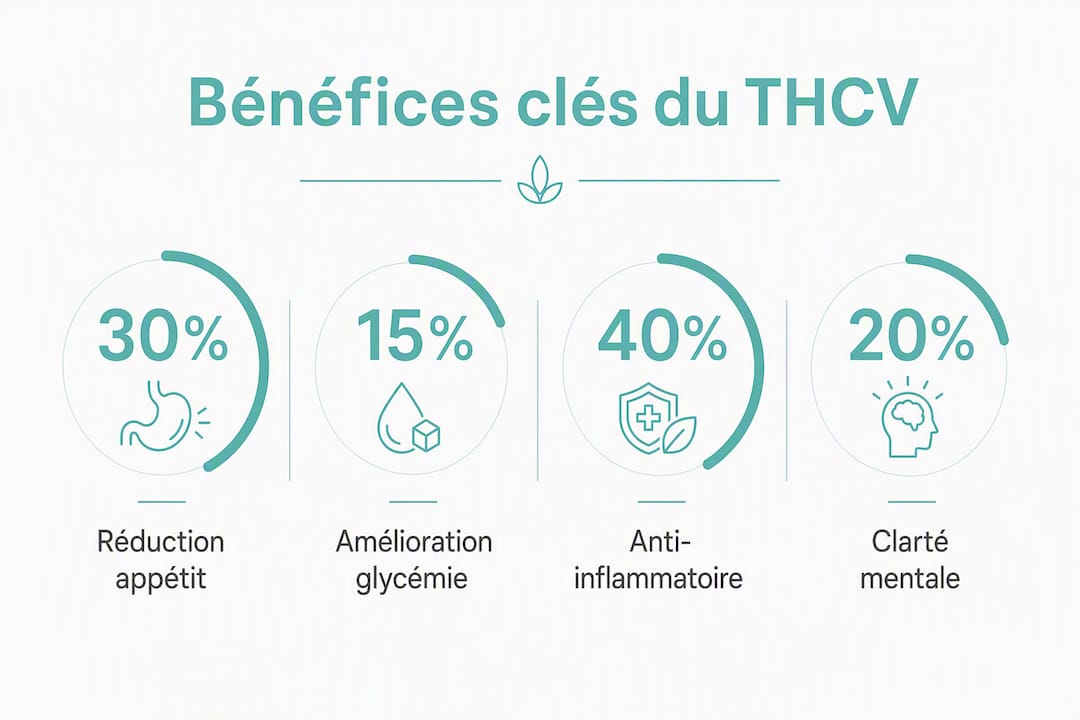
The effects of THCV vary depending on the dose administered. At low doses, CB1 antagonism predominates, with reported reductions in appetite and increased mental clarity. At higher doses, relative agonist activity may emerge, leading to mild psychoactivity. This biphasic profile is key to understanding why some users describe very different effects depending on the amount consumed.
Alternative receptors
Preclinical studies also suggest that the GPR55 and TRPV1 receptors are involved in the metabolic effects of THCV. These pathways, which are distinct from the classical endocannabinoid system, may contribute to the regulation of blood glucose levels and the modulation of inflammation, although the precise mechanisms remain to be elucidated.
What are the main benefits of THCV that have been studied?
Effect on appetite: the most well-documented signal
The appetite-suppressing effect of THCV is best supported by the current scientific literature. Rodent models have shown that at doses as low as 3 mg/kg, food intake was significantly reduced. This finding is consistent with the CB1 antagonism mechanism described above. Early indications in humans are encouraging, but studies remain few and small in scale.
Blood Sugar Control and Insulin Sensitivity
This is the area where human evidence is most advanced. A pilot clinical trial reported a reduction in fasting blood glucose levels and an improvement in pancreatic beta-cell function in patients with type 2 diabetes treated with THCV. These results, published in a peer-reviewed journal, represent a notable clinical finding, even though the study’s sample size remains limited. In obese mice, THCV also reduced hepatic lipid accumulation and improved glucose tolerance in diet-induced obesity models.

Anti-inflammatory and neuroprotective properties
Preclinical data suggest that THCV may modulate inflammatory pathways through partial CB2 activity and antioxidant mechanisms. Studies in animal models have observed a reduction in certain inflammatory markers, but these results have not yet been replicated in controlled human trials. The neuroprotective potential, particularly in the context of neurodegenerative diseases, remains exploratory.
Mental Clarity and Antipsychotic Potential
At low doses, some users report a sense of mental clarity and alertness, consistent with its CB1-antagonist profile. Preliminary observations suggest antipsychotic potential, in contrast to the sometimes anxiety-inducing effect of THC at high doses. However, these data are very limited and do not support any clinical conclusions.
Comparison with THC and CBD
| Cannabinoid | Action CB1 | Effect on Appetite | Psychoactivity | Human Data |
|---|---|---|---|---|
| THC | Agonist | Stimulation | Yes (checked) | Numerous studies |
| CBD | Indirect modulator | Neutral/Low | No | Moderate studies |
| THCV | Antagonist (low doses) | Discount | Low to none (low doses) | Limited, preliminary |
For an in-depth comparison of cannabinoids, the article “CBD vs. THC: What Are the Differences? ” by Pure-extract-cbd details their respective mechanisms.
Pro tip: The doses used in clinical studies on THCV generally range from 5 to 10 mg per dose, or even higher. Most commercial products contain amounts of THCV that are generally lower than those used in clinical studies. This discrepancy explains why the effects reported by consumers are often less pronounced than those observed in the laboratory.
Safety, Side Effects, and Contraindications
The safety profile of THCV appears generally favorable at the low doses studied, but several points warrant special attention.
Reported Adverse Effects
- Diarrhea and mild digestive upset, especially when first starting to use the product.
- Changes in appetite, sometimes more pronounced than expected.
- At high doses (greater than 10 mg), mild psychoactive effects have been observed in human studies, although 10 mg administered orally did not produce marked subjective effects in some trials. Very high doses (greater than 100 mg) have shown mild effects similar to those of THC.
- Serious side effects are rare but possible with unregulated or contaminated products.
At-risk populations
- Pregnant and breastfeeding women: No safety data are available; use is not recommended.
- Children and adolescents: The endocannabinoid system is still developing; any exposure to cannabinoids should be avoided without strict medical supervision.
- Older adults: slower metabolism, potentially more frequent drug interactions.
- People taking diabetes medication: THCV may lower blood sugar levels; combining it with hypoglycemic agents (insulin, metformin, sulfonylureas) increases the risk of hypoglycemia. A medical consultation is required before use.
- People taking psychotropic medications: Possible interactions with antipsychotics and antidepressants; consult a healthcare professional.
Clinical Consideration: The scientific literature explicitly recommends that THCV not be considered a substitute for established medical treatments, particularly for chronic conditions such as type 2 diabetes. Anyone currently taking medication should consult their doctor before using a product containing THCV, due to potential pharmacodynamic interactions.
For a broader perspective on precautions related to cannabinoids, the article “Adverse Effects of CBD: Taking a Cautious Approach” by Pure-extract-cbd provides a useful framework.
Timeline of Effects by Route of Administration
The sublingual route (oils) generally produces effects within 15–45 minutes, peaking around 1–2 hours. Inhalation (vaporized flowers) acts more quickly, within a few minutes. Solid oral forms (capsules, edibles) have a longer onset time, often 1–2 hours, with a prolonged duration of effect. These data are extrapolated from studies on cannabinoids in general; specific data on THCV remain limited.
What Do the Studies Really Say? Evidence, Limitations, and Gaps
Summary Table of Key Studies
| Type of study | Model / Population | Main dose | Key Findings |
|---|---|---|---|
| Preclinical (rodents) | Obese mice (DIO) | 3 mg/kg | Reduced food intake, improved glucose tolerance |
| Preclinical (rodents) | Obese mice | Variable | Reduction in hepatic steatosis, improvement in insulin sensitivity |
| Pilot Human Trial | Patients with T2D | 5–10 mg/day | Reduction in fasting blood glucose levels, improvement in β-cell function |
| Human Dose-Response Study | Healthy volunteers | 10 mg by mouth | No marked subjective effects at this dose |
| Systematic Review | Preclinical and Clinical Literature | N/A | The Need for Larger Randomized Trials |
Methodological Limitations to Be Aware Of
The available studies have several recurring weaknesses that call for caution in interpreting the results:
- Small sample sizes: Most human trials involve fewer than 50 participants, which limits statistical power.
- Variability in formulations: pure isolates, broad-spectrum extracts, varying doses—the results are not directly comparable across studies.
- Short duration: Most trials last a few weeks, with no data on long-term effects.
- Possible industry funding: Some studies are funded by entities in the cannabinoid industry, which may introduce publication bias.
- Limited transferability of animal models: Results from rodent studies do not always translate to humans, particularly with regard to metabolic effects.
Systematic reviews emphasize the need for larger randomized controlled trials before clinical recommendations can be made. The mechanisms involving GPR55 and TRPV1 have yet to be confirmed in human models.
How to Read a Study on THCV
Always check the following: the type of model (animal or human), the sample size, the dose administered, the duration of the study, and the source of funding. A positive preclinical study is a sign of promise, not proof of clinical efficacy.
What is the legal status of THCV in France?
The French regulatory framework governing cannabinoids is complex and evolving. THCV, like most minor phytocannabinoids, is not explicitly listed as a narcotic in France, but its legality depends on several factors: the THC content of the finished product, the origin of the hemp (authorized varieties), and the form in which it is sold.
What You Need to Check Before Making a Purchase
- The THC content of the finished product must remain within the legal limits set by French law (currently set at 0.3% in the plant, with specific rules for processed products).
- The hemp used must come from varieties listed in the European catalog of authorized varieties.
- Products must be accompanied by a certificate of analysis (COA) issued by an independent third-party laboratory.
Availability on the French market
THCV is available in the form of isolates, broad-spectrum oils, and enriched flowers at specialty stores. The THCV concentration varies considerably depending on the product. For flowers, the distinction between industrial hemp and narcotic cannabis is legally significant.
Pro tip: A complete COA must include: the THCV content (in mg/g or as a percentage), the total THC content (THC + THCA × 0.877), confirmation that pesticide levels do not exceed regulatory thresholds, and test results for heavy metals and residual solvents. Require a COA dated within the last 12 months and issued by an ISO 17025-accredited laboratory.
How can you buy THCV responsibly in France?
Before making any purchase, it’s important to conduct a thorough check. Here are the steps to follow in order.
- Request the Certificate of Analysis (COA): The document must be available on the seller’s website or upon request, dated within the last 12 months, and issued by an accredited third-party laboratory. Do not purchase without a COA.
- Check the THC content: Ensure that the total THC level remains within French legal limits. A non-compliant product poses a legal risk.
- Check the actual THCV concentration: compare the dose per serving listed on the packaging with the doses used in studies (typically 5–10 mg). A product labeled as containing 1 mg of THCV per serving will likely not produce the effects documented in clinical research.
- Check the source of the hemp: choose products made from European organic hemp grown using traceable methods.
- Identify the extraction method: Supercritical CO₂ extraction is generally considered the cleanest method for producing cannabinoid extracts.
- Choose the form that best suits your goal: sublingual oils offer faster absorption and more precise dosing than flowers or capsules for targeted therapeutic use.
- Start with a low dose: Begin with the minimum recommended dose, and monitor the effects for 5 to 7 days before adjusting. Keeping a log of the effects (time taken, dose, how you feel) makes it easier to adjust the dose.
- Consult a healthcare professional if you are taking medication for diabetes or psychiatric medications, or if you belong to a high-risk group.
Pro tip: Choose stores that publish their COAs directly on the product pages, with a link to the full lab report. A customer service team capable of answering technical questions about the analyses is a reliable indicator of a reputable business.
For guidance on cannabinoid dosages in general, the guide “How Much CBD Should You Take?” from Pure-extract-cbd provides a practical framework that can be applied to other cannabinoids.
Key Points
THCV shows real therapeutic potential for appetite and blood sugar control, but evidence from human studies remains preliminary, and commercial products often contain lower doses than those used in studies.
| Point | Details |
|---|---|
| The best-documented benefit | Reduced appetite and improved metabolism, particularly in preclinical studies and small human trials. |
| Current Level of Evidence | Mostly preclinical; human trials show promise but are small in scale and should be interpreted with caution. |
| Dosage and Psychoactivity | Low psychoactivity at low doses (1–5 mg); psychoactive effects are possible at doses above 10 mg, according to some studies. |
| Pre-Purchase Inspection | Require a recent COA (from an ISO 17025-accredited laboratory); verify the total THC and actual THCV concentration. |
| Compliant Call Option | Pure-extract-cbd offers cannabinoid products with accessible COAs and verified legal compliance in France. |
Analytical transparency: the only criterion that really matters
The debate over the benefits of THCV suffers from a structural problem that popular science articles often avoid addressing directly: the majority of effects reported by consumers do not match the conditions of scientific studies—not because the compound is ineffective, but because commercial doses are too low.
This situation creates a harmful information asymmetry. A consumer who purchases a product labeled “THCV-enriched” without checking the COA may ingest less than one milligram of THCV per dose, whereas pilot clinical trials use doses of 5 to 10 mg. The absence of an effect does not invalidate the molecule; it reveals a disconnect between marketing and pharmacology.
Pure-extract-cbd’s editorial stance on this issue is clear: analytical traceability is not a marketing gimmick; it is a basic requirement for credibility. An accessible, dated COA issued by an accredited laboratory is the only document that allows a consumer to know exactly what they are buying. Other claims—whether regarding organic origin, extraction methods, or expected benefits—are worthless without this foundation.
For minor cannabinoids such as THCV, for which clinical research is still in its early stages, this analytical rigor is all the more important. The strongest evidence to date concerns the modulation of metabolism and blood glucose levels. This is where human trials have produced the most consistent findings. The other potential effects—neuroprotection, antipsychotic effects, and anti-inflammatory effects—deserve attention but have not yet been definitively established.
This article is provided for general informational purposes only. It does not constitute medical advice. Consult a healthcare professional before using any product containing THCV, especially if you are taking medication.
Would you like to try a cannabinoid product that complies with French regulations?
Pure-extract-cbd selects its products based on a non-negotiable criterion: every item in the catalog comes with a certificate of analysis issued by an independent third-party laboratory, which can be viewed directly on the product page. For those interested in exploring minor cannabinoids such as THCV, this analytical transparency is the minimum guarantee of an informed purchase.

The catalog covers a wide range of dosage forms: oils, flowers, extracts, and isolates, all derived from organic hemp grown using traceable practices. For beginners, starting with a low-concentration oil allows you to gradually adjust the dose while observing the effects. Browse all available products to find the form best suited to your needs, or go directly to the Pure-extract-cbd store to verify each product’s compliance and COAs.
Reminder: If you are taking medication for diabetes or psychotropic drugs, consult your doctor before using any product containing cannabinoids.
Sources and Recommended Reading
To learn more about the scientific data on THCV, here is a selection of reliable sources, organized by level of evidence:
- The Role of THCV in Metabolic Disorders: Preclinical Evidence and Implications — A Preclinical Review of the Effects of THCV on Appetite and Metabolism in Rodents; A Database of Dosages and Mechanisms.
- THCV Is Not THC: A Review of Pharmacological and Physiological Differences — A Comparative Analysis of CB1/CB2 Mechanisms and the Biphasic Dose-Response Profile; A Reference for Understanding Dose-Dependent Psychoactivity.
- Commentary on the Potential Therapeutic Benefits of Δ9-THCV for Obesity and Diabetes — Analysis of pilot human trials on blood glucose levels and β-cell function; level of evidence: pilot clinical trial.
- THCV: Promising Prospects for Obesity and Diabetes (AIMS Press) — Preclinical data on hepatic steatosis and glucose tolerance in models of induced obesity.
- WebMD article on tetrahydrocannabivarin — A summary for the general public of reported adverse effects and drug interactions; useful for practical precautions.
- Cannabis and Cannabinoids: Information for Healthcare Professionals (Canada.ca) — A Canadian government document covering clinical data on several cannabinoids, including THCV; level of evidence: government review.
- PubMed — Studies on Cannabinoids (NCBI) — A reference database for accessing original publications on THCV and verifying the results cited by sellers.
These sources make it possible to verify the concentrations and dosages claimed by manufacturers and to distinguish marketing claims from data actually published in peer-reviewed journals.



