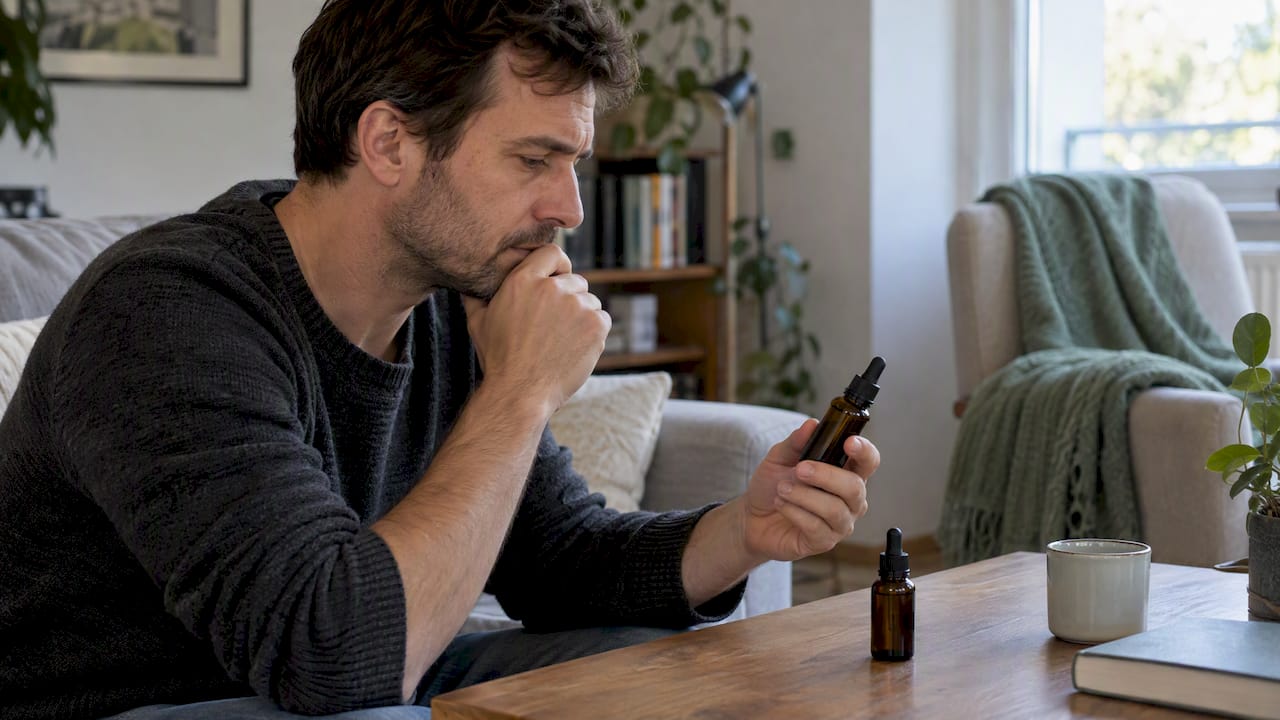
Start with 1 to 3 mg of CBD per puff—about 5 to 15 mg per session, depending on your goal—then gradually increase your dose following the “start low and go slow” rule. Always check the concentration listed on the label and, if possible, the product’s certificate of analysis (COA) before calculating your dose. CBD dosage when vaping is adjusted puff by puff, not by the entire bottle.
In short:
- The actual CBD concentration in an e-liquid can vary by as much as double the amount stated on the label, making it necessary to check the certificate of analysis.
- A beginner should choose an e-liquid with a nicotine strength between 150 and 300 mg per bottle—or about 5 to 10 mg/ml—and start with one or two puffs.
- The device's power and the inhalation technique have a significant impact on the amount of CBD actually absorbed with each puff.
- The conservative titration method recommends starting with 1 to 2 mg per puff, then adjusting in small increments after a period of observation.
- Verifying the independence of the laboratory that issued the certificate of analysis ensures greater reliability of the product's contents, rather than relying solely on the label.
Table of Contents
- Understanding CBD Vape Concentration Units to Calculate Your Dose
- What CBD concentration should you choose based on your profile and goals?
- How Vaping Equipment Affects the Amount of CBD Actually Inhaled
- How can you gradually adjust your CBD dosage when vaping?
- Interactions, at-risk populations, and label reliability
- What to Check on a Certificate of Analysis Before Buying CBD E-Liquid
- What I've learned after researching CBD dosage in vaping
- Buy a CBD e-liquid where you can verify every number
- Sources
- Frequently Asked Questions
Understanding CBD Vape Concentration Units to Calculate Your Dose
A CBD e-liquid label almost always displays three types of information, and confusing them will throw off all your calculations. The total mg indicates the amount of CBD in the entire bottle (for example, 500 mg per 30 ml). The mg/ml specifies the concentration per milliliter, which is the actual strength of the product. The percentage expresses the same thing differently: 1% is equivalent to 10 mg/ml.
To convert a label value to an actual dose, the formula is simple: divide the total mg by the volume in ml to get the mg/ml, then divide that number by the number of puffs typically taken in one session. A 500 mg bottle containing 30 ml yields approximately 16.6 mg/ml. If a cartridge of this e-liquid produces about 150 puffs, each puff delivers roughly 3.3 mg of CBD—a calculation cited in practical vaping guides as a standard method for estimating consumption.
How to estimate the number of puffs per cartridge:
- A 2-ml tank typically lasts for between 150 and 300 puffs, depending on the wattage and the duration of each inhalation.
- A 1-ml pre-filled cartridge often delivers 100 to 200 puffs.
- A long inhalation (direct-to-lung method) uses more e-liquid than a short, cigarette-style puff.
Keep this in mind before you buy: two bottles at the same price may deliver very different amounts of CBD per puff, depending on their volume.
What CBD concentration should you choose based on your profile and goals?
The right CBD dosage for vaping depends less on your weight than on your experience with cannabinoids and what you’re looking for. A complete beginner should never start with a highly concentrated e-liquid, even if the urge to jump right in is understandable.
Guidelines by experience level (for a 30-ml bottle):
- Beginner: 150 to 300 mg per bottle, or about 5 to 10 mg/ml. One or two puffs are enough to start a session.
- Occasional use: 300 to 600 mg per bottle, or about 10 to 20 mg/mL. Two to four puffs per session.
- Standard: 600 to 1,000 mg per bottle, or approximately 20 to 33 mg/mL. Three to six puffs, depending on tolerance.
- Tested: 1,000 to 1,500 mg per vial, or 33 to 50 mg/mL. The amount varies, often exceeding 20 mg per session.
Frequency is just as important as concentration. Beginners should space out their sessions by at least four to six hours during the first week to observe how their bodies react. Regular users can vape two to three times a day without exceeding their minimum effective dose—the amount that produces the desired effect without going overboard.
The purpose also makes a difference. For occasional relaxation during the day, 5 to 10 mg per session is generally sufficient, with the advantage of a rapid and easily adjustable effect. For sleep, practical guides suggest slightly higher doses for evening sessions—around 15 to 25 mg—after first testing your tolerance during the day. For managing chronic pain oranxiety, some users gradually increase their dosage to 20 to 40 mg spread throughout the day, but always after several weeks of careful titration. None of these figures are a prescription: they serve as a starting point, not a guaranteed dose.

How Vaping Equipment Affects the Amount of CBD Actually Inhaled
Two people vaping the same e-liquid may absorb very different amounts of CBD simply because of their devices. The power, coil resistance, and inhalation style all affect the rate at which the liquid turns into vapor.
A low-power pod (around 10 to 15 watts) heats up gently and delivers a smaller dose per puff, which is well-suited for beginners who want to maintain precise control. An adjustable mod set to 40 watts or higher vaporizes much more e-liquid in a single puff, meaning more CBD, even with the same e-liquid. The resistance of the coil (measured in ohms) works in the same way: a lower resistance heats up more intensely and produces denser vapor.
The inhalation style matters, too. The MTL (mouth-to-lung) technique—which is more similar to smoking a traditional cigarette—limits the amount of vapor per puff and makes it easier to control your dosage precisely, an approach recommended by several specialized vaping guides. The DL (direct-to-lung) technique, used with high-powered mods, draws in much more vapor in a single puff and is not well-suited for someone who is just starting to adjust their dosage.
Key practical points to remember:
- Start with a device set to a low power level to test your tolerance before increasing the intensity.
- Focus on the MTL method during the first few weeks: it makes each puff more predictable.
- A high resistance (above 1 ohm) generally produces less vapor per puff than a low resistance.
- A moderate vaporization temperature, around 160 to 180 °C, better preserves the terpenes in the e-liquid and prevents degradation that would distort your perception of the dose.
Pro tip: If you switch devices, don’t assume that your previous dosage is still valid. Set the power to the lowest setting and count your puffs as if you were trying the product for the first time.
How can you gradually adjust your CBD dosage when vaping?
Finding your minimum effective dose requires a method, not random trial and error. Here is the protocol that most clinical guidelines follow for individual CBD titration, in the absence of a validated universal dose.
- Start with a low dose: 1 to 2 mg per puff, or one to two puffs of a low-nicotine e-liquid (around 10 mg/ml).
- Wait 15 to 30 minutes after those first few puffs before taking another one. Inhaled CBD takes effect quickly—usually within a few minutes—so this waiting period is long enough to gauge the effect.
- Write down how you feel in a notebook or app: the intensity of the relaxation, whether you feel drowsy, or if you don't notice any effect.
- Adjust at the next session: if you don't feel anything after several attempts at the same dose, increase by one puff, not ten.
- Repeat the test over several days—never all at once—to distinguish a genuine effect from a simple variation in fatigue or stress on that particular day.
A concrete example: Someone who starts at 3 mg per session and sees no noticeable effect after three days can increase the dose to 6 mg, then wait another week before increasing it again. This gradual increase prevents jumping directly to doses of 20 or 30 mg, which would mask the actual desired effect.
Two signs warrant special attention during this phase. Increasing tolerance—where the same dose produces an increasingly weaker effect—suggests spacing out sessions rather than systematically increasing the dosage. Side effects such as severe dry mouth, excessive drowsiness, or headaches should prompt a return to the previous dose—the one that was effective without causing discomfort. The clinical literature emphasizes precisely this cautious, individualized titration rather than a fixed dose applicable to everyone.

Interactions, at-risk populations, and label reliability
Vaping CBD allows for rapid absorption through the lungs, but this speed does not mean you should let your guard down. Data on the long-term safety of vaping cannabinoids remains limited, and public health sources recommend informing your doctor if you use it regularly, as noted by Santé sur le Net.
Situations that require increased vigilance:
- Taking medications metabolized by the liver (anticoagulants, certain antiepileptic drugs), as CBD may affect their effectiveness.
- Pregnancy and breastfeeding: periods during which no dose is considered safe.
- Chronic liver or kidney diseases, which alter the way the body metabolizes cannabinoids.
- Children and adolescents, for whom CBD vaping is simply not appropriate.
Laboratory analyses have revealed significant discrepancies between the labeled concentration and the actual concentration of certain CBD e-liquids, with products advertised as containing 3.3 mg/ml but actually containing between 6.5 and 7.6 mg/ml, according to a study published on PubMed.
This discrepancy—which is twice as large as stated—explains why a dosage calculated based solely on the label can be misleading. Improper storage or a degraded liquid can also cause the actual concentration to fall below the value listed on the bottle. The only reliable safeguard is to choose suppliers who publish recent and verifiable certificates of analysis, and to consult a healthcare professional before any regular use, especially if you are taking medication. To better understand the possible side effects of CBD, a cautious approach remains the best safeguard.
What to Check on a Certificate of Analysis Before Buying CBD E-Liquid
A certificate of analysis (COA) is the only document that truly confirms what a bottle contains, regardless of what the label states. It must come from a third-party laboratory that is independent of the manufacturer in order to be considered valid.
Items to check systematically on a COA:
- The actual CBD content, compared to the amount listed on the packaging.
- The THC content, which must remain within the applicable legal limits.
- The absence of residual solvents used during extraction.
- The absence of heavy metals (notably lead, mercury, and arsenic).
- The absence of microbiological contamination (mold, bacteria).
- The date of the test—a COA that is several years old is no longer of much value.
The importance of this document is not merely theoretical. The discrepancies already observed between label claims and actual content show that a product without independent testing exposes users to an unpredictable dose—one that may be too low to be effective or too high for a beginner. A supplier that publishes its COAs without being asked sends a clear signal of reliability.
Some stores emphasize transparency in their product listings, featuring lab tests designed to ensure the compliance and safety of each item, whether it’s cartridges, oils, or extracts. Before making a purchase, take the time to review these documents, and if you have any questions, contact customer service for more information about a specific batch.
What I've learned after researching CBD dosage in vaping
The “start low and go slow” rule isn’t just a cautious slogan with no practical implications. It’s the only method that takes into account the fact that there is no one-size-fits-all CBD dose, and that each person’s weight, metabolism, and goals influence their individual response. Starting with 1 to 3 mg per puff, waiting, taking notes, and then adjusting in small increments is more reliable than looking for a magic number in an article.
What strikes me most is the gap between the trust we place in a label and its actual reliability. A bottle that claims a certain concentration may actually contain nearly twice that amount, and only a recent certificate of analysis can resolve this uncertainty. If you’re already taking medication, the best course of action is to talk to your doctor before making any changes.
— Steven
Buy a CBD e-liquid where you can verify every number
Once you have your dosing method in mind, the next logical question is: where can you find an e-liquid whose actual concentration matches what’s listed on the label? Pure-extract-cbd offers a selection of CBD flowers, resins, oils, and extracts derived from organic hemp, with each product accompanied by independent lab test results that can be viewed before purchase.

This transparency makes a real difference in how you calculate your dose: instead of guessing at a possible discrepancy between the label and the contents, you’re working with a verified figure. The store often offers fast shipping in discreet packaging, and customer service is available to answer questions about a specific batch or product. Browse the full range of CBD products available at Pure-extract-cbd and always check the certificate of analysis displayed on each product page before placing an order.
Sources
- PubMed — Study on the Variability of Concentrations in E-Liquids
- Medical News Today — CBD Vaping: Pens and Oils for Pain, Depression, and Anxiety
- Weedmaps — How much CBD should I vape?
This article is intended to provide general information and is not a substitute for the advice of a qualified healthcare professional. Consult a qualified healthcare professional about your specific situation before taking any action based on this content.
Frequently Asked Questions
How many mg of CBD are in one puff of vape?
It depends on the bottle, but one puff typically delivers between 1 and 3.3 mg of CBD for a standard e-liquid—a figure obtained by dividing the total mg in the bottle by the estimated number of puffs.
Does CBD in vapes interact with medications?
Yes, CBD can alter the effects of certain medications metabolized by the liver, such as blood thinners. You should consult a healthcare professional before using it regularly.
What should you do if you experience side effects after vaping CBD?
Go back to the previous dose that did not cause any problems, and space out your sessions. If symptoms persist or worsen, see a doctor.
How much do CBD products cost at Pure-extract-cbd?
They can be viewed directly on the Pure-extract-cbd online store.
Can we trust all CBD e-liquid labels?
No, analyses have shown significant discrepancies between the stated concentration and the actual concentration. Always check the certificate of analysis provided by the manufacturer before estimating your dose.