

The real danger almost never lies at the point of departure: it lies at the destination or during a layover, in a country where local laws simply do not recognize French tolerance. Opt for oils, capsules, or cosmetics rather than flowers, and always keep the original packaging within reach.
In short:
- Verify that the product contains less than 0.3% THC and that it falls into one of the authorized categories, such as oil or capsules.
- Always keep the certificate of analysis—dated and corresponding to the same shipment—along with the purchase invoice and the original packaging to facilitate verification.
- Customs and police inspections while traveling are based primarily on visual inspection, smell, and documentation, but products without a certificate are often seized.
- The legal framework abroad is different; some countries enforce a zero-tolerance policy or very strict laws, particularly when transiting through an airport or certain hubs.
- Avoid bringing CBD to destinations or during layovers where there is a strict zero-tolerance policy, or where local laws have recently changed; instead, buy it locally or travel with a translated prescription.
Table of Contents
- Traveling with CBD from France: What the Law Says
- What items can you bring on a plane, and how should you pack them?
- What are the risks of traveling with CBD abroad?
- What documents should you present during an inspection?
- How does an audit work, and what should you do if your property is seized?
- Can CBD cause you to fail a saliva test while driving?
- How can you make sure a CBD product is safe before traveling?
- Is CBD subject to the same regulations on trains, in cars, or on boats?
- Is it sometimes better to leave your CBD at home?
- Packing Your CBD for Travel with Pure-extract-cbd
- Sources
Traveling with CBD from France: What the Law Says
French law permits the sale and transport of CBD-based products with a THC content of less than 0.3 percent, a threshold established by official regulations available on Légifrance. This limit applies to the finished product, not to the raw plant: a compliant oil, capsule, or cosmetic product can circulate freely within the country, whereas raw flowers remain in a gray area that authorities often view with suspicion, even if their product specifications comply with the legal threshold.
This policy covers your trip starting in France, but it ends at the border. Specifically, before you pack your suitcase, check these three things:
- The THC content listed on the label is less than 0.3%.
- The product falls into an authorized category (oil, capsule, cosmetic) rather than being a flower or resin.
- You have a document proving this compliance, separate from the packaging itself.
These French regulations do not apply once the plane has landed elsewhere. That's when the real work of preparation begins.
What items can you bring on a plane, and how should you pack them?
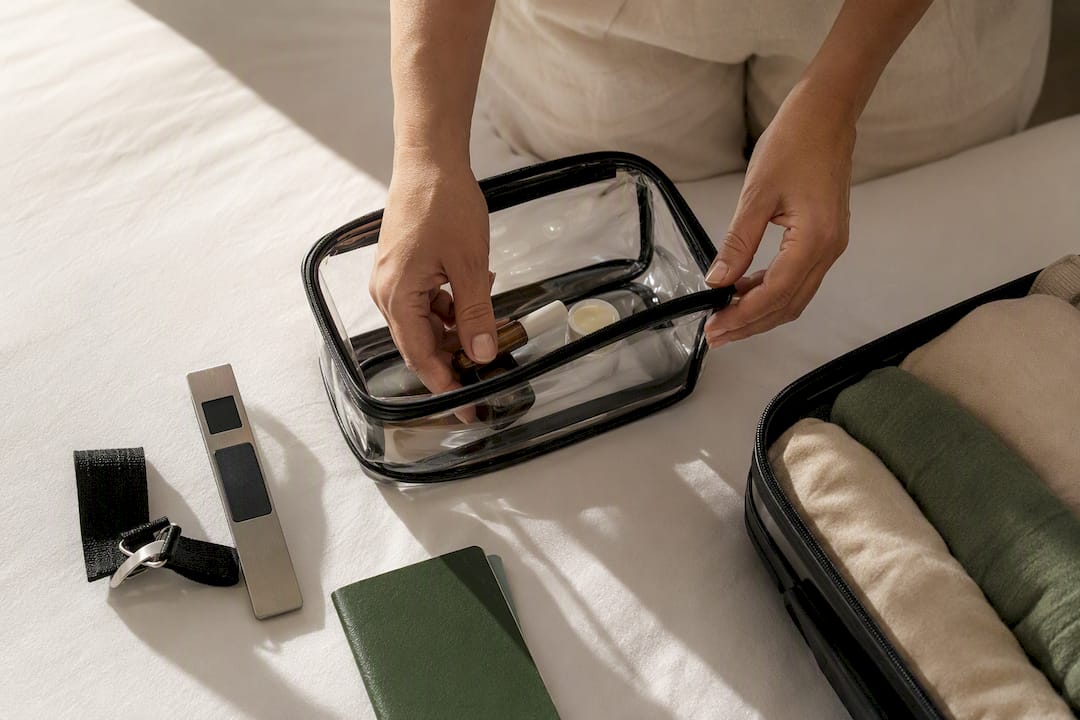
For flights departing from France, CBD oils are subject to the general rule for carry-on liquids: each bottle must be less than 100 ml and stored in a clear bag with your other liquids. Capsules and solid cosmetics are exempt from this restriction and pass through security checks more easily. Flowers and resins, on the other hand, pose a different problem: they look and smell identical to illegal cannabis, and sniffer dogs detect terpenes—not THC—which almost always triggers a thorough search.
Here are the steps to follow to minimize friction during the inspection:
- Place the certificate of analysis (COA) in an easily accessible pocket, not at the bottom of your checked luggage.
- Keep the product in its original packaging with the label visible.
- If an officer questions you, present the COA on your own initiative rather than waiting to be asked for it.
Pro tip: Bring a paper copy of the COA in addition to the digital version. A dead or locked phone at the wrong moment can complicate a verification that should have taken just thirty seconds.
What are the risks of traveling with CBD abroad?
The law that matters is never the one in your country of origin, but rather the law of the country where you land—and sometimes even the law of a country you’re just passing through without ever stepping outside. CBD that is perfectly legal in France can become a criminal offense elsewhere, because each country applies its own definition of cannabis and its derivatives.
Some jurisdictions enforce a zero-tolerance policy without distinguishing between CBD and traditional cannabis: the United Arab Emirates and Singapore are among the destinations where mere possession can result in severe criminal penalties, which are sometimes disproportionate to the actual risk posed by the product. Moreover, the regulatory landscape is changing faster than one might think. Thailand, long considered a permissive destination, reversed its policy in 2025. This change turned an entire industry upside down overnight.
Before booking, always make sure to:
- The legal status of CBD in the destination country, as reported in the INCB database.
- The status of each stopover—even if it's only a few hours—not just the final destination.
- Travel advisories published by the Department of State to help travelers identify recent alerts.
An airport hub known for its strict security measures can, on its own, nullify all the legal certainty originally established in France.
What documents should you present during an inspection?
The certificate of analysis (COA) remains the most effective form of protection during an inspection, provided it is dated and clearly linked to the batch you are carrying. A valid COA lists the exact THC content, the name of the laboratory that performed the analysis, the test date, and the lot number corresponding to the product in your luggage.
Also keep the purchase receipt and the original packaging together, rather than scattered throughout your suitcase. For certain destinations outside the European Union, a certified translation of the Certificate of Origin (COA) greatly facilitates communication with an official who does not read French; the forms and procedures available on service-public.fr provide an overview of the administrative templates you can adapt to your needs.
- Certificate of Analysis (COA) dated, including THC content, laboratory, and lot number.
- Purchase receipt kept with the original packaging.
- Translation of the COA for destinations outside the French-speaking or English-speaking regions.
How does an audit work, and what should you do if your property is seized?
Customs authorities do not have the means to instantly test a product’s THC content on the spot. Inspection therefore relies on visual examination, smell, and, in cases of doubt, the seizure of the product for laboratory analysis—a process that can take several weeks.
- Stay calm and present the COA and the invoice immediately, without waiting to be asked for them.
- If the product is selected, request the written procedure, including the case number or reference number.
- Contact the French embassy or consulate if you encounter difficulties while abroad, usingthe official directory of the Ministry of Foreign Affairs.
The lack of a COA is the most common reason for confiscation, far ahead of the nature of the product itself.
Can CBD cause you to fail a saliva test while driving?
Unlike blood alcohol tests, there is no minimum tolerance threshold for a positive THC saliva test in France. Even legal consumption of CBD can leave detectable traces, and drug tests for drivers do not distinguish between recreational cannabis use and a fully compliant CBD product.
- Avoid driving for several hours after taking a CBD product, even in small doses.
- The detection time varies depending on the usage pattern and frequency of use.
- Check out our article on CBD and positive saliva tests to understand the actual timeframes.
This risk exists both in France and abroad, where tolerance thresholds may be even stricter.
How can you make sure a CBD product is safe before traveling?
A reliable COA includes a laboratory accreditation—ideally in accordance with ISO 17025—and precisely matches the lot number to the product you are transporting. A recent test date is also important: a certificate that is two years old for a product purchased yesterday has no probative value in the event of an inspection.
When traveling outside the European Union, a broad-spectrum product or a CBD isolate helps avoid confusion, as it eliminates or significantly reduces the presence of other cannabinoids that could complicate an analysis. Also, be sure to keep a complete record of traceability: invoice, detailed product description, and the seller’s return policy in case of a dispute.
- Dated certificate of analysis, with the laboratory's accreditation listed.
- Exact match between the lot number and the product being transported.
- Whether to choose a broad-spectrum vaccine or a monovalent vaccine when traveling outside the EU.
- Invoice and product sheet retained as proof of traceability.
Pro tip: Before making a purchase, always ask the seller for the COA for the specific lot you’ll be receiving—not just a generic example posted on their website. This ensures that the document will actually match what you’re shipping.
Is CBD subject to the same regulations on trains, in cars, or on boats?
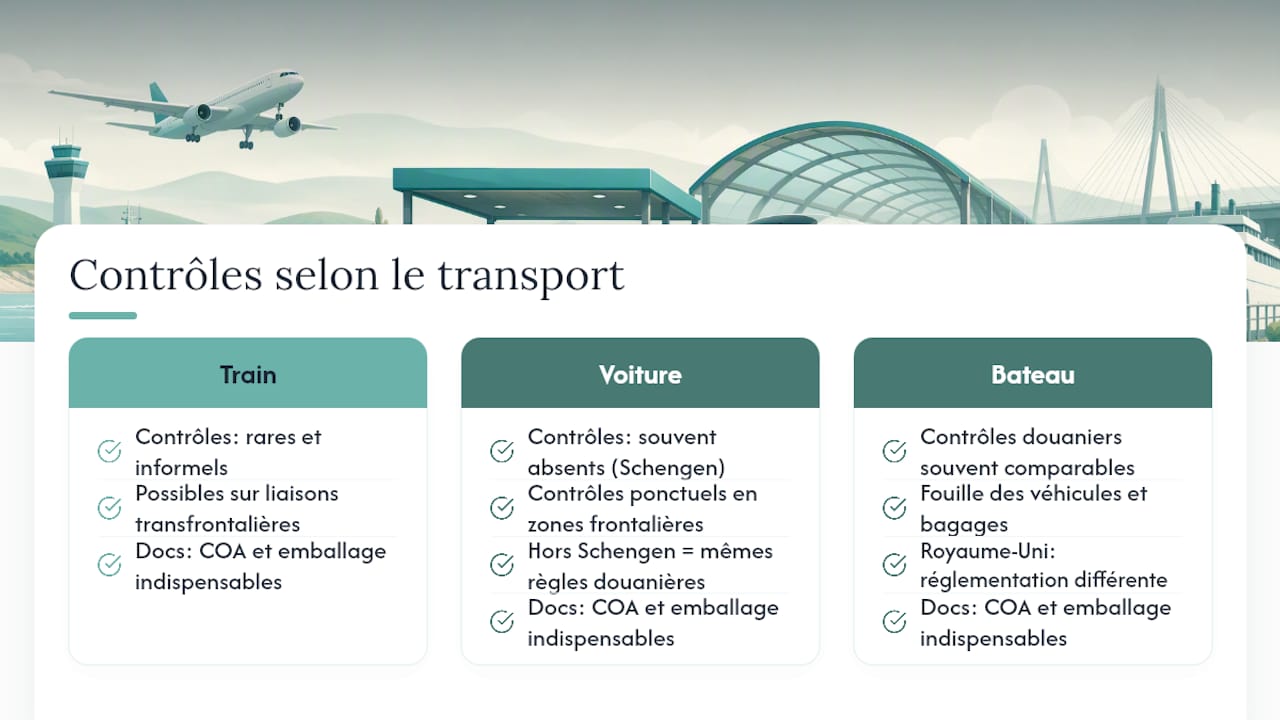
Trains and cars are largely exempt from airport security checks, but not from the law. On the French rail network, checks remain rare and informal, lacking the systematic rigor of an airport, but a police check is always possible, particularly on cross-border routes such as those to Belgium, Spain, or Italy. The same caution is therefore required: keep your COA within reach, and ensure the original packaging is intact.
When traveling by car, crossing an internal border within the European Union generally does not involve systematic checks thanks to the Schengen Agreements, but random checks do occur, particularly near monitored border areas. Crossing into a non-Schengen country, on the other hand, is subject to the same customs rules as at an airport, with the same risk of having goods seized if you lack the proper documentation.
Ferry routes, particularly those to the United Kingdom or certain Mediterranean islands, often enforce customs checks comparable to those at airports, including searches of vehicles and luggage. The United Kingdom, in particular, has CBD regulations that differ from those of the European Union, which justifies a preliminary check even for a crossing that seems routine.
In any case, the principle remains the same: the more the mode of transportation involves a controlled border crossing, the more important the documentation becomes.
Is it sometimes better to leave your CBD at home?
Some itineraries aren’t worth the risk: a layover at a zero-tolerance hub, a destination like the United Arab Emirates or Singapore, or a country where the law has just changed without notice. In these cases, buying locally at your destination or traveling with a translated medical prescription is safer than bringing a product purchased in France. The golden rule can be summed up in one sentence: if you’re unsure about local laws, don’t take the risk. Your personal safety comes before the convenience of bringing your usual product with you.
— Steven
Packing Your CBD for Travel with Pure-extract-cbd
It is recommended that you choose products that have been tested by an independent laboratory, come with a certificate of analysis, and have clear labeling on each item, rather than making a last-minute purchase at an airport or an unfamiliar pharmacy abroad.

When traveling, CBD oils in bottles that comply with the 100-ml rule, capsules, and cosmetics remain the most suitable options: they’re discreet, odorless, and easy to account for with their documentation. Flowers like Northern Light small buds or resins like Strawberry Cake FTS are still perfect for home use, but it’s best to leave them in a drawer before a flight. Before your next trip, check out the full range of Pure-extract-cbd products to choose a travel-friendly format that comes with its certificate of analysis, and avoid any unpleasant surprises at security.
This article is intended to provide general information and is not a substitute for the advice of a qualified attorney. Consult a qualified legal professional regarding your specific case before taking any action based on this content.
Sources
- Légifrance — Texts on the Status of the CBD
- Ministry of Europe and Foreign Affairs — Directory of Embassies and Consulates



