

Shipping CBD products within Europe is legal under strict conditions. Each European Union member state enforces its own customs regulations, even though the harmonized threshold for tetrahydrocannabinol (THC) is set at 0.3% at the European level. Compliance with this threshold alone is not sufficient: you must present a purchase invoice, a certificate of analysis (COA), and the original, sealed packaging at every inspection. Some countries, such as the Netherlands and the United Kingdom, enforce even stricter thresholds, making the question “CBD and European customs: can it be shipped everywhere?” more complex than it seems.
What are the customs regulations for shipping CBD in Europe?
CBD regulations in Europe are based on a fundamental principle: the free movement of goods within the European Union applies to legal CBD, but each member state retains its criminal jurisdiction. This means that a product that complies with French regulations may be seized at the border of another country if that country’s national regulations are more restrictive.

The 0.3% THC threshold is the benchmark standard in the EU. France, for example, allows the transport of CBD that complies with this threshold, provided that the destination country also accepts these products.
Not all products are treated the same way by customs:
- Generally accepted products: CBD oils, cosmetics, capsules, creams.
- High-risk products: CBD flowers and resins, which look similar to recreational cannabis.
- Products in a regulatory gray area: CBD-based dietary supplements subject to Novel Food regulations.
The Novel Food Regulation creates significant legal uncertainty for CBD products intended for ingestion. As of 2026, no product has yet received official authorization at the European level, which undermines their status at customs.
Pro tip: Opt for oils and cosmetics when shipping across borders. These items are more easily identifiable as legal products and are less likely to raise suspicion during inspections.
How to Ensure a Smooth Customs Clearance Process for CBD?
A successful customs clearance depends above all on the quality of the documentation. Without these documents, the risk of confiscation is nearly 100%. Here are the steps to follow to put together a solid set of documents.
-
Please attach the original purchase invoice. This document proves the product’s legal commercial origin and its purchase price. A handwritten or incomplete invoice is not sufficient.
-
Provide the Certificate of Analysis (COA). The COA must explicitly state the measured THC level, which must be below the legal threshold of the destination country. Analyses conducted by ISO/IEC 17025-certified laboratories provide the necessary credibility for cross-border inspections.
-
Keep the original packaging sealed. A product that has been unpacked or repackaged will immediately arouse suspicion among customs officials. The labeling must be clear, legible, and list the ingredients.
-
Check the regulations of the destination country before shipping. Rules vary considerably from country to country. Checking in advance helps prevent avoidable seizures.
-
Adjust the quantities you are carrying. Quantities that are clearly intended for commercial purposes and lack a valid business justification increase the risk of a thorough inspection. For personal use, reasonable quantities are generally more readily accepted.
Pro tip: Print multiple copies of the COA and the invoice. Keep one set inside the package and another set readily available separately. In the event of an inspection, you can present the documents immediately without opening the package.
What are the major differences among European countries when it comes to shipping CBD?
The diversity of national regulations is the main obstacle to smooth CBD shipping in Europe. The Schengen Area eliminates physical borders, but customs regulations continue to be enforced at the discretion of each country, leading to significant discrepancies.
Comparison of THC Thresholds by Country
| Country | Permitted THC Threshold | Special Features |
|---|---|---|
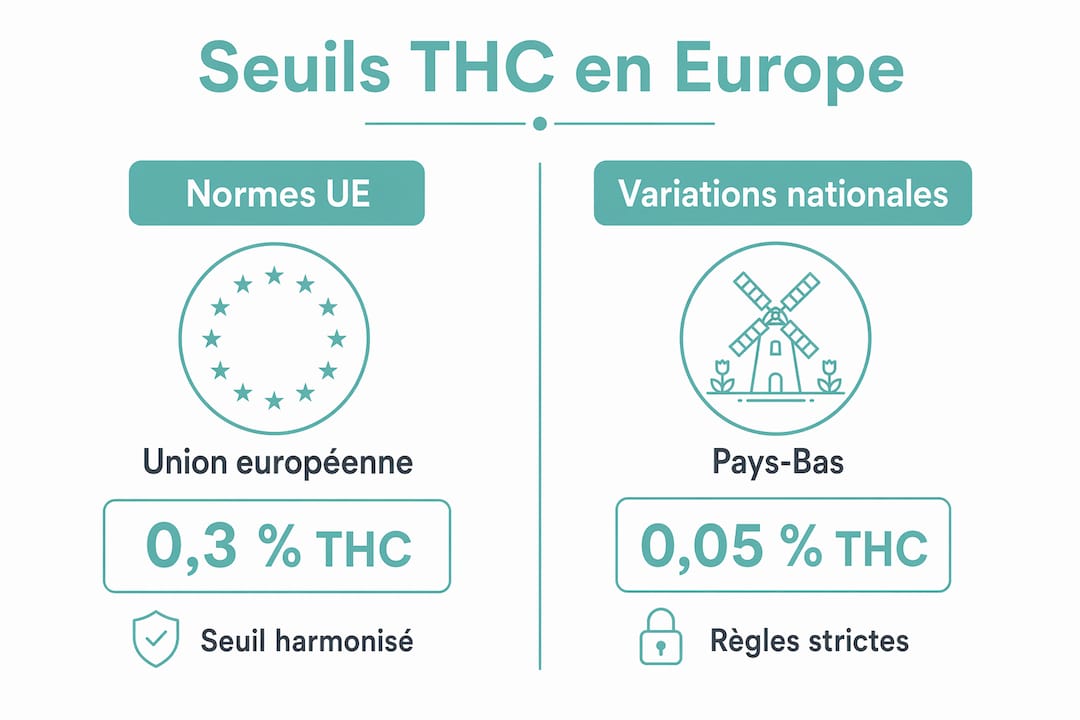
| European Union (standard) | 0,3 % | Harmonized threshold, applied differently by state |
| France | 0,3 % | Flowers Permitted for Sale, Variable Inspections |
| United Kingdom | 0,2 % | Post-Brexit, FSA-approved suppliers are required |
| Netherlands | 0,05 % | Threshold six times lower than the EU standard |
| Switzerland | 1 % | Among the most permissive in Europe |
The United Kingdom enforces a THC threshold of 0.2% and requires that imports come from suppliers approved by the Food Standards Agency (FSA). Since Brexit, U.K. regulations have been completely independent of the European framework.
The Netherlands has the strictest regulations in the EU. Its maximum limit of 0.05% is one-sixth of the European standard. A product that is fully compliant in France becomes illegal in the Netherlands without a specific reformulation.
Switzerland, which is not part of the EU, allows CBD with a THC content of less than 1%. Inspections of personal quantities of up to 10 grams or 3 bottles are rare there. It is one of the most favorable environments for transporting CBD in Europe.
Additional considerations by country:
- CBD flowers: banned or strictly regulated in several member states, even when the THC content is within legal limits.
- Resins: often mistaken for hashish by customs officials, even when their composition is legal.
- Edible products: subject to national food regulations in addition to CBD regulations.
To avoid countries that are prohibited or subject to strict restrictions, always check the official regulations of the destination country before shipping any items. Embassies and national health authorities publish up-to-date information.
How to Legally Ship CBD in Europe: Best Practices and Mistakes to Avoid
Shipping CBD legally in Europe requires meticulous preparation at every stage. Even a fully compliant product may be seized by customs officials as a precautionary measure, with no guarantee of prompt release, which poses a real legal and financial risk.
The most common mistakes to avoid:
- Shipping flowers without complete documentation. The flowers are visually indistinguishable from recreational cannabis. They trigger extensive inspections and frequent seizures, even with a valid COA.
- Failing to check the destination country. Every country has its own rules. Shipping a product containing 0.2% THC to the Netherlands is illegal, even if that product is legal in France.
- Using a carrier that does not have a clear CBD policy. E-commerce platforms and carriers may enforce stricter policies than official regulations, leading to additional delays or seizures.
- Omit the term “CBD” from the label. Ambiguous labeling raises suspicions during inspections.
In the event of seizure, European case law offers theoretical protection. The Court of Justice of the European Union’s Kanavape ruling protects the free movement of legal CBD products, but legal challenges remain time-consuming and costly. Proactive documentation remains the best strategy.
Pro tip: Choose a carrier that specializes in regulated products or that explicitly accepts CBD in its terms and conditions. Keep a copy of these terms with your shipping documentation.
For professionals wishing to distribute CBD, the requirements go even further. Wholesale distribution of CBD requires a business registration, notification to the ARS, and compliance with DGCCRF regulations for dietary supplements.
Key Points
Shipping CBD to Europe is legal only if the product complies with the THC limit of the destination country and if the documentation is complete and certified.
| Point | Details |
|---|---|
| THC threshold varies by country | The EU standard is 0.3%, but the Netherlands requires 0.05% and the United Kingdom 0.2%. |
| Required Documents | A purchase invoice, an ISO/IEC 17025-certified COA, and the original, sealed packaging are required. |
| High-Risk Flowers | CBD flowers trigger stricter inspections because they resemble recreational cannabis. |
| Carriers and Internal Policies | Some carriers refuse to ship CBD, even if it is legal; be sure to check their policies before shipping. |
| Limited Remedies in the Event of Seizure | The Kanavape ruling provides theoretical protection, but restitution proceedings are lengthy and costly. |
What Real-World Experience Reveals About Shipping CBD in Europe
The complexity of shipping CBD within Europe stems not from the regulations themselves, but from the gap between the written law and its practical application. I have seen perfectly documented packages held up for weeks due to a local interpretation of the rules. The Schengen Area gives a false impression of uniformity: in reality, each customs officer applies the rules of their own country, sometimes with a margin for personal discretion.
What struck me was how often compliant products are seized as a precautionary measure. Agents are not always trained in the specifics of legal CBD. A Certificate of Analysis (COA) in English without a translation, or plain packaging without an explicit mention of the THC content, is sometimes enough to trigger a seizure.
My long-term recommendation: Keep an eye on developments in the Novel Food framework at the European level. As soon as a CBD product receives official authorization, the customs status of the entire category will be strengthened. In the meantime, careful documentation and choosing less suspicious formats, such as oils, remain the best protection.
— Steven
Pure-extract-cbd: Compliant Products for Worry-Free Shipping
Choosing a supplier whose products are tested and certified makes all the difference when it comes to a smooth shipment.
Pure-extract-cbd offers a range of CBD flowers and oils made from organic hemp, all accompanied by detailed certificates of analysis. Each product has a verified THC content that complies with European standards. The Northern Light small buds and H4CBD oils are examples of products that come with full traceability, ready to be presented to customs. With Pure-extract-cbd, compliance isn’t an option—it’s the foundation of every product we sell.
Frequently Asked Questions
Is it legal to ship CBD throughout Europe?
No, not everywhere. The legality of shipping CBD depends on the THC threshold and the specific regulations of the destination country, which vary significantly from state to state.
What documents are required to clear customs with CBD?
The original purchase invoice, the certificate of analysis (COA) stating the THC content, and the original, sealed packaging are the three documents required for any customs inspection.
Are CBD flowers allowed to be shipped within Europe?
CBD flowers are legal in some countries, but they remain the most strictly regulated products at customs because they visually resemble recreational cannabis. Shipping them carries a high risk of seizure.
Which European country has the strictest rules regarding CBD?
The Netherlands has the lowest THC limit in Europe, set at 0.05 percent—six times lower than the European standard of 0.3 percent. The United Kingdom also enforces strict post-Brexit rules with a limit of 0.2 percent.
What should you do if a CBD package is seized by customs?
European case law, particularly the Kanavape ruling, protects the free movement of legal CBD products. However, legal proceedings are lengthy and costly. The best approach is to prevent seizure by providing complete and certified documentation before shipping.



