
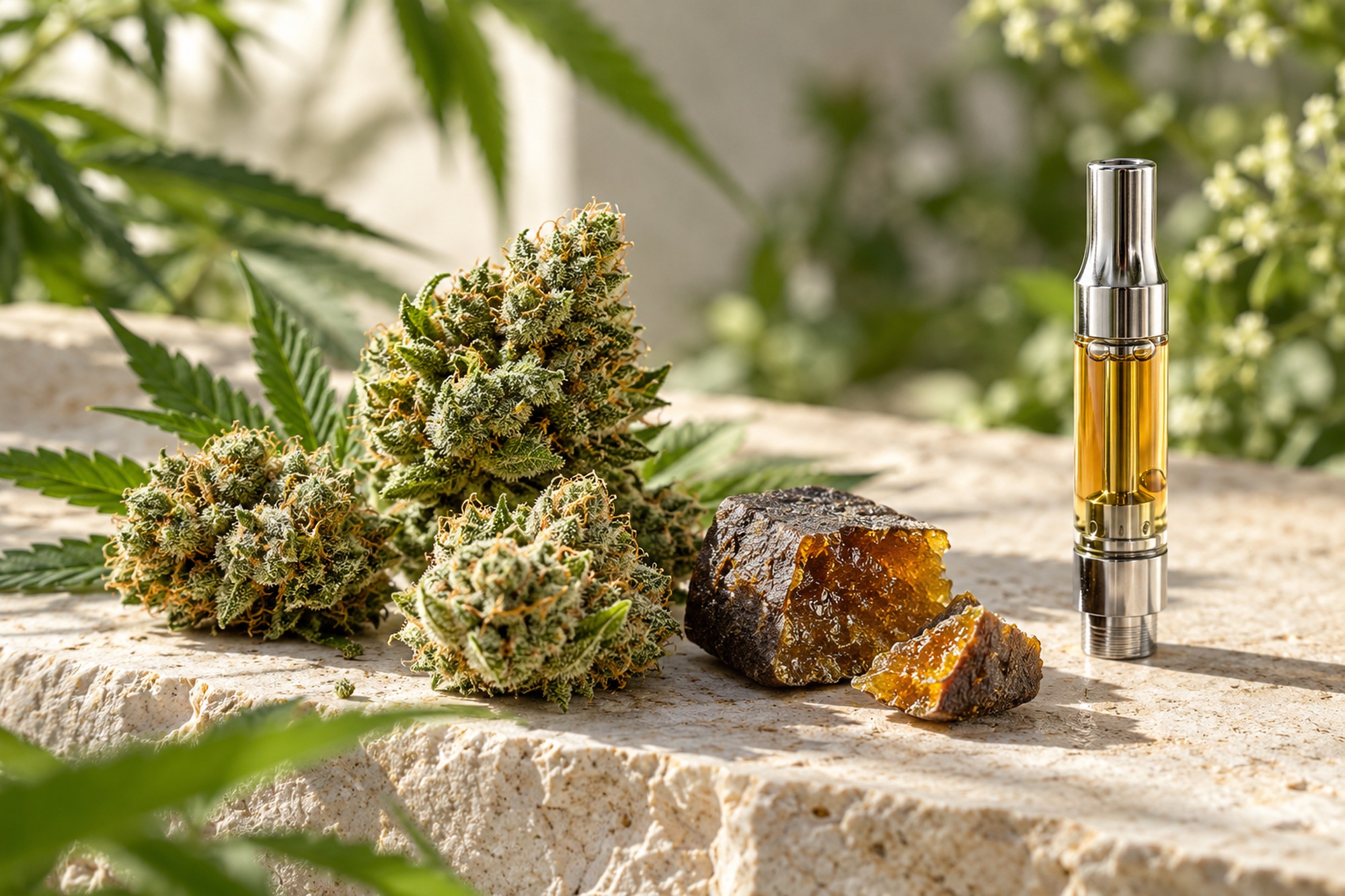
CBD as a molecule: Behind this search often lies a very practical question. What can you actually find in a CBD shop specializing in cannabinoids, and what sets a standard product apart from one marketed as potent? Between CBD flowers, resins, THCA, vapes, and new formulations, the possibilities are multiplying. To make a choice, you need to understand both the composition and the format.
Market terminology can group different products under the same term. A product high in cannabidiol, an enriched flower, and a cartridge containing another cannabinoid may all appear in a search for a potent CBD molecule. While their commercial presentation is similar, their characteristics are distinct.
On Pure Extract CBD, you can explore a variety of product categories, from CBD flowers and resins to product lines dedicated to THCA, THV-N10, or 10-OH-HHC. This guide provides the information you need to navigate these categories: understanding the compounds, interpreting the percentages, comparing delivery methods, and identifying useful information before making your choice.
Molécule CBD Shop: A store specializing in cannabinoids
The term “CBD shop” generally refers to a store that bases part of its product lineup on cannabinoids. There, you can search for a specific substance, a product category, or a particular formulation, and then find that selection in various formats.
This approach complements the standard product-based navigation. You can start with “flowers” or “resins,” but also with “THCA” or “THV-N10.” In the first case, you choose the product type first. In the second, you explore a product line based on its listed composition.
Searches for “CBD molecule” therefore often reflect a desire to better understand the product’s composition. You may want to know what distinguishes two products that look similar, why their concentrations differ, or how the same product name applies to flower, hash, and vape.
To get started, consider three key pieces of information: the cannabinoid or formula, the concentration, and the format. It’s the combination of these that defines the product. This guide will help you browse the Pure Extract CBD shop with more specific criteria and find the categories that match your search.
CBD Molecule: What Is Cannabidiol?
CBD is short for cannabidiol, a cannabinoid found in cannabis. It has a specific chemical structure. In its report on cannabidiol, the World Health Organization distinguishes its profile from that of THC and finds no evidence in the human data reviewed of effects indicating a potential for abuse or dependence with CBD.
Pure CBD does not cause the intoxication typically associated with THC. This does not mean that every product sold in a CBD shop has the same composition or profile. A flower contains plant material; an extract or cartridge may contain several ingredients. The finished product must therefore be considered as a whole.
Research on the CBD molecule benefits from this simple distinction: cannabidiol is a substance, whereas a commercial product is a product. To learn more about this distinction, you can consult the WHO report on CBD.
Potent CBD molecule: How potent is it, exactly?
"Potency" can refer to several different criteria. In a product description, it may refer to a high concentration, another cannabinoid, a concentrated formulation, or a user's reported experience. It can also describe very distinctive flavors. You must identify the specific criterion before making a comparison.
Concentration: the amount present in the product
A percentage describes a proportion. In a solid substance, 20% by mass corresponds to 200 milligrams of the compound per gram of material. At 40%, this theoretical quantity becomes 400 milligrams per gram. This calculation remains valid as long as both results are based on the same unit.
The concentration provides information about the content. It is not a universal measure of effectiveness. So, when looking for a potent CBD compound, start by checking what substance the number refers to and exactly what the laboratory or manufacturer is measuring.
The Molecule: The Nature of the Compound
Two products with a 20% concentration may contain different substances. The same percentage does not automatically mean they have the same properties. The CBD content and the THCA content should be considered as two separate pieces of information.
When it comes to the CBD molecule, this distinction is fundamental: each cannabinoid has its own identity. Its concentration cannot be converted into a cannabidiol equivalent based on a simple percentage ratio.
The experience: it varies
A review describes what someone reports in a given context. It can help you evaluate a store’s presentation, aromas, or service. It does not predict your experience exactly and is not a substitute for product information.
When comparing products, focus on measurable information: ingredients, percentage, net quantity, and lot number. You can then factor in your preferences for format and flavors when making your selection.
CBD, CBG, CBN, and THCA: A Guide to Understanding These Compounds
There are many acronyms, but they become easier to understand once you distinguish between the name of the substance and the name of the product line. The following table will help you organize your search for CBD molecules.
| Designation | Main Landmark | Information to Review |
|---|---|---|
| CBD | Cannabidiol. | Its content and the other ingredients in the product. |
| CBG | Cannabigerol, which is distinct from CBD. | The specific CBG content and the associated formulation. |
| CBN | Cannabinol, another cannabinoid. | The complete composition, without making any therapeutic claims. |
| THCA | The acidic precursor form of THC. | The distinct results regarding THCA and THC. |
| THV-N10, FTS, DC10, T9HC | Names commonly found in specialty stores. | The composition specified in the manufacturer's reference and documentation. |
This table serves as a starting point. It helps you identify the terms that appear in the descriptions and know what information to ask for. It does not rank the references according to their presumed intensity.
When it comes to a potent CBD molecule, a useful comparison always involves a specific product. The concentration, ingredients, and carrier should be considered together, rather than treating every label as a general promise.
THCA: Why Is This Cannabinoid Generating So Much Interest?
THCA is an acidic precursor of THC. When heated, it can be converted into THC through decarboxylation. Experimental studies on acidic cannabinoids have examined this conversion. To understand a product containing THCA, it is therefore necessary to distinguish between its initial composition and the possible transformations of the compound.
The presence of the term “THCA” on a product label does not mean it has the same characteristics as CBD. When researching the CBD molecule, keep in mind that this is a different compound, which should be evaluated based on its own composition and compliance information.
Pure Extract CBD offers a THCA category organized into several formats. You can also check out our article explaining what THCA is for further reading. For each product, compare the listed concentrations and available information rather than assuming its percentage is equivalent to the CBD concentration.
THV-N10, FTS, DC10, and T9HC: How Do the Product Lines Compare?
Specialty retailers use product line names and formulations to help you navigate their selections. Terms like THV-N10, FTS, DC10, or T9HC may appear in your searches for CBD shops that sell specific compounds. The comparison becomes more meaningful when you view the description for each product.
On Pure Extract CBD, you can browse the THV-N10 and FTS collections. First, check the product format, then the listed concentration and detailed ingredients. You can then compare products within the same collection based on common criteria.
When searching for a potent CBD molecule, this method helps you avoid comparing numbers that don’t measure the same thing. A concentration may refer to an individual compound, the total amount of cannabinoids, or a proportion of the formulation. The product sheet should help you understand which of these pieces of information is being highlighted.
Other product names found on the market can serve as points of comparison. Always check the specific ingredients of the product you’re researching. This will make your search for CBD molecules more precise, without relying solely on a product line name.
10-OH-HHC and New Cannabinoids: The Importance of Documentation
New cannabinoids have expanded the vocabulary used by specialty stores. Their names may appear in separate categories and in various formats. To examine them, start with the advertised name, then review the information available about the finished product.
The European Union Drug Agency describes a rapidly evolving market for semisynthetic cannabinoids, with information on certain substances still limited. This context explains the importance of distinguishing between published data, product analyses, and commercial claims.
In Pure Extract CBD’s 10-OH-HHC category, review each product page to identify the format and advertised characteristics. A search for the CBD molecule should lead you to this specific information. A numerical potency rating, on the other hand, requires a standardized method and comparable data.
Potent CBD: The Role of the Carrier, the Extract, and the Formulation
The way a product is presented influences how you view it. A flower retains its plant structure; a resin has a refined texture; a cartridge contains a formulation intended for use with a compatible device. These formats may share a name without being identical.
A search for the CBD molecule may also lead you to extracts. In this case, the percentage indicates the stated concentration of the product. To understand the information provided, ask what is being measured, what other components are included, and whether any additional ingredients are listed.
When a product is fortified after harvest or manufacturing, this information helps clarify its final composition. You can then distinguish between the characteristics of the base product and those of the added substances. The product’s appearance and its analytical results serve two complementary purposes.
To compare a potent CBD molecule, start with the finished product. Information about a raw material is interesting, but it doesn't necessarily describe all the steps or all the ingredients in the product you're looking at.
CBD Flowers: Compare Ingredients and Packaging Quality
Flowers allow you to explore hemp through its appearance, form, and the aromatic characteristics of each variety. At a Molécule CBD shop, they may be offered in several categories based on their listed composition.
To begin, identify the product category: CBD flowers or other cannabinoid products. You can then review the concentration, the quantity offered, and the information available about the batch. This initial review gives you a solid foundation before comparing the product’s appearance.
Browse Pure Extract CBD's CBD flowers to discover the products in this category. The photos help you see what they look like, and the product descriptions provide more details about their characteristics.
A large bud or an unusual color may catch your eye, but that doesn’t indicate the concentration. So, when researching CBD products, compare what you see with what’s described and documented. That way, you’ll be able to make a choice that takes both your preferences and the product information into account.
Resins and hash: a concentration that requires careful reading
Resin has a visual and tactile quality that differs from that of the flower. You may encounter materials that are crumbly, pliable, or more compact. The terms used to describe them guide your exploration, while the percentages and composition provide information about the advertised contents.
When comparing two resins, make sure the percentages refer to the same substances. CBD content and total cannabinoid content are not necessarily equivalent. Also check the other ingredients and whether the product has been fortified.
Browse Pure Extract CBD's CBD resins, then open the product pages that interest you. You'll be able to compare descriptions of texture, available sizes, and information about their composition.
Choosing a potent CBD compound in hash form is therefore not simply a matter of selecting the highest number. A useful comparison takes into account the nature of the compound, the percentage, the net quantity, and the available documentation. These criteria allow you to evaluate the product as a whole.
Vapes and cartridges: Understand the difference between volume and concentration
In a cartridge or vape, the tank’s volume is a first point of reference. It does not, on its own, indicate the amount of each cannabinoid. A specification of 1 ml or 2 ml must be considered in conjunction with the composition and the base used to express the concentration.
The percentage can be expressed as a mass measurement; volume is expressed in milliliters. To convert from one to the other, additional information may be needed, particularly regarding the density of the solution. Therefore, avoid automatically converting one milliliter to one gram.
Pure Extract CBD offers a selection of THCA cartridges. For each product, check the compatible device, the listed formulation, and the manufacturer’s instructions. This will help you distinguish between the hardware and the contents.
When conducting CBD research focused on vaping products, a detailed product description is a good place to start. A product’s compact size does not necessarily indicate low potency, and a high concentration does not mean you can ignore the other specifications.
Aromas, terpenes, and potency: criteria that should be considered separately
A citrusy, fruity, earthy, or woody profile can help you choose a specific product. These descriptions give the product its character and make it easier to navigate when multiple sizes or varieties are available.
However, aromatic richness is a different criterion from cannabinoid concentration. A distinctive scent does not allow you to identify the substances present or measure an effect. For your research on the CBD molecule, keep the aromatic and analytical information in two separate columns.
The same applies to claims of synergy. If a product description mentions a combination of ingredients, you can look for data supporting the claimed effect for that specific formulation. Simply combining several ingredients does not, in and of itself, prove therapeutic efficacy or a specific potency.
This allows you to give flavor profiles due consideration in your choice while still maintaining a clear overview of the ingredients. Sensory preferences and measured data enrich your comparison when each is presented for what it contributes.
What is the most potent CBD molecule?
This question comes up often, but the answer depends on the criterion used. Are you comparing cannabidiol content, a substance’s affinity for a receptor, an effect observed in a study, or experiences reported by buyers? These measures do not describe the same reality.
The 2019 study on THCP illustrates this distinction. In particular, it examined binding affinity for the CB1 receptor in the laboratory. The figure often cited—a 33-fold increase in potency—does not indicate that the effect in humans is consistently 33 times greater. An experimental result must always be considered in the context of the method used.
When searching for a potent CBD compound, the most helpful approach is to define what you want to compare. The concentrations of two CBD products can be compared if they use the same units. For different substances, appropriate data is needed before establishing an equivalence.
When searching for a CBD product, you don't have to choose the one with the highest percentage. You can opt for a product with a clear ingredient list, a format that suits your needs, and information that's easy to verify.
How to Read a Certificate of Analysis at a Molecule CBD Shop
An analysis certificate allows you to view the results obtained from a sample. Its usefulness depends, in particular, on the relationship between that sample and the reference being studied. Start by checking the product name, lot number, and date.
Next, review the parameters you’re looking for. A report that measures CBD and THC does not automatically answer questions about all the possible components of a formulation. For a product marketed based on a specific cannabinoid, check to see if that cannabinoid is clearly identified in the results.
Units deserve equal attention. A percentage, a value in milligrams per gram, and a value in milligrams per milliliter should each be interpreted on their own terms. This approach makes your research on CBD molecules more accurate and facilitates comparisons.
A “not detected” result must be interpreted in light of the method’s limits. It indicates that the substance was not detected under the conditions of the analysis. It does not necessarily mean that the substance is completely absent. The limits of detection and quantification specify the scope of the result.
Finally, a certificate describes the parameters that were analyzed. It does not replace a review of all marketing regulations. Measured composition and regulatory compliance are two complementary pieces of information you can look for before making your choice.
CBD Molecule: Regulatory Considerations to Check Based on Your Country
A store may offer a catalog to an international customer base. When placing an order, the applicable rules must be reviewed based on the product and the destination country. A status in one country does not constitute uniform authorization throughout Europe.
In France, the ANSM has classified H4-CBD, H2-CBD, and THCP as controlled substances. Its June 2024 update also includes an exemption for THCAs, subject to a condition regarding THC content that complies with the threshold set forth in the applicable decree. This clarification must be read in conjunction with its condition; it does not automatically authorize all products high in THCA.
You can find this information in the ANSM’s official statement on cannabinoids. For a recent formulation, verification requires identifying the components, not just looking up the brand name.
As part of your experience at the CBD Shop Molécule, this information also covers shipping and delivery terms. Review the details specific to your order and check for any applicable restrictions before selecting an item.
Compare the price of a potent CBD compound
Price becomes a useful comparison tool when products are comparable. For flowers or resin, compare the net quantities and prices per gram. For vape products, check the contents and the equipment included. A cartridge alone and a complete device are not the same offer.
Next, add the product’s composition to your comparison. A CBD product and a formulation containing other cannabinoids have different characteristics. You cannot determine the price based solely on their appearance or the listed concentration.
Your search for CBD molecules can thus be organized around a few criteria: product, quantity, ingredients, concentration, and available documentation. You’ll be able to review the options using a consistent framework and make a choice based on your budget without losing sight of their unique characteristics.
Powerful Products: Essential Precautions
The ingredients also matter for your safety.The ANSM and ANSES have issued warnings about cases of poisoning linked to products marketed as CBD but containing other substances or non-compliant levels of THC. You should therefore cross-check the label with reliable information about the product.
CBD may interact with certain medications. If you are taking any medications, consult a healthcare professional. If you experience any unexpected side effects, stop using the product and seek medical advice. If you lose consciousness or feel unwell, call emergency services immediately.
Do not drive after use. Do not operate machinery. Products containing cannabinoids must be kept out of the reach of children. Avoid using them while pregnant or breastfeeding. They are not a substitute for medical treatment.
FAQ: CBD Shop "Molécule" and "Molécule" High-Potency CBD
What is a "Molécule" CBD shop?
This is a search term used to find a store that specializes in CBD and other cannabinoids. It highlights the composition of the products. You can then choose a format—such as flower, resin, or a cartridge—from the selection that interests you.
What is the difference between CBD and a potent CBD molecule?
CBD stands for cannabidiol. The term “powerful CBD molecule” can refer to a product with a high concentration of CBD or to a product containing another cannabinoid. To determine which of these applies, check the ingredients list and the concentration listed for each substance.
Is THCA a form of CBD?
THCA and CBD are two different substances. THCA is an acidic precursor of THC. Its presence should be evaluated based on the product-specific information, without automatically attributing the characteristics of cannabidiol to it.
Does a higher rate guarantee a greater effect?
A high percentage indicates a significant proportion of the measured compound. It does not guarantee a specific effect. To compare products, check the substance, units, format, and available data. This will make your search for CBD molecules more precise.
How do you choose between flower, resin, and vape?
Start by choosing the size that matches what you're looking for. Then compare the products in this line based on their composition, quantity, and packaging. For a cartridge, be sure to check for hardware compatibility as well.
Where can I find the Pure Extract CBD product lines?
Use the site's categories to explore CBD flowers and resins, then browse the selections dedicated to the cannabinoids that interest you. Open the individual product pages to review their features and the available information before making your choice.
Your search for "CBD molecule" on Pure Extract CBD
Understanding a CBD product comes down to connecting three elements: what the product contains, in what proportions, and in what form. Once you’ve identified these key points, it becomes easier to navigate the different categories and make more useful comparisons.
You can start with CBD flowers, explore the textures of resins, or check out the different cartridge sizes. If you’re interested in another cannabinoid option, review its description and the specific information for each product. This way, your search for a potent CBD compound can be based on concrete characteristics.
Browse the Pure Extract CBD catalog, compare products, and take the time to read their product descriptions. The product that best matches your search is the one whose contents, format, and applicable terms you understand, with information that is clear enough to help you make your choice.



