Supercritical CO2 extraction heats CO2 to temperatures above 31.1 °C and pressures above 73.8 bars—a point at which the gas behaves like a liquid solvent while retaining the fluidity of a gas. This hybrid state allows it to penetrate plant material and selectively capture cannabinoids and terpenes without leaving any traces of solvent behind. The resulting extract remains raw at this stage: specialized equipment and post-processing are then required to produce a usable oil or isolate.
In short:
- Supercritical CO2 extraction requires a pressure greater than 73.8 bars and a temperature above 31.1 °C, with an optimal pressure of around 250 bars for CBD.
- This technique ensures the complete removal of residual solvents through depressurization, making it the preferred method for high-end CBD.
- Proper adjustment of pressure, temperature, and extraction time is crucial for maximizing cannabinoid yield while preserving terpenes.
- After extraction, purification through winterization, decarboxylation, and distillation is essential to obtain a clear, stable, and compliant final product.
- The quality of the extract must be verified by a detailed certificate of analysis confirming the absence of solvents and the concentration of cannabinoids.
Table of Contents
- How does CO2 CBD extraction work, step by step?
- What are the optimal pressure and temperature settings?
- Supercritical CO2 Compared to Other Methods: Advantages and Limitations
- Why are winter storage and purification essential after extraction?
- What equipment and budget are needed for a supercritical CO2 system?
- How can you check the quality of a CO2 extract before buying it?
- Will supercritical CO2 become the standard for high-end CBD?
- CBD products that are carefully extracted, tested, and transparent
- Sources
- Frequently Asked Questions
How does CO2 CBD extraction work, step by step?
Before extraction, the hemp biomass is dried and then ground. This grinding increases the contact surface area between the CO2 and the plant material, which accelerates the diffusion of cannabinoids; however, grinding it too finely produces particles that clog downstream filters—a pitfall that extraction line operators are well aware of, as noted in this technical guide on supercritical CO2.
The process then proceeds in five steps:
- Loading the dried biomass into the extraction tank, a sealed chamber designed to withstand high pressure.
- Pressurizing and heating CO2 until it reaches its supercritical state, generally above 73.8 bar and 31.1 °C.
- Supercritical CO2 flows through the plant material, where it gradually dissolves cannabinoids and terpenes.
- Transfer of the loaded fluid to one or more separators, followed by controlled depressurization to release the extract.
- CO2 is recovered and recycled; it returns to its gaseous state and is used to fuel a new extraction cycle.
This closed-loop system minimizes waste of raw materials and clearly distinguishes this CBD extraction method from liquid-solvent processes, in which the solvent is often lost or must be reprocessed separately.
What are the optimal pressure and temperature settings?
The critical point of CO2—31.1 °C and 73.8 bars—simply marks the threshold for entering the supercritical state. Beyond that point, operators fine-tune the pressure and temperature to control what the fluid will extract first.
Key figure: Experimental studies indicate that the optimal pressure for CBD is around 250 bars, at a temperature between 40 and 45 °C. Other trials extend the useful range up to 320 bars and 60 °C, depending on the target molecule.
What these variations actually show is:
- Lower pressure (around 130 to 150 bars) promotes the extraction of lighter, more volatile terpenes.
- Higher pressure (above 280 bars) makes it possible to dissolve heavier compounds, such as cannabinoids themselves.
- Research on scCO2 extracts published in *Pharmaceuticals* confirms that the final composition—including both cannabinoids and the terpene profile—varies significantly depending on these settings.
- Extraction time also plays a role: extending it increases yield, but also exposes fragile terpenes to greater thermal degradation.
In practice, the term “cold CBD extraction” is somewhat misleading: the process takes place at moderate temperatures—never freezing—and the key to preserving flavors lies in the balance between pressure, temperature, and duration.
Supercritical CO2 Compared to Other Methods: Advantages and Limitations
Compared to solvents such as ethanol or butane, supercritical CO2 has an advantage that is hard to match: upon depressurization, it reverts to a gas and evaporates completely, leaving no solvent residue in the final extract. This property explains why the method has become the standard in the premium and pharmaceutical sectors, where reproducibility and traceability are just as important as yield.
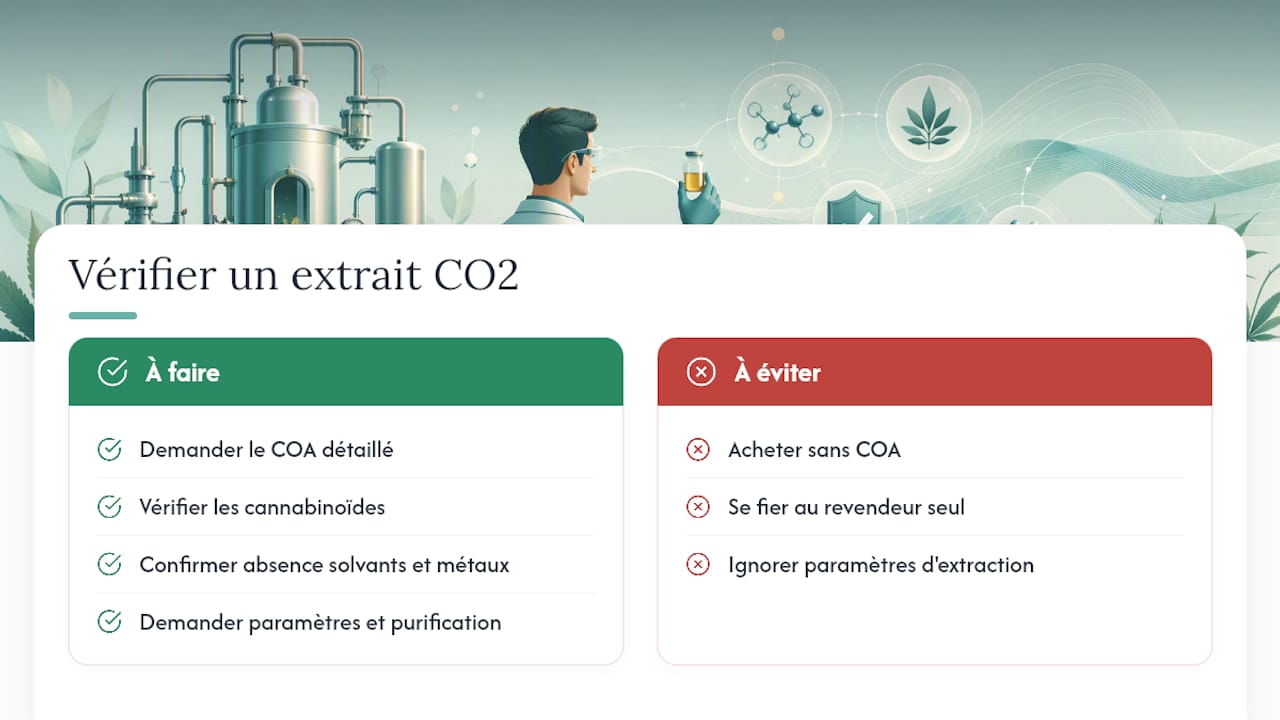
Pro tip: Always ask for the certificate of analysis (COA) for a CO2 extract: it must state that there are no residual solvents, not just the cannabinoid content.
The technical benefits can be summarized as follows:
- No traces of residual solvent in the finished product.
- High selectivity, adjustable depending on the target molecule.
- A closed-loop system with CO2 recycling, considered more efficient than single-use solvent processes.
- High reproducibility, valued for laboratory analyses and production under strict specifications.
There are limitations as well: the equipment is expensive, the process requires real technical expertise, and improper pressure settings can result in the loss of some of the most volatile terpenes during depressurization.
Why are winter storage and purification essential after extraction?
The crude extract that comes out of the separator is almost never the final product. It still contains waxes, lipids, and sometimes chlorophyll—compounds that cloud its appearance and alter its texture. This is where post-extraction purification techniques come into play; they have become an almost routine step in any professional production process.
- Winterization: The extract is diluted in ethanol and then cooled for several hours, causing waxes and lipids to precipitate so they can be filtered out. An extract that has not been properly winterized remains cloudy and solidifies unevenly when left to stand.
- Decarboxylation: Heating the extract to between 100 and 150 °C converts CBDA into active CBD; without this step, the cannabinoid remains largely inactive in terms of its desired effects.
- Advanced purification: chromatography, fractional distillation, or crystallization can be used to isolate high-purity CBD or to concentrate a specific cannabinoid profile.
Each of these steps slightly reduces the final volume but improves the product's clarity, stability, and consistency—three factors that carry significant weight for a discerning buyer.
What equipment and budget are needed for a supercritical CO2 system?
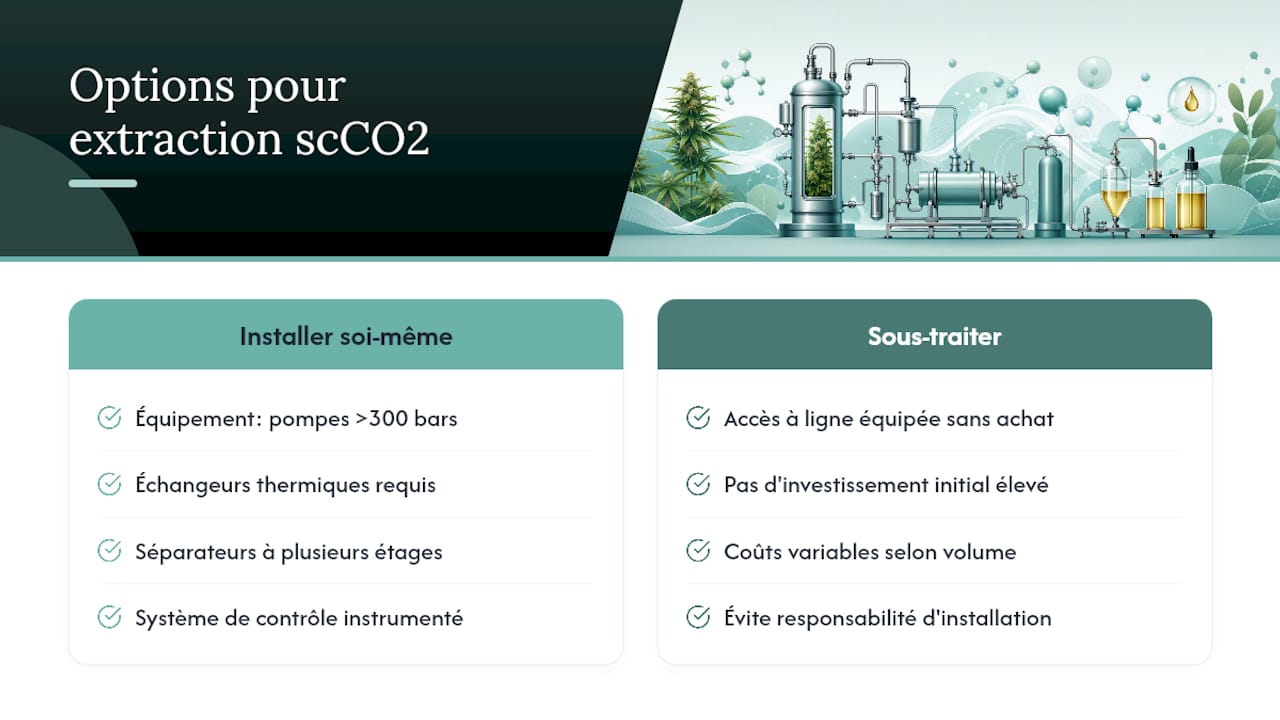
An scCO2 extraction line relies on a few critical components: high-pressure pumps capable of exceeding 300 bars, heat exchangers to regulate the fluid’s temperature, multi-stage separators, and an instrumented control system that continuously monitors pressure and temperature.
Safety is not optional at these pressure levels: tanks and piping must meet strict strength standards, and any industrial facility requires specialized training for operators.
In terms of budget, the investment in equipment often exceeds €50,000 for a standard industrial-scale setup, plus operating costs related to energy and maintenance. For a small producer, outsourcing extraction to a contract manufacturer with the necessary equipment is often more cost-effective than investing in a complete production line as long as production volumes remain modest.
How can you check the quality of a CO2 extract before buying it?
A high-quality CO2 extract always comes with a certificate of analysis detailing the cannabinoids present and confirming the absence of solvent residues and heavy metals. Our guide to CBD analytical testing explains exactly what a reliable COA should include. Before making a purchase, also ask about the extraction parameters used and the purification steps applied: this information distinguishes a transparent producer from a mere reseller.
Will supercritical CO2 become the standard for high-end CBD?
scCO2 is gaining ground in the premium market, driven by its ability to deliver a consistent, solvent-free product. Research continues to seek a balance between preserving terpenes and the cost per kilogram of extract. My advice remains the same: prioritize traceability and the COA over price.
— Steven
CBD products that are carefully extracted, tested, and transparent
Every product sold is accompanied by an independent laboratory analysis that meets rigorous traceability requirements similar to those described throughout this article.

Want to see what a high-quality extract looks like? Our Northern Light small buds CBD flower exemplifies this level of quality, with a product sheet that details its origin and lab results. To explore our entire selection—oils, resins, flowers, or isolates—check out our complete catalog. Have a technical question about an extraction method or a cannabinoid profile? Our customer service team is here to answer your questions before you make a purchase, and every COA is available for review.
Sources
The numerical data in this article are based, in particular, on the PMC’s experimental study of extraction parameters, Root Sciences’ technical guide on the critical point of CO2, and research published in *Pharmaceuticals* on terpene profiles.
- Fractional Factorial Design Study for the Extraction of Cannabinoids Using scCO2 — PMC
- Terpenes and Cannabinoids in Supercritical CO₂ Extracts — MDPI Pharmaceuticals
- Post-extraction purification techniques — ACS Publications
Frequently Asked Questions
What is supercritical CO2 extraction?
This method raises the temperature of CO₂ above 31.1 °C and the pressure above 73.8 bars, giving it both the dissolving power of a liquid and the penetrating ability of a gas, which allows for the selective extraction of cannabinoids without leaving any solvent residue.
Is CO2 extraction safer than solvent extraction?
CO2 completely re-evaporates upon depressurization, eliminating the risk of solvent residues that can occur with improperly controlled ethanol- or butane-based methods.
Why does the crude extract need to undergo winterization?
Winterization removes waxes and lipids that cloud the appearance and texture of the extract; without this step, the final product remains unstable and visually cloudy.
What pressure and temperature yield the highest CBD yield?
Experimental studies indicate that the optimal conditions are around 250 bars and 40 to 45 °C, although some protocols go as high as 320 bars and 60 °C, depending on the target compound.
How can you tell if a CO2 extract is high-quality?
Every reputable product comes with an independent laboratory analysis certificate, which can be viewed before purchase, confirming the absence of residual solvents and detailing the cannabinoid content.