

CBD, CBG, and CBN are three distinct cannabinoids derived from hemp, each with its own chemical structure and specific effects on the endocannabinoid system. Understanding the differences between these cannabinoids helps you choose the right extract based on your wellness goals, whether that’s managing stress, relieving pain, or improving sleep quality. These three molecules are non-psychoactive at legal doses and work synergistically. Pure-extract-cbd offers a complete line of products based on these cannabinoids, all derived from organic hemp and lab-tested.
What are the chemical differences between CBD, CBG, and CBN?
CBD (cannabidiol), CBG (cannabigerol), and CBN (cannabinol) share the same plant origin but differ significantly in their molecular structure and how they interact with receptors in the human body.

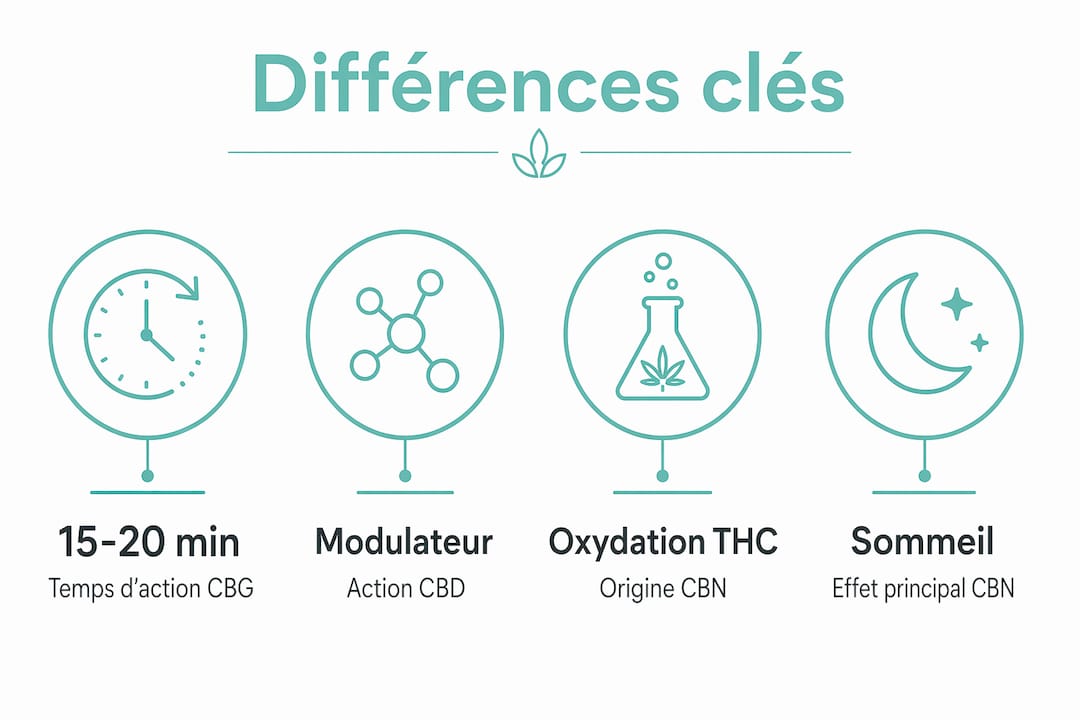
CBD acts primarily as a negative allosteric modulator of the CB1 and CB2 receptors. This means that it does not directly activate these receptors but modifies their response to other molecules. This indirect action explains why CBD has broad effects on anxiety and inflammation without causing euphoria.
CBG, on the other hand, binds directly to the CB1 and CB2 receptors with moderate affinity. This direct binding produces more targeted and faster effects. CBG is also considered the biochemical precursor to CBD and THC: in the young plant, cannabigerolic acid (CBGA) is converted into other cannabinoids as the plant matures.
CBN has a different profile. It is formed through the natural oxidation of THC, a process known as partial degradation or decarboxylation. CBN derived from the oxidation of THC retains a low affinity for CB1 receptors, which reduces euphoric effects while retaining sedative properties. These properties are partly due to the oxidized terpenes present in aged extracts.
Onset of action and bioavailability
The three cannabinoids also differ in how quickly they take effect. CBG takes effect within 15–20 minutes when taken sublingually. CBD takes 30–45 minutes. CBN, which has a more sedative effect, takes 45–60 minutes to take effect. This time difference is a key factor in choosing the right cannabinoid based on the time of day and the desired effect.
| Cannabinoid | Mechanism of action | Sublingual onset time | CB1/CB2 Affinity |
|---|---|---|---|
| CBD | Indirect allosteric modulator | 30–45 min | Weak, indirect |
| CBG | Direct connection to the receivers | 15–20 min | Moderate, direct |
| CBN | THC breakdown product | 45–60 min | Mild, sedative |
Pro tip: For fast results during the day, sublingual CBG is the best choice. Save CBN for the evening, at least one hour before bedtime.
What practical effects can you expect from CBD, CBG, and CBN?
Each cannabinoid serves a distinct purpose. Confusing them is like using an anti-inflammatory to treat insomnia: the mechanism of action doesn’t match the intended purpose.
CBD: Stress, Inflammation, and Epilepsy
CBD is the most clinically studied cannabinoid. Its recognized effects include:
- Anxiety reduction: CBD modulates the 5-HT1A serotonergic receptors, which are involved in mood regulation.
- Inflammation: It inhibits the production of pro-inflammatory cytokines, making it a strong candidate for mild chronic pain.
- Epilepsy: Epidiolex, a medication made from pure CBD, has been approved by the U.S. FDA for certain forms of refractory epilepsy.
- Indirect sleep benefits: By reducing anxiety, CBD improves sleep quality without having a direct sedative effect. The benefits of CBD for sleep are well documented in recent scientific literature.
CBG: Neuroprotection and Rapid Analgesia
CBG is notable for its rapid onset of action and its neuroprotective effects. Preliminary studies suggest that it inhibits the reuptake of GABA, an inhibitory neurotransmitter, producing a relaxing effect without drowsiness. CBG also activates TRPV1 receptors, which are involved in pain perception, giving it targeted analgesic properties. Its shorter half-life allows for daytime use without the risk of residual drowsiness. To learn more about its specific characteristics, the report on the benefits of CBGA provides additional insights.
CBN: Sleep and Deep Relaxation
CBN is the cannabinoid most closely associated with sleep. A meta-analysis of 54 clinical trials involving 2,477 participants found a significant increase in sleep duration with cannabinoids, including CBN. The estimated effect size is 0.54 (95% CI: 0.14–0.95), representing a clinically relevant benefit. However, the sedative effects of CBN taken alone are often disappointing. It is when combined with CBD that its effects are fully realized.
Pro tip: According to available data, the combination of 10 mg of CBN and 25 mg of CBD optimizes the circadian rhythm and prolongs sleep. Do not take CBN on its own if your goal is to achieve lasting improvements in sleep.
How to Choose and Combine CBD, CBG, and CBN?
The choice of a cannabinoid depends first and foremost on your personal goal. Here is a structured approach to help guide your decision.
-
Define your main goal. Stress and anxiety: opt for CBD. Pain during the day or difficulty concentrating: choose CBG. Trouble falling asleep: CBN, combined with CBD, is the best option. Each cannabinoid has a specific and complementary use, which eliminates the need to search for a one-size-fits-all solution.
-
Start with low doses. For beginners, a dose of 5–10 mg of CBD per serving is a reasonable starting point. For CBG, 10–15 mg is often enough for a daytime effect. CBN is generally taken in doses of 5–10 mg in the evening. The guide on CBD oil use details administration methods and practical dosages.
-
Follow the recommended timing for use. CBG should be taken in the morning or early afternoon, as it takes effect quickly—within 15–20 minutes. CBD can be used at any time of day. CBN should be taken in the evening, 45–60 minutes before bedtime.
-
Harness the entourage effect. The entourage effect among cannabinoids increases overall efficacy through molecular interactions. A broad-spectrum extract containing CBD, CBG, and CBN produces greater effects than each molecule taken separately. This synergy is particularly well-documented for sleep: the combination of CBN and CBD improves sleep more effectively than CBN alone.
-
Be aware of potential interactions. CBD inhibits certain cytochrome P450 enzymes in the liver, which can alter the metabolism of other medications. Anyone currently taking medication should consult a healthcare professional before adding a cannabinoid to their routine.
The various cannabinoids found in hemp are discussed in detail on the Pure-extract-cbd blog, where you can learn more about each one.
What are the differences in cost and extraction methods between CBD, CBG, and CBN?
The availability of these three cannabinoids varies considerably depending on their abundance in the plant and the complexity of their extraction.
- CBD is the most abundant cannabinoid in industrial hemp varieties. Its extraction using supercritical CO₂ is a well-established process, and its production cost is relatively low. That is why CBD products remain the most affordable on the market.
- CBG makes up less than 1% of the mature plant. Its scarcity and the need to harvest hemp early (before CBGA converts into CBD or THC) make its extraction costly. CBG costs 5 to 10 times more than CBD of equivalent quality. This price difference is directly reflected in the price of finished products.
- CBN is even rarer in its natural state. It forms primarily through aging or exposure to light and oxygen. Producing it intentionally requires processes that involve the controlled breakdown of THC, which complicates the extraction process and increases costs.
Check the quality before buying
The scarcity of CBG and CBN exposes consumers to products of varying quality. There are three criteria to ensure a safe purchase:
- Require a certificate of analysis (COA) issued by an independent laboratory that confirms the actual cannabinoid content.
- Verify that the THC content is less than 0.3% (the legal limit in France and Europe).
- Give preference to extracts derived from organic hemp with documented traceability.
Products containing minor cannabinoids are popular, but the clinical evidence remains incomplete to date. Standardized randomized trials are still needed to confirm all of the claimed therapeutic properties.
Key Points
CBD, CBG, and CBN act on distinct biological targets and address complementary wellness needs, making their combination more effective than using them individually.
| Point | Details |
|---|---|
| Distinct Mechanisms of Action | CBD indirectly modulates the CB1/CB2 receptors, CBG binds to them directly, and CBN acts through sedative pathways. |
| Different action times | CBG takes effect in 15–20 minutes, CBD in 30–45 minutes, and CBN in 45–60 minutes: choose based on the time of day. |
| The Synergy of CBN and CBD for Sleep | 10 mg of CBN combined with 25 mg of CBD optimizes the circadian rhythm more effectively than CBN alone. |
| Cost Due to Scarcity | CBG costs 5 to 10 times more than CBD because of its low concentration in the mature plant. |
| Ongoing clinical trials | There is still a lack of comprehensive randomized trials on minor cannabinoids; caution is still warranted. |
My Perspective on These Three Cannabinoids After Years of Observation
Having closely followed developments in the market and in cannabinoid research, I’ve noticed a recurring mistake: people often search for “the best cannabinoid” as if there were a one-size-fits-all answer. This line of thinking is counterproductive.
CBD, CBG, and CBN are not in competition with one another. They function as different tools in the same toolbox. Using CBN to manage acute pain during the day is like choosing the wrong tool. Using CBD alone for a severe sleep problem means failing to take full advantage of what the combination with CBN can offer.
What concerns me most is the speed at which the popularity of CBG and CBN has outpaced clinical evidence. The growing popularity of these cannabinoids is outpacing solid data, and some manufacturers are taking advantage of this to make exaggerated claims. Caution is warranted, especially for people undergoing medical treatment.
My practical advice: Start with CBD, monitor your reactions for two to three weeks, and then introduce CBG or CBN depending on which goal you haven’t yet achieved. A thoughtful, experimental approach—using products with laboratory-verified compositions—remains the best strategy. It’s important to understand cannabinoids and their differences before consuming them.
— Steven
Quality-verified CBD, CBG, and CBN products at Pure-extract-cbd
Choosing between CBD, CBG, and CBN is a decision that calls for reliable products whose composition has been verified by independent testing.
Pure-extract-cbd offers a selection of CBD, CBG, and CBN products made from organic hemp, each accompanied by certificates of analysis for every batch. Oils, flowers, resins, and infused products cover a wide range of needs, from daytime relief to sleep support. The online store offers fast shipping throughout France and Europe, with customer service available to help you find the right product for your needs. Discover the entire product line at Pure-extract-cbd.
Frequently Asked Questions
What is the main difference between CBD and CBG?
CBD acts as an indirect allosteric modulator of the CB1 and CB2 receptors, while CBG binds to them directly with moderate affinity. CBG also takes effect more quickly (15–20 minutes versus 30–45 minutes for CBD).
Is CBN effective on its own for sleep?
The sedative effects of CBN taken alone remain limited. Combining 10 mg of CBN with 25 mg of CBD produces better results for sleep thanks to the entourage effect.
Can you take CBD, CBG, and CBN together?
Yes. The combination of these three cannabinoids harnesses the entourage effect, which enhances overall efficacy through complementary molecular interactions. It is recommended to start with low doses and increase them gradually.
Why is CBG more expensive than CBD?
CBG makes up less than 1% of a mature hemp plant. Its rarity and the complexity of the extraction process make it 5 to 10 times more expensive than CBD of equivalent quality.
Are the cannabinoids CBD, CBG, and CBN legal in France?
Yes, provided that the THC content remains below 0.3%, in accordance with European regulations. The products sold by Pure-extract-cbd comply with this legal threshold, as confirmed by independent laboratory analyses.



