Dosage calculations must take into account weight and current treatments, as CBD can interact with certain medications. If in doubt, seeking medical advice and verifying the product's certificate of analysis are essential before any consumption.
In short:
- The actual dose in milligrams depends on the total volume, the percentage concentration, the number of drops per milliliter, and the viscosity of the oil.
- A higher concentration, such as 20 to 30%, reduces the number of drops needed but increases the risk of dosage error, especially in the case of a small drop error.
- The initial calculation rule recommends a dose between 0.1 and 0.25 mg of CBD per kilogram of body weight, with a gradual increase to limit undesirable effects.
- Regulatory safety is supported by the 0.0275 mg/kg/day threshold established by EFSA, but this figure is a cautious reference, not an absolute ceiling.
- Systematically checking the origin and conformity of the certificate of analysis linked to the batch of oil avoids surprises, as many analyzed samples show significant deviations from the declared concentration.
Table of Contents
- What does a percentage on a CBD label mean?
- Which concentration should I choose based on my user profile?
- Calculating your dose: the weight rule and the titration method
- Safety, drug interactions and regulatory guidelines
- Checking the quality of an oil: certificate of analysis and batch number
- Choosing your focus and sticking to it: the method in practice
- What Pure Extract CBD's editorial experience brings to the subject
- What I've learned after looking into this topic
- Find an oil that has been tested and is suitable for your dosage.
- Sources
- Frequently Asked Questions
What does a percentage on a CBD label mean?
The percentage indicated on a bottle corresponds to the proportion of cannabidiol relative to the total volume of the solution, and not to a measure of effect or perceived potency. This total quantity is then distributed in each milliliter, and then in each drop, which requires two successive conversions before obtaining an actual dose.
The first conversion gives the concentration per milliliter: simply divide the total amount of CBD by the volume of the bottle. In the previous example, 1000 mg divided by 10 ml gives 100 mg of CBD per milliliter. The second conversion, the one that really matters when taking the product, depends on the number of drops per milliliter dispensed by the dropper, a figure that varies considerably from one manufacturer to another.
- A standard pipette delivers a number of drops per millilitre which can vary depending on the viscosity of the carrier oil, generally around twenty.
- A more viscous oil, often hemp-based, produces larger drops and therefore fewer drops per milliliter.
- The temperature of the bottle and the angle of the pipette at the time of dropping also affect the actual volume delivered.
This variability explains why two bottles with the same percentage concentration do not necessarily deliver the same dose per drop. The administration guide details how to measure doses more regularly on a daily basis.
Which concentration should I choose based on my user profile?
CBD oils are generally divided into three concentration levels, each corresponding to a different use and tolerance.
- Low concentration, around 5% : a 10ml bottle contains an amount of CBD proportional to this percentage. This level is suitable for people who are new to CBD or who are looking for a mild effect for occasional relaxation, with a comfortable safety margin during the initial observation period.
- Medium concentration, between 10% and 15% : a 10ml bottle contains a higher amount of CBD proportional to this percentage, thus reducing the number of drops needed to reach a given dose. This level is suitable for users who have already identified an effective dose at a low concentration and who wish to limit the amount of oil ingested each day.
- High concentration, from 20% up to 30% or more : the concentration is high, making it suitable for regular, long-term use or more sustained needs. The main risk at this level is miscalculation, as a single drop too many can result in a significant variation in dosage compared to a less concentrated oil.
Choosing a higher concentration is primarily justified by ease of administration—fewer drops to count, a longer-lasting bottle—rather than by inherent superior efficacy. The same caution applies at all dosage levels: it is the total daily dose in milligrams that determines actual exposure, not the figure on the label.
Calculating your dose: the weight rule and the titration method
A practical way to estimate a starting dose is to use a guideline of between 0.1 and 0.25 mg of CBD per kilogram of body weight, although this range is not a universally accepted rule. This estimate serves as a cautious starting point, not a target dose to be reached quickly.
It is precisely for this reason that a low concentration facilitates fine adjustments at the beginning of use: each drop weighs less in the total dose.
The dose increase should follow a gradual protocol rather than an adjustment based on immediate sensation:
- Start with a low dose for three to seven consecutive days without modification, to allow time to observe any possible reaction.
- Then increase the dose by 10% to 20% every five to seven days if no adverse effects appear, according to the protocol described in a 2024 study on commercial CBD oils.
- Note each dose change and the effects felt, which allows for the rapid identification of a threshold of discomfort or interaction.
This gradual titration approach limits the risk of unknowingly exceeding an uncomfortable dose, especially with a concentrated oil where a small measurement error results in a larger dose difference than with a diluted oil.
Safety, drug interactions and regulatory guidelines
The EFSA has established a provisional intake level for CBD of 0.0275 mg per kilogram per day, which represents a low daily dose for an average adult. This threshold is generally lower than the doses commonly consumed via commercial oils, illustrating the gap between provisional regulatory guidelines and actual usage practices.
This figure remains provisional: the agency itself acknowledges toxicological uncertainties and does not cover certain groups, particularly pregnant women or very young children, due to insufficient data. This level should therefore not be interpreted as an absolute safety ceiling, but as a guideline for caution, calling for additional data from manufacturers.
Meanwhile, the ANSM (French National Agency for Medicines and Health Products Safety) is raising awareness about interactions between CBD and certain medications , a point often underestimated by users who consider CBD a product without any particular risk. Reported side effects include nausea, drowsiness, dizziness, headaches, and, in rarer cases, significant interactions with ongoing treatments.
- The treatments most affected by a risk of interaction include antidepressants, antiepileptics, opioids, benzodiazepines, statins and immunosuppressants.
- The ANSM recommends informing your doctor of any CBD consumption, including occasional use, before starting or changing any treatment.
- In case of unusual symptoms after taking the product, the agency advises stopping the product and seeking prompt medical advice.
A highly concentrated oil doesn't inherently increase this risk, but it makes it more likely in practice, because a small error in the amount of oil dispensed results in a much larger dose variation than with a diluted oil. The page on CBD side effects details the symptoms to monitor daily.
Checking the quality of an oil: certificate of analysis and batch number
A reliable certificate of analysis, often referred to by its acronym COA, must indicate the measured quantity of CBD, the possible presence of THC, the absence of residual solvents and heavy metals, as well as the analytical method used. This document is only valid if it is linked to a specific batch number corresponding to the purchased bottle, and not to a generic document valid for an entire range.
This requirement is not theoretical. A study published in 2024 on commercial CBD oils measured discrepancies ranging from 81% to 226% between the concentration stated on the label and the concentration actually measured in the laboratory, with traces of Δ9-THC detected in the majority of the samples analyzed.
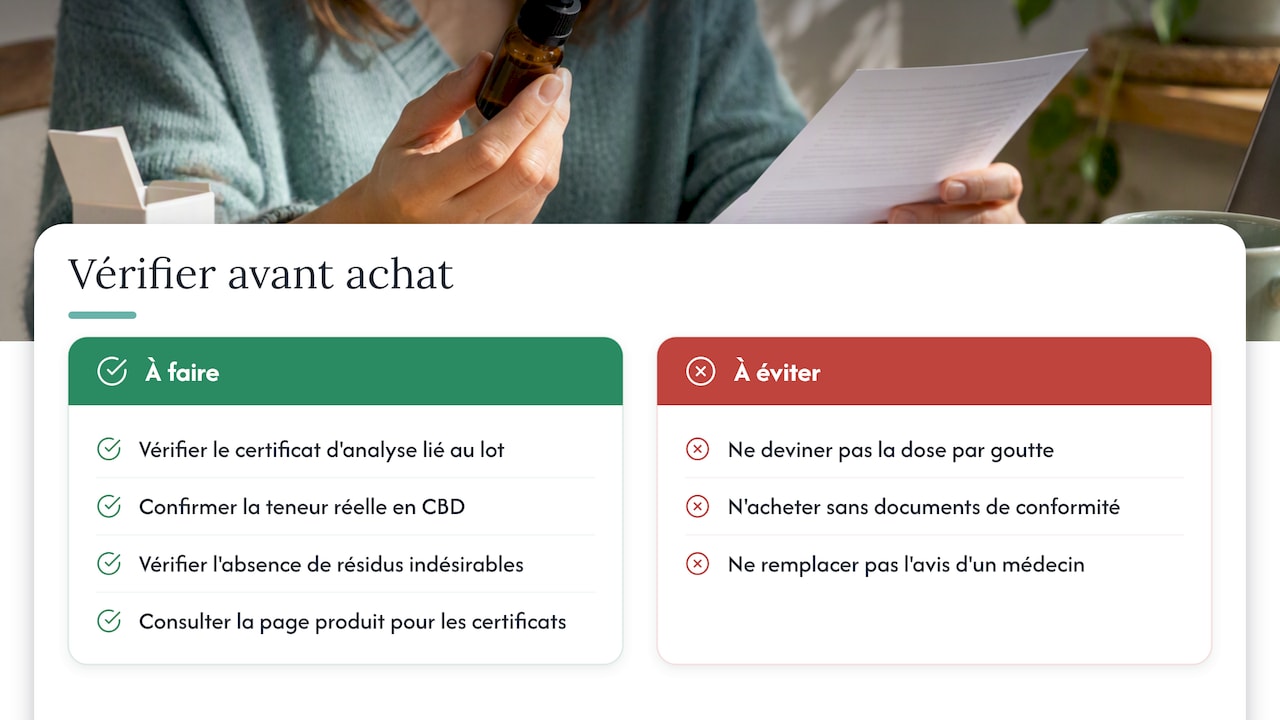
Before making a purchase, a few simple checks significantly reduce the risk of unpleasant surprises:
- Always request the certificate of analysis linked to the batch number of the bottle in question, not a document dated from another batch.
- Verify that the analysis was carried out by an independent third-party laboratory, and not solely by the manufacturer itself.
- Keep the proof of purchase and the corresponding certificate, which will be useful in case of any questions or claims later.
Pro tip: always compare the date of the certificate of analysis and the batch number written on the bottle before validating a purchase; a discrepancy between the two invalidates the guarantee of conformity.
Choosing your focus and sticking to it: the method in practice
Before choosing a concentration, four elements deserve to be clearly stated: the purpose of use (occasional relaxation or regular use), body weight, the presence or absence of ongoing drug treatment, and the availability of a certificate of analysis linked to the batch of the product under consideration.
- Choose a cautious starting concentration , usually between 5% and 10%, by calculating the initial dose in milligrams rather than relying solely on the percentage displayed.
- Titrate gradually over several weeks, increasing the dose in small increments and respecting several days of observation between each change.
- Documenting each intake and each effect felt allows for informed adjustment of the concentration or dose rather than random adjustments.
Once the dose is stabilized, consistency is just as important as the number itself: taking the oil at the same time of day makes it easier to monitor the effects, and a bottle stored away from light and heat retains its concentration longer. The guide to choosing a CBD oil covers these criteria according to the form and spectrum of the product.
What Pure Extract CBD's editorial experience brings to the subject
The practical information in this guide is based on publicly available regulatory guidelines and a careful review of the laboratory tests accompanying the oils sold by Pure Extract CBD, a range covering several concentration levels derived from organic hemp. Each product comes with its certificate of analysis, allowing you to verify the accuracy of the labeling and the actual CBD content before making a purchase.
To delve deeper into some of the points discussed here, the page on the differences between full spectrum, broad spectrum and isolate sheds light on the issue of residual THC presence depending on the type of extract chosen, a factor that directly influences the reading of a certificate of analysis.
What I've learned after looking into this topic
The percentage displayed on a bottle is an easy-to-remember marketing claim, but it tells you nothing about the actual dose you ingest with each intake. What matters is the calculation in milligrams per day, adjusted to each individual's weight and tolerance, not the highest number on the shelf.
A beginner benefits from starting low and observing, a regular user can aim for a more practical concentration once they know their dose, and anyone undergoing treatment should consider CBD as a fully active product in its own right, never as a harmless supplement. When in doubt, the advice of a healthcare professional remains more reliable than any forum or label.
— Steven
Find an oil that has been tested and is suitable for your dosage.
Choosing the right concentration becomes simpler when each bottle is accompanied by a clear certificate of analysis linked to its batch number, which avoids guessing the actual dose contained in each drop.

Several concentration levels derived from organic hemp are offered, with compliance documents available for each reference, allowing verification of the actual CBD content and the absence of undesirable residues before purchase.
Find the entire range on the CBD oils page to compare available concentrations and view the certificates associated with each product.
This article is intended to provide general information and is not a substitute for the advice of a qualified healthcare professional. Consult a qualified healthcare professional about your specific situation before taking any action based on this content.
Sources
- News – Mixing CBD and medication is never harmless – ANSM
- Provisional safe level for cannabidiol as a novel food | EFSA
- Comprehensive analysis of 19 cannabinoids in commercial CBD oils: concentrations, profiles, and safety implications | Journal of Consumer Protection and Food Safety
Frequently Asked Questions
Does CBD help with concentration?
The publicly available data do not allow us to conclude that CBD has a direct effect on mental concentration. Existing guidelines focus primarily on safe consumption and drug interactions, not on measured cognitive effects.
Which CBD should I choose if I have spondylitis?
No official source recommends a specific concentration or form of CBD for ankylosing spondylitis. Anyone undergoing treatment for this condition should consult their doctor before introducing CBD, due to the risk of interactions highlighted by the ANSM (French National Agency for Medicines and Health Products Safety).
Is CBD effective against ADHD?
There is no official data establishing the effectiveness of CBD in the management of attention deficit hyperactivity disorder (ADHD). The available guidelines concern the general safety of consumption, not a specific therapeutic indication.
Is CBD good for the brain?
No regulatory source supports a general benefit of CBD on brain function. Health authorities are focusing on safety thresholds and potential interactions with neurological treatments, which justifies caution rather than general statements.