

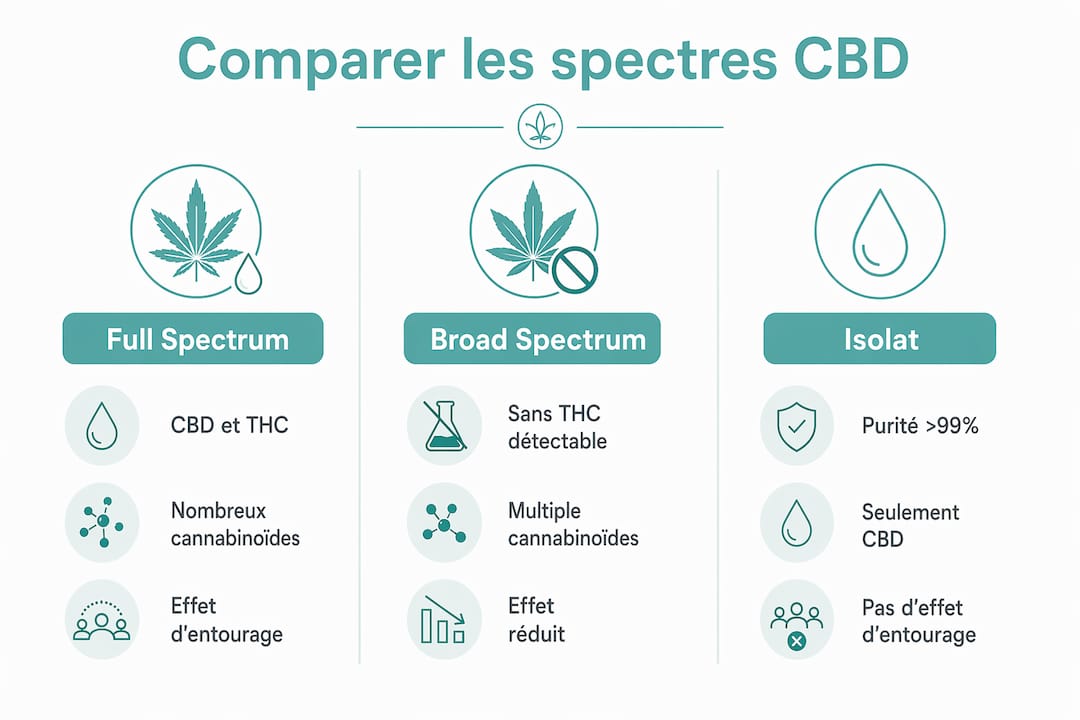
Full-spectrum CBD is defined as a hemp extract containing all the cannabinoids, terpenes, flavonoids, and legal traces of THC present in the plant. Broad-spectrum CBD retains this molecular diversity but specifically removes the THC. Isolate, on the other hand, is cannabidiol purified to over 99%, without any other active molecules. Understanding these three profiles is essential for choosing a product suited to your wellness goals, your personal tolerance, and French law, which requires a THC content of less than 0.3% for all products sold.
What are the chemical profiles of each type of CBD?
Full-spectrum, broad-spectrum, and isolate differ primarily in their molecular composition, which results directly from the extraction and purification process applied to the hemp plant.
Full spectrum: the extract that most closely resembles the plant
Full-spectrum extract retains all of hemp’s natural compounds: CBD, BCG, CNN, CBC, terpenes, flavonoids, and trace amounts of THC. In France, these trace amounts are legally limited to less than 0.3%. The chemical complexity of full-spectrum extract makes it more similar to the whole plant, which can enhance certain effects but also introduces greater variability from one batch to another. Extraction is generally performed using supercritical CO₂ or ethanol, two methods that preserve fragile molecules such as terpenes.
Broad spectrum: variety without THC
Broad-spectrum products are derived from a full-spectrum extract from which THC is removed through fractional distillation or chromatography. The result is a profile rich in cannabinoids and terpenes, but with no detectable THC. This form offers a compromise between the richness of full-spectrum products and the safety of isolates for people subject to workplace drug testing.
Isolate: Maximum purity, simplified profile
CBD isolate comes in the form of crystals or white powder. Its purity exceeds 99%, which means it is completely free of THC, terpenes, and any other cannabinoids. Isolate crystals are produced through several successive purification steps following extraction. To learn more about the specific uses of this form, Pure-extract-cbd offers an article dedicated to CBD crystals.
Comparison Chart of the Three Profiles
| Feature | Full spectrum | Broad spectrum | Isolate |
|---|---|---|---|
| CBD | Present | Present | Present (> 99%) |
| Other Cannabinoids | Present (BCG, CBN, CBC…) | Present | Absent |
| Terpenes | Present | Present | Absent |
| THC | Traces (< 0,3 %) | Not detectable | Absent |
| Surrounding effect | Maximum | Partial | Absent |
| Risk of THC Screening | Unlikely but possible | Very low | None |
What is the halo effect, and how does it influence perceived effects?
The entourage effect refers to the synergy between the cannabinoids, terpenes, and flavonoids in hemp, which amplifies or modulates the effects experienced compared to CBD alone. This theory lies at the heart of the debate surrounding the three types of spectra.
Scientific research is now shedding light on this mechanism. Terpenes, when combined with cannabinoids, specifically modulate the CB1 and CB2 receptors, influencing the entourage effect in a targeted manner depending on the molecule in question. Some terpenes even act as allosteric modulators on these receptors, subtly modifying cannabinoid responses. It is therefore not a general, undifferentiated synergy, but rather a set of precise and specific interactions.
Research from 2025–2026 confirms that the entourage effect is not a general synergy, but rather a specific interaction in which certain terpenes act as modulators on targeted receptors. This nuance changes the way we evaluate the supposed superiority of full-spectrum products over isolates.
The combined presence of CBD, THC, terpenes, and flavonoids in full-spectrum products increases the likelihood of an entourage effect that is perceived as more comprehensive. Broad-spectrum products offer a partial entourage effect, as they retain terpenes and secondary cannabinoids despite the absence of THC. Isolates, on the other hand, do not benefit from any entourage effect. To understand the role of each cannabinoid in these interactions, Pure-extract-cbd’s article on the different cannabinoids provides useful insight.
Pro tip: Check the terpene profile on the product’s certificate of analysis. The presence of myrcene, limonene, or linalool indicates an active spectrum and can help guide your choice based on the desired effects.
How do you choose between full-spectrum, broad-spectrum, and isolate based on your needs?
The choice of spectrum depends on personal goals, THC tolerance, and any regulatory restrictions or potential urine tests. Here is a decision-making framework organized according to the most common profiles.
-
If you want to maximize the potential benefits of CBD, full-spectrum CBD is the best choice. Its rich molecular profile enhances the entourage effect. Make sure the product complies with the legal limit of 0.3% THC and that an independent certificate of analysis confirms this.
-
You are required to undergo drug testing in the workplace. Broad-spectrum and isolate products are recommended to avoid any risk of THC detection. Choose a broad-spectrum product certified as “non-detectable THC” by an independent laboratory, or an isolate with certified purity.
-
You’re new to CBD and want a predictable profile. Isolate offers precise and consistent dosing. Its lack of terpenes and secondary cannabinoids makes it easier to assess the effects. Note, however, that isolate may require higher doses to achieve certain effects, since there are no other molecules to modulate them.
-
If you’re sensitive to THC or want to avoid it as a precaution, broad-spectrum CBD offers the best balance. It retains the terpenes and secondary cannabinoids while removing the THC. For a detailed comparison of CBD and THC, the Pure-extract-cbd article on the differences between CBD and THC is a helpful resource.
-
Are you looking to incorporate CBD into your daily wellness routine? Full-spectrum or broad-spectrum CBD is best suited for long-term use. Their diverse profiles offer a richer sensory experience. Start with a low dose and adjust gradually based on how you feel.
Pro tip: Consult a healthcare professional before incorporating CBD into your routine, especially if you’re taking medication. Some cannabinoids interact with the cytochrome P450 liver enzymes.
How do you read labels and test results to identify the spectrum of a CBD product?
The transparency of the cannabinoid profile relies entirely on laboratory analysis certificates. Marketing claims alone are not enough to guarantee a product’s actual composition.
A reliable certificate of analysis must include the following:
- The CBD concentration, expressed as a percentage or in milligrams per milliliter.
- The list of detected cannabinoids: CBG, CBN, CBC, CBDV, and—for full-spectrum products—THC, along with its exact concentration.
- The terpene profile: myrcene, limonene, beta-caryophyllene, linalool, etc., along with their respective concentrations.
- THC content: less than 0.3% for legal full-spectrum products, “undetectable” (below the limit of quantification) for broad-spectrum products.
- The name of the accredited laboratory that performed the analysis, along with the test date.
Independent laboratory analyses indicate whether a product is genuinely broad-spectrum with no detectable THC or full-spectrum with legal traces of THC. This distinction is crucial because some products are labeled as “broad-spectrum” even though traces of THC are still present. Strict adherence to these analyses ensures transparency regarding cannabinoid and terpene concentrations, which is essential for consumer trust.
| Label Statement | What she must include on the certificate |
|---|---|
| Full spectrum | THC < 0,3 %, cannabinoïdes et terpènes présents |
| Broad spectrum | Undetectable THC; cannabinoids and terpenes present |
| Isolate | CBD > 99%, no other compounds present |
A product without a publicly available certificate of analysis is not worthy of your trust, regardless of what is stated on its packaging.
Key Points
The choice between full-spectrum, broad-spectrum, and isolate is based on three non-negotiable criteria: the desired chemical composition, personal tolerance to THC, and validation by an independent certificate of analysis.
| Point | Details |
|---|---|
| Full spectrum: the most comprehensive profile | Contient CBD, cannabinoïdes secondaires, terpènes et traces de THC < 0,3 %. |
| Broad-spectrum: THC-free blend | Preserves terpenes and cannabinoids but removes THC in a certified manner. |
| Isolate: Purity and Predictability | CBD purity greater than 99%, precise dosage, no entourage effect. |
| Hood effect: a targeted mechanism | Terpenes modulate CB1/CB2 receptors in a specific, not a general, manner. |
| Certificate of Analysis: A Decisive Factor | Only an accredited independent laboratory can verify a product's actual spectrum. |
Full-spectrum CBD isn't a trend—it's about precision
After years of observing trends in the CBD market, one thing is clear: too many people choose their products based on the term “full spectrum,” as if it were synonymous with absolute quality. This oversimplification is misleading.
Full-spectrum products are not inherently superior. They are better suited to certain users, particularly those seeking an “entourage effect” who have no THC-related concerns. However, for someone who undergoes regular urine tests or simply wants to avoid any exposure to THC, a certified broad-spectrum product or a high-quality isolate is objectively the best choice.
What concerns me even more is the lack of rigor in interpreting test reports. I’ve seen products labeled “broad spectrum” that still contained traces of THC, simply because the purification process was inadequate. Analytical transparency isn’t a marketing gimmick. It’s a minimum requirement.
My advice: Before focusing on the type of spectrum, first make sure that the certificate of analysis is recent, issued by an accredited laboratory, and freely available. The rest is secondary.
— Steven
Pure-extract-cbd: Certified products for every consumer profile
Pure-extract-cbd offers a complete line of CBD products covering all three spectrum types: full spectrum, broad spectrum, and isolate. Each product is made from organic hemp and comes with a certificate of analysis from an independent laboratory, guaranteeing compliance with the legal THC limit and accuracy of the stated cannabinoid profile.
Whether you’re looking for the richness of a full-spectrum extract, the safety of a broad-spectrum product with no detectable THC, or the purity of an isolate, Pure-extract-cbd’s comprehensive lineup meets every need with transparency. Lab reports are available directly on the website, with no additional steps required. To explore the full range of available products, the product catalog showcases all forms and concentrations tailored to your wellness goals.
Frequently Asked Questions
What is the difference between full-spectrum and broad-spectrum?
Full-spectrum contains all the compounds found in hemp, including trace amounts of THC below 0.3%. Broad-spectrum retains the secondary cannabinoids and terpenes but removes THC until it is undetectable in laboratory tests.
Does CBD isolate produce an entourage effect?
No. CBD isolate, which is more than 99% pure, contains neither terpenes nor secondary cannabinoids. The entourage effect—which relies on the interaction between these molecules and the CB1/CB2 receptors—is therefore absent in this form.
What type of CBD should you choose if you're facing a drug test?
Broad-spectrum CBD certified as “THC not detectable” or isolate are the safest options. Both of these forms eliminate the risk of THC being detected in a workplace urine test.
How can you verify that a CBD product is truly broad-spectrum?
The certificate of analysis from an accredited independent laboratory must indicate that THC is “undetectable,” meaning below the limit of quantification. A simple statement on the label is not sufficient to guarantee this.
Is full-spectrum CBD legal in France?
Yes, provided that the THC content is strictly below 0.3%. Any CBD product sold in France must comply with this threshold, regardless of the spectrum type.



