

CBD may provide relief for some patients with restless legs syndrome, but the clinical evidence remains limited and inconsistent. The available studies focus primarily on THC/CBD combinations rather than cannabidiol alone, which explains the cautious nature of current recommendations. A supervised trial under medical supervision remains the most reasonable approach for assessing individual benefit.
In short:
- Current clinical evidence on the efficacy of CBD alone for RLS is limited and is primarily based on THC/CBD combinations or uncontrolled studies.
- An ongoing randomized trial could shed light on the effect of pure CBD in the treatment of RLS, which remains uncertain—it may be a promising avenue or an approach that requires cautious confirmation.
- Treating iron deficiency, maintaining good sleep hygiene, and avoiding substances such as caffeine remain essential steps to take before considering CBD.
- In practice, starting with a low dose, careful dose adjustment, and daily monitoring by a healthcare professional are recommended for any supervised use.
- CBD does not directly address the cause, but its possible mechanisms involve modulation of the endocannabinoid or dopaminergic systems, although there is no clear evidence of its effectiveness to date.
Table of Contents
- What is restless legs syndrome?
- Causes and Triggers of RLS
- Plausible biological mechanisms to explain an effect of CBD
- A Critical Review of Recent Evidence and Recommendations
- How to Use CBD in Practice to Help Relieve RLS
- Complementary Approaches and Established Treatments
- When to See a Doctor and What Tests to Request
- Proof of Expertise and Quality Assurance at Pure Extract CBD
- The Author’s Perspective: Caution, Clinical Curiosity, and Methodology
- Try CBD with complete transparency with Pure Extract CBD
- Frequently Asked Questions
- Sources
What is restless legs syndrome?
Restless Legs Syndrome, or RLS, is characterized by an irresistible urge to move the legs, often accompanied by unpleasant sensations such as tingling, burning, or pulling. These symptoms typically occur at rest, worsen in the evening and at night, and are temporarily relieved by movement: this clinical description forms the basis of the diagnosis, which is primarily based on the patient’s history.
Clinicians often use the IRLS (International Restless Legs Syndrome Study Group Rating Scale) to quantify the severity of symptoms and monitor their progression over time. A high score indicates a significant impact on the ability to fall asleep, sleep continuity, and, by extension, daytime alertness, mood, and quality of life.
SJSR affects a wide range of individuals, but certain conditions can contribute to its onset or worsening: pregnancy, chronic kidney disease, certain nutritional deficiencies, and advancing age. In some patients, symptoms remain mild and occasional; in others, they become daily and severely debilitating, which warrants structured treatment rather than simply adjusting sleep habits.
Causes and Triggers of RLS
SJSR can be primary, with no identifiable cause, or secondary to an underlying condition that can be identified and, in some cases, corrected. Iron deficiency is a key factor among these modifiable causes: a deficiency of iron in the brain—even in the absence of overt anemia—disrupts dopamine synthesis and exacerbates symptoms. This is why a ferritin test is part of the initial workup.
Several factors—whether related to medication or lifestyle—are known to trigger or worsen symptoms:
- Certain antidepressants, antihistamines, and antiemetics can intensify nighttime sensations.
- Kidney failure, diabetes, and peripheral neuropathy are among the most common comorbidities.
- Consuming alcohol and caffeine in the evening often disrupts sleep and makes the discomfort worse.
- Night work or shift work disrupts the circadian rhythm, creating conditions that can worsen symptoms.
Identifying these modifiable triggers is often a useful first step, even before considering a supplement like CBD.
Plausible biological mechanisms to explain an effect of CBD
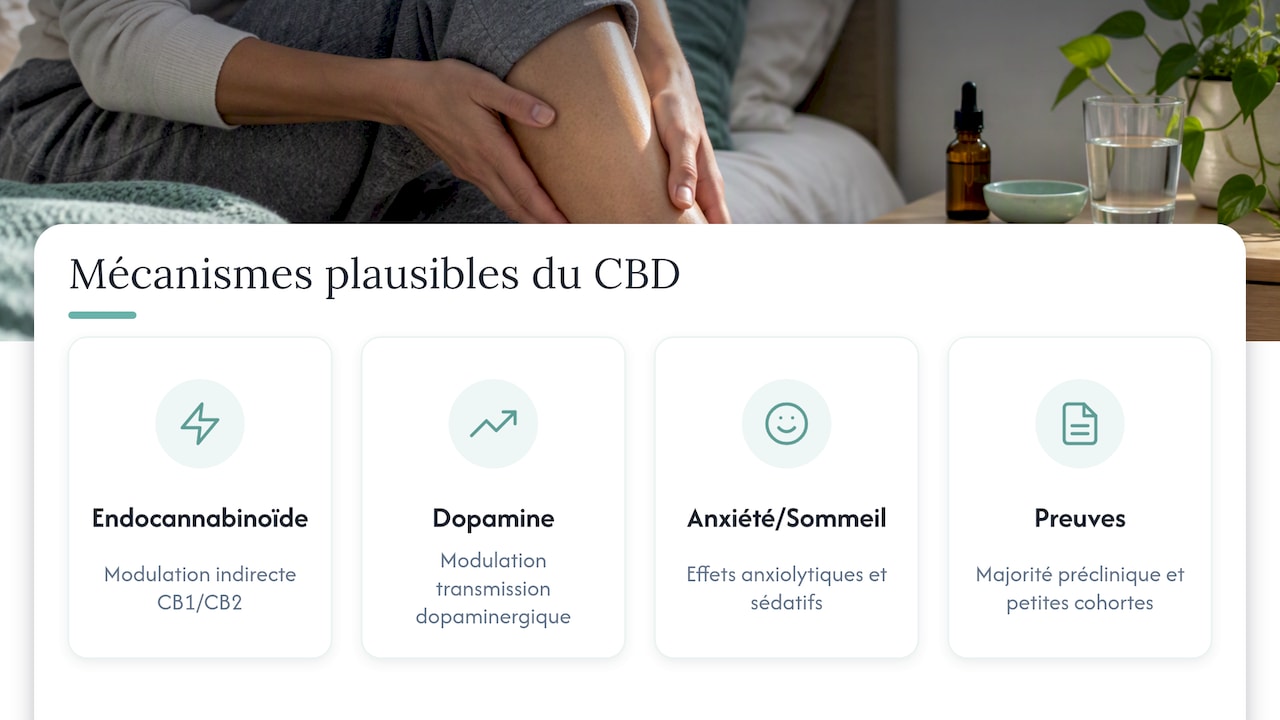
Cannabidiol interacts with the endocannabinoid system, a network of receptors and mediators involved in regulating pain, sleep, and mood. This interaction is indirect: unlike THC, CBD does not bind strongly to the CB1 and CB2 receptors, but rather modulates their activity and that of other signaling pathways, which may explain certain observed effects without the intoxication associated with THC.
The endocannabinoid system may also act as a modulator of dopaminergic transmission, a point that is particularly relevant to RLS since this disorder is closely linked to dysfunction of the dopaminergic system. Preclinical studies suggest that the endocannabinoid system modulates dopaminergic transmission, which opens up a plausible avenue of investigation, even though these data remain largely experimental and do not demonstrate a direct clinical effect on RLS symptoms.
Beyond this dopaminergic hypothesis, CBD is also being studied for its anxiolytic and sedative properties—two factors that play a role in the nocturnal symptoms of RLS. Anxiety related to the anticipation of symptoms and the resulting difficulty falling asleep could, in theory, be alleviated by the calming effect of cannabidiol, even though this does not address the underlying cause of the disorder.
However, the actual scope of these mechanisms must be assessed. Most of the data come from preclinical studies, animal models, or small, uncontrolled cohorts, which rarely focus specifically on RLS. In other words, while there is biological plausibility, this does not constitute proof of clinical efficacy: the identified pharmacological pathways offer a direction for research, not a therapeutic certainty.
A Critical Review of Recent Evidence and Recommendations
The literature on CBD and RLS continues to be dominated by case series, small open-label trials, and a few retrospective analyses, rather than by large-scale, double-blind, randomized trials. A recent review highlights that the available evidence on THC and CBD for the treatment of RLS comes primarily from this type of fragmented data, showing positive signals in some patients but significant heterogeneity in the results, the doses used, and the formulations tested.
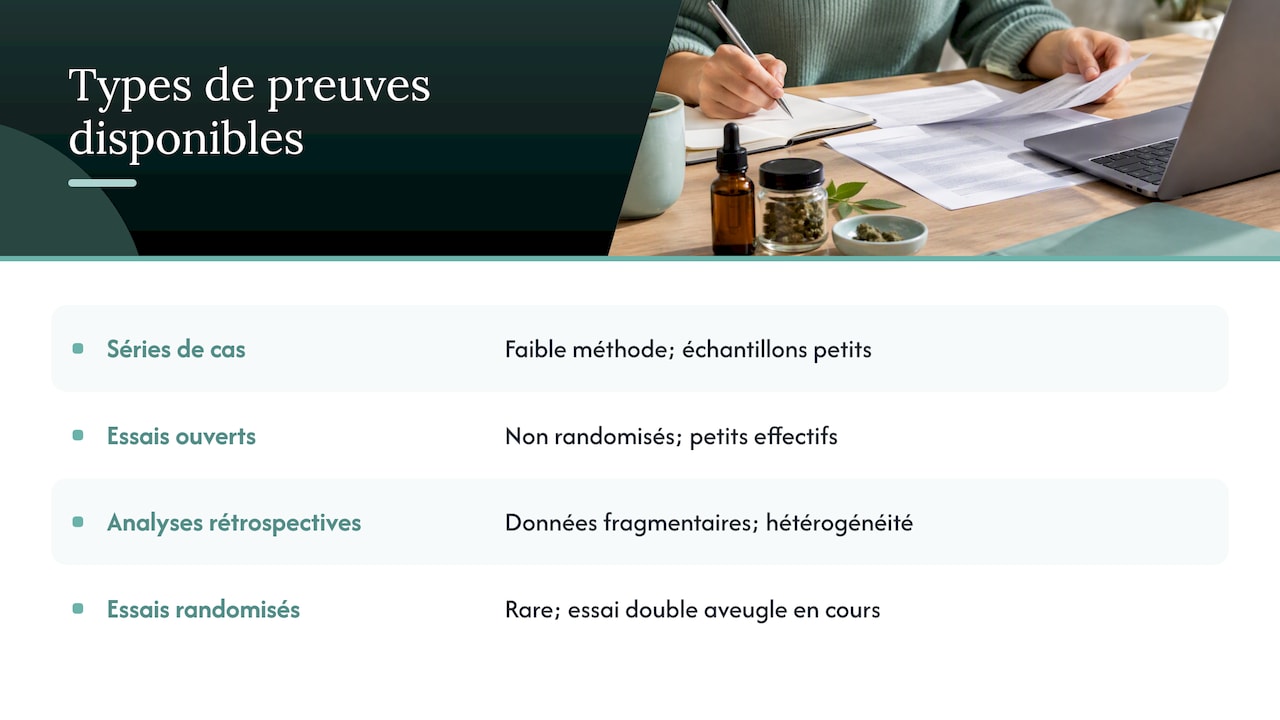
A double-blind, randomized trial, currently underway, is specifically evaluating a CBD-rich botanical extract for idiopathic RLS. This placebo-controlled study is expected to provide more robust data on the tolerability and efficacy of CBD alone—a gap that current research has not yet filled.
Several exploratory studies reported in the medical literature have observed an improvement in IRLS scores and a reduction in periodic leg movements in patients treated with formulations combining THC and CBD, particularly in cases of multiple sclerosis. However, these encouraging results remain difficult to generalize: the sample sizes are small, protocols vary from one study to another, and the specific effect of CBD alone, without THC, is rarely tested independently.
A post hoc analysis conducted on a subgroup of patients with Parkinson’s disease showed no significant difference between CBD and a placebo in terms of RLS-like symptoms, which tempers the enthusiasm generated by the more favorable case series. This contrast between isolated positive results and more neutral controlled data clearly illustrates the current lack of scientific consensus.
In this context, the recommendations from cannabinoid medicine societies take a measured stance: when standard treatments fail or are poorly tolerated, an individualized therapeutic trial using cannabis—often containing THC—may be considered on a case-by-case basis. For pure CBD, documented clinical experience remains limited, which justifies a cautious approach rather than a general recommendation. The reasonable conclusion at this stage is to consider CBD as a supervised trial option, reserved for situations where conventional approaches have been insufficient, and always under medical supervision.
How to Use CBD in Practice to Help Relieve RLS
If a CBD trial is being considered in consultation with a healthcare professional, certain forms are better suited to a controlled protocol than others. Sublingual oil and capsules allow for precise and reproducible dosing, unlike inhalation, which has greater variability in bioavailability and makes dose monitoring less reliable in a therapeutic setting.
As a precaution, it is best to start with low doses and increase them gradually. Here is a structured approach to organizing this trial:
- Start with a low dose—for example, about 2.5 mg of CBD in the evening—and follow a slow titration schedule rather than starting with a high dose right away.
- Increase gradually over several days or weeks, checking for tolerance before each additional increase.
- Set a threshold for dose adjustment: If there is no noticeable effect after a cautious titration, you should discuss the matter further with your doctor rather than increasing the dose repeatedly without a clear plan.
- Check for drug interactions, particularly with medications metabolized by cytochrome CYP450 enzymes, as CBD may interfere with their breakdown in the liver.
- Always inform your doctor if you are taking CBD, especially if you are already taking dopaminergic, anticoagulant, or sedative medications.
Pro tip: Record each dose in a daily log: time, exact dose, severity of symptoms, and perceived sleep quality, so you can distinguish a real effect from a simple natural fluctuation in symptoms.
Keeping this log is not a minor detail: it helps provide an objective view of trends over several weeks, whereas memory alone tends to overestimate or underestimate good and bad nights. It also facilitates discussion with the healthcare provider during follow-up visits by providing concrete data rather than general impressions.
In terms of safety, CBD is generally well tolerated, but side effects are still possible: daytime drowsiness, dry mouth, changes in appetite, or—more rarely—elevated liver enzymes with prolonged use of high doses. Our guide on CBD’s side effects details these risks and the precautions to take. If you experience any unusual or persistent symptoms, it’s best to stop using CBD and seek medical advice promptly rather than waiting for symptoms to resolve on their own.
Complementary Approaches and Established Treatments
CBD should never replace structured medical management of RLS, but should be considered as an experimental adjunct to already validated treatments. Several approaches are worth exploring in parallel:
- Treat an iron deficiency if the ferritin test indicates one, as this treatment is sometimes enough to significantly improve symptoms.
- Establish a regular sleep routine, with consistent bedtimes and limited screen time in the evening.
- Do gentle stretching and moderate physical activity, and avoid intense exercise right before bedtime.
- Discuss established pharmacological treatments, such as dopamine agonists or alpha-2-delta ligands, with your doctor when symptoms remain severe.
CBD should be considered as a complementary approach to explore within this framework, but never as a substitute for an already prescribed and effective treatment.
When to See a Doctor and What Tests to Request
Certain signs should prompt you to seek medical attention immediately: a rapid worsening of symptoms, a significant impact on sleep despite lifestyle changes, or the onset of symptoms in a child.
To ensure an effective consultation, it is helpful to bring your symptom tracking log, a complete list of medications you are taking—including supplements such as CBD—and a detailed description of the circumstances under which your symptoms first appeared.
Proof of Expertise and Quality Assurance at Pure Extract CBD
Every item in our catalog—whether oils, capsules, flowers, or resins—undergoes testing at independent laboratories to ensure it complies with legal requirements in France and Europe. This analytical traceability allows readers who are considering trying CBD to know exactly what’s in the product they’ve chosen.
To learn more about the practical aspects discussed in this article, our guides on CBD-related side effects and the impact of CBD on sleep provide additional insight. However, these resources are never a substitute for personalized medical advice, especially when dealing with a condition like RLS, which has multiple causes.
The Author’s Perspective: Caution, Clinical Curiosity, and Methodology
When it comes to SJSR, CBD deserves more curiosity than rejection, but certainly not blind enthusiasm. Current data do not allow us to either confirm its widespread effectiveness or completely rule it out for certain patient profiles.
What matters most, in my view, is not the molecule itself but the method used to evaluate it: a time-limited trial, a predetermined dose, a meticulously kept journal, and a reassessment shared with a healthcare provider. This discipline transforms an uncertain experiment into actionable data—both for oneself and for the future of medicine.
— Steven
Try CBD with complete transparency with Pure Extract CBD
If you’re considering a supervised CBD trial to complement your RLS treatment, the quality and traceability of the product you choose make all the difference. We offer a line of products made from organic hemp, with each batch lab-tested to ensure compliance and safety.

The catalog includes several options suitable for a conservative titration protocol:
- CBD oils for precise sublingual dosing that’s easy to adjust in small increments.
- Fixed-dose CBD capsules, which are convenient for maintaining a consistent dosage from day to day.
- CBD flowers and resins, for readers who prefer to explore other formats once they’ve established that they tolerate the product well.
Before making any purchase, our page dedicated to CBD oil use provides practical guidelines to help you get started smoothly. We always recommend starting with the lowest dose and keeping a daily log—in addition to consulting a healthcare professional—to honestly assess the effects you experience. To browse our full selection of lab-tested products, explore our entire lineup and choose the format that best suits your needs.
This article is intended to provide general information and is not a substitute for the advice of a qualified healthcare professional. Consult a qualified healthcare professional about your specific situation before taking any action based on this content.
Frequently Asked Questions
Does CBD really relieve RLS symptoms?
In some patients, CBD may alleviate RLS symptoms, but clinical evidence remains limited and comes primarily from studies on THC/CBD combinations rather than on CBD alone. A recent review highlights that the literature still lacks large-scale randomized trials to confirm a generalizable effect.
How long does it take to feel the effects of CBD on RLS?
Keeping a progress journal over several weeks is still the best way to assess gradual progress rather than expecting immediate results.
What dose of CBD should you try for restless legs syndrome?
The conservative regimens mentioned in clinical practice often recommend starting with a low dose in the evening, followed by slow titration based on current clinical practice and recommendations, as well as individual tolerance. This gradual approach—which should always be discussed with a doctor—allows the dose to be adjusted without exceeding a reasonable threshold if no noticeable effects are observed.
Can CBD interact with my RLS medications or other treatments?
Yes, CBD can interfere with the cytochrome CYP450 liver enzymes, which metabolize many medications, including certain dopaminergic or sedative treatments. Our article on CBD-related side effects details these potential interactions, which should always be discussed with a healthcare professional.
Is CBD legal for treating RLS?
In France, CBD products derived from hemp that comply with European regulations are legal as long as they meet the permitted THC thresholds. However, this does not constitute specific medical authorization for treating RLS, which should still be discussed with a doctor.
Sources
- Tetrahydrocannabinol/Cannabidiol in the Treatment of Restless Legs Syndrome — PubMed
- Clinical Trials


