A Certificate of Analysis (COA) indicates the measured composition of a specific batch of CBD product. It serves as proof of the CBD, THC, and contaminant levels for that batch, but does not guarantee anything about the bottle you’re holding unless you verify the lot number, analysis date, and traceability QR code yourself. What to do right away: Open the COA, check the “THC” line, verify the analytical method used, and then keep a copy of this proof.
In short:
- Verifying the lot number, analysis date, and QR code is essential to ensure the authenticity of the COA and that it corresponds to the product purchased.
- An independent COA must specify the analytical method used—typically tandem mass spectrometry (LC-MS/MS)—to ensure the reliability of the results.
- The THC content must be below the regulatory limit of 0.3%, but this does not guarantee that a test will not come back positive due to variations or cross-contamination.
- The frequency of COA renewals must keep pace with production, with recent reports for each batch, since a certificate dated several years ago may no longer reflect the current composition.
- Buying only products whose sellers directly publish the COA for each batch helps minimize the risk of counterfeit or improperly inspected products.
Table of Contents
- What is a CBD certificate of analysis, and who issues it?
- How to Read the Cannabinoid Profile and Units on a COA
- Contaminants: What the COA Should Test For and How to Interpret the Results
- Verifying the Authenticity of an Analysis Certificate: The Checklist
- THC Levels and the Risk of Testing Positive: What the COA Cannot Guarantee
- What to Do If You Have Doubts About the Certificate of Analysis
- What a Transparent Seller Discloses on Its Certificates of Analysis
- Differences Between COAs for Oil, Flowers, and Other CBD Products
- What French and European regulations say about COAs
- How often must a COA be renewed?
- How should the COA results guide your product selection?
- Perspective: Why Checking Your COA Is No Longer Optional
- Where to find products for which a Certificate of Analysis (COA) is published for each batch
- Sources
- Frequently Asked Questions
What is a CBD certificate of analysis, and who issues it?
A certificate of analysis is a technical report produced by an independent laboratory after testing a sample taken from a specific production batch. This document lists the cannabinoids detected, their concentrations, and the results of contaminant tests performed on that specific sample.
Its value lies in the laboratory’s independence from the manufacturer: a COA issued by the manufacturer itself does not carry the same credibility as a report signed by an accredited third party. That is why the laboratory’s name, address, and accreditation are normally listed in the document’s header.
However, the COA has a structural limitation that you should keep in mind as you read this: it certifies the results of a sample taken on a specific date, not of every unit sold thereafter. A batch tested as compliant in January may differ slightly from a subsequent batch, even if they have the same product code. The test date and lot number listed on the report must therefore match exactly those on the package you have in your hands.
How to Read the Cannabinoid Profile and Units on a COA
The central section of an analysis certificate lists the detected cannabinoids and their concentrations, along with technical explanations regarding THCa vs. THC that can help you better understand the cannabinoid profile. Three lines deserve special attention before any other data.
- CBD: the amount of cannabidiol that is already active, in its decarboxylated form.
- CBDa: the acidic precursor of CBD, present before it is converted by heat.
- Total CBD: a calculated value that adds together CBD and converted CBDa (often using the formula CBD + CBDa × 0.877), which is intended to reflect the product’s actual potency once heated or vaporized.
- Δ9-THC: the level of psychoactive tetrahydrocannabinol, which is the most critical threshold from both a legal and screening perspective.
Converting mentally between these scales helps prevent reading errors: 1% is equivalent to 10 mg/g. Noticing a 10-fold difference between two lines in the same report is often a sign of a typo, not an actual result.
You’ll also come across the abbreviations ND (not detected), LOD (limit of detection, the minimum threshold that the device can detect), and LOQ (limit of quantification, the threshold above which the result is numerically reliable). An “ND” for THC is a good sign; a number close to the LOQ should be viewed with caution rather than ignored.
Finally, check the method listed in the footer or header: tandem mass spectrometry coupled with liquid chromatography (LC-MS/MS) is the gold standard for cannabinoids, while gas chromatography (GC-MS) is used primarily for residual solvents and certain volatile pesticides. The complete absence of any mention of a method is a red flag.
Contaminants: What the COA Should Test For and How to Interpret the Results
A reliable certificate is never limited to cannabinoids. It generally covers four categories of contaminants that determine the product's actual safety.
- Pesticides: residues from agricultural treatments, which are particularly problematic on flowers that have been fumigated or sprayed.
- Heavy metals: lead, arsenic, mercury, and cadmium, which hemp easily absorbs from the soil.
- Residual solvents: ethanol, butane, or propane used during extraction; hazardous above certain thresholds.
- Microbiological testing: molds, yeasts, and mycotoxins—a risk particularly for poorly dried flowers.
A test result is interpreted in two steps: first, the presence or absence of the substance; second, a comparison with the regulatory or safety threshold established for that category. A trace detected below the threshold is not considered abnormal; if the threshold is exceeded, however, the product must be systematically rejected.
The most common red flag is an incomplete report: a page that only tests for cannabinoids without mentioning contaminants at all, or that displays blank fields instead of numerical values. A detailed guide on pesticides, heavy metals, and solvents in CBD allows you to explore each category in greater depth if you want to take your verification a step further.
Verifying the Authenticity of an Analysis Certificate: The Checklist
A genuine COA can be identified by a few specific features, which should be checked in the following order.
- Laboratory identification: The full name, physical address, and verifiable contact information must be provided, ideally along with a statementof ISO/IEC 17025 accreditation, the international standard for the competence of testing laboratories.
- QR code or direct link: More and more laboratories, such as LLFC with its LC-MS/MS analyses, are including a QR code that links to the original report hosted online. Scan it and compare the lot number and date displayed to those on your packaging.
- Consistent analytical method: The technique specified must correspond to what is being measured. LC-MS/MS for cannabinoids, GC-MS for solvents; the absence of a specific method or the use of a generic method should raise suspicion.
This three-step check takes less than two minutes once you know where to look, and it eliminates most of the falsified or reused reports from one batch to the next.
THC Levels and the Risk of Testing Positive: What the COA Cannot Guarantee
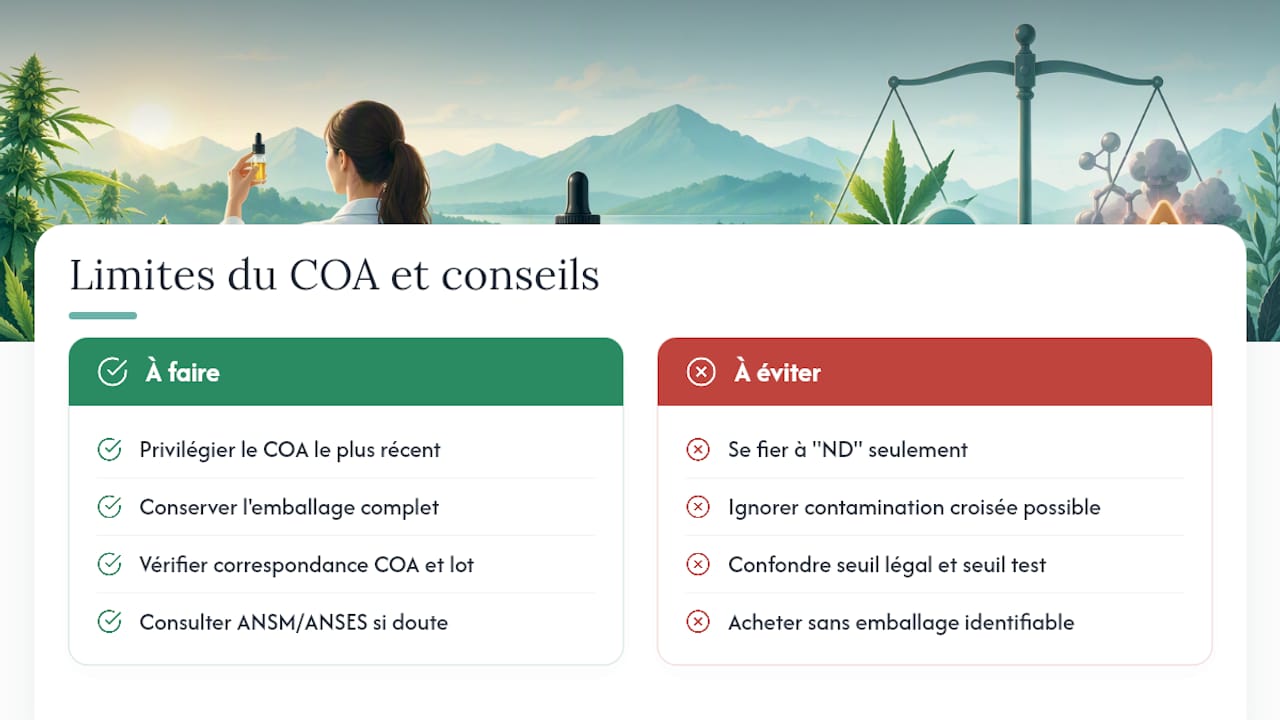
A THC level listed as “ND” or a very low value on a certificate is reassuring, but it does not completely eliminate the risk of testing positive. The ANSM report on the safety of cannabidiol explicitly states this: the COA provides information on the composition of a tested batch, not that of the specific product you are consuming if its packaging cannot be identified in the report.
Several factors can explain a positive result despite a reassuring COA: a sample different from the one actually purchased, a test sensitivity higher than the threshold listed on the report, cross-contamination at the manufacturing facility, or the presence of synthetic cannabinoids not detected by the standard analysis. Commercial thresholds (often 0.3% THC for a product to be legal) and the detection limits of saliva or urine tests are entirely unrelated, which accounts for much of the confusion.
Pro tip: Always use the most recent COA available for your specific batch, keep the original packaging until the product is completely used up, and consult resources from the ANSM or ANSES if you still have doubts about a product before engaging in a high-risk activity (driving, workplace drug testing). Our article on the link between CBD and saliva tests details these specific situations, as does our analysis of the scientific and legal differences between CBD and THC.
What to Do If You Have Doubts About the Certificate of Analysis
A missing, incomplete, or obviously repurposed SDS from another product calls for a methodical response rather than mere hesitation to make a purchase.
- Keep everything —the unused product, the packaging, the label, and a copy of the COA provided—before contacting anyone.
- Contact the seller: Ask for the report that corresponds exactly to the lot number listed on your box, the laboratory's signature, and, if possible, the verification link via QR code.
- Please report as necessary: In the event of adverse effects or suspected synthetic cannabinoids, authorities explicitly recommend keeping the product to allow for analysis through the SINTES/OFDT system, or contacting a poison control center.
Our article on the French authorities' oversight of CBD products details the reporting channels available to consumers.
What a Transparent Seller Discloses on Its Certificates of Analysis
A website that publishes its COAs by batch—directly accessible from each product page—stands out clearly from those that provide a report only upon request. Some stores publish their certificates of analysis by batch directly, along with technical FAQs that explain the results displayed.
This practice gives consumers a simple way to compare sellers: those who publish a recent and comprehensive COA, and those who merely make a vague claim that their “products have been tested” without providing an accessible report.
Pro tip: Before making any purchase, contact the seller’s customer service to request the COA for a specific lot. A reputable seller will respond within a few hours with the exact document; an unusually long delay or an evasive response should raise more red flags than the mere absence of a customer review.
Differences Between COAs for Oil, Flowers, and Other CBD Products
The structure of a certificate varies depending on the type of product being tested, and understanding these differences prevents you from comparing reports that measure different things.
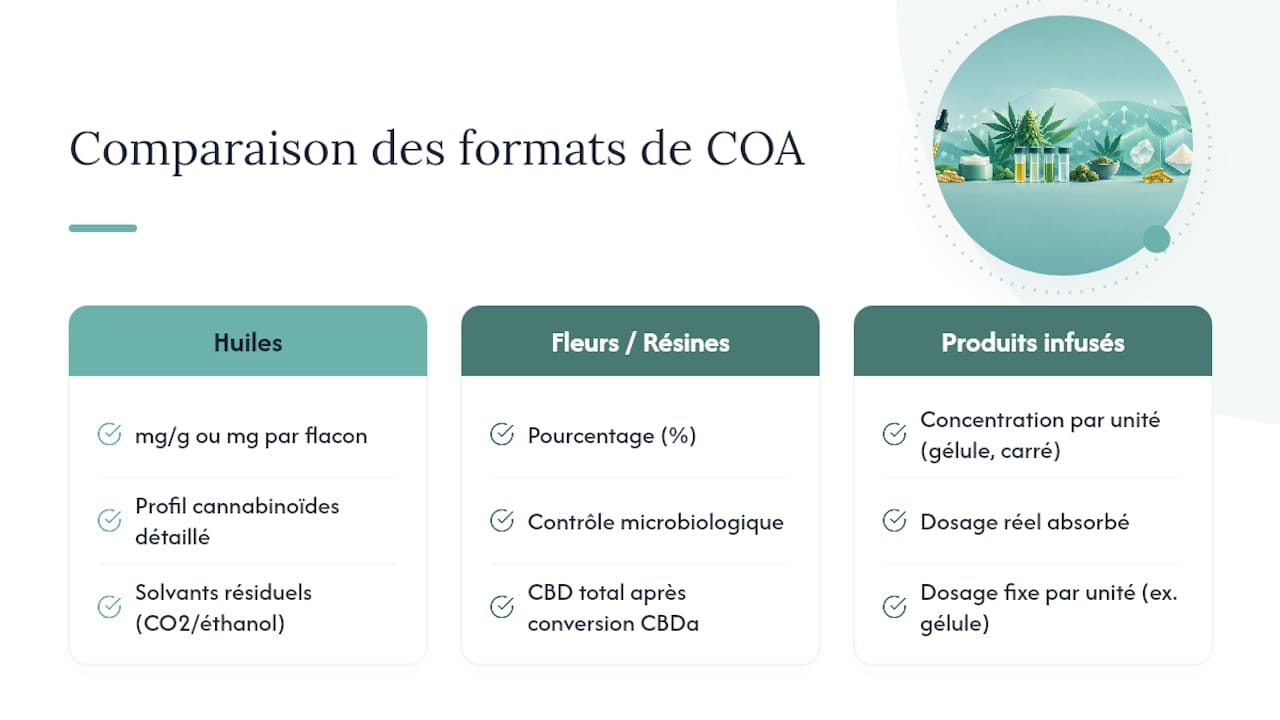
For CBD oil, the COA typically lists concentrations in mg/g or mg per total bottle, along with a detailed cannabinoid profile and a test for residual solvents—which is particularly important if supercritical CO₂ or ethanol was used in the extraction process. Our guide on how to use CBD oil explains how these measurements translate into practical use.
For flowers and resins, the percentage is often used instead of mg/g, and microbiological testing takes on particular importance since these products are generally smoked or vaporized without further processing that could neutralize mold. The total CBD content—calculated after theoretical conversion of CBDa—is almost always higher than the free CBD measured at room temperature.
For infused products (edibles, capsules, cosmetics), the COA must specify a concentration per unit of consumption (per capsule, per square of chocolate) rather than simply an overall concentration, since this value determines the actual dosage absorbed. Capsules, for example, typically have a fixed dosage per unit, unlike oils, where the dosage depends on the number of drops.
A COA that does not clearly specify this measurement basis, or that mixes units without clear conversions, unnecessarily complicates interpretation and warrants scrutiny.
What French and European regulations say about COAs
No French law formally requires the systematic publication of an analysis certificate for every CBD product sold, but the regulatory framework strongly encourages this practice. The legal threshold of 0.3% Δ9-THC in the finished product—set at the national level in France in accordance with European guidelines—can only be verified through laboratory analysis, which makes the COA indispensable in practice for any reputable seller.
Recent developments in the health authorities’ position reinforce this requirement for transparency. In 2025, ANSES proposed classifying cannabidiol as a substance presumed to be toxic to reproduction—a proposal based on animal studies and submitted for public consultation that same year. This direction does not immediately change the legal status of CBD, but it illustrates why the analytical traceability of each batch is becoming an increasingly important regulatory issue rather than simply a matter of good business practice.
This is yet another reason to rely on the COA for the specific lot actually sold in France rather than on standards generically listed by a foreign manufacturer.
How often must a COA be renewed?
A certificate of analysis is valid only for the production batch it describes. It must therefore, logically, be updated for each new batch that enters production, rather than simply being republished at fixed intervals on a generic product data sheet.
In practice, this means that a conscientious seller updates its COAs as often as it changes batches, which can amount to several updates per year for a fast-moving product like a flagship oil, and far fewer for a resin produced in small batches. The analysis date listed on the report must remain reasonably close to the date the product goes on sale: a COA that is several years old for a product still on the market is a red flag, even if there is no indication that the composition has changed.
Some manufacturers also have the same batch reanalyzed at regular intervals to verify the stability of cannabinoids over time, particularly for oils that are sensitive to oxidation. However, this practice remains voluntary and is not uniformly applied across the industry, which makes it all the more important to systematically check the date listed on each report before purchasing, rather than assuming the product is fresh by default.
How should the COA results guide your product selection?
The information in a certificate of analysis isn’t just meant to confirm a product’s legality—it should actively influence which product you choose from among several comparable options. A COA that shows a significant discrepancy between the CBD listed on the label and the total CBD measured indicates a problem with production consistency, even if the document otherwise meets standards for contaminants.
A study reported by the CEIP and cited by the ANSM showed that a significant majority of the products tested had a CBD content that differed from what was indicated on their labels. This finding makes comparing COAs a key factor in making a rational purchasing decision: two products priced the same and with the same theoretical concentration may yield very different measured results once tested in a laboratory.
In practical terms, you should always choose the product whose COA shows the smallest difference between the advertised value and the measured value, rather than the one that simply lists the highest theoretical CBD content on its packaging.
Perspective: Why Checking Your COA Is No Longer Optional
The COA remains an analytical safety tool—never a medical endorsement. It simply states what a batch contained at a given moment—nothing more. The rise in cases of food poisoning reported by health authorities in recent years shows that this verification—long reserved for wary buyers—is becoming standard practice for any reasonable consumer.
What’s still missing is the habit of reporting an issue rather than simply switching providers quietly: every report contributes to the monitoring systems that protect all consumers. And for anyone taking medication, reading the COA is never a substitute for consulting a healthcare professional, particularly regarding the possible side effects of CBD and the enzymatic interactions that have already been documented.
— Steven
Where to find products for which a Certificate of Analysis (COA) is published for each batch
Choosing a CBD product without being able to review its certificate of analysis is like buying blind, no matter how reputable the brand may seem. Some stores publish their certificates of analysis by batch directly on their product pages, allowing you to verify the total CBD content, the absence of detectable THC, and the results for contaminants before placing an order.

The complete product line includes flowers, resins, oils, capsules, and extracts, each with its own accompanying lab report. If you’re looking for a concrete starting point, the Northern Light small buds CBD flower or the 25 mg CBD capsules are two options with easy-to-read COA profiles for an initial review. Feel free to compare several COAs with one another and ask customer service about a specific point in the report before purchasing: that’s exactly the approach this article encourages you to take.
This article is intended to provide general information and is not a substitute for the advice of a qualified healthcare professional. Consult a qualified healthcare professional about your specific situation before taking any action based on this content.
Sources
- UPDATE ON CANNABIDIOL SAFETY DATA — ANSM (2022 Report)
- ISO/IEC 17025 — ISO
- Analysis of 15 Cannabinoids by LC-MS/MS — LLFC (2024)
Frequently Asked Questions
How much does a laboratory CBD analysis cost?
The price depends on the number of cannabinoids being tested for and the contaminants included in the panel; a comprehensive analysis is more expensive than a simple CBD and THC test. Reputable sellers generally include this cost in their selling price rather than charging the consumer separately for it.
Can you test positive for THC if you use CBD?
Yes, this is possible even with a reassuring COA, particularly if the product consumed does not exactly match the batch that was tested or if the test used is highly sensitive. The ANSM report on the safety of cannabidiol recommends systematically verifying the batch and the method before any high-risk situation, as also detailed in our article on CBD and driving.
Which CBD product should you choose for sciatica?
There are no official medical recommendations endorsing CBD as a treatment for sciatica, and this issue should be addressed through individualized medical advice rather than a product choice. What can be independently verified, however, is the analytical quality of the chosen product: always look for a recent COA that provides a comprehensive list of contaminants before use.
What kind of authorization is required to sell CBD legally?
It is precisely this threshold that the certificate of analysis makes it possible to verify, batch by batch, before the product is put up for sale.
How can you tell if a certificate of analysis is genuine?
Check the following three items in this order: the identity and accreditation of the issuing laboratory; the presence of a QR code or a link to the original report; and whether the lot number on the document matches the one listed on your packaging. The absence of a clearly stated analytical method, such as LC-MS/MS, should also raise your suspicions.