

Therapeutic claims regarding consumer CBD products have been banned in France sincethe decree of December 30, 2021, and expose both sellers and consumers to real legal and health risks. Avoiding such claims is not merely a formal precaution: it is a legal obligation subject to criminal and administrative penalties, compounded by documented pharmacological safety concerns.
Key points to remember right away:
- Legal prohibition: No CBD product that is not authorized as a medication may claim to have therapeutic effects (curing, treating, or alleviating a medical condition).
- Health risks: drowsiness, digestive problems, elevated transaminase levels, and an increase in reported cases of poisoning since 2024 linked to mislabeled products.
- Drug interactions: CBD inhibits the liver enzymes CYP2C19 and CYP3A4, altering the plasma concentrations of many common medications.
Immediate Steps for Consumers:
- Require an independent certificate of analysis (COA) before making any purchase.
- Consult a doctor or pharmacist if you are taking other medications at the same time.
- Report any adverse effects to a poison control center or through the official ANSM/ANSES websites.
Pro tip: If a seller uses terms like “anti-anxiety,” “treats,” or “cures” on its packaging or website, that’s an immediate regulatory red flag. Opt for products whose marketing focuses solely on general wellness benefits.
Table of Contents
- What does French law say about medical claims related to CBD?
- What are the actual health risks, and which populations are at risk?
- How does CBD affect the metabolism of your medications?
- How can you legally market CBD without making medical claims?
- A Handy Checklist Before Buying a CBD Product
- Key Points
- Pure-extract-cbd's Position on Transparency and Compliance
- Compliant and transparent CBD products, available in France
- Sources and Recommended Reading
What does French law say about medical claims related to CBD?
The decree of December 30, 2021, establishes the framework: CBD products intended for the general public may not legally claim to have any therapeutic, preventive, or curative properties. Only pharmaceutical products that have obtained marketing authorization (MA) may do so. In France, only one CBD-based medication has received this authorization: Epidyolex®, which is prescribed for rare forms of pediatric epilepsy and is available only by prescription.
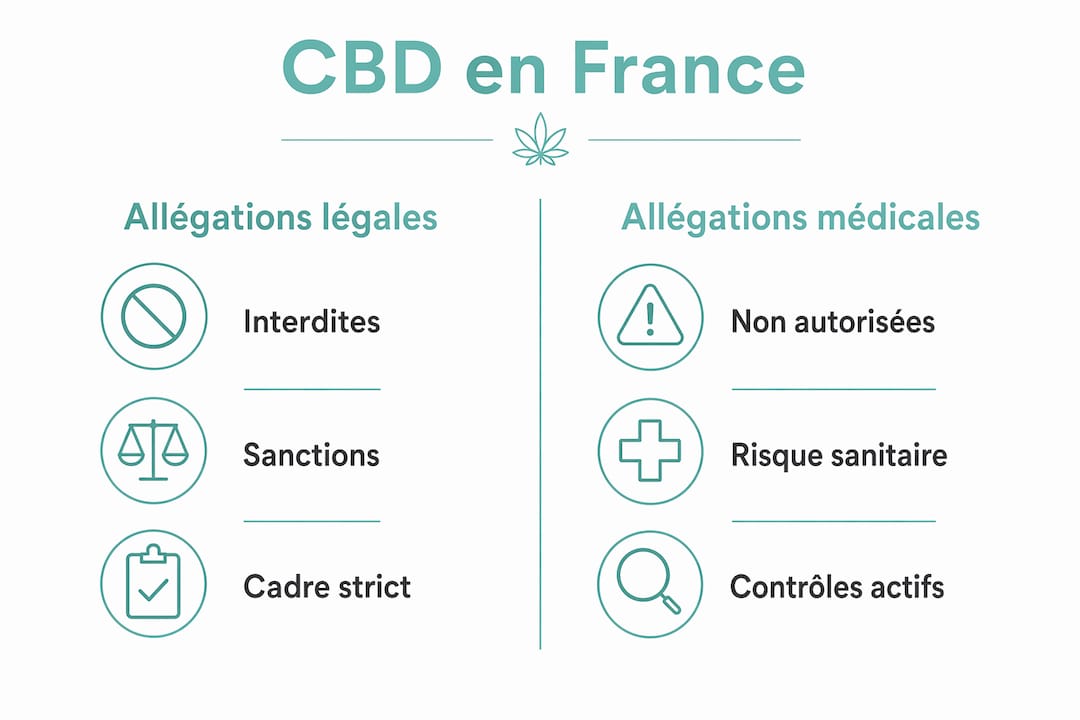
This distinction is fundamental. An over-the-counter wellness product, regardless of its quality, cannot be marketed as a treatment, even if preliminary studies suggest potential therapeutic applications.The National Academy of Medicine also points out that the consumer market has far outpaced scientific validation, creating a troubling gap between marketing and clinical evidence.
| Location | Legal status | Possible Consequences |
|---|---|---|
| Therapeutic claim on a consumer CBD product | Prohibited | Formal Notice, Product Recall, Criminal Penalty |
| Communication Focused on “Well-Being” and “Comfort” | Approved | No penalty if the wording is correct |
| CBD medication with marketing authorization (e.g., Epidyolex®) | Permitted under certain conditions | Prescription required |
| Patient testimony presented as medical evidence | Prohibited | Equated with a therapeutic claim |
Potential penalties include administrative seizures of inventory, formal notices from the DGCCRF, fines, and, in the most serious cases, criminal prosecution for deceptive business practices. The commercial impact is immediate: loss of inventory, damage to reputation, and the need to redesign labeling. Regulatory inspections of CBD products in France have intensified in recent years.
What are the actual health risks, and which populations are at risk?
The side effects of CBD are dose-dependent and have been documented by several health authorities. The most common side effects include drowsiness, diarrhea, fatigue, and, at high doses, elevated liver enzymes (transaminases). These data come primarily from studies on Epidyolex®, where therapeutic doses are significantly higher than those in over-the-counter products.
Since 2024, ANSES has reported an increase in cases of poisoning linked to CBD products. A study supported by Mildeca (CEIP Lyon, Paris, Montpellier) revealed that the majority of products showed discrepancies between the stated and actual CBD or THC content. These discrepancies largely explain the occurrence of unexpected, sometimes serious, side effects.
“The regulatory tolerance for THC levels below 0.3% does not eliminate individual risk: even at these concentrations, drowsiness may occur, and a drug test may come back positive.” — Vidal, summary of precautions related to CBD.
Populations at particularly high risk:
- Drivers and machine operators: CBD-induced drowsiness, even at low doses, can impair alertness.
- Workers exposed to industrial hazards: any change in concentration poses an occupational hazard.
- Patients on long-term treatment: risk of drug interactions (see the following section).
- Children and pregnant women: There are insufficient safety data for these groups.
In the event of an adverse reaction, the guidelines from ANSES and ANSM are clear: keep the product for possible analysis through the SINTES network, contact a poison control center, and report the incident through the official pharmacovigilance portals.
How does CBD affect the metabolism of your medications?
CBD is a potent inhibitor of two major liver isoenzymes: CYP2C19 and CYP3A4. These enzymes are responsible for metabolizing a large proportion of common medications. When they are inhibited, the plasma concentration of the affected medications increases—sometimes to toxic levels—even though the prescribed dose has not changed.
The pharmacology note on drogues.gouv.fr documents this mechanism in detail. The regional pharmacovigilance centers (CRPV) have identified several cases of interactions between CBD and common medications between 2017 and 2023.
| Drug class | Enzyme in question | Main Risk |
|---|---|---|
| Antiepileptic drugs (valproate, clobazam) | CYP2C19, CYP3A4 | Overdose, increased sedation |
| Antidepressants (SSRIs, tricyclics) | CYP2C19 | Exacerbated side effects |
| Proton pump inhibitors (omeprazole) | CYP2C19 | Change in Effectiveness |
| Anticoagulants (warfarin) | CYP3A4 | Risk of bleeding |
| Statins (atorvastatin) | CYP3A4 | Myopathy, rhabdomyolysis |
The practical recommendation in pharmacovigilance guidelines is clear: when taking high doses of CBD, or when taking any of the medications listed above concurrently, a prior medical consultation is essential. Furthermore, the EFSA has proposed a very low provisional daily dose, which underscores the ongoing uncertainty regarding typical consumption levels.
Pro tip: If you experience any suspicious symptoms after combining CBD with medication (unusual drowsiness, nausea, heart palpitations), stop taking CBD, keep the product, and consult a doctor or pharmacist immediately. Report the incident via the pharmacovigilance portal.
How can you legally market CBD without making medical claims?
The line between permissible claims and prohibited claims is clear. Pure-extract-cbd's guide to prohibited claims details which phrases to avoid and their compliant alternatives.
Prohibited formulations:
- "Relieves anxiety," "treats insomnia," "cures chronic pain"
- "Clinically proven anti-inflammatory effect"
- Patient testimonials presented as evidence of medical efficacy
- Any reference to a diagnosable medical condition (depression, epilepsy, cancer)
Legal alternatives focused on well-being:
- "Helps promote a feeling of relaxation"
- "Promotes everyday comfort"
- "As part of a wellness routine"
- « Produit issu de chanvre biologique, conforme au seuil THC < 0,3 % »
The documentation required for any product to be sold includes: a certificate of analysis (COA) quantifying CBD, CBG, CBN, and THC, specifying the analytical method used; traceability of the raw material; and compliance with the legal THC threshold. Without a reliable COA, the product’s safety cannot be guaranteed.
To handle a customer complaint without veering into medical claims, the rule is simple: refocus the conversation on general well-being and recommend consulting a healthcare professional for any health-related questions. A well-trained customer service representative never responds to the question, “Does your CBD treat my anxiety?” with a therapeutic claim.
A Handy Checklist Before Buying a CBD Product
Before purchasing:
- Verify that a recent COA (issued within the last 12 months) from an independent accredited laboratory is available.
- Verify that the THC content is less than 0.3% on the COA, not just on the label.
- Make sure the seller has a physical address and verifiable contact information.
- Check the dosage in milligrams: a product without a specific dosage indication is suspicious.
- Verify traceability: origin of the hemp, extraction method, production batch.
Warning signs to watch for:
- Medical terminology on the packaging or website (diseases mentioned, claimed therapeutic effects).
- No COA, or a COA that is undated, unsigned, or issued by an unidentifiable laboratory.
- An unusually low price with no explanation regarding quality or origin.
- Patient testimonials presented as evidence of therapeutic efficacy.
If symptoms appear after ingestion:
- Keep the product and its packaging for possible analysis.
- Contact the nearest poison control center (national number: 15 or 3114).
- Consult a doctor and mention that you are taking CBD as well as any other medications you are currently taking.
- Report the adverse reaction through the ANSM portal or to your pharmacist.
Key Points
Avoiding medical claims about CBD in France is both a legal requirement and a public health measure: therapeutic claims are prohibited, drug interactions have been documented, and mislabeled products have led to an increase in cases of poisoning since 2024.
| Point | Details |
|---|---|
| Legal prohibition | The decree dated December 30, 2021, prohibits any therapeutic claims for consumer CBD products in France. |
| Drug Interactions | CBD inhibits CYP2C19 and CYP3A4; consult a healthcare professional if taking more than 50 mg per day or if taking other medications at the same time. |
| Incorrectly Labeled Products | 8 out of 10 products show discrepancies between the declared and actual content; an independent COA is essential. |
| At-risk populations | Drivers, exposed workers, people undergoing long-term medical treatment, and children are particularly vulnerable. |
| Pure CBD Extract | Provides independent certificates of analysis (COAs), wellness-focused communication, and full traceability for each product. |
Pure-extract-cbd's Position on Transparency and Compliance
The issue of medical claims about CBD deserves a frank answer, and here is mine: the French market suffers from an excess of promises and a lack of evidence. Sellers continue to use medical terminology to attract consumers who are legitimately seeking wellness solutions. This practice is not only illegal, but it also creates unrealistic expectations that ultimately lead to disappointment or, worse, expose people to real risks.
What strikes me is that regulatory caution is not an obstacle to the CBD market—it is essential to its survival. Companies that communicate honestly, provide verifiable COAs, and train their customer service teams not to make medical claims build a lasting relationship of trust. The others risk product recalls and an irreversible loss of credibility.
Pure-extract-cbd has chosen transparency: accessible independent lab reports, product descriptions focused on well-being and comfort, and a consistent recommendation to consult a healthcare professional for any medical questions. This isn’t defensive marketing. It’s the only responsible way to operate in this industry.
Compliant and transparent CBD products, available in France
Vous cherchez des produits CBD dont la qualité est vérifiable et la communication conforme au cadre légal français ? Pure-extract-cbd propose une gamme complète, issue de chanvre biologique, avec des COA indépendants accessibles pour chaque référence. Aucune allégation médicale, aucune promesse thérapeutique : uniquement des produits de bien-être testés, tracés et conformes au seuil THC < 0,3 %.
Among the most popular options, the Northern Light Small Buds and Fruit strains exemplify this commitment: test results available, traceable origin, and descriptions focused on comfort and relaxation. For those undergoing medical treatment, the recommendation remains the same: consult your doctor or pharmacist before starting regular CBD use. Discover the entire lineup at pure-extract-cbd.com.
Sources and Recommended Reading
| Source | Type | Purpose |
|---|---|---|
| Decree of December 30, 2021 — drogues.gouv.fr | Regulatory | Ban on CBD therapeutic claims |
| CBD Pharmacological Note — drogues.gouv.fr | Pharmacological | CYP2C19/CYP3A4 Mechanism and Interactions |
| ANSES — CBD Poisonings | Plumbing | Rise in Cases of Poisoning, Reliability of Labeling |
| National Academy of Medicine — CBD | Scientist | Adverse effects, the gap between science and the market |
| CRPV Île-de-France — Drug Interactions | Pharmacovigilance | several reported cases of interactions (2017–2023) |
| Addict’Aide — Precautions for Use | Practical | Alert threshold: 50 mg/day |
| Vidal — CBD and Risks | Medical | EFSA Proposal, THC Precautions |
To report an adverse reaction related to a CBD product, use the ANSM portal (ansm.sante.fr) or contact your regional pharmacovigilance center directly. Every report helps improve national surveillance and consumer safety.
This article is provided for general informational purposes only and does not constitute medical or legal advice. For any questions regarding your personal situation, consult a healthcare professional or a qualified legal advisor.



