

Terpenes are the aromatic molecules in the plant that determine the smell, flavor, and much of the sensory experience of CBD. They shape the olfactory profile of each flower or extract—ranging from citrusy to woody—and influence the subjective perception of relaxation or alertness. However, their direct therapeutic value remains to be confirmed: robust clinical evidence is still lacking.
In short:
- The volatility of monoterpenes such as limonene requires that products be stored in a cool, airtight environment to preserve their aroma.
- Most studies on CBD terpenes remain preclinical, with no solid clinical evidence of synergistic therapeutic effects or a confirmed “entourage effect.”
- Checking for a recent and detailed certificate of analysis helps ensure a product’s legality and actual composition, particularly with regard to terpenes.
- The diversity of the terpene profile varies depending on the hemp variety and genetics, making each aromatic experience unique even when the CBD content is the same.
- Terpenes such as beta-caryophyllene have a better-understood mechanism of action, as they bind directly to CB2 receptors, but their synergistic effect with CBD remains unproven.
Table of Contents
- What are terpenes, and where do they come from?
- The Major Terpenes Found in Hemp
- The Bandwagon Effect: What Does the Evidence Really Show?
- How to Read a Terpene Profile to Choose a Product
- Vaporization, Extraction, and Preservation: Preserving Terpenes
- Why Analytical Rigor Matters When Choosing a Product
- CBD Terpenes and Terpenes from Other Plants: A Difference in Context
- Terpenes and Cannabinoids: What Interactions Go Beyond the Entourage Effect?
- How are terpenes measured in CBD products?
- What You Need to Know About Terpenes in Everyday Life
- Transparent terpene profiles, from selection to product sheet
- Frequently Asked Questions
- Sources
What are terpenes, and where do they come from?
Terpenes are volatile organic compounds synthesized in glandular trichomes—the small, mushroom-shaped structures that cover the flowers and leaves of the hemp plant. It is there that the plant simultaneously produces cannabinoids and terpenes, which explains why these two families of molecules are often found together in extracts.
Based on their chemical structure, they can be divided into two main categories, each with specific implications for preservation:
- Monoterpenes, such as limonene and myrcene, are light and highly volatile: they evaporate quickly at room temperature and degrade rapidly if the product is stored improperly.
- Sesquiterpenes, such as beta-caryophyllene and humulene, are heavier and more stable, and therefore less sensitive to brief exposure to heat or air.
This difference in volatility explains why a flower that has been dried for too long or stored in an open bag loses some of its aroma long before it loses its CBD content.
The Major Terpenes Found in Hemp
Each terpene has its own distinctive scent profile, and some have been the subject of preclinical studies that warrant a nuanced interpretation rather than being overhyped.
- Myrcene: earthy and musky notes reminiscent of cloves. A review dedicated to this compound reports promising anxiolytic and analgesic properties in preclinical studies, while noting the lack of robust human studies.
- Limonene: a bright citrus aroma that consumers often associate with a feeling of lightness.
- Pinen: the scent of pine and the forest; also found in rosemary.
- Linalool: a floral note similar to lavender, frequently cited for its soothing properties in preclinical studies.
- Beta-caryophyllene: the only terpene known to bind directly to the CB2 receptors of the endocannabinoid system, which is why it is sometimes referred to as a “dietary cannabinoid.”
- Humulene: a hoppy, woody aroma reminiscent of beer.
- Terpinolene: a complex profile, with herbaceous, floral, and slightly fruity notes.
What the preclinical data show: A review of terpenes derived from Cannabis sativa reports that myrcene, limonene, caryophyllene, and humulene exhibit anti-inflammatory or analgesic effects in animal models and in vitro; however, these findings have not yet been confirmed by large-scale clinical trials in humans.
The mechanism by which beta-caryophyllene acts on CB2 receptors remains the best-characterized exception: for most other terpenes, the mechanisms of action remain hypothetical or have been described only in laboratory settings.
The Bandwagon Effect: What Does the Evidence Really Show?
The term “entourage effect” refers to the hypothesis that terpenes and cannabinoids work together more effectively than each molecule does on its own. The idea is appealing, but it still rests on a fragile scientific foundation.
A systematic review published in 2024 concludes that, to date, there is no robust clinical evidence demonstrating that terpenes enhance the therapeutic efficacy of CBD in humans.
The Entourage Effect in Medicinal Cannabis Products: A Comprehensive Review
Previous studies, including a review focusing on the potential synergies between phytocannabinoids and terpenoids, had already noted that terpenes are effective at very low concentrations and significantly influence aroma, though they did not establish firm clinical evidence of a confirmed synergistic therapeutic benefit.
In practical terms, this means consumers should be mindful of several key points:
- A product labeled as having a “rich terpene profile” has not been scientifically proven to be more effective than a product without added terpenes.
- Most of the available studies are still preclinical or exploratory, with results that are sometimes contradictory depending on the dosages and combinations tested.
- Analytical transparency (see below) matters more than a marketing promise based on word-of-mouth.
How to Read a Terpene Profile to Choose a Product
A terpene profile listed on a product sheet or certificate of analysis (COA) provides useful information, provided you know how to interpret it.
- Check to see if there is a recent COA issued by an independent laboratory that lists both cannabinoids and terpenes.
- Identify the dominant terpenes and match them to your sensory preferences: limonene evokes citrus notes that are often perceived as invigorating, while myrcene and linalool evoke more soothing notes.
- Compare the total terpene percentage: a high-quality flower or resin typically has a detailed profile rather than a vague description.
- Be wary of products for which no analysis is available or whose aroma seems out of proportion to the stated cannabinoid content—a possible sign of artificially added terpenes.
Pro tip: Always compare the advertised terpene profile to the actual smell of the product when you receive it: a significant discrepancy between the two is often a sign of inaccurate labeling.
Our guide to CBD flowers explains how to balance CBD levels and flavor profiles to help you make a more informed choice.
Vaporization, Extraction, and Preservation: Preserving Terpenes
Terpenes evaporate at temperatures much lower than those required for CBD decarboxylation, which is why gradual vaporization is preferable to a single, high-temperature heating cycle.
These values, verified in the laboratory, explain why a spray that rises gradually from the bottom to the top releases the lighter notes first, followed by the woodier notes.
- Start a vaporizing session at around 170 °C, then gradually increase the temperature to explore different flavor notes.
- Store flowers, resins, and extracts away from light, in a cool place, and in an airtight container to minimize the evaporation of the most volatile monoterpenes.
Why Analytical Rigor Matters When Choosing a Product
Trust in a CBD product is based on factual evidence rather than on promises.
- Organically grown hemp minimizes exposure to residues that could skew both the aroma and the terpene analysis.
- An independent certificate of analysis must specify the CBD content, the THC content, and, ideally, details of the terpene profile.
- The THC content must remain within the current legal limit, a point that every reliable product description should clearly state.
The health alert issued by the ANSM in 2025 reports an increase in cases of poisoning linked to products sold as “CBD” but containing other undeclared cannabinoids or THC levels exceeding 0.3%, which is why you should always request an up-to-date COA before making a purchase. Our page on the differences between full-spectrum, broad-spectrum, and isolate products details the role of non-cannabinoid compounds—including terpenes—in these distinctions.
CBD Terpenes and Terpenes from Other Plants: A Difference in Context
Limonene, pinene, and linalool are not unique to hemp: they are found in citrus fruits, conifers, and lavender, where they perform the same basic chemical functions—namely, attracting pollinators and repelling certain pests. The molecule itself is identical, whether it comes from an orange or a CBD flower.
What sets hemp terpenes apart is, above all, their combination: hemp produces a complex and variable blend of dozens of different terpenes in proportions unique to each variety, whereas a plant like the lemon tree concentrates its aromatic profile around just a few dominant molecules. This combinatorial diversity, combined with the presence of cannabinoids, makes hemp’s terpene profile particularly variable from one harvest to the next, even within the same variety.
Furthermore, genetic selection in modern strains has altered the average terpene content of commercially available flowers, which explains why two products with identical CBD levels can offer very different aromatic and sensory experiences depending on their genetic lineage.
Terpenes and Cannabinoids: What Interactions Go Beyond the Entourage Effect?
Beyond the general hypothesis of the entourage effect, some studies explore more specific interactions between a particular terpenoid molecule and a given receptor. Beta-caryophyllene remains the best-documented example: its direct binding to CB2 receptors constitutes a molecular interaction distinct from that of CBD, which acts through different pathways that are still not fully understood.
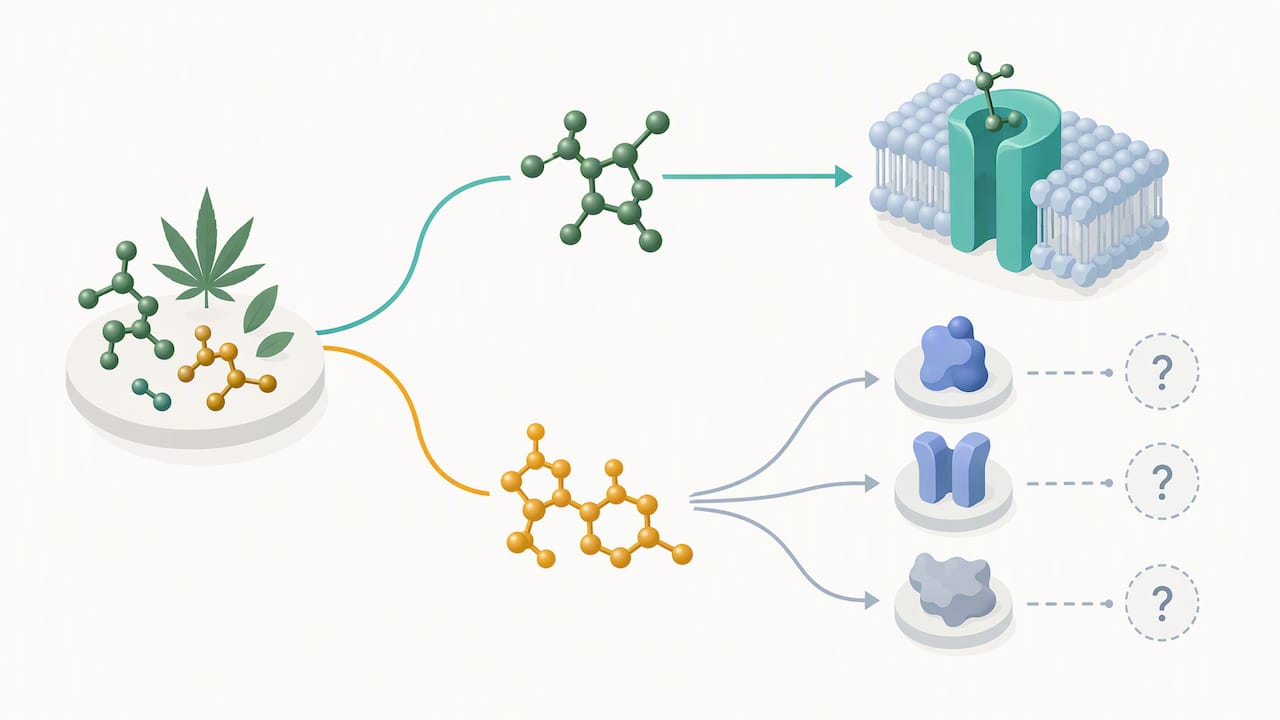
Other lines of research suggest that certain terpenes may modulate the permeability of cell membranes, which could theoretically influence the absorption of cannabinoids; however, these mechanisms have been described primarily in laboratory settings and do not constitute evidence of an effect in humans.
Consumers should exercise caution and not interpret the presence of a particular terpene as a guarantee of a stronger effect, but rather as one element of the product’s overall profile—both aromatic and chemical.
How are terpenes measured in CBD products?
Terpene analysis relies primarily on gas chromatography coupled with a mass spectrometer, a method that separates the various volatile molecules present in a sample and then identifies them individually. This technique makes it possible to quantify each terpene as a percentage or in milligrams, providing an accurate picture of the actual aromatic profile of a flower, resin, or extract.
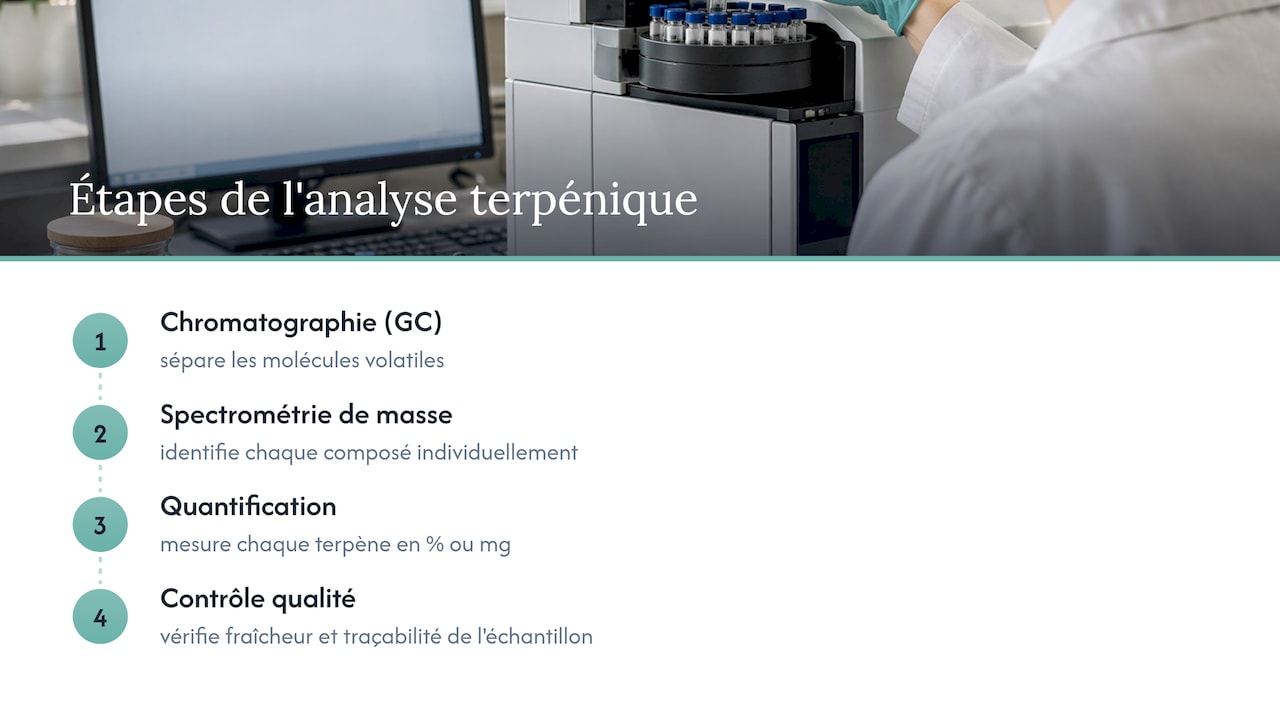
Independent laboratories are increasingly including this analysis in the certificates issued to brands, in addition to standard cannabinoid testing. However, the reliability of the results depends on the freshness of the sample being tested, as the most volatile terpenes can evaporate between harvest and analysis if the cold chain is not properly maintained.
For the reader, the key is to verify that the document provided specifies a recognized method and a recent test date, rather than relying on a simple percentage that is not traceable.
What You Need to Know About Terpenes in Everyday Life
Terpenes are best explored with curiosity rather than with specific therapeutic expectations: start with small amounts of a product with a clearly documented profile, then note your sensory impressions over several uses. Prioritize your olfactory experience as much as your intended goal, and treat every terpene profile as a guide for selection, never as a guarantee of results.
— Steven
Transparent terpene profiles, from selection to product sheet

Each product listing in our catalog allows you to verify compliance before purchasing, and our customer service team is available to answer your questions about specific flavor profiles. Browse our entire product lineup to compare profiles and find the product that matches your sensory preferences.
This article is intended to provide general information and is not a substitute for the advice of a qualified healthcare professional. Consult a qualified healthcare professional about your specific situation before taking any action based on this content.
Frequently Asked Questions
What are the effects of terpenes?
Preclinical data suggest that some of these compounds, such as myrcene, may have anti-inflammatory, analgesic, or anxiolytic effects; however, to date, there is no robust clinical evidence to confirm these effects in humans.
Which CBD molecule is the strongest?
This question confuses two distinct concepts: CBD is a cannabinoid, and terpenes are different aromatic molecules found alongside it in the plant. Among terpenes, beta-caryophyllene stands out because it binds directly to CB2 receptors—a mechanism that is better understood than that of other terpenes in hemp.
What do terpenes taste like?
Each terpene has its own unique taste and scent profile: limonene is reminiscent of citrus fruits, pinene evokes a coniferous forest, linalool has floral notes similar to lavender, and humulene has a woody, hoppy aroma. It is this combination of terpenes that gives each hemp variety its distinct aromatic identity.
What is the definition of terpenes?
Terpenes are volatile organic compounds produced by many plants, including hemp, in structures called glandular trichomes. They determine a plant’s smell and flavor and are the subject of preclinical research into potential complementary properties, although there is currently no robust clinical evidence of a direct therapeutic benefit in humans.
How can you preserve the terpenes in CBD flowers?
The most volatile terpenes, such as myrcene and limonene, evaporate quickly at room temperature or when exposed to light. Storing a product in an airtight container, away from light and in a cool place, helps preserve its aromatic profile for longer.
Sources
- The Entourage Effect in Medicinal Cannabis Products: A Comprehensive Review
- Myrcene—What Are the Potential Health Benefits of This Flavoring and Aromatic Agent?
- Guide to Cannabis Terpenes | PhenoDB
- ANSM — Increase in cases of poisoning caused by CBD-based products containing other substances



