Amanita muscaria primarily causes transient stimulation of the central nervous system, followed by a phase of depression characterized by drowsiness and lethargy. These effects result from the combined action of muscimol and ibotenic acid on GABA-A and NMDA receptors. According to data from the Belgian Poison Control Center, the first symptoms appear between 30 minutes and 3 hours after ingestion, and treatment is exclusively symptomatic, as no antidote is available.
Typical effects include:
- Neurological and perceptual: agitation, euphoria, visual and auditory hallucinations, synesthesia, sensation of macroscopy or microscopy (altered perception of size)
- Independent effects: hypersalivation, sweating, possible bradycardia, mydriasis or miosis depending on the dose
- Gastrointestinal: nausea, vomiting, abdominal pain, especially in the early stages
- Motor symptoms: ataxia, tremors, lack of coordination
The time course follows a relatively predictable pattern: onset between 30 and 90 minutes, peak between 2 and 4 hours, and resolution typically within 6 hours; however, the duration may extend up to 12–24 hours depending on the dose and formulation. There is high variability among cases. In the event of suspected ingestion, contact a poison control center immediately without waiting for symptoms to appear.
Key Points
Amanita muscaria causes unpredictable psychoactive effects due to muscimol and ibotenic acid; there is no available antidote, and there is high toxicological variability among specimens.
| Point | Details |
|---|---|
| Main effects | CNS stimulation followed by depression: hallucinations, drowsiness, ataxia, autonomic effects. |
| Timeline | Onset: 30–90 min; peak: 2–3 h; usual duration: 6 h; may last up to 24 h. |
| Variability and Dose | Concentrations vary widely depending on the season, region, and preparation method; it is not possible to accurately measure concentrations at home. |
| If swallowed | Call 15 or a poison control center immediately; do not induce vomiting without medical advice. |
| A Safe Alternative | Pure-extract-cbd offers lab-tested CBD/CBG oils for stress and sleep that are legal and traceable. |
Table of Contents
- What Is Amanita muscaria? — Identification and Background
- Which molecules are responsible for the effects of Amanita muscaria?
- What effects are actually felt—phases, intensity, and duration
- How do dosage and preparation affect the effects?
- What are the possible risks and complications?
- What should you do if you swallow it or experience poisoning?
- Legality and Sales: What Is the Regulatory Framework?
- What Recent Literature Reveals About Amanita muscaria
- What really stands out to me about Amanita muscaria
- Legal and proven alternatives for well-being
- Sources
What Is Amanita muscaria? — Identification and Background
Amanita muscaria, commonly known as the fly agaric, is one of the most recognizable mushrooms in the world. Its bright red cap, dotted with white warts (remnants of the universal veil), makes it an iconic species, although these warts may disappear after rain. The gills are white and free, and the stem has a membranous ring and a bulbous volva at the base.
It grows mainly under birch, spruce, and pine trees from summer through fall in the temperate and boreal zones of the Northern Hemisphere. It is found in Europe, Asia, and North America.
Several key points are worth noting:
- The color of the cap can range from orange-red to pale yellow depending on the regional varieties (var. formosa, var. flavivolvata)
- Young specimens completely wrapped in their white veil can be mistaken for the eggs of Amanita phalloides, the deadly death cap
- Amanita pantherina (panther amanita), which has similar but often more intense effects, has a brown cap speckled with white and contains the same active compounds
The traditional use of this species for ritual purposes has been documented in Siberia and among certain Native American cultures. This historical context is fueling growing interest today, but it should not be confused with a safety endorsement. Amanita muscaria is not a psilocybin mushroom: its mechanisms of action and risk profile are fundamentally different, as explained in the authoritative encyclopedia article.
Pro tip: When identifying mushrooms in the field, never rely on a single visual characteristic. Use an up-to-date regional mycological guide (such as those published by the Société mycologique de France) and compare several criteria at once: color, warts, gills, ring, volva, and habitat. A photo alone is not enough to rule out a potentially fatal misidentification.
Which molecules are responsible for the effects of Amanita muscaria?
Two compounds play a key role in the pharmacology of the fly agaric: muscimol andibotenic acid. Understanding their respective mechanisms is essential to grasping why the effects are so unpredictable.
Muscimol: a GABA-A agonist
Muscimol acts as a potent agonist of the GABA-A and GABA-C receptors, the brain’s primary inhibitory receptors. This action produces sedation, behavioral disinhibition, and profound perceptual alterations, distinct from the serotonergic hallucinations induced by psilocybin (which acts on 5-HT2A receptors). The effects of muscimol are more akin to a dissociative or dreamlike state than to a classic psychedelic “trip.”
Ibotenic acid: NMDA agonist and precursor
Ibotenic acid is an agonist of NMDA receptors and metabotropic glutamate receptors. It is responsible for the initial excitatory effects and for part of the neurological toxicity. When dried or heated, it partially decarboxylates into muscimol, which alters the profile of effects: a dried mushroom contains proportionally more muscimol and less ibotenic acid than a fresh mushroom. According to PIMS/Inchem data, central nervous system disturbances have been observed at doses of approximately 6 mg of muscimol or 30 to 600 mg of ibotenic acid.
Muscazone and muscarine: secondary roles
Muscazone is a breakdown product of ibotenic acid; it is present in small quantities, and its contribution to the effects remains poorly understood. Muscarine, despite its evocative name, is present in very low concentrations in Amanita muscaria and is not the primary source of the psychotropic effects. As Wikipedia notes, it is a persistent historical error to attribute the effects of this species to muscarine. Muscarinic symptoms (intense hypersalivation, severe bradycardia) are actually characteristic of other species, such as Clitocybe dealbata.
What effects are actually felt—phases, intensity, and duration
Poisoning from the fly agaric generally proceeds in two distinct phases, although their relative severity varies depending on the dose and how the mushroom is prepared.
Phase 1 — Excitement (0 to 2–3 hours): agitation, euphoria, sometimes anxiety or confusion, visual hallucinations (often geometric or macroscopic), excessive salivation, nausea. Some people report a feeling of lightness or invulnerability.

Phase 2 — CNS depression (beginning 2–4 hours later): deep drowsiness, lethargy, sleep that is difficult to interrupt, and, in severe cases, sometimes a light coma. Lucid dreams or hypnagogic states are frequently reported.
| System | Typical Symptoms | Time to onset |
|---|---|---|
| Neurological / Perceptual | Hallucinations, euphoria, confusion, synesthesia, macroscopy | 30–90 min |
| Autonomous | Excessive salivation, sweating, mydriasis, bradycardia | 30 minutes |
| Gastrointestinal | Nausea, vomiting, abdominal pain | 30–90 min |
| Engine | Ataxia, tremors, lack of coordination | 1–2 hours |
| Residual | Headaches, prolonged drowsiness, partial amnesia | 6–24 hours |
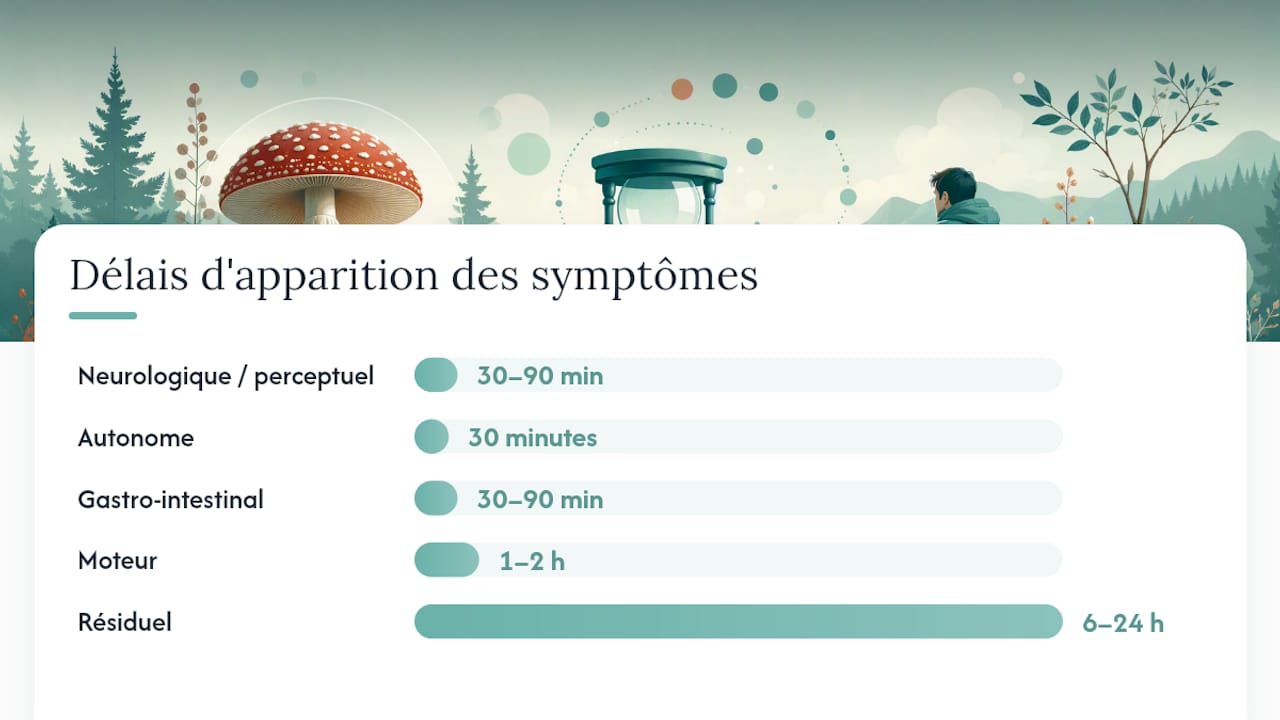
The Poison Control Center fact sheet confirms this two-phase pattern and specifies that symptoms peak at 2–3 hours. PIMS/Inchem data indicate a typical duration of 6 hours, with a possible extension to 12–24 hours depending on the amount ingested. Residual effects, particularly headaches and partial retrograde amnesia, may persist even after the main symptoms have resolved.
How do dosage and preparation affect the effects?
The concentration of muscimol and ibotenic acid varies considerably from one specimen to another, making any empirical dosage particularly risky. Several factors account for this variability, which is documented by Wikipedia and confirmed by the PMC journal.
- Season: Concentrations tend to be higher in the summer and early fall than at the end of the season
- Geographic region: Specimens from Northern Europe have biochemical profiles that differ from those of North America or Asia
- Part of the mushroom: the cap contains the majority of the toxins; the stem contains significantly fewer
- Age of the specimen: Young mushrooms that are actively growing may have different concentrations than mature specimens
Drying is the most well-documented preparation method. Heat and dehydration promote the decarboxylation of ibotenic acid into muscimol, reducing the excitotoxic component and increasing the sedative/hallucinogenic component. Boiling in water (decoction) extracts the water-soluble molecules into the broth, which may lower their concentration in the mushroom itself but does not destroy them. Certain Siberian traditions specifically used this solubility to “detoxify” the mushroom, though this does not guarantee safety.
Pro tip: The “recipes” circulating on forums and social media (specific drying times, temperatures, ratios) are not based on any standardized protocol or individual chemical analyses. Two mushrooms harvested from the same spot on the same day can contain very different concentrations. No home preparation method can predict the actual active dose.
What are the possible risks and complications?
Amanita muscaria is rarely fatal to a healthy adult, but this relative rarity of fatalities should not obscure the potential severity of severe poisoning. The journal *Frontiers* (2026) documents cases of hospitalization involving coma and prolonged delirium, most often followed by complete recovery after treatment.
The most serious acute complications are:
- Seizures, especially in children or when high doses are taken
- Coma or deep stupor, requiring continuous neurological monitoring
- Pantherine syndrome: severe confusion, extreme agitation, prolonged hallucinations, hyperthermia—described by the Poison Control Center and often associated with Amanita pantherina, but also observed with Amanita muscaria at high doses
- Prolonged delirium that can last for several hours after the acute phase
The most vulnerable populations deserve special attention:
- Children: proportionally lower toxic threshold, higher risk of seizures
- Older Adults: Slowed Metabolism, Risk of Prolonged Confusion
- Patients on multiple medications: potential interactions with benzodiazepines, antidepressants, and antiepileptic drugs
- People with preexisting psychiatric disorders: risk of decompensation or worsening of symptoms
A key point: there is no specific antidote for Amanita muscaria poisoning. Treatment is strictly symptomatic, as confirmed by both the Poison Control Center and the PIMS/Inchem data.
What should you do if you swallow it or experience poisoning?
Suspected ingestion of Amanita muscaria is a potential medical emergency, even in the absence of immediate symptoms. Since symptoms may not appear for up to 3 hours, the absence of signs in the first few minutes does not mean there is no risk.
First Aid Protocol:
- Do not induce vomiting on your own without medical advice—this can worsen certain neurological conditions
- Call a poison control center or dial 15 (SAMU) in France immediately, without waiting for symptoms to appear
- Keep a constant watch on the person and never leave them alone, even if they seem calm
- Place the person in the recovery position if they are drowsy or vomiting
- Give fluids if the person is conscious and can swallow without the risk of choking
- Keep a sample of the mushroom or take photos to help emergency responders identify it
Information to have ready before calling:
- Estimated time of ingestion
- Approximate amount consumed (number of hats, weight if possible)
- Identification of the mushroom (photos, description, collection site)
- The person's age, weight, and general health
- Medications You May Be Taking
In the hospital, management includes continuous neurological monitoring, symptomatic treatment of seizures if necessary (benzodiazepines), intravenous hydration, and supportive care. No specific antidote is administered.
Useful phone numbers in France:
- Paris Poison Control Center: 01 40 05 48 48
- Emergency Medical Services (SAMU): 15
- European emergency number: 112
Legality and Sales: What Is the Regulatory Framework?
This article does not constitute legal advice and is not a substitute for checking with the relevant local authorities.
A few points of reference:
- In France, Amanita muscaria is not listed as a controlled substance, unlike psilocybin. Possession and collection of the mushroom are not explicitly prohibited, but its sale for human consumption may be subject to food and health regulations.
- Online sales of processed products made from extracts (gummies, tinctures, powders) are growing rapidly in several European countries, with widely varying levels of regulation
- The absence of explicit regulations does not mean there is no legal risk: placing a product on the market that poses a health hazard may result in the seller being held liable.
- Before any transaction, check the applicable local laws and ensure that the products have independent laboratory test results certifying their composition.
Legal compliance and analytical traceability are the two minimum requirements for any product containing Amanita muscaria extracts that is sold on the market.
What Recent Literature Reveals About Amanita muscaria
Research on Amanita muscaria remains fragmented and largely insufficient to support recommendations for therapeutic use. The PMC review makes this clear: the toxicological variability among specimens is such that no reliable dosing protocol can be established based on the available data, and no controlled clinical trial has validated any therapeutic benefit.
The journal *Frontiers* (2026) sheds light on a concerning epidemiological trend: reports of poisoning related to recreational use have increased in recent years, directly linked to the spread of unverified accounts of experiences on social media and specialized forums. The same journal documents muscimol’s interaction with GABA-A and GABA-C receptors, confirming a mechanism of action distinct from that of classic psychedelics.
The journal *Frontiers* (2026) concludes that the variability in reported psychoactive experiences with *Amanita muscaria*, combined with the lack of controlled trials, makes any recommendation for therapeutic use premature. It also notes a recent increase in recreational poisonings, partly attributable to the spread of unverified stories online.
From a public health perspective, several indicators point in the same direction. European poison control centers are seeing an increase in calls related to this species, particularly regarding intentional ingestion by young adults. The circulation of “preparation guides” on video platforms contributes to a false sense of control over the risk. However, as the PIMS/Inchem fact sheet notes, the margin between the active dose and the toxic dose remains narrow and unpredictable from one specimen to another.
What really stands out to me about Amanita muscaria
The growing interest in Amanita muscaria follows a familiar pattern: an ancient substance, steeped in symbolism, rediscovered by a culture seeking alternatives to conventional psychotropic drugs. The fascination is understandable. But the available literature paints a picture that is far less romantic than the one portrayed by online communities.
What strikes me most about this literature review is the gap between the confidence expressed by recreational users and the actual uncertainty of the scientific data. We are not talking about a substance whose effects are simply “variable” in the statistical sense of the term. We’re talking about a mushroom where two specimens harvested side by side can produce radically different experiences—one benign, the other requiring hospitalization. No home preparation method solves this fundamental problem.
The therapeutic argument also warrants rigorous examination. Muscimol is a pharmacologically interesting molecule, and research into its anxiolytic and neuroprotective properties is ongoing. But “interesting in the lab” and “safe to consume in the form of dried mushrooms purchased online” are two claims separated by a gulf of missing data. For those seeking relief from stress, anxiety, or sleep issues, alternatives with a documented safety profile do exist, including natural remedies for anxiety and lab-tested legal cannabinoids. Caution here is not a conservative stance. It is the only honest response to the available data.
Legal and proven alternatives for well-being
For those seeking calming effects or support for sleep and stress relief without the risks associated with Amanita muscaria, Pure-extract-cbd offers a range of fully legal cannabinoid products derived from organic hemp and subject to independent laboratory testing.

The 5% broad-spectrum CBD/CBG oil andthe 20% broad-spectrum CBD/CBG oil are two options particularly well-suited for the daily management of stress and mild sleep disorders, with concentrations tailored to different levels of experience. Each product comes with its test results, guaranteeing compliance and the absence of contaminants, in accordance with French and European regulatory requirements. To learn more about the importance of these tests, the article on pesticides, heavy metals, and solvents in CBD details the criteria to check before making a purchase. Visit the store to explore the entire lineup and choose the product that best suits your needs.
Sources
- Fly Agaric (Amanita muscaria) – Poison Control Center
- Amanita muscaria in the Evolving Landscape of Novel Psychoactive Substances – Frontiers in Pharmacology (2026)
- Amanita muscaria — Wikipedia (French article)
- Scientific journal (PMC article) — toxicological variability and lack of clinical trials
This article is provided for informational purposes only and is not a substitute for professional medical or legal advice. If you suspect ingestion, consult a healthcare professional or poison control center immediately.