
Natural CBD is a compound extracted directly from the Cannabis sativa plant, whereas synthetic cannabinoids are molecules manufactured in a laboratory to mimic or amplify certain effects of cannabis. This distinction—which is central to the debate over the differences between natural CBD and synthetic cannabinoids—results in radically different risk profiles. The EFSA has proposed a provisional daily safety intake for natural CBD of 0.0275 mg/kg/day, which is approximately 2 mg for a 70-kg adult. No equivalent threshold exists for synthetic cannabinoids due to a lack of sufficient data. The OFDT and the EUDA are actively monitoring the proliferation of these new molecules on the European market.
What are the chemical differences between natural CBD and synthetic cannabinoids?
Professor Nicolas Authier clearly outlined the fundamental distinction between natural CBD and synthetic cannabinoids: the former is extracted from the plant, while the latter are chemically synthesized or modified. This difference in origin results in very distinct biological behaviors.
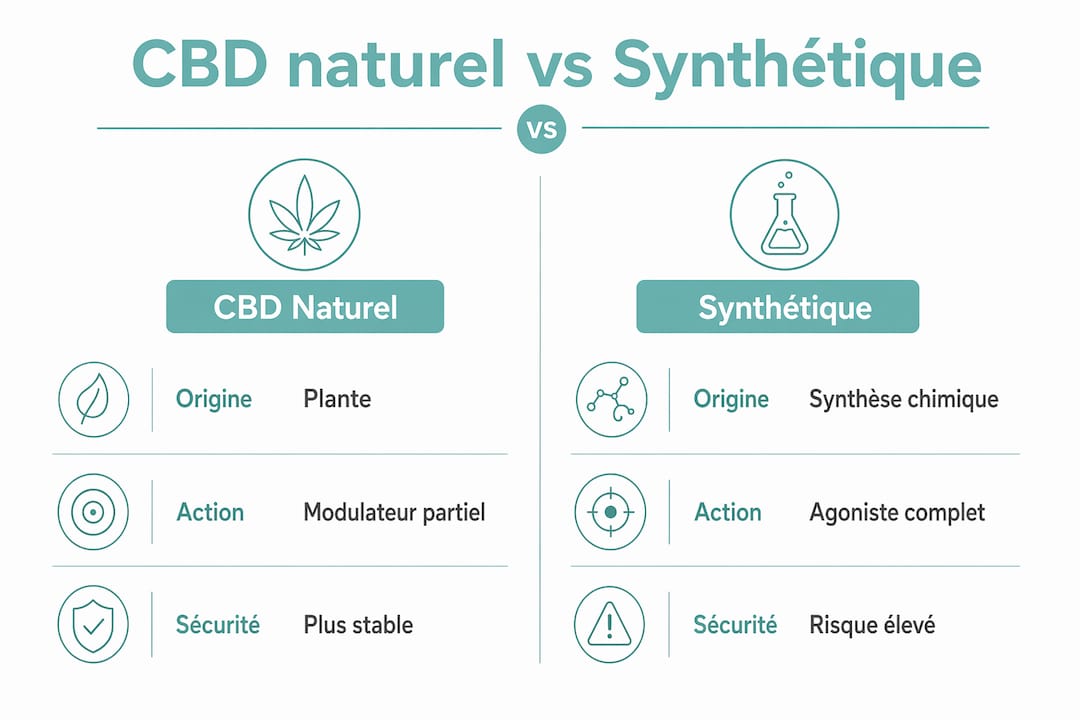
Natural CBD acts as a partial modulator of the CB1 and CB2 receptors in the endocannabinoid system. It does not fully activate these receptors, which limits its psychoactive potential and side effects. Synthetic cannabinoids, on the other hand, often behave as full agonists of CB1 receptors. This means they activate these receptors to their fullest extent, producing much more intense and less predictable effects.
A full CB1 receptor agonist can produce a response that is ten to one hundred times stronger than that of natural THC. This increased potency does not equate to therapeutic benefit. On the contrary, it indicates a high toxicological risk.

| Criteria | Natural CBD | Synthetic cannabinoids |
|---|---|---|
| Origin | Cannabis sativa plant | Chemical Synthesis in the Laboratory |
| CB1 Interaction | Partial Modulator | Full agonist |
| CB2 Interaction | Partial Modulator | Varies depending on the molecule |
| Psychoactive effects | Absent or very weak | Potentially intense |
| Predictability of Effects | Good | Low to very low |
| Documented Toxicity | Limited to high doses | High, often unknown |
The unpredictable effects of synthetic cannabinoids have been documented by the EUDA, which emphasizes that these molecules interact differently with the endocannabinoid system. To learn more about the differences between cannabinoids, there are specialized resources that provide detailed information on each molecular family.
Pro tip: A molecule’s potency does not indicate its safety. A synthetic cannabinoid that is more potent than natural THC poses a much higher risk profile—not a therapeutic benefit.
What are the health risks associated with synthetic cannabinoids?
Synthetic cannabinoids can trigger bouts of anxiety, panic attacks, and severe discomfort, often without the person affected being aware of it before the episode begins. Philippe Batel, a psychiatrist specializing in addiction, has warned about psychotic episodes linked to these substances when mixed with CBD products.
Synthetic cannabinoids are manufactured to circumvent regulations and are often much more potent than natural THC. Their toxicity is frequently unknown at the time they are released onto the market, making their use particularly risky.
In France, several hundred cases of poisoning have been reported to the ANSM, often linked to the presence of undeclared synthetic cannabinoids in products sold as CBD. These cases of poisoning occur because consumers are unaware of the actual composition of what they are buying.
The warning signs to watch for are as follows:
- Vague or missing labeling: no indication of botanical origin; no certificate of analysis.
- Unusually low prices: A high-quality, natural CBD product has a real production cost.
- Very rapid and intense effects: a strong psychoactive high after consuming a product marketed as CBD is a red flag.
- Lack of traceability: no lot number, no identifiable supplier, and no accessible laboratory test results.
- Sales through unregulated channels: informal markets, social media platforms without age verification.
In 2025, the EUDA was monitoring 1,050 new psychoactive substances, including 50 synthetic cannabinoids detected for the first time. This figure illustrates the speed at which new molecules are emerging, making any prior toxicological assessment virtually impossible.
Pro tip: Be wary of products without an available certificate of analysis. A reputable seller consistently publishes the results of independent laboratory tests, confirming the absence of synthetic cannabinoids.
What is the regulatory framework governing natural CBD and synthetic cannabinoids in Europe?
Natural CBD is subject to the European “Novel Food” regulation. CBD-based food products are not authorized for sale in the European Union because they have not undergone a comprehensive safety assessment. This includes dietary supplements, herbal teas, and certain oils intended for ingestion.
In France, the ANSM and the Ministry of Agriculture exercise stricter oversight over hemp-based products. The sale of CBD flowers and leaves is regulated by a decree that sets maximum THC levels. Synthetic cannabinoids, on the other hand, have no recognized legal status as consumer products. They are generally classified as narcotics or psychoactive substances as soon as they are identified.
| Regulatory criterion | Natural CBD | Synthetic cannabinoids |
|---|---|---|
| EU Novel Food Status | Currently being evaluated | Not applicable |
| Sales in France | Encadrée (taux THC < 0,3 %) | Prohibited or unregulated |
| ANSM Inspection | Yes | Ad hoc monitoring |
| EFSA Assessment | In progress | Absent |
| Legal Recognition | Partial | A tie or a stunning result |
No food products containing CBD or synthetic cannabinoids have yet undergone the Novel Food process to validate their food safety in the EU. This regulatory gap poses a significant health risk to uninformed consumers. To better understand the legal implications, reading about legal psychoactive cannabinoids provides useful insight into current regulatory distinctions.
How can you recognize and choose high-quality, natural CBD?
Identifying a reliable natural CBD product depends on concrete, verifiable criteria. Here are the steps to follow for a responsible purchase:
-
Check the product’s botanical origin. Natural CBD comes exclusively from hemp varieties (Cannabis sativa L.) with a THC content of less than 0.3%. Information about the cultivated variety and country of origin is a good indicator of transparency.
-
Require a certificate of analysis (CoA) issued by an independent laboratory. This document must include the complete cannabinoid profile and confirm the absence of pesticides, heavy metals, and residual solvents. It must explicitly state that the product contains no synthetic cannabinoids.
-
Check the extraction method. Supercritical CO₂ extraction is the gold standard for obtaining a pure extract free of chemical residues. Ethanol extraction is also acceptable. Be wary of products that do not specify the extraction method.
-
Assess the seller’s transparency. A reputable supplier clearly lists its contact information and SIRET number and provides technical data sheets for each batch. The side effects of natural CBD are well-documented and predictable, unlike those of synthetic CBD.
-
Compare the price to market rates. High-quality natural CBD has actual production costs associated with organic cultivation, extraction, and testing. A very low price should raise concerns about the product’s quality or actual composition.
-
Avoid unregulated sales channels. Products sold without a receipt, without proper labeling, or through informal networks carry a high risk of containing undeclared substances.
Pro tip: Before making a purchase, compare natural CBD to THC in terms of composition and effects. Reading resources such as the CBD vs. THC comparison helps you understand why molecular origin makes all the difference.
Key Points
Natural CBD and synthetic cannabinoids differ in their origin, their mechanism of action on the endocannabinoid system, and their risk profile, making product traceability essential for safe use.
| Point | Details |
|---|---|
| Determining Chemical Origin | Natural CBD comes from the plant; synthetic CBD is manufactured in a laboratory and often has unpredictable potency. |
| High pharmacological risk | Synthetic cannabinoids activate CB1 receptors at full strength, producing documented toxic effects. |
| Persistent Regulatory Gap | No synthetic cannabinoids have recognized legal status in Europe; their sale is either prohibited or unregulated. |
| Traceability as a Key Criterion | An independent certificate of analysis is the only reliable way to verify the absence of synthetic substances. |
| EFSA Sets a Threshold for Natural CBD | The provisional daily dose of 0.0275 mg/kg/day applies only to plant-derived CBD, not to synthetic CBD. |
What Field Experiments Reveal About These Two Families of Molecules
After years of tracking developments in the CBD market and the market for new psychoactive substances, one thing is clear: the confusion between natural CBD and synthetic cannabinoids is not accidental. It is sometimes deliberately perpetuated by players who take advantage of regulatory loopholes to sell products that are inexpensive to manufacture but yield high profit margins.
What strikes me most is the speed at which new synthetic molecules are appearing on the market. The EUDA reported 50 new synthetic cannabinoids detected for the first time in 2025. No toxicologist can assess their safety in real time. Consumers are, in effect, serving as unwitting guinea pigs.
Exercising caution regarding neo-cannabinoids is not a conservative stance. It is a rational response to a well-documented reality: hundreds of reported cases of poisoning in France, severe psychotic effects, and a complete lack of clinical data on most of these molecules. Demanding transparency regarding a product’s origin and composition is not a burden. It is the bare minimum required to make informed consumption choices.
— Steven
Pure-extract-cbd: Natural, tested CBD—with no compromise on quality
Pure-extract-cbd offers a range of products made with natural CBD, derived from organic hemp and tested by an independent laboratory. Every batch is traceable, and every certificate of analysis is available. None of the products in the store contain synthetic cannabinoids.

Whether you’re looking for CBD oil in Bordeaux or want to browse the entire catalog, Pure-extract-cbd guarantees that its products comply with French and European regulations. Delivery is fast, and customer service is available to answer your questions about ingredients and usage. Browsing the available products allows you to compare formats, concentrations, and origins with complete transparency.
Frequently Asked Questions
What is the main difference between natural CBD and synthetic cannabinoids?
Natural CBD is extracted from the Cannabis sativa plant, while synthetic cannabinoids are chemically manufactured in a laboratory. This difference in origin results in radically different mechanisms of action and risk profiles.
Are synthetic cannabinoids legal in France?
No. Synthetic cannabinoids have no recognized legal status in France and are generally classified as narcotics as soon as they are identified by health authorities.
How can you tell if a CBD product contains synthetic cannabinoids?
A certificate of analysis issued by an independent laboratory is the only reliable method. This document must explicitly state that the product is free of synthetic cannabinoids and detail the product’s complete cannabinoid profile.
What are the health risks associated with synthetic cannabinoids?
They can cause anxiety attacks, panic attacks, psychotic episodes, and severe poisoning. Several hundred cases have been reported to the ANSM in France, often linked to products falsely marketed as natural CBD.
Is natural CBD completely safe?
Natural CBD has a well-documented safety profile at moderate doses. The EFSA has established a provisional daily intake of 0.0275 mg/kg/day. At very high doses, adverse effects such as fatigue or drug interactions are possible.



