
CBD may relieve certain symptoms associated with withdrawal, including anxiety and reactivity to tobacco-related cues, but it is neither a validated treatment nor a substitute for nicotine. Nicotine replacement therapies, varenicline, and bupropion remain the recommended treatments. However, a pilot study observed a reduction in cigarette consumption among those using CBD, an encouraging sign that has yet to be confirmed.
In short:
- CBD has no direct effect on nicotine dependence, but it may reduce anxiety and the attentional salience associated with relapse triggers.
- Available studies show a reduction in consumption or a change in attention to smoking cues, but without concrete evidence of an effect on actual physiological need.
- Non-combustible forms, such as sublingual oil or capsules, are preferable for smoking cessation support, as they avoid the inhalation of smoke.
- CBD is not a substitute for recommended treatments such as nicotine replacement therapy, varenicline, or bupropion, and its use should be supervised by a healthcare professional, especially if you are currently undergoing treatment.
- Caution is still warranted, as research is still limited and current findings are primarily indicative rather than definitive.
Table of Contents
- How CBD Affects Withdrawal Symptoms
- State of the Scientific Evidence: Key Studies and Limitations
- Safety, Interactions, and the Position of Health Authorities
- Practical Guide: Forms, Dosage, and Incorporation into a Smoking Cessation Strategy
- Editorial evidence and resources for further study
- Testimonials and Experiences with CBD and Quitting Smoking
- Duration and Protocol for CBD Use During Nicotine Withdrawal
- Comparing CBD to Nicotine replacement therapies and Medications
- For whom might CBD be a realistic supplement?
- Smoke-free products to support smoking cessation efforts
- Sources
- Frequently Asked Questions
How CBD Affects Withdrawal Symptoms
CBD interacts with the endocannabinoid system, a network of receptors involved in regulating stress, mood, and sleep. This interaction may partly explain its anxiolytic effects observed in several clinical settings—effects that could alleviate some of the discomfort experienced during the first few days of quitting smoking.
One mechanism that is particularly relevant to smoking cessation is attentional salience—that is, the brain’s tendency to identify and focus its attention on cues associated with cigarettes (a pack, a lighter, the smell of smoke). Reducing this salience could decrease the likelihood of impulsive relapse, without affecting the pharmacological mechanism of nicotine dependence itself.
- CBD has no direct affinity for the nicotinic receptors responsible for addiction.
- It appears to have a greater effect on the emotional aspects of withdrawal (anxiety, irritability, sleep disturbances) than on physical cravings.
- Its reported effects are temporary and do not replace treatment for the addiction itself.
In other words, CBD appears to address the psychological aspects of withdrawal rather than its chemical aspects, which explains why it is presented as a supplement and never as a standalone treatment.
State of the Scientific Evidence: Key Studies and Limitations
The available data are still limited but consistent on one point: CBD appears to have a measurable effect on indirect markers of withdrawal, with no solid evidence of an effect on addiction itself.
According to a randomized pilot study conducted in 2013, 24 smokers reduced their cigarette consumption by nearly 40% in one week using a CBD inhaler on an as-needed basis. However, the small sample size and the lack of long-term follow-up limit the significance of this finding, which should be interpreted as a preliminary indication rather than as evidence of efficacy.
A second study, this time an experimental one, tested a single oral dose of 800 mg of CBD in abstinent smokers. CBD reduced the attentional salience of smoking cues but did not significantly reduce cravings or subjective withdrawal symptoms—an important distinction: the brain reacts less to visual triggers, without necessarily reducing the intensity of the cravings.
- The 2013 study involved a sample of 24 people, which is too small to generalize the findings.
- The 2018 study measured an effect on attention, not on subjective withdrawal.
- An ongoing clinical trial, registered under the reference NCT06218056, is evaluating CBD over a 56-day period based on objective criteria such as the number of cigarettes smoked and plasma cotinine levels.
This ongoing research could provide more robust data, but for now, caution is still warranted before drawing any definitive conclusions.
Safety, Interactions, and the Position of Health Authorities
The WHO’s international recommendations advocate a combination of behavioral therapies and validated pharmacological treatments—such as nicotine replacement therapy, varenicline, and bupropion—as the standard-of-care approach to smoking cessation. Alternative approaches, including CBD, are not among the recommended first-line options due to a lack of sufficient evidence.
CBD is metabolized by cytochrome CYP450 enzymes, which can alter the effects of certain medications, including anticoagulants and psychiatric medications. French health authorities also note that mixing CBD with tobacco in a joint perpetuates nicotine dependence, which runs counter to the goal of quitting.
- Avoid combining CBD with smoked tobacco, as this combination prolongs exposure to nicotine.
- Tell a healthcare professional about your CBD use if you are taking any regular medication.
- Pregnancy and breastfeeding call for special caution, as there are insufficient safety data.
Pro tip: Always opt for non-combustible forms; inhaling smoke is harmful to the respiratory tract, regardless of the substance being smoked.
Practical Guide: Forms, Dosage, and Incorporation into a Smoking Cessation Strategy
To ensure informed use, certain forms are better suited to the context of withdrawal than others. Non-combustible consumption methods —such as sublingual oil, nicotine-free CBD e-liquids, or vaporizers—limit exposure to substances produced by combustion, unlike a joint that combines CBD and tobacco.
- Start with a low dose, then monitor the effects for 7 to 14 days before adjusting the dose—a timeframe consistent with the time it takes for effects to become apparent, as reported in expert reviews on the subject.
- Focus on high-risk moments —such as a sudden craving, a social situation associated with smoking, or immediately after a relapse—rather than taking it systematically without a specific goal.
- Combine this approach with behavioral support, and consider using a nicotine replacement therapy at the same time if physical withdrawal symptoms remain severe.
Pro tip: Keep a simple journal of your cravings to smoke and their intensity before and after taking CBD; this will help you objectively assess whether the perceived effect is real or related to other factors.
Editorial evidence and resources for further study
Pure Extract CBD selects products made from organic hemp that have been laboratory-tested to verify their compliance and safety—an approach focused on transparency rather than any therapeutic claims. Since CBD is not recognized as a treatment for withdrawal, this content is intended to inform and is not a substitute for medical advice.
- Read a comprehensive scientific review on CBD and addiction to learn more about the mechanisms discussed above.
- Check out the practical guide to quitting smoking with CBD for detailed usage instructions.
- If you are currently taking medication, a tobacco specialist or doctor is the best person to consult before taking CBD.
Testimonials and Experiences with CBD and Quitting Smoking
The experiences shared by people who have tried to quit smoking with the help of CBD often point to a similar observation: a noticeable effect on nervous tension and restlessness during the first few days, without the physical craving for nicotine disappearing. Some users describe using it selectively—taking sublingual oil before a stressful meeting or after an argument—moments they identify as common triggers for smoking.
Other, more cautious accounts report observing no noticeable changes, which is consistent with the individual variability documented in the available scientific data. This heterogeneity in reports can be explained in part by differences in dosage, form of consumption, and lifestyle—factors that are rarely controlled for in personal use.
One point comes up frequently in these accounts: CBD seems to work better when used as part of a structured approach, with a clearly defined goal of quitting, rather than as a stand-alone solution. People who combine CBD with behavioral counseling or a nicotine replacement therapy generally report a more satisfying experience than those who use it alone, hoping for an effect comparable to that of a medication. While these testimonials are useful for understanding real-world use, they do not replace data from controlled clinical trials and should be interpreted with the same caution as the pilot studies mentioned above.
Duration and Protocol for CBD Use During Nicotine Withdrawal
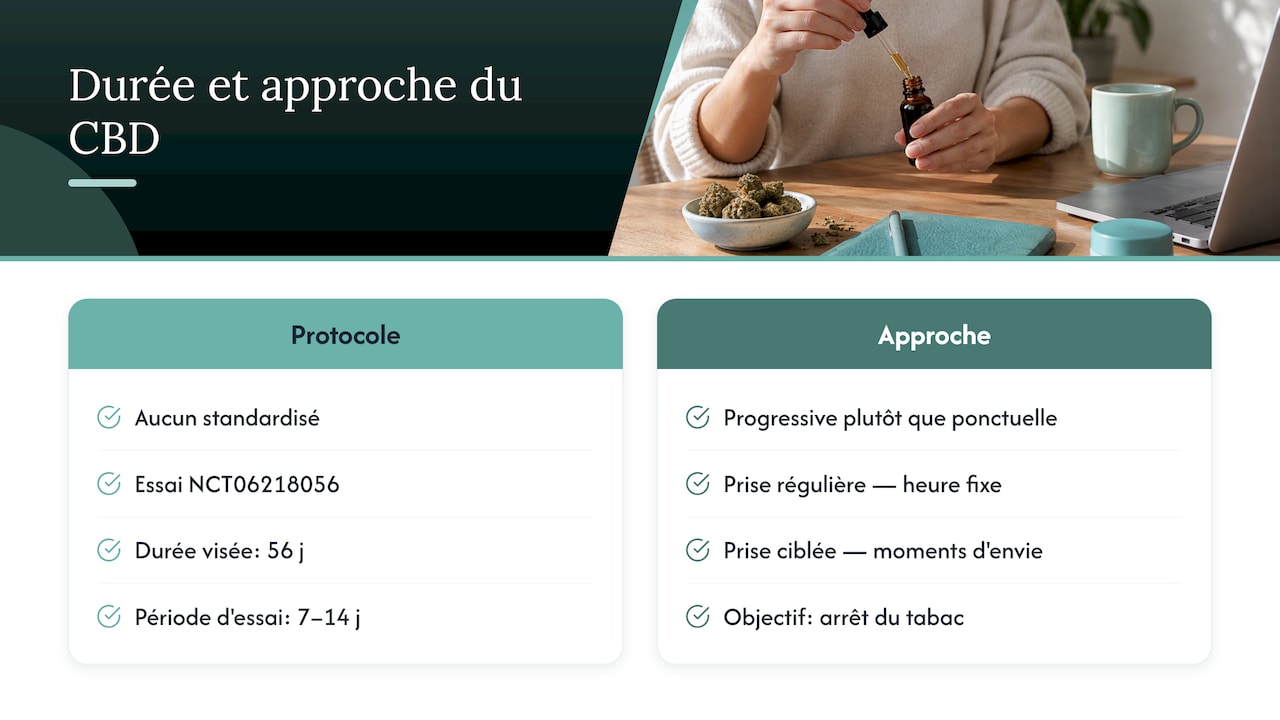
To date, no standardized protocol exists for the use of CBD in smoking cessation; ongoing clinical trials—including the one listed under NCT06218056—aim precisely to establish more precise guidelines for a 56-day treatment period. In the absence of a formal consensus, the available observations suggest a gradual approach rather than a single dose.
A 7- to 14-day trial period at a stable dose generally allows for an assessment of whether an effect is present before adjusting the amount or frequency. This timeframe corresponds to the time it takes for effects to become apparent, as reported in clinical field observations. Longer-term use, spanning several weeks, is more in line with the concept of ongoing anxiety management than with a withdrawal protocol per se.
In practice, there are two distinct approaches: regular use at set times, intended to stabilize one’s overall mood, and targeted use, reserved for moments of strong cravings or situations identified as triggers. The second approach aligns more closely with the concept of active cessation, as it directly targets episodes of relapse risk rather than providing a long-term effect. Regardless of the approach chosen, quitting smoking remains the central goal, with CBD serving only as occasional support for this broader effort.
Comparing CBD to Nicotine replacement therapies and Medications
Nicotine replacement therapies (patches, gum, lozenges) directly address physical cravings by providing a controlled dose of nicotine, which alleviates withdrawal symptoms while gradually reducing dependence. Varenicline and bupropion, two pharmacological treatments recommended by the WHO, act on nicotinic receptors in the brain or on dopamine regulation, with a level of evidence significantly higher than that of CBD.
Unlike these options, CBD does not target nicotinic receptors and therefore has no direct effect on pharmacological dependence. Its benefits lie instead in addressing peripheral symptoms—such as anxiety, irritability, and reactivity to visual cues associated with tobacco—which often accompany withdrawal without constituting its core physiological mechanism.
This difference in mechanism explains why CBD is not presented by any health authority as an alternative to approved treatments, but why some view it as a possible supplement—particularly for people whose relapses are more closely linked to stress than to pure physical cravings. A smoker with a strong nicotine dependence will likely benefit more from a properly dosed nicotine replacement therapy, while a person whose cravings are triggered by social anxiety might find CBD to be a useful supplement—provided they do not expect it to have an effect on the physical cravings themselves.
For whom might CBD be a realistic supplement?
CBD appears to be most beneficial for smokers whose relapses are linked to stress or anxiety rather than purely physical cravings. While it alleviates certain symptoms, it does not replace nicotine. Consulting with a smoking cessation specialist or a doctor remains the best way to assess its role in a personalized smoking cessation strategy.
— Steven
Smoke-free products to support smoking cessation efforts
A selection of products made from organic hemp—laboratory-tested to verify their compliance and safety—is available, though these products are never presented as a treatment for smoking cessation. For readers interested in exploring smoke-free options,sublingual oil, fixed-dose capsules, or CBD extracts are suitable starting points for targeted and measured use.

- CBD oils allow for precise dosing, which can be adjusted based on individual sensitivity.
- CBD capsules provide a discreet and consistent way to take the product, without having to adjust the dosage.
- CBD and CBG extracts are intended for more concentrated use and should be reserved for people who are already familiar with these products.
| Format | Recommended Use | Main Advantage |
|---|---|---|
| Sublingual oil | Targeted intervention before a risky situation arises | Adjustable dosage |
| CBD capsules | Taken regularly at a set time | Simplicity and discretion |
| CBD/CBG Extracts | Intensive use for experienced users | High concentration |
Before taking any product, check for possible interactions with any current medications and consult a healthcare professional if you have any questions. Explore the full range of CBD products offered by Pure Extract CBD to choose the form that best suits your needs.
Sources
- Cannabidiol Reduces Cigarette Consumption Among Tobacco Smokers: Preliminary Findings
- Cannabidiol Reverses Attentional Bias Toward Cigarette Cues in a Human Experimental Model of Tobacco Withdrawal
- WHO Clinical Treatment Guideline for Tobacco Cessation in Adults
- Solidarity in Health
Frequently Asked Questions
Which CBD product should you choose to help you quit smoking?
Smoke-free forms—such as sublingual oil, capsules, or nicotine-free e-liquid—are preferable because they avoid the inhalation of smoke. The choice depends mainly on the desired ease of use; oil allows for more precise dosing than a capsule with a fixed concentration.
Can CBD replace nicotine?
No, CBD does not act on the nicotinic receptors responsible for physical dependence and therefore cannot serve as a substitute for nicotine. However, according to preliminary experimental studies, it may alleviate certain associated symptoms, such as anxiety.
Does nicotine counteract the effects of CBD?
There is no evidence that nicotine counteracts the effects of CBD, as these two substances act on different systems in the body. However, smoking tobacco while using CBD perpetuates nicotine addiction, which French health authorities advise against.
Is CBD safer than tobacco?
CBD is not psychoactive and does not pose the respiratory risks associated with tobacco combustion when consumed in the form of oil or capsules. However, the comparison is limited, since CBD is being studied for its effects on smoking cessation and not as a substitute product evaluated in the same way as tobacco.