
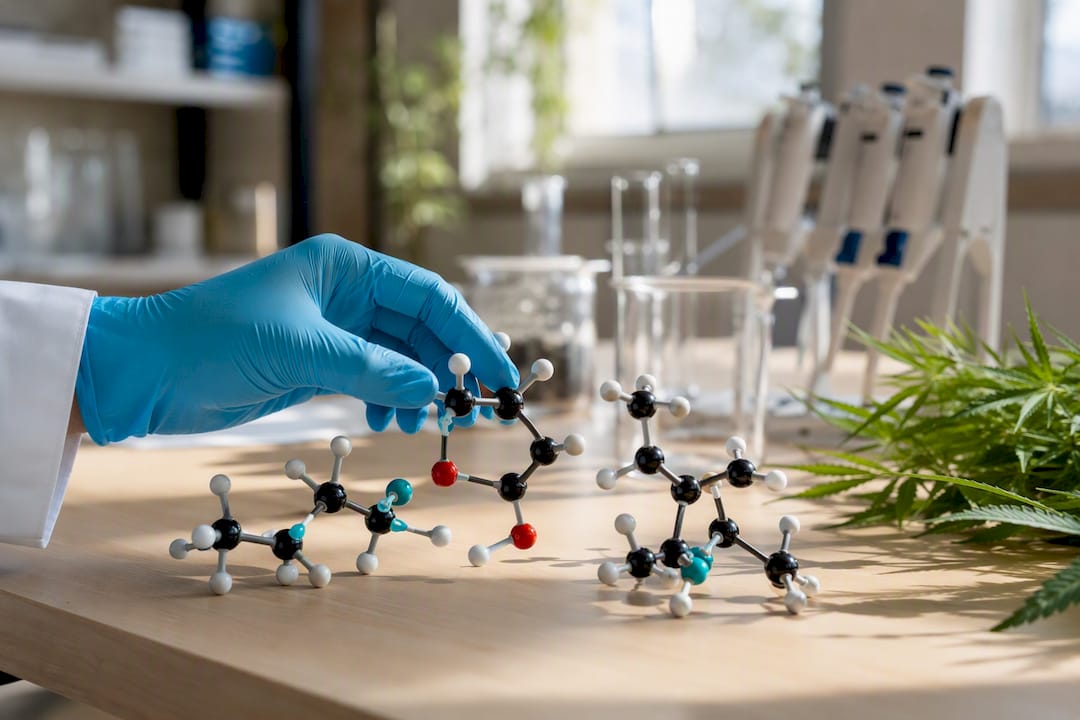
THC causes cannabis intoxication; CBD does not produce a “high” and instead acts as a modulator of the body. The practical difference between CBD and THC comes down to two things: each molecule’s affinity for brain receptors, and the level of Δ9-THC contained in the product.
Here are the key points to keep in mind before we get into the details:
- Chemistry: The two molecules have the same formula (C21H30O2), but their atomic structure differs, which completely changes their biological behavior.
- Effects: THC is psychoactive and intoxicating; CBD, on the other hand, helps alleviate anxiety and inflammation without causing a “high,” even though it is not entirely neutral on the brain.
- Legality: In France, a product may not legally contain more than 0.3% Δ9-THC, a threshold that should always be checked on the label or the certificate of analysis.
This distinction is not merely academic. It determines how you will feel, what you risk during a traffic stop, and what you are allowed to buy.
Key Points
The difference between CBD and THC lies in their affinity for brain receptors, a legal threshold of 0.3% Δ9-THC, and the need to verify a certificate of analysis before purchasing.
| Point | Details |
|---|---|
| Isomers, Distinct Effects | The same chemical formula, but a different atomic arrangement—which explains why THC is intoxicating and CBD is not. |
| Legal threshold to be met | Under French regulations, a CBD product may not legally contain more than 0.3% Δ9-THC. |
| Screening Risk | The tests target THC metabolites; a mislabeled product could cause a person to fail a drug test. |
| The COA Above All Else | Checking the batch analysis certificate is still the best practice for avoiding non-compliant products. |
| Pure CBD extract, a tried-and-true option | Pure-extract-cbd offers flowers, oils, and resins that have been tested by an independent laboratory and comply with French regulations. |
Table of Contents
- Chemical Structure and Isomerism: Why Two Similar Molecules Behave Differently
- Mechanisms of Action: How CBD and THC Affect the Brain and Body
- The Entourage Effect: What Happens When CBD and THC Work Together
- The Legality of CBD and THC: Thresholds and Rules You Need to Know
- Can you test positive for THC if you use CBD?
- How to Read a Certificate of Analysis Before Buying CBD
- What People Forget to Mention About the CBD vs. THC Debate
- Where to Find Lab-Tested, Compliant CBD
- Sources
Chemical Structure and Isomerism: Why Two Similar Molecules Behave Differently
CBD (cannabidiol) and THC (tetrahydrocannabinol) share the same chemical formula: C21H30O2. On paper, they are twins. In reality, they are isomers—that is, the same atoms are arranged differently in space, much like two keys cut from the same metal but with teeth that don’t open the same lock.
This structural difference has a direct consequence. THC has a closed ring structure that allows it to bind precisely to the CB1 receptor in the brain, much like a key turning in a lock. CBD, on the other hand, has a free hydroxyl group in place of this ring: it does not bind to the receptor in the same way and therefore does not trigger the same cascade of effects.
In practical terms, this explains why:
- THC directly and strongly activates CB1 receptors, which causes the cannabis-induced high.
- CBD interacts more weakly and differently with these same receptors, without causing intoxication.
- Even the slightest variation in the position of a single chemical group is enough to distinguish a toxic molecule from a non-toxic one.
Bioavailability also varies depending on the route of administration. CBD oil taken sublingually does not take effect at the same rate as inhaled flowers—a factor that applies equally to both THC and CBD, depending on the available forms.
Mechanisms of Action: How CBD and THC Affect the Brain and Body
THC is a direct agonist of the CB1 receptor, which is primarily found in the central nervous system. By binding to this receptor, it triggers euphoria, an altered perception of time, and, in some people, anxiety or psychiatric symptoms with repeated and heavy use. The CB2 receptor, which is more prevalent in the immune system, contributes to anti-inflammatory effects but has less of a psychoactive impact.
CBD works in the opposite way. It acts as a negative allosteric modulator of the CB1 receptor: it does not activate it directly, but alters its shape in a way that reduces THC’s affinity for that same receptor when the two are present together. It also stimulates the 5-HT1A serotonin receptor, which accounts for part of its calming effect, and interacts with the GPR55 receptor, which is involved in regulating inflammation.
CBD is not classified as a narcotic and is not addictive, but it does have psychoactive effects through its interactions with the brain, Ameli points out. In other words, “non-intoxicating” does not mean “without any effect on the brain.”
One point deserves special attention: CBD is metabolized by the liver enzyme CYP3A4, the same enzyme that metabolizes many medications. A scientific review published on PMC documents that this interaction can increase the plasma concentration of certain medications, such as clobazam, an antiepileptic drug. If you are taking a long-term medication, this interaction makes it important to consult a healthcare professional before combining it with CBD.
Pro tip: Before combining CBD with prescription medication, check whether your medication is metabolized by CYP3A4 (this is often indicated on the package insert) and ask your pharmacist for advice.
These mechanisms remain largely documented in laboratory settings or in preclinical models. Large-scale clinical trials in humans are still limited, which calls for caution regarding the promises that can reasonably be attributed to each molecule.
The Entourage Effect: What Happens When CBD and THC Work Together
The entourage effect refers to the idea that cannabinoids act differently when combined than when taken separately, with CBD potentially mitigating certain undesirable effects of THC rather than amplifying them. Preclinical data support this: they show a reduction in certain anxiety-inducing effects of THC when it is combined with CBD, although clinical results in humans remain limited.
For the user, this translates into a concrete choice:
- A full-spectrum product retains the entire range of cannabinoids found in hemp, including trace amounts of THC, and may provide a more pronounced entourage effect.
- An isolate product contains only pure CBD, without the entourage effect, but with virtually no risk of traces of THC.
- Broad-spectrum lies somewhere in between: it contains several cannabinoids, with no detectable THC in theory.
The choice therefore depends on your investment objective and your risk tolerance, especially if you are subject to regulatory oversight.
The Legality of CBD and THC: Thresholds and Rules You Need to Know
In France, the reference threshold is clear on paper: a product cannot legally contain more than 0.3% Δ9-THC to be sold. Above that threshold, it falls under the narcotics regulations, with the criminal consequences that entails. This threshold applies to the plant and its raw derivatives; it does not exempt manufacturers from verifying each finished product, as the concentration can vary from one batch to another.
Here are the key points to remember:
- CBD is not classified as a narcotic per se, but some related cannabinoids have recently been classified as such.
- The list of banned substances is changing: authorities have recently classified cannabinoids such as HHC, THCP, and HHCPO as controlled substances—a regulatory landscape in flux that must be monitored.
- Medical claims are regulated: a seller may not claim that a CBD product treats a medical condition without authorization, or face penalties.
Before making any purchase, two simple steps are enough to minimize risks: request the certificate of analysis (COA) for the specific batch, and be wary of overly specific therapeutic claims. Our detailed comparison of CBD and THC breaks down these legal nuances point by point, including the areas where regulations remain unclear.
Can you test positive for THC if you use CBD?
The vast majority of saliva and urine tests do not screen for CBD, but rather for THC metabolites—specifically THC-COOH in the case of urine tests. A compliant CBD product, with a Δ9-THC level below the legal threshold, should therefore, in theory, not result in a positive test.
The problem rarely stems from CBD itself, but rather from the quality of the product. Mislabeled products may contain Δ9-THC levels above the stated threshold, which can be enough to cause a positive test result, especially with frequent and cumulative use.
To minimize this risk, especially if you are driving or are subject to workplace drug testing:
- Choose isolate or broad-spectrum formulations rather than full-spectrum ones.
- Always request the COA for the purchased batch, not just a generic product analysis.
- As a precaution, space out or reduce your intake before a scheduled checkup.
Our article on the link between CBD and positive saliva tests details specific cases experienced by drivers.
How to Read a Certificate of Analysis Before Buying CBD
The certificate of analysis (COA), issued by an independent laboratory, remains the most reliable way to verify a product’s actual contents. Making an informed choice about the product and its origin significantly reduces the risk of non-compliant traces of Δ9-THC.
Here's what you should check before making any purchase:
- The actual CBD and Δ9-THC content, compared to what is stated on the label.
- The absence of pesticides, heavy metals, and residual solvents, which is particularly important for inhaled products.
- The source of the hemp and the extraction method, as supercritical CO2 is generally considered cleaner than chemical solvents.
- Choose the product form that best suits your goal: oil for regular, measured use; a flower or resin for a faster effect; or an edible for a prolonged effect.
Pro tip: Never trust a “lab-tested” claim without a direct link to the full report. A legitimate COA includes a lot number, a date, and the name of the lab—not just a logo.
Also keep in mind that no CBD product is officially recognized by French health authorities as a treatment for any specific condition, including chronic pain. So be cautious of any overly assertive claims—a point we discuss in detail in our article on the limitations of medical claims regarding CBD.
What People Forget to Mention About the CBD vs. THC Debate
Most articles on CBD vs. THC pit the two molecules against each other as if readers had to choose a side: one “bad” and intoxicating, the other “good” and risk-free. This binary view does a disservice to the reader. CBD is not a harmless version of THC; it is a molecule with its own mechanisms, its own limitations, and its own interactions that need to be monitored, particularly through CYP3A4.
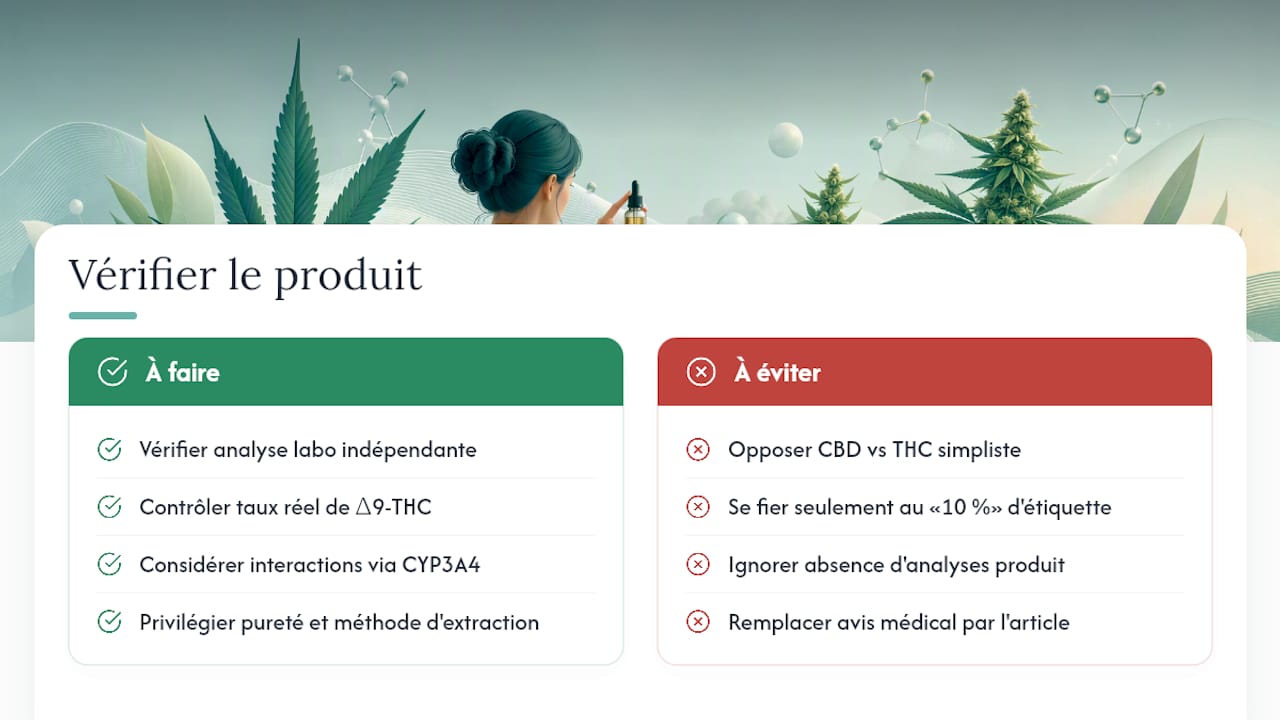
Another factor that’s often underestimated is the importance of product quality in the equation. Two CBD oils labeled “10%” may behave radically differently depending on their actual Δ9-THC content, purity, and extraction method. The scientific debate between CBD and THC is important, but it becomes almost secondary if the product you’re holding in your hands has never been properly analyzed. So the real question isn’t just “CBD or THC,” but “does this bottle really contain what it claims to?”
This article provides an educational overview based on available scientific and regulatory data; it is in no way a substitute for personalized medical advice, especially if you are currently undergoing treatment.
— Steven
Where to Find Lab-Tested, Compliant CBD
Checking a COA before making a purchase is good. Not having to look for it yourself is even better. Pure-extract-cbd offers flowers, oils, resins, and infused products made from organic hemp, each accompanied by independent lab reports guaranteeing that the Δ9-THC level complies with the legal threshold.
Unlike some sellers who simply display a “lab-tested” logo without providing an accessible report, every item in the store comes with verifiable information about its composition. If you’re looking for a popular strain to try as a beginner, Northern Light small buds are a great place to start—as is the entire catalog of lab-tested products available online. Browse the store and compare the certificates of analysis directly on each product page before placing your order.
This article is intended to provide general information and is not a substitute for the advice of a qualified healthcare professional. Consult a qualified healthcare professional about your specific situation before taking any action based on this content.
Sources
If you'd like to explore the topic of CBD versus THC further beyond this article, these are some authoritative resources:
- MILDECA | CBD
- Ameli | Non-Medical Cannabidiol (CBD): Definition and Precautions for Use
- Review article on the mechanisms of THC and CBD — PMC
- Health Magazine | Cannabis: Are CBD Products Effective for Relaxation or Sleep?



