
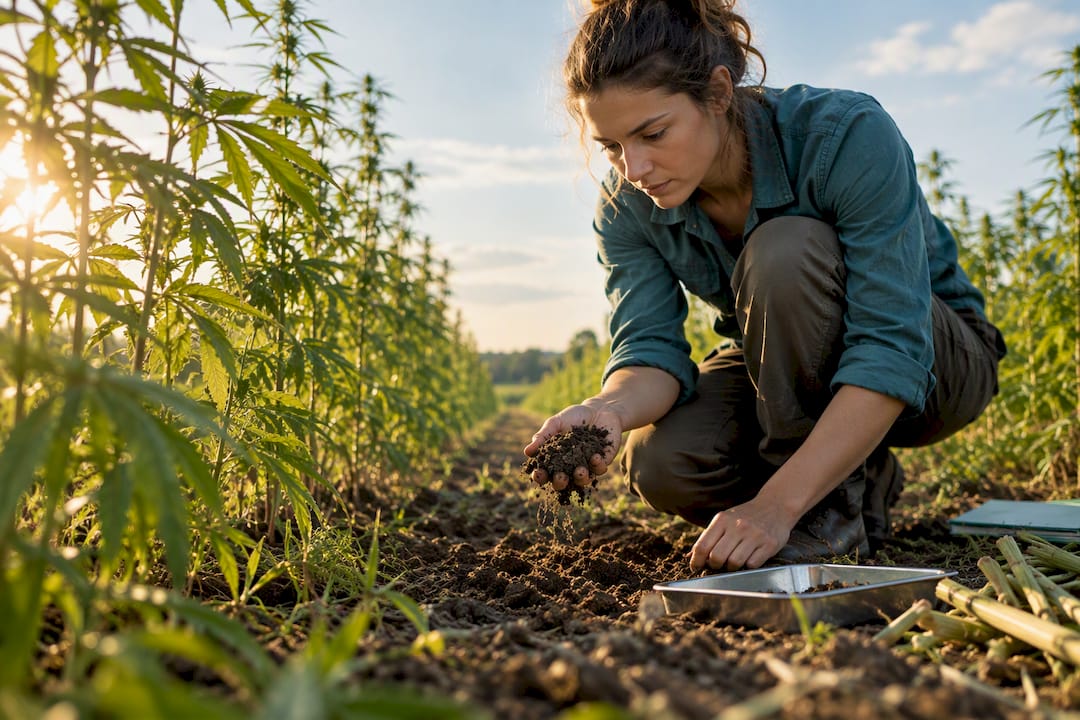
The “organic” label describes a method of cultivation, never a guarantee of the finished product. For textiles, organically grown hemp generally has a more favorable environmental footprint, but for CBD-based products, safety depends primarily on batch testing and the processing method. Before making any purchase, always ask for the certificate of analysis (COA), the certifying body’s code, and the extraction method used.
In short:
- Organic certification does not guarantee the absence of residues or the final composition of a CBD-based product; only batch analysis is conclusive.
- The average cost premium for organic processed products ranges from 15 to 30 percent, due to certification costs and farming constraints.
- The true ecological value of hemp depends primarily on downstream processing and traceability, not just on how it is grown.
- Always check the certificate of analysis, the certifying agency’s code, and the extraction method to ensure the product’s safety.
- Caution is advised when considering products that lack a recent COA or lack transparency regarding the extraction method, whether they are organic or conventional.
Table of Contents
- A Practical Comparison of Organic and Conventional Farming
- What is the actual environmental impact of organic and conventional hemp?
- Quality and Safety: Labels, Certificates of Analysis, and Health Alerts You Should Know About
- Textiles, food, CBD: The criteria vary depending on the intended use
- How to Choose Between Organic and Conventional Hemp Before Buying
- What the debate between organic and conventional farming too often overlooks
- Where to Find Truly Certified Organic Hemp
- Sources
- Frequently Asked Questions
A Practical Comparison of Organic and Conventional Farming
Both cultivation methods share a common characteristic: hemp naturally requires few inputs, which limits the agronomic gap between the two production systems compared to other crops. The difference lies primarily in certification, crop rotation, and the absence of synthetic inputs in organic farming, which has a direct impact on production costs.
- Yield and crop rotation: Organic farming requires longer crop rotations and prohibits the use of synthetic fertilizers, which can slightly reduce the yield per hectare.
- Price: Specialized guides estimate that organic products typically cost 15 to 30 percent more than conventional products for certain processed goods, due to certification costs and production constraints.
- Textile properties: The mechanical strength and comfort of fibers depend more on post-harvest processing (retting, scutching) than on the cultivation method itself.
- Dyeing and blending: Organic fibers behave similarly to conventional fibers during the dyeing process, provided that the subsequent chemical treatment meets the same standards.
For CBD-based products, organic farming remains a useful criterion but is insufficient on its own. A batch analysis certificate often makes the decisive difference in assessing actual quality, since extraction and processing can introduce residues regardless of the initial farming method.
What is the actual environmental impact of organic and conventional hemp?
Hemp has recognized environmental benefits: relatively low water consumption compared to other textile fibers and a reduced need for pesticides, whether organic or conventional.
- Water and Pesticides: Hemp requires few inputs and uses less water than other fiber crops, an advantage that holds true regardless of organic certification.
- Phytoremediation: Plants effectively absorb certain pollutants from the soil, a capability that becomes a risk when the soil contains heavy metals, as these can end up in the harvested plant.
- Industrial processing: The extraction process, fiber bleaching, or the solvents used for CBD often have a greater impact on the final environmental footprint than the original cultivation method.
Key takeaway: Hemp requires little water and few inputs compared to other textile crops, but its true environmental benefit depends primarily on downstream processing and supply-chain traceability—two factors that cultivation methods alone cannot guarantee.
Quality and Safety: Labels, Certificates of Analysis, and Health Alerts You Should Know About
Regulation (EU) 2018/848 establishes a framework for organic production and governs the use of the European logo, known as the Euroleaf. This regulation primarily sets forth rules for cultivation and agricultural traceability; it does not certify either the final composition of a processed product or the absence of undesirable residues.
- Check the batch COA: An independent certificate of analysis must specify the THC content, the complete cannabinoid profile, and test results for pesticides, heavy metals, and residual solvents.
- Check it against the certification body’s code: this code allows you to verify that the Euroleaf logo corresponds to an actual, recent inspection.
- Check the official health alerts:ANSES reports an increase in cases of poisoning linked to CBD-based products containing synthetic cannabinoids or THC levels exceeding 0.3%, and notes that the organic label does not guarantee the absence of these substances.
- Review the available analytical benchmarks:ANSES provides data on CBD residue levels in certain hemp-based products, which can help identify potential contamination or adulteration.
These warnings also apply to at-risk populations: pregnant women, people taking medication, and professionals exposed to regulatory testing should exercise extra caution, as explained in our article on the side effects of CBD.
Pro tip: Always ask for a Certificate of Analysis (COA) dated for the specific batch you are purchasing—never accept a generic document that applies to an entire product line.
Textiles, food, CBD: The criteria vary depending on the intended use
Audit priorities vary depending on the end use of hemp.
- Textiles: Prioritize mechanical strength, comfort to the touch, and the quality of the finish rather than simply the “organic” label, which does not directly affect these properties.
- Edible seeds: This segment remains subject to strict regulations regarding novel foods and traceability; our article on the distinction between industrial hemp and cannabis clarifies the legal boundaries surrounding the plant.
- CBD products: Prioritize batch analysis, the extraction method, and the origin of the hemp over the “organic” label alone, which does not cover processing.
- Quick checklist: COA available online, verifiable certification code, extraction method specified, geographic origin listed.
How to Choose Between Organic and Conventional Hemp Before Buying
When faced with two similar products, a few simple checks can help you make a quick decision.
- Ask about the exact scope of the organic certification: does it cover only cultivation, or does it also include processing and packaging?
- Request the code of the certification body and verify that it corresponds to a body recognized under Regulation (EU) 2018/848.
- Insist on a publicly available COA that tests for pesticides, heavy metals, and residual solvents—not just the advertised CBD content.
- Find out about the extraction method used for oils or resins, a factor that is often more critical than the cultivation method when it comes to the safety of the finished product.
Immediately rule out any product that does not have a publicly available COA, has ambiguous organic certification, or lacks any information about the extraction process. For frequent use or ingestion, always choose an organic product that comes with a complete COA. For occasional textile use, conventionally grown hemp with a clear supply chain may be sufficient, provided that the supply chain remains transparent.
Pro tip: Always compare the COA to the date of purchase: a document that’s several months old may not necessarily reflect the batch you receive.
What the debate between organic and conventional farming too often overlooks
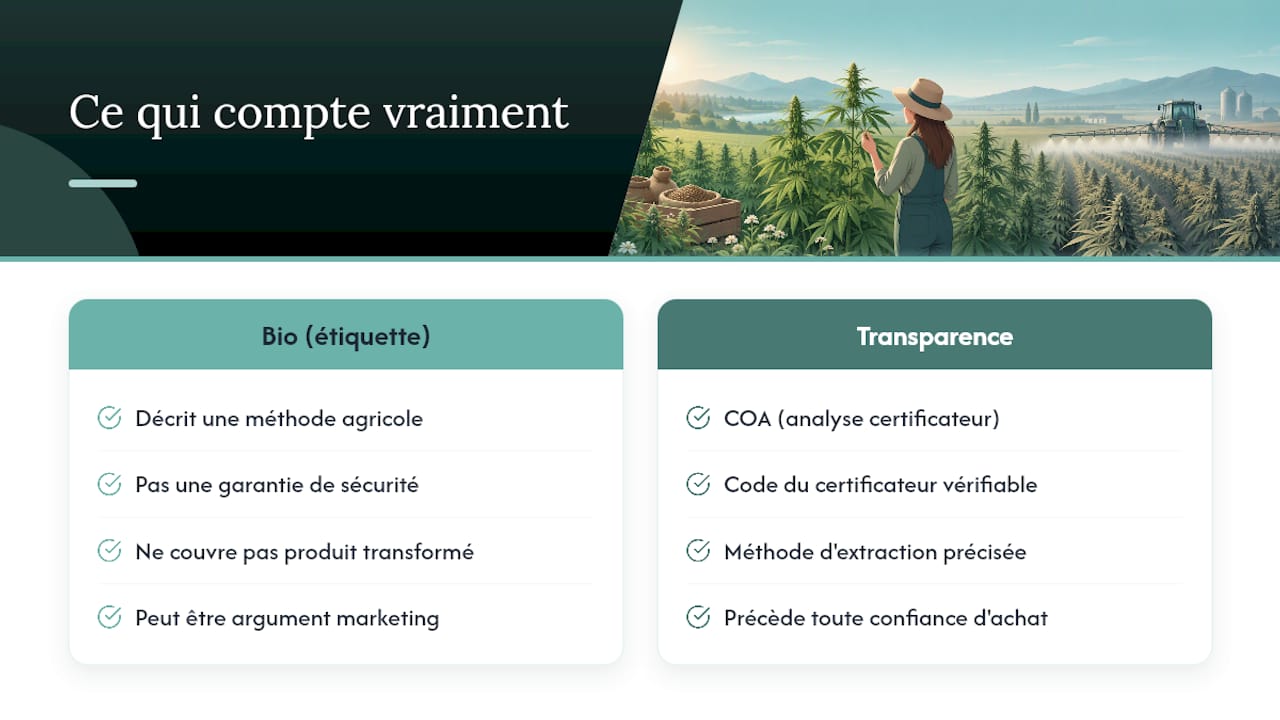
The word “organic” is reassuring, but it describes a farming method, not a guarantee of safety for a processed product such as oil or CBD resin. Transparency in documentation—namely the COA, the certification code, and the extraction method—matters more than any marketing claim printed on the packaging.
Recent health warnings serve as a reminder that any product with insufficient documentation poses a risk, whether organic or not. When faced with a product lacking verifiable evidence, caution remains the best course of action.
— Steven
Where to Find Truly Certified Organic Hemp
A specialty online store offers flowers, resins, oils, and extracts made from organic hemp, which are tested by an independent laboratory to verify their compliance. Some websites display the COA and the certifying body’s code for each product before purchase.

To compare profiles and choose the one that best suits your needs, you can explore our full product lineup and review the compliance documents associated with each product code.
Sources
Regulation (EU) 2018/848 establishes the legal framework for the organic label. ANSES’s opinions on CBD poisoning and residual cannabinoid levels help verify health claims. To better understand the distinction between cannabinoid profiles, this comparison between CBD and THC provides additional insight.
Frequently Asked Questions
Why isn't hemp used more widely, despite its benefits?
The main obstacle remains economic and industrial: the processing sectors are less developed than those for cotton or polyester, which limits availability and keeps costs higher. The additional cost of organic products—estimated at between 15 and 30 percent for certain processed goods—further widens this competitiveness gap.
What are the contraindications for hemp and CBD?
Pregnant or breastfeeding women, individuals taking medication, and professionals subject to regulatory oversight should exercise particular caution. ANSES has proposed classifying CBD as suspected of being toxic to reproduction, which underscores the importance of seeking medical advice before any regular use.
What is the difference between hemp and CBD?
Hemp refers to the plant (Cannabis sativa L.) grown for its fibers, seeds, or flowers, while CBD is a compound extracted from this plant, primarily from its flowers and leaves. Our article on the distinction between industrial hemp and cannabis details the legal thresholds that separate these two uses.
Does the organic certification guarantee that a CBD product is free of residues?
No, the organic certification applies to the cultivation method but does not replace a batch analysis certificate. ANSES notes that abnormally high levels of cannabinoids may indicate contamination or adulteration, regardless of the original cultivation method.



