
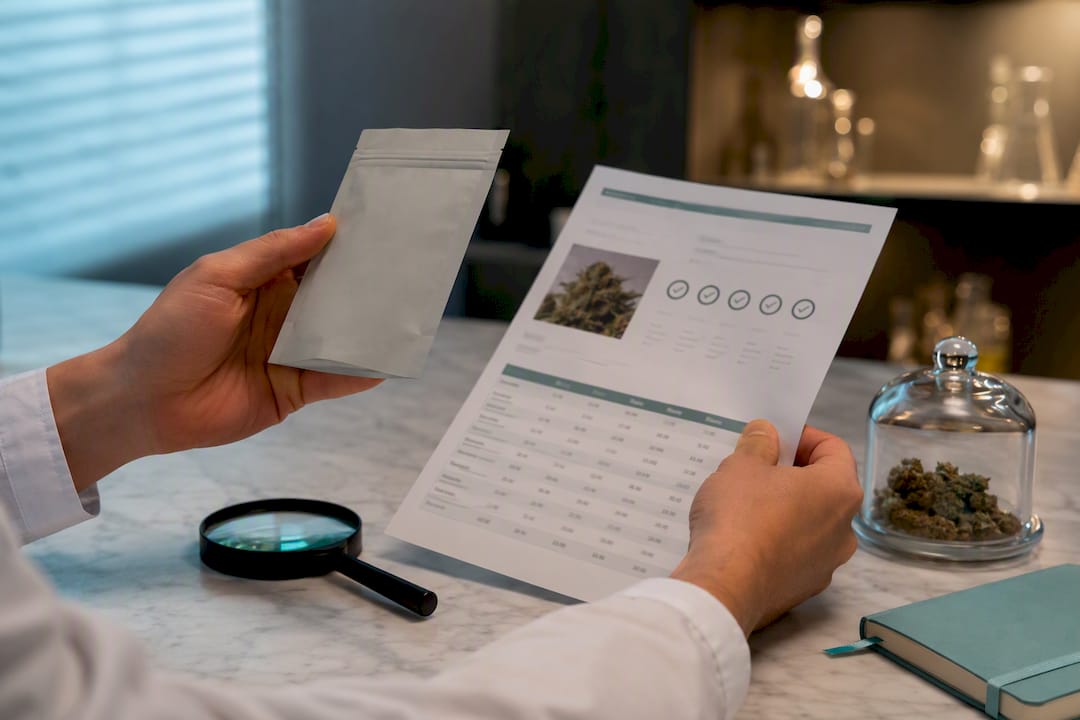
Choosing a reliable online CBD store comes down to three verifiable criteria: publicly available certificates of analysis (COAs) for each batch, clear traceability of the hemp used, and a THC level that complies with regulations. These three elements are enough to rule out most questionable sites, even before looking at the price. The following checklist details how to verify them in practice.
In short:
- Only sites with publicly available batch-specific test reports, clear traceability of the hemp, and THC levels that comply with regulations are reliable.
- Make sure the store displays a recent, accurate COA with no discrepancies, and compare the actual CBD content to the price per milligram to avoid false savings.
- Choose shops that have been in business for at least five years and offer responsive customer service, batch-by-batch testing, and complete transparency regarding the origin and extraction method.
- The supercritical CO2 extraction method and a full-spectrum product guarantee the product’s quality and optimal effectiveness, unlike methods that use solvents or isolates.
- Payment security must be ensured through an HTTPS protocol, using recognized payment options such as secure credit card payments or PayPal, to prevent any risk of fraud.
Table of Contents
- How do you choose a reliable online CBD store?
- How do you read a certificate of analysis (COA) before making a purchase?
- What should you check on a product page before placing an order?
- How to Calculate the True Price of CBD and Spot Fake Sales?
- What evidence of trustworthiness should a CBD store provide?
- What are the best payment methods for buying CBD online?
- What exactly do return and refund policies cover?
- How can you assess the true reputation of an online CBD store?
- Shipping Costs and Delivery Times: What to Compare When Shopping Online?
- What is the purpose of a true customer service program for CBD?
- My take on these criteria, after years of analyzing this market
- Pure Extract CBD: A store that checks all the boxes on this checklist
- Sources
How do you choose a reliable online CBD store?
Sorting through online CBD stores requires a method, not just intuition. Here are the eight criteria that truly distinguish a reputable site from a marketing gimmick with no substance behind it.
The website’s history and reputation. A store that has been in business for five to eight years has generally already weathered several regulatory changes regarding CBD in France, which has forced it to streamline its supply chain and quality control processes. A website launched six months ago may be trustworthy, but it has not yet proven itself in the face of logistical or legal challenges.
Public laboratory test results (COA). This is non-negotiable. Transparency in batch-by-batch testing is the criterion most frequently cited by specialized guides, and for good reason: without an accessible COA, you’re buying blind. The certificate must be viewable with a single click from the product page—not sent upon request three days later.
Traceability of hemp’s origin. Where does the plant come from? Is it grown in open fields in France, in greenhouses in Switzerland, or imported from Eastern Europe? A reputable website states this clearly, providing details on the growing conditions. A complete lack of information about the origin is a red flag in and of itself.
Extraction method. Supercritical CO2 extraction remains the gold standard: it leaves no solvent residues and better preserves the terpene profile than low-cost methods using ethanol or butane. A store that doesn’t even mention its extraction method probably doesn’t have much to say about it.
Product spectrum. Full spectrum, broad spectrum, or isolate: each option affects how the product is experienced. Full-spectrum products retain all of the cannabinoids and terpenes found in hemp, including trace amounts of THC below the legal threshold, which enhances the entourage effect. Isolates, on the other hand, contain only pure CBD, with no other compounds.
A variety of compounds available. If you’re looking for more than just a relaxing effect, the diversity of the product line matters: CBG for its specific properties, CBN for sleep, or newer cannabinoids like THCP. A catalog limited to just three basic CBD products often indicates a supplier that isn’t very invested in product research.
Pricing policy and calculating the actual price. Never compare two listed gross prices. Divide the price by the actual amount of CBD in milligrams: that’s the only meaningful metric.
Customer service and delivery times. Consumers prefer platforms that offer personalized customer service and fast, discreet delivery, with neutral packaging that does not reveal the contents of the package. A short target shipping time remains the expected standard in this market.
Pro tip: *Before checking out, open the product's certificate of analysis (COA) in a new tab and verify that the batch number displayed matches exactly the one shown on the packaging in the photo.
A detailed comparison of CBD stores allows you to delve deeper into these criteria by analyzing customer feedback and product variety.
How do you read a certificate of analysis (COA) before making a purchase?
A COA is read in five steps, in a specific order that ensures you don't miss any anomalies.
-
Check the document’s metadata: recent issue date, laboratory name, and lot number. This number must match exactly the one listed on the product sheet or packaging. If it does not match, the COA belongs to a different lot, which may be older or of a different quality.
-
Check the THC content. The legal limit in France requires that the finished product contain less than 0.3% THC. The COA must clearly display this figure, along with the measurement method used (usually liquid chromatography).
-
Compare the advertised CBD, CBG, and CBN levels with the product label. A variation of a few percent between batches is normal: hemp is a plant, not a synthetic chemical. A discrepancy of more than 20% between the advertised and measured levels should raise a red flag.
-
Look for the “Contaminants” section. A comprehensive COA tests for the absence of residual solvents, pesticides, mycotoxins, and heavy metals. The outright absence of this section—or a vague statement such as “complies with standards” without specific numerical data—has no probative value.
-
Look for signs of a suspicious COA. No lot number, a laboratory that is not accredited or cannot be found online, or a document in an editable PDF format (and therefore potentially tamperable): these are the three red flags that should make you close the tab.
📊 A key figure to remember: Industry experts explicitly recommend avoiding synthetic cannabinoids and insisting on natural products obtained through clean extraction methods. This is precisely what a comprehensive COA allows you to verify objectively, without having to take marketing claims at face value.
If the COA is missing or incomplete on a product sheet, do not place an order if you have any doubts. Contact customer service in writing and request the specific document for the batch in question. A reputable website will respond within a few hours with the file attached. A website that evades the question, provides a generic response, or fails to respond at all should be removed from your list, regardless of the listed price. For more information on specific contaminants to watch out for, this guide on pesticides, heavy metals, and solvents in CBD details the thresholds you need to know.
What should you check on a product page before placing an order?
A well-structured product sheet contains specific information, never vague phrases. Here is what must be included:
- The exact CBD concentration, expressed as a percentage or in total milligrams.
- The type of spectrum used (full spectrum, broad spectrum, or isolate) and its significance for the desired effect.
- The measured THC level, with a direct link to the COA for the relevant batch.
- The geographic origin of hemp and, ideally, the cultivation method (organic, open field, greenhouse).
- The extraction method used to obtain the oil or isolate.
The choice of format and dosage depends primarily on your goal. For sleep-related use, full-spectrum oils in higher dosages are often preferred at the end of the day. To manage occasional stress throughout the day, lower dosages and formats such as flowers or herbal teas are better suited for use throughout the day. For localized pain, products applied directly to the affected area (balms, creams) are a useful complement to oral intake.
Terpenes play an underestimated role in the final effect. A full-spectrum product retains this richness; a pure isolate is completely devoid of it.
Be wary of product descriptions that use vague language such as “carefully selected natural ingredients” or “guaranteed premium quality” without any supporting figures. The absence of a visible lot number, or a generic COA valid for “the entire product line” rather than for the specific lot being sold, are two red flags that should always raise your suspicions. A reputable store’s full product lineup allows you to compare these details across different items.
How to Calculate the True Price of CBD and Spot Fake Sales?
The price listed on a label doesn't mean anything on its own. What matters is the price per milligram of CBD actually contained in the bottle or packet.
The formula is simple: take the total price of the product and divide it by the amount of CBD in milligrams listed on the packaging. A €30 oil containing 500 mg of CBD costs €0.06 per milligram. It is this calculation—and this alone—that allows you to compare two products fairly.
An unusually low price may mask questionable production methods: inferior-quality hemp, sloppy extraction using cheap solvents, or dilution of the finished product. A fair price reflects the quality of the crop, the actual cost of batch-by-batch laboratory testing, and a margin that allows the company to remain in business.
Here are a few simple things to keep in mind regarding promotions:
- Make sure the discount applies to a specific product with its own lot number, and not to a vague category.
- Check the expiration or best-by date listed: a sale item nearing that date is perceived as less effective.
- A discount of more than 50% on a product that is usually expensive should raise questions about the seller's actual initial markup.
To save money without sacrificing quality, opt for family-size packages or loyalty programs that let you earn points over time, as well as trial packs that allow you to test several strengths before committing to a large size.
What evidence of trustworthiness should a CBD store provide?
Seniority alone is not enough to build trust, but it remains a solid benchmark. Stores that have been in business for five to eight years have generally weathered several legislative and logistical changes, which have forced them to professionalize their quality controls far more than a brand-new business would.
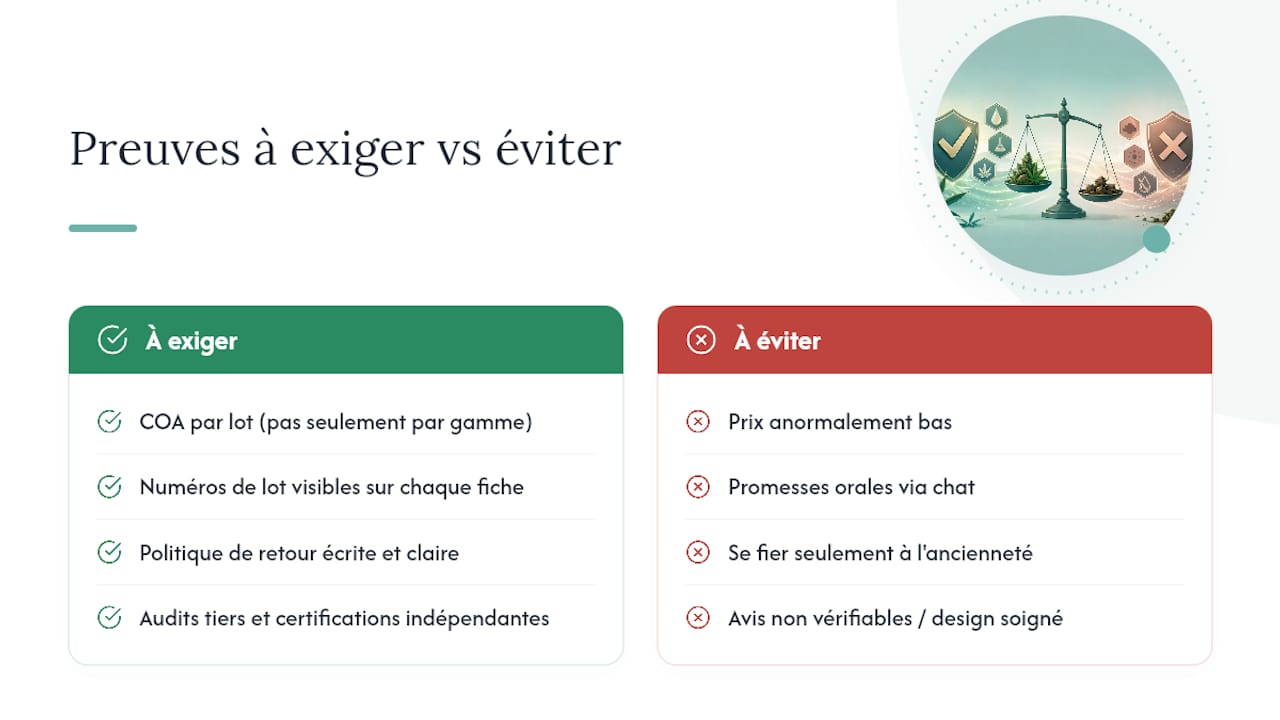
In practical terms, the required evidence can be verified with just a few clicks: a COA for each batch rather than for each product line, a written return policy—not just a verbal promise from a customer service representative—and batch numbers that are consistently visible on every product page. Third-party audits and independent certifications—such as European organic labels or ISO accreditation for the partner laboratory—add an extra layer of oversight that goes beyond the seller’s own self-declaration.
A reliable website combines two things that are rarely found together: complete analytical transparency for every lot sold, and a price that reflects the actual cost of that transparency. Prices that are too low are, almost without exception, a sign of compromised quality rather than a good deal.
These factors aren’t just abstract theory. A store that clearly displays its full product line, batch-by-batch lab test results, and delivery terms—with no gray areas—builds its credibility on verifiable facts, not on flattering adjectives. It is this evidence-based approach that should guide your final decision, far more than a polished website design or unverifiable customer reviews.
What are the best payment methods for buying CBD online?
Transaction security depends first and foremost on the payment options offered. A reputable online store accepts credit cards through a recognized secure payment provider that uses the 3D Secure protocol, which requires additional verification for each purchase. This is the minimum standard expected in this market.
Some websites also offer payment options such as PayPal, which provides an extra layer of buyer protection in the event of a dispute, or bank transfers for larger orders. Cash on delivery remains less common in this sector, but is still available through some providers.
One technical detail you should always check: the website address must begin with “https” and display a padlock icon in the address bar, indicating a valid security certificate. Without this, your banking information is transmitted unencrypted, which is unacceptable in 2026 for any e-commerce site.
Be wary of stores that only accept bank transfers or cryptocurrency payments with no other alternatives: this choice often limits your options for recourse if a problem arises, and may indicate an attempt to avoid banking scrutiny related to the nature of the product being sold. A website that offers several traditional and secure payment methods generally has a stable relationship with its banking partners, which suggests that its business is properly registered and compliant.
What exactly do return and refund policies cover?
A CBD store’s return policy often reveals more about its reliability than its “About” page. It should be written out in full, accessible from the website’s footer, and not summarized in a vague one-liner such as “satisfaction guaranteed or your money back.”
Specifically, a clear policy outlines the legal withdrawal period (14 days in France for online purchases), the return conditions for both opened and unopened products, and the exact terms of reimbursement: the method and timeframe. Some stores also offer a satisfaction guarantee that goes beyond the legal minimum, accepting exchanges even for partially used bottles if the product is unsuitable.
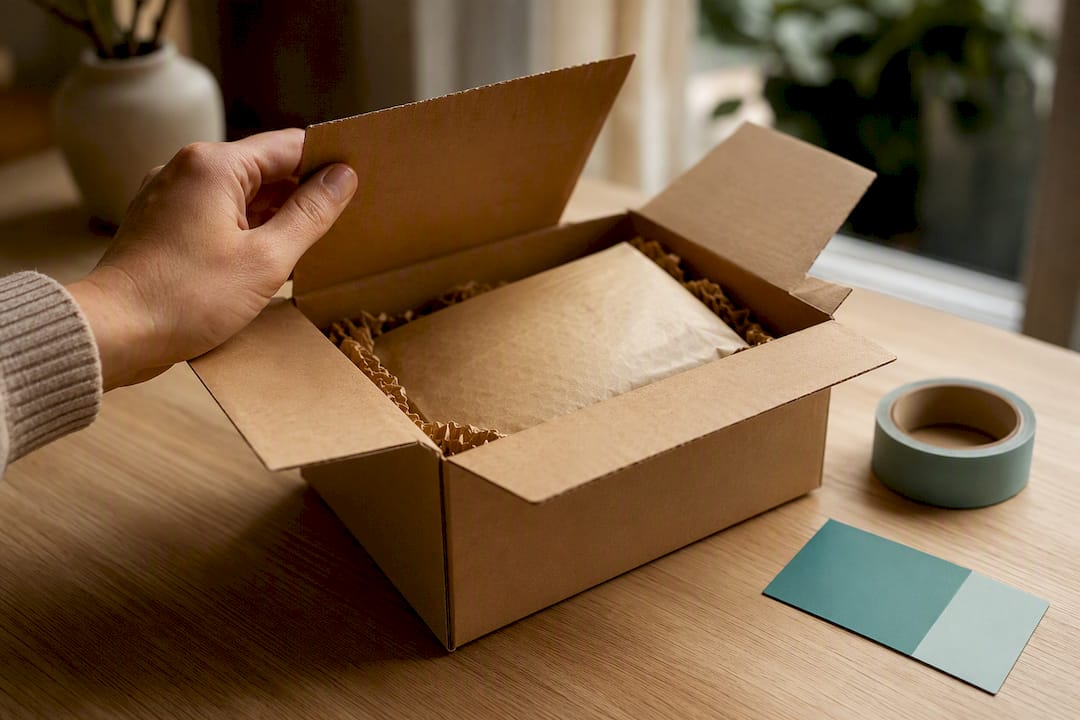
An often-overlooked point: if a product arrives damaged or does not match its product description (different concentration, missing COA upon receipt), the store must allow you to return it at no cost to you. Always take photos of the package when you open it: this is your only proof in the event of a dispute with the carrier or the seller.
The complete lack of any mention of returns—or terms and conditions that are deliberately worded in a confusing manner—should raise red flags just as much as the absence of a Certificate of Analysis (COA). A company that has nothing to hide has no reason to complicate a legitimate refund process.
How can you assess the true reputation of an online CBD store?
Customer reviews posted directly on the seller’s website are of limited value: there’s nothing to prevent negative comments from being filtered out before publication. Third-party, independent review platforms provide a more accurate picture, provided you also read the less favorable reviews—not just the overall average.
Some specialized media outlets place anonymous test orders to truly evaluate online stores, assessing the quality of the product received, adherence to advertised delivery times, and how responsive customer service is to questions or issues. This method of evaluation through test orders is more reliable than a simple star rating, as it is based on a concrete and verifiable shopping experience.
A strong indicator of a reputable business: the store publicly responds to negative reviews—without deleting them—by offering a concrete solution. This transparency in the face of criticism often speaks volumes more than an artificially high average rating. Be wary, however, of sites that display only five-star reviews without any variation: in a market as young and technical as the CBD market, the total absence of mixed feedback is not statistically credible.
Shipping Costs and Delivery Times: What to Compare When Shopping Online?
Shipping costs vary widely from one store to another, but that’s not the only factor to consider. The minimum order amount required for free shipping, the actual shipping time (which is typically between 24 and 48 hours for well-organized sites), and the discretion of the packaging are just as important.
Discreet packaging—with no visible logo or explicit mention of the contents—remains an important confidentiality factor for many buyers. Also check whether a tracking number is provided automatically, without having to request it, and whether express delivery options are available for urgent needs. Pages dedicated to CBD delivery in France generally detail these options by region.
One last thing to watch out for: stores that advertise very short delivery times but fail to live up to their promises in practice quickly lose credibility, as evidenced by the reviews mentioned above. Comparing the advertised delivery times with the actual delivery times reported by other buyers remains the best way to avoid unpleasant surprises.
What is the purpose of a true customer service program for CBD?
CBD remains a technical product, with issues related to dosage, interactions, and format selection that go far beyond a simple commercial transaction.
A good indicator of after-sales service quality: the response time to a specific technical question—not just to a complaint. A customer service team that responds within a few hours with a personalized answer, rather than a generic automated message, indicates a team that truly knows its products.
Some stores also offer detailed practical guides, such as how to use CBD oil depending on the time of day and the desired effect. These resources are a useful complement to a direct conversation with an advisor, especially for new users who are still unsure about the starting dosage.
My take on these criteria, after years of analyzing this market
Most guides on CBD simply list a series of criteria without ever specifying which one takes precedence over the others. In my view, it all boils down to a simple hierarchy: the COA comes first, even before price or reputation. A website with excellent reviews but missing or generic COAs is not trustworthy, no matter how popular it is on social media.
Here’s my practical, three-step recommendation before making your first purchase from an unfamiliar store: First, open the COA for the exact product you want to order and check the lot number. Next, calculate the price per milligram of active CBD and compare it to a product you’re already familiar with. Finally, if the site passes these two checks, try a small size before ordering in bulk—even if the per-liter price seems more cost-effective.
If you still have doubts after following these three steps, contact customer service in writing and ask a specific question about a particular batch. The quality and speed of their response will tell you more than any online review.
— Steven
Pure Extract CBD: A store that checks all the boxes on this checklist
You’ve just read about eight verification criteria. At Pure Extract CBD, these aren’t just theoretical: each product comes with its own batch-specific lab report; the product line includes flowers, oils, resins, and infused products made from organic hemp; and the extraction process is carried out with a constant focus on legal compliance in France and Europe.

What really sets this store apart is the lack of any gray areas when it comes to the issues that matter most: traceability of origin, extraction methods, THC levels that comply with legal limits, and customer service that answers questions about dosage rather than referring customers to a generic FAQ. Fast delivery and discreet packaging round out an experience designed to put customers at ease rather than to sell at any cost.
To directly apply the per-milligram pricing method mentioned above, Northern Light small buds CBD flowers are a good point of comparison, as supported by their COA. You can also browse the entire range of CBD products to compare different formats before placing your first order.
Sources
To go a step further in verifying a CBD store before making a purchase, there are a few resources worth consulting directly. The guide “Choosing the Best Online CBD Site” details the criteria for analytical transparency discussed throughout this article. The “Best CBD Site” ranking: Cannanews’ Top 10 provides a concrete example of how to use test orders to evaluate a store based on facts rather than promises.
The article “How to Choose an Online CBD Store: The 8 Criteria That Make a Difference” provides a useful supplement to the discussion on synthetic cannabinoids to avoid. Finally, the feature “CBD Online: 5 Criteria for Identifying a Trustworthy Site” delves into more detail regarding expectations related to customer service and discreet delivery.
To find an official COA, always look for the name of the laboratory listed on the document and verify its accreditation on the laboratory’s own website, regardless of which store sold you the product.
This article is intended to provide general information and is not a substitute for the advice of a qualified healthcare professional. Consult a qualified healthcare professional about your specific situation before taking any action based on this content.
- Choosing the Best Online CBD Store: A Guide
- Best CBD Websites: Cannanews' Top 10 (2026)
- How to Choose an Online CBD Store? The 8 Criteria That Make a Difference – Serious CBD – The CBD Blog



