

CBD causes drowsiness, dizziness, nausea, diarrhea, and headaches in some users. These common side effects are generally mild, but they should not obscure more serious risks: significant drug interactions, poisoning from non-compliant products, and rare serious effects such as tachycardia or neuropsychiatric disorders. The European Food Safety Authority (EFSA) has established a provisional daily safe dose of approximately 2 mg for a 70-kg adult, which is well below the doses commonly consumed (10 to 25 mg/day). This discrepancy between the theoretical safe dose and actual consumption alone warrants increased vigilance.
Key indicators to watch for:
- Drowsiness and lethargy, which may last for several hours after taking the medication
- Dizziness and transient hypotension, especially when standing
- Digestive problems: nausea, diarrhea, abdominal pain
- Headaches, usually dose-dependent
- Rare serious adverse effects: tachycardia, hallucinations, suicidal thoughts (reported in French pharmacovigilance data)
Anyone on long-term medication, pregnant women, children, or individuals with liver disease should consult a healthcare professional before considering CBD use. The quality of the product chosen also determines the actual level of risk.
Table of Contents
- What side effects can CBD cause, and what drug interactions should you watch out for?
- CBD Products in France: How Quality Affects the Risk of Poisoning
- What French Regulations Say About CBD in 2026
- How to Use CBD Safely: Practical Tips
- How long do the side effects of CBD last?
- Pure-extract-cbd: Traceable CBD Products for Informed Consumption
- Key Points
What side effects can CBD cause, and what drug interactions should you watch out for?
The side effects of CBD are dose-dependent: as the dose increases, so does the risk. Drowsiness is the most common side effect, affecting up to 25% of users according to available data, and requires that individuals avoid driving or operating machinery after consumption. In older adults, this drowsiness increases the risk of falls, a point that official recommendations consistently emphasize.
Drug Interactions: An Underestimated Risk
The underlying mechanism is well understood: CBD inhibits the liver enzymes CYP3A4 and CYP2C19 of the cytochrome P450 family, which are responsible for metabolizing approximately 60% of common medications. In practical terms, combining CBD with certain medications can lead to drug overdoses, even with small amounts of CBD. The drug classes most affected are anticoagulants (warfarin), antiepileptics, immunosuppressants, and antidepressants.
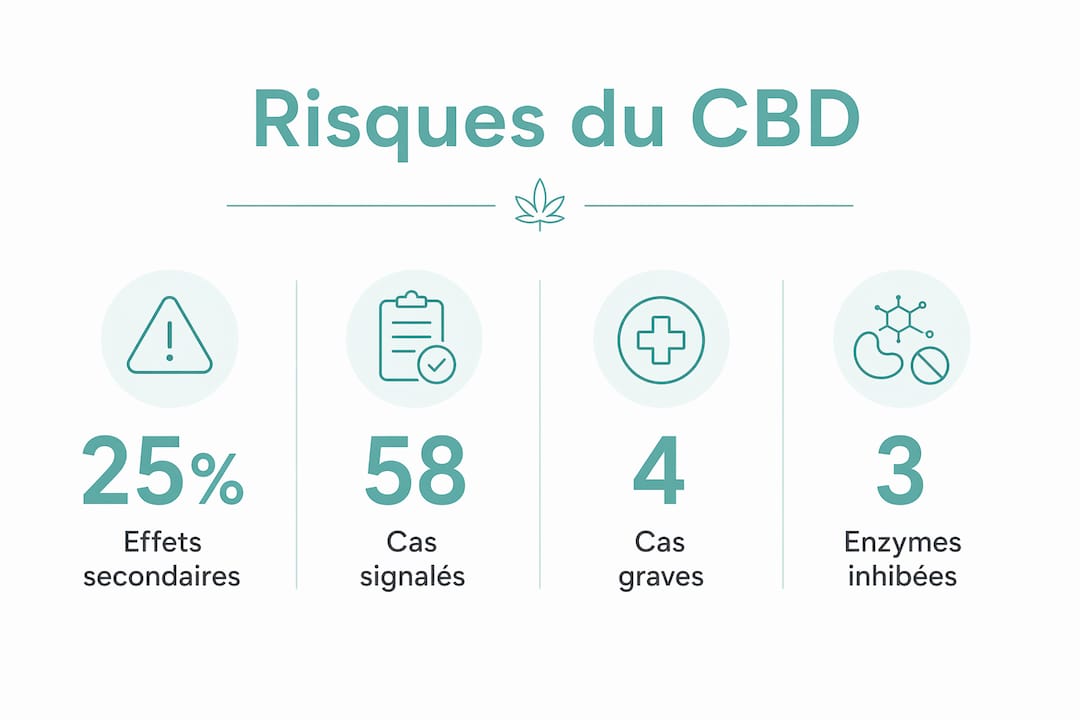
The ANSM has recorded 58 reportedcases of drug interactions in France between 2017 and 2023, including 4 confirmed serious cases between 2021 and 2022. These figures likely reflect underreporting, as many consumers do not inform their doctors about their use of CBD.
| Drug class | Risk of Interaction | Mechanism |
|---|---|---|
| Anticoagulants (warfarin) | High | Enzyme inhibition → increased anticoagulant effect |
| Antiepileptic drugs (valproate) | High | CYP3A4 inhibition → drug accumulation |
| Immunosuppressants (cyclosporine) | High | CYP3A4 inhibition → possible overdose |
| Antidepressants (SSRIs) | Moderate | CYP2C19 inhibition → change in plasma concentration |
| Benzodiazepines | Moderate | Potentiation of the sedative effect |
Populations at particularly high risk
Certain profiles account for the vast majority of serious risks:
- People on long-term medication: polypharmacy and enzyme inhibition are a high-risk combination
- Pregnant women: insufficient safety data; generally contraindicated
- Children and Adolescents: The Developing Endocannabinoid System and Potential Neuropsychiatric Effects
- People with liver failure: slowed CBD metabolism, potential accumulation
- Older Adults: Increased Susceptibility to Drowsiness and Risk of Falls
There is a fundamental difference between information about CBD and personalized medical advice: only a healthcare professional can assess the interactions specific to your treatment.

CBD Products in France: How Quality Affects the Risk of Poisoning
Legal compliance for a CBD product does not automatically guarantee its safety. Variations in quality among manufacturers remain a real risk, as documented by French health authorities.
Compliant Products vs. Non-Compliant Products
A CBD product that is legal in France must contain less than 0.3% THC and must not contain synthetic cannabinoids. However, the ANSM has reported an increase in cases of poisoning caused by products marketed as CBD but that actually contain synthetic cannabinoids or THC levels above the legal threshold. Since 2024, several hundred cases of poisoning have been recorded in France, the majority of which are attributable to these non-compliant products, according toAmeli’s toxicovigilance data.
The consequences of consuming a non-compliant product may include:
- Tachycardia and severe palpitations
- Confusion, disorientation, hallucinations
- Severe anxiety attacks
- Severe nausea and vomiting
- In the most severe cases, emergency hospitalization
It is therefore essential to distinguish between natural CBD and synthetic cannabinoids before making any purchase.
Inadequate Labeling and Associated Risks
Many CBD products on the market have inaccurate or incomplete labeling: the actual CBD concentration differs from what is advertised, there is no information about the extraction solvents, or there is no mention of pesticide residues. An independent certificate of analysis, issued by an accredited laboratory, is the only document that allows you to verify a product’s actual composition.
Pro tip: Before making any purchase, always ask for the certificate of analysis (CoA) for the specific batch. Verify that it comes from an accredited third-party laboratory and that it lists the THC and CBD content, as well as the absence of contaminants (pesticides, heavy metals, residual solvents). A reputable seller will provide it immediately.
What French Regulations Say About CBD in 2026
French law permits the sale and consumption of CBD products derived from hemp varieties with a THC content of no more than 0.3 percent. CBD itself is not classified as a narcotic, but THC is. This distinction has significant practical implications.
Driving and Traffic Stops
Even a legal CBD product can leave detectable traces of THC in a saliva or urine test. French traffic regulations penalize driving while THC is present in the body, regardless of the THC content of the product consumed.The National Academy of Medicine recommends avoiding driving after consuming CBD, particularly in the case of broad-spectrum products containing traces of THC.
Excluded populations or those under strict surveillance
The official recommendations from the ANSM and Ameli agree on several points:
- Pregnant and breastfeeding women: Use is not recommended due to a lack of safety data
- Minors: No safety data available; use not recommended
- People taking medication: A prior medical consultation is required
- People with a history of psychiatric disorders: documented risk of decompensation
Choose a legal and safe product
There are a few objective criteria that can help reduce risk when making a purchase:
- Give preference to sellers who publish analysis certificates for each batch
- Verify that the product is made from hemp grown in Europe (agricultural traceability)
- Make sure the THC content is less than 0.3% on the certificate, not just on the label
- Avoid products sold without information about their origin or extraction method
Pure-extract-cbd applies these standards to its entire product line: each product comes with independent lab reports, which are available for review before purchase.
How to Use CBD Safely: Practical Tips
A gradual, supervised approach significantly reduces the risk of adverse effects. The National Academy of Medicine emphasizes that side effects increase sharply at doses above 50 mg/day, and that self-adjusting the dose without medical supervision can mask warning signs.
Practical recommendations to follow:
- Start with the lowest possible dose, ideally around 2 to 5 mg/day, and increase the dose only after one week of observation
- Tell your doctor and pharmacist if you are using CBD, especially if you are taking other medications at the same time
- Stop use immediately if any side effects occur and consult a healthcare professional
- Do not exceed the daily reference dose established by the EFSA (approximately 2 mg for a 70-kg adult) without consulting a doctor
- Avoid driving for several hours after consuming alcohol
- Do not combine CBD with alcohol: documented potentiation of sedation
For those seeking advice onhow to use CBD oil, we strongly recommend reading the guidelines on gradual dosing beforehand.
Pro tip: Keep a usage log: Note the dose taken, the time, the product form (oil, flower, capsule), and any symptoms you experience within the next 6 hours. This log is invaluable to your doctor or pharmacist and helps quickly identify any interactions or your individual tolerance level.
How long do the side effects of CBD last?
The kinetics of CBD's adverse effects vary depending on the route of administration, the dose, and each person's metabolic profile.
When inhaled (as vaporized flower), the effects set in within a few minutes and generally wear off within 1 to 3 hours. Drowsiness may, however, persist beyond this timeframe in sensitive individuals or when a high dose is taken.
When taken sublingually (as oil), the effects begin to be felt between 15 and 45 minutes after ingestion. The duration of action is generally between 4 and 6 hours, but residual effects such as fatigue or mild confusion may last up to 8 hours.
When taken orally (capsules, edibles), the onset of action is slower—ranging from 30 minutes to 2 hours, depending on digestive status—and the duration of effect can last up to 6 to 8 hours. This is the route of administration with the highest risk of underestimating the dose, as the user may take another dose before the first one has taken full effect.
Drug interactions, on the other hand, do not follow the same timeline as the perceived effects: cytochrome P450 enzyme inhibition can persist for several days after CBD use is discontinued, maintaining a risk of interaction even in the absence of noticeable subjective effects. This discrepancy between perceived effects and pharmacological activity is one of the least intuitive aspects of CBD safety.
Pure-extract-cbd: Traceable CBD Products for Informed Consumption
Choosing a CBD product with a verifiable composition is the first concrete step toward reducing risks. Pure-extract-cbd offers a complete line of products made from organic European hemp, each accompanied by independent laboratory analysis certificates that are available for review before purchase.
For those new to CBD or those who want to carefully control their dosage,the 5% broad-spectrum CBD/CBG oil offers a concentration suitable for gradual progression, with full batch traceability. More experienced users may opt forthe 20% CBD/CBG oil, formulated for those who have already established their tolerance level under medical supervision.
Toute la gamme Pure-extract-cbd est conforme à la réglementation française (THC < 0,3 %) et disponible avec livraison rapide partout en France.
Key Points
CBD has real and well-documented side effects, the frequency and severity of which increase with higher doses and in the presence of concomitant medication.
| Point | Details |
|---|---|
| Recommended Daily Intake | The EFSA sets the limit at approximately 2 mg/day for a 70-kg adult, which is well below the amounts typically consumed. |
| Drug Interactions | 58 cases reported in France (2017–2023), including 4 severe cases, due to inhibition of the CYP3A4 and CYP2C19 enzymes. |
| Risks Associated with Non-Compliant Products | Several hundred cases of poisoning have been reported since 2024, mostly due to synthetic cannabinoids or excessive THC intake. |
| Priority At-Risk Populations | Pregnant women, children, the elderly, and patients undergoing long-term treatment should consult a healthcare professional before use. |
| Key purchasing criterion | Require an independent laboratory analysis report for each batch, specifying THC, CBD, and the absence of contaminants. |



