

Neocannabinoids are synthetic or semi-synthetic molecules derived from natural cannabinoids, designed to mimic or modify their biological effects on the endocannabinoid system. Unlike CBD or THC derived from hemp, these molecules are produced through chemical processes in the laboratory, such as hydrogenation or acetylation. Their emergence raises serious public health concerns: the Directorate General for Health (DGS) and the National Agency for Medicines and Health Products Safety (ANSM) are warning of a rapid increase in cases of poisoning, particularly among adolescents. Understanding these advanced cannabinoid molecules is now essential for any consumer wishing to make informed choices.
What are the chemical characteristics of neo-cannabinoids?
Neocannabinoids are produced by structurally modifying existing natural cannabinoids. The most common processes are hydrogenation, used to produce HHC from THC, and acetylation, which produces THC-O. These chemical transformations alter the molecule’s structure and, consequently, the way it interacts with the body’s receptors.
The result is increased affinity for the CB1 and CB2 cannabinoid receptors in the endocannabinoid system. This enhanced affinity produces effects that are often more intense and less predictable than those of natural cannabis. Molecules such as THCP, HHC, THC-O, and H4CBD clearly illustrate the chemical diversity of this new generation of cannabinoids.

Stronger effects pose a practical problem: it becomes difficult to control the dosage. A user accustomed to natural CBD may experience a disproportionate reaction when using a product containing THCP, which is significantly more potent than conventional THC.
Key pharmacological characteristics to remember:
- HHC: produced by hydrogenating THC; moderate to strong psychoactive effects
- THCP: estimated to bind to CB1 receptors much more strongly than natural THC
- THC-O: produced by acetylation; delayed and very potent effects
- H4CBD: a hydrogenated derivative of CBD; less psychoactive but still under study
The side effects of natural CBD are well documented and significantly less severe than those of synthetic compounds.
Pro tip: Before purchasing a cannabinoid product, always check to see if the product information sheet mentions a chemical synthesis process. The absence of this information is a red flag.
What are the health risks associated with neo-cannabinoids?
The clinical risks associated with synthetic cannabinoids are well-documented and serious. Observed symptoms include seizures, hallucinations, cardiovascular problems, and panic attacks. These effects can occur as early as the first use, without any warning signs.
Neocannabinoids saturate cannabinoid receptors with a potency that is disproportionate to that of natural cannabis. They are like “keys that force the lock”—more potent and more dangerous than natural THC.
Source: toxicology experts, RMC BFMTV
Recent figures are cause for concern. Nearly 500 cases of poisoning have been reported since the beginning of 2026, including at least two deaths. More than 70% of these cases involve young people aged 13 to 18, and the majority of the poisonings are classified as severe. These data reveal widespread exposure among a particularly vulnerable population.
| Indicator | Data for 2026 |
|---|---|
| Reported Cases of Poisoning | Nearly 500 |
| Percentage of 13- to 18-year-olds | More than 70% |
| Severe cases | Most cases |
| Confirmed deaths | At least 2 |
| Cases Involving Classified Narcotics | More than 1 in 5 |
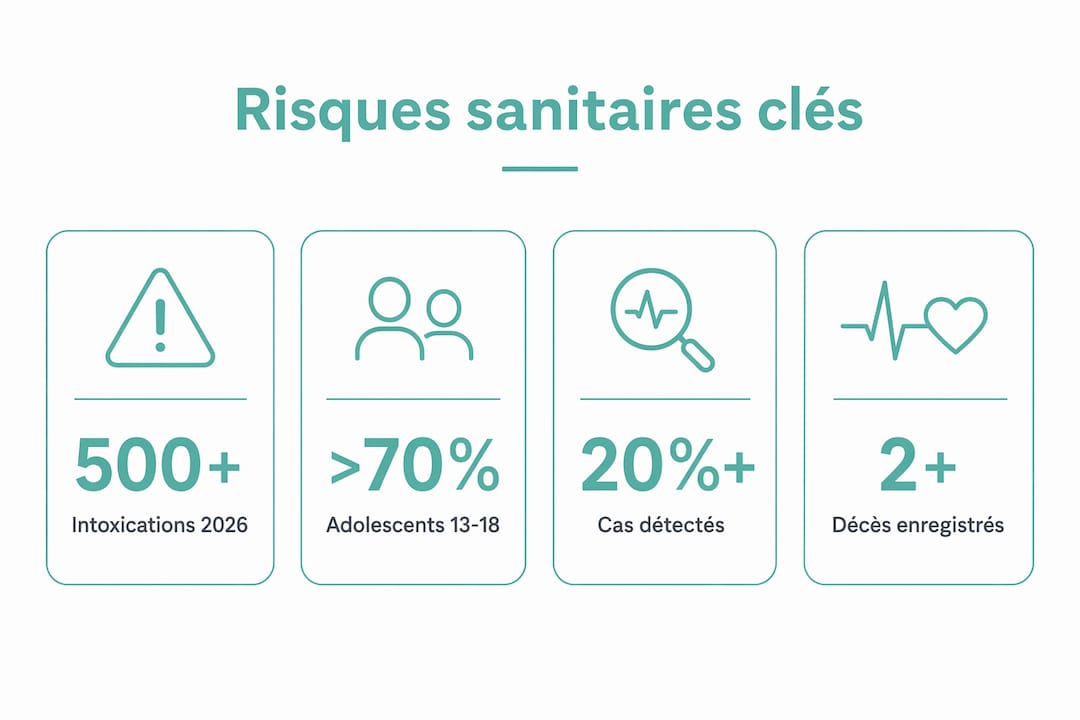
Medical detection also poses a problem. More than one in five cases of poisoning confirms the presence of cannabinoids classified as controlled substances, but standard tests do not always detect these molecules. This complicates care in the emergency room and delays appropriate treatment.
Products such as “Pète ton crâne” and “Buddha Blue” are widely circulating among teenagers. These substances are invisible, potent, and difficult to detect, posing a major challenge for school and hospital health professionals.
What is the legal status of neo-cannabinoids in France?
French regulations are based on the principle of chemical analogy. Any molecule structurally similar to THC is prohibited, even if it has not yet been specifically targeted by a regulatory order. This legal framework based on analogy makes investing in and consuming neo-cannabinoids legally risky, even for products marketed as legal.
Bans have come one after another in recent years:
- HHC: banned in France by executive order in 2023
- HHCP: Classified as a controlled substance shortly after HHC
- THCP: targeted due to its chemical similarity to THC
- THC-O: Banned in Several European Union Member States
At the European level, regulations are also becoming stricter. The European Commission has tightened restrictions on new foods containing synthetic cannabinoids. The uncertain legal status of these substances exposes consumers to real criminal risks, even when they purchase products in stores or online.
The commercial gray area is a common pitfall. Some products are labeled “CBD” or “wellness” but contain undeclared synthetic compounds. The lack of traceability and unguaranteed composition are major sources of health risks identified by public health authorities.
Pro tip: Always ask for an independent laboratory analysis certificate (COA) before purchasing a cannabinoid product. A reputable seller will provide it without hesitation.
How do you choose between synthetic cannabinoids and natural cannabinoids?
The fundamental difference between the two groups lies in their origin and safety profile. CBD, CBG, and CBN are natural cannabinoids extracted from hemp. Their effects are well documented, they are generally well tolerated, and their interactions with the endocannabinoid system are better understood. To learn more about how they differ, a comparison of CBD, CBG, and CBN is a useful starting point.
"Spray-on" products pose the most underestimated risk on the market. Synthetic cannabinoids are sprayed onto low-quality hemp flowers. This makes the dosage completely unpredictable, and consumers cannot determine the actual dose they are receiving. These adulterated products cast doubt on the safety of the entire CBD market.
| Criteria | Natural Cannabinoids (CBD, CBG, CBN) | Neocannabinoids (HHC, THCP, THC-O) |
|---|---|---|
| Origin | Hemp Extraction | Chemical synthesis or semisynthesis |
| Security Profile | Well-researched | Little research has been done; high risks |
| Legality in France | Legal under certain conditions | Prohibited or Gray Area |
| Traceability | Available with COA | Often absent |
| Effects | Moderate and predictable | Intense and unpredictable |
When choosing a reliable product, there are several criteria to consider:
- Full traceability: origin of the hemp, place of cultivation, extraction method
- Certificate of Analysis: Independent laboratory testing confirming the absence of synthetic ingredients
- Clear labeling: a list of the cannabinoids present, along with their concentrations
- Legal compliance: THC content below 0.3% in accordance with European regulations
To help you choose the right product, Pure-extract-cbd's " Which CBD to Choose " guide details the key criteria to consider.
Key Points
Neocannabinoids pose documented health and legal risks that fundamentally distinguish them from natural cannabinoids such as CBD, CBG, and CBN.
| Point | Details |
|---|---|
| Definition of Neocannabinoids | Synthetic or semisynthetic molecules obtained by hydrogenation or acetylation of natural cannabinoids. |
| Serious Health Risks | Nearly 500 cases of poisoning were reported in 2026, more than 70% of which involved young people aged 13 to 18. |
| Strict legal framework in France | The chemical analogy prohibits any molecule similar to THC, even in the absence of a specific regulation. |
| Dangers of Aerosol Products | The dosage is unpredictable, and toxic effects can be severe without the user realizing it. |
| Criteria for Making a Safe Choice | Choose natural cannabinoids that come with a certificate of analysis and have verified traceability and legal compliance. |
What I've Observed in the Field After Years in the Cannabinoid Industry
The debate surrounding neo-cannabinoids concerns me for one specific reason: the confusion between apparent legality and actual safety. For a long time, the mere fact that a product was sold in a store was enough to reassure consumers. This line of reasoning is dangerous.
I’ve seen products labeled “relaxing CBD” that contained undeclared synthetic compounds. Even the sellers themselves were sometimes unaware of the actual composition of their inventory. This is a sign of a market that has grown too quickly, without the necessary safeguards.
What makes me cautiously optimistic is the authorities’ response. The DGS and the ANSM acted quickly in the face of the rising number of poisonings. Regulation based on chemical analogy, while imperfect, gives the authorities a tool to act before every new molecule is specifically banned. This is a more realistic approach than waiting for an exhaustive list.
My advice to people interested in wellness through cannabinoids: stick to natural compounds that have been thoroughly studied. CBD, CBG, and CBN have well-documented profiles. Their regulatory implications are well understood. Neo-cannabinoids, on the other hand, are still a mystery to both science and the law.
The future of the industry lies in transparency and traceability, not in the race to develop ever-more-powerful molecules.
— Steven
Pure-extract-cbd: natural, traceable, and compliant products
The synthetic cannabinoid market has highlighted a simple reality: quality and transparency are non-negotiable when it comes to well-being.
Pure-extract-cbd offers a range of CBD flowers and oils derived from organic hemp, all accompanied by certificates of analysis from independent laboratories. Each product complies with French and European regulations, with a THC content of less than 0.3%. Northern Light CBD flowers exemplify this commitment: traceable origin, verified composition, and documented soothing effects. To explore the entire lineup, the Pure-extract-cbd store features all certified products available for fast delivery in France.
Frequently Asked Questions
What are the most common neo-cannabinoids?
The most common neo-cannabinoids are HHC, THCP, THC-O, and H4CBD. They are produced through the chemical modification of natural cannabinoids such as THC or CBD.
Are neo-cannabinoids legal in France?
Most are banned or fall into a legal gray area. French law applies the principle of chemical analogy, which prohibits any molecule structurally similar to THC, even in the absence of a specific regulation naming it.
What is the difference between neo-cannabinoids and natural CBD?
Natural CBD is extracted directly from hemp and has a well-documented safety profile. Neo-cannabinoids are produced through chemical synthesis, produce more intense and unpredictable effects, and pose significantly higher health risks.
How can you tell if a product contains synthetic cannabinoids?
Any product that lacks an independent laboratory analysis certificate, does not provide traceability of the hemp’s origin, or is sold at an abnormally low price should be viewed with suspicion. “Sprayed” products are particularly difficult to identify visually.
Do neo-cannabinoids have recognized therapeutic applications?
No therapeutic use for these molecules is officially recognized in France or Europe. Clinical studies are insufficient, and the documented risks far outweigh the potential benefits at this stage.



