Pesticides, heavy metals, and residual solvents have indeed been detected in unregulated CBD products sold in France. This is not mere speculation: the MILDECA 2023 report, based on an analysis of 248 products, highlights the lack of systematic testing for non-pharmaceutical CBD products. These contaminants are, however, detectable and avoidable—provided you know what to look for before making a purchase.
The three immediate steps to take before making any purchase:
- Request the Certificate of Analysis (COA) for the relevant batch, issued by an independent third-party laboratory accredited to ISO 17025 (listed in the COFRAC registry in France).
- Verify that the COA includes a lot number, a recent analysis date, and explicitly lists the analytical methods used: ICP-MS for heavy metals, and GC-MS or LC-MS/MS for pesticides and residual solvents.
- Ensuring agricultural traceability: hemp certified as organic (AB or Euroleaf label) significantly reduces the risk of pesticide residues.
A COA that covers only the cannabinoid profile does not guarantee the product’s safety. A comprehensive certificate must cover at least six categories of contaminants: cannabinoids, pesticides, heavy metals, mycotoxins, residual solvents, and microbiological indicators. Any partial analysis leaves gaps that the consumer cannot assess.
Table of Contents
- Which contaminants should always be checked on a COA?
- How do these contaminants end up in a CBD product?
- CO2 extraction or solvent extraction: Which method is safer?
- Which tests and certifications actually guarantee the safety of a batch?
- How to Read a Certificate of Analysis, Step by Step?
- How do you choose a safe CBD product, and what warning signs should you watch out for?
- What are the health risks in the event of contamination?
- What should you do if you suspect a product is contaminated?
- How Pure-extract-cbd Ensures the Safety of Its Products
- Key Points
- Consumer vigilance does not replace official inspections, but rather complements them
- Pure-extract-cbd: Tested, traceable products available online
- Useful Sources and References (France / European Union)
Which contaminants should always be checked on a COA?
A comprehensive COA covers six categories of contaminants: the cannabinoid profile (including residual THC), pesticides, heavy metals, mycotoxins, residual solvents, and microbiological indicators. Each category corresponds to a distinct risk and a specific analytical method.
Priority Heavy Metals and Their European Thresholds
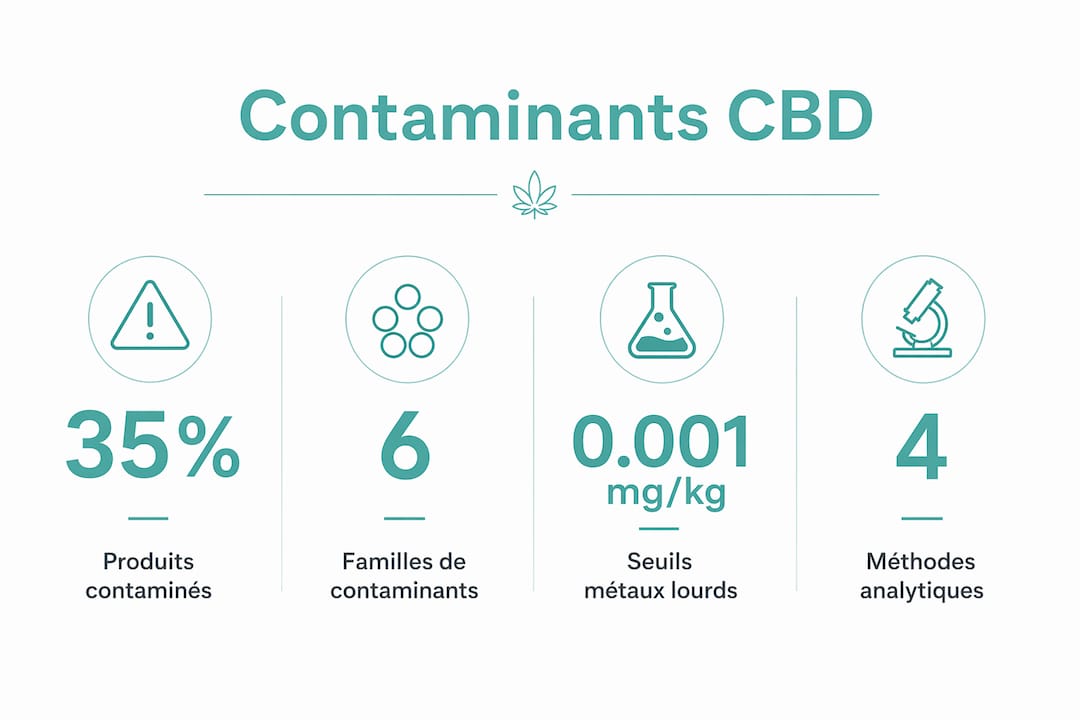
Le chanvre est une plante hyperaccumulatrice : il absorbe les métaux présents dans le sol avec une efficacité bien supérieure à la plupart des cultures. Le règlement CE n°1881/2006 fixe des seuils maximaux applicables aux denrées alimentaires, dont les extraits de chanvre. Les quatre métaux prioritaires sont le plomb (seuil < 3 mg/kg), le cadmium (< 1 mg/kg), le mercure (< 0,1 mg/kg) et l’arsenic inorganique. Une étude publiée sur PubMed a détecté du plomb dans une proportion significative des produits comestibles à base de CBD testés, de l’arsenic dans des produits contenant de l’arsenic et du mercure, avec certains échantillons dépassant les seuils réglementaires.
Residual Pesticides and Solvents
For pesticides, Regulation (EC) No. 396/2005 establishes the maximum residue limits (MRLs) applicable to hemp. Residual solvents to be monitored include ethanol, butane, propane, and hexane. The reference thresholds used by laboratories are derived from the ICH Q3C guideline and ISO 21710: according to these industry standards, hexane and butane are limited to specific thresholds.
The absence of analysis for any one of these six categories renders the COA incomplete, regardless of the quality of the results for the other parameters. A product whose COA does not list mycotoxins or residual solvents cannot be considered fully verified.
How do these contaminants end up in a CBD product?
Understanding the pathways by which contaminants enter the system makes it possible to evaluate a producer’s practices and identify critical control points in the production chain.
-
Phytoremediation and root uptake. Hemp (Cannabis sativa) is used in phytoremediation precisely because it effectively absorbs heavy metals and organic pollutants from the soil and irrigation water. This property, which is useful for decontaminating land, becomes a direct risk when the plant is grown on soil contaminated by past industrial or agricultural activities.
-
Pesticide residues. Some persistent pesticides accumulate in the soil for years after their last application. Crops grown on land that was previously treated may therefore contain residues even if no pesticides were used during the current growing cycle. The direct use of fungicides or insecticides that are not registered for use on hemp poses an additional risk.
-
Storage Conditions and Mycotoxins. Improper storage (high humidity, poor ventilation) promotes the growth of molds that produce mycotoxins, particularly aflatoxins and ochratoxin A. This risk applies to both the raw plant material and semi-finished extracts.
-
Concentration during extraction. Extraction and concentration processes do more than just isolate cannabinoids; they can simultaneously concentrate contaminants present in the raw material. An extract may therefore contain higher levels of metals or pesticides than those measured in the raw flower.
-
Residual solvents that have not been sufficiently removed. When the degassing or solvent evaporation step is incomplete, residues of hexane, butane, or other industrial solvents remain in the final product.
-
Agricultural traceability as the first line of defense. Certified organic hemp (AB/Euroleaf) is grown without synthetic pesticides and on soil whose quality is monitored. While this certification alone does not guarantee the absence of all contaminants, it significantly reduces the risks associated with pesticide residues and contaminated soil.
CO2 extraction or solvent extraction: Which method is safer?
The extraction process largely determines the residual solvent profile of a hemp extract and also influences the concentration of other contaminants.
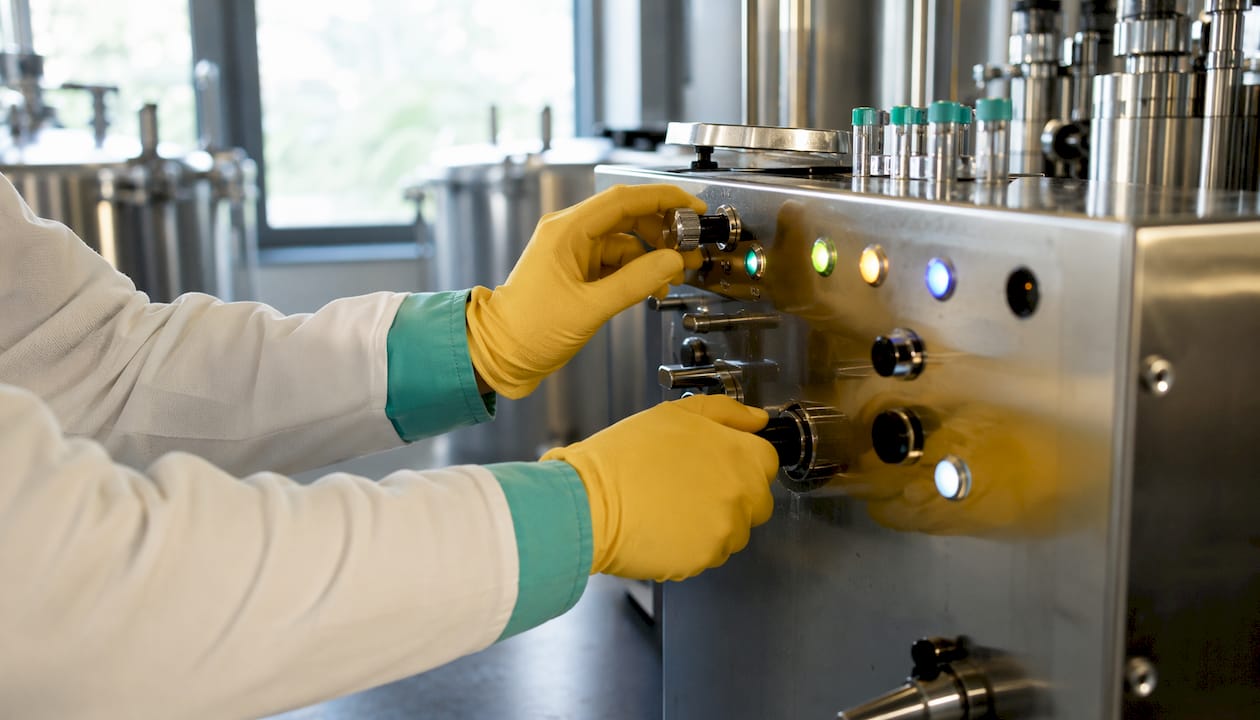
- Supercritical CO2 extraction: the gold standard for safety. CO2 is a gas at ambient conditions, which means it leaves no chemical residue in the extract once the pressure is released. The risk of residual solvents is virtually zero, and the selectivity of the process limits the extraction of certain polar impurities. It is the preferred method for products intended for regular consumption.
- Extraction using hydrocarbon solvents (hexane, butane, propane): effective for cannabinoid yield, but demanding during the purging stage. Insufficient degassing leaves residues detectable by GC-MS. Crumble- or wax-type concentrates obtained through this method require systematic testing for residual solvents.
- Ethanol extraction: generally considered safe if evaporation is complete and controlled. Ethanol is a Class 3 solvent according to ICH Q3C (low intrinsic toxicity), but it also extracts chlorophyll and certain polar mycotoxins, which can complicate subsequent purification steps.
- Purification and winterization: These post-extraction steps (cold filtration, molecular distillation) reduce certain contaminants, such as waxes and chlorophylls, but can concentrate other impurities if not properly controlled.
Pro tip: Choose products whose COA lists residual solvent results obtained by GC-MS, with the limit of quantification (LOQ) clearly indicated for each solvent tested. A COA that states “not detected” without specifying the LOQ does not indicate whether the analysis was sufficiently sensitive.
Which tests and certifications actually guarantee the safety of a batch?
Reference Analytical Methods
| Family of contaminants | Reference Analytical Method | Applicable standard or guideline |
|---|---|---|
| Heavy metals (Pb, Cd, Hg, As) | ICP-MS | EC Regulation No. 1881/2006 |
| Non-volatile pesticides | LC-MS/MS | EC Regulation No. 396/2005 |
| Volatile pesticides | GC-MS / GC-MS/MS | EC Regulation No. 396/2005 |
| Residual solvents | GC-MS (headspace) | ICH Q3C / ISO 21710 |
| Cannabinoids (THC/CBD profile) | HPLC-UV or HPLC-DAD | National Regulations |
| Mycotoxins | LC-MS/MS | EC Regulation No. 1881/2006 |
These analytical methods are those used by accredited laboratories for cannabis and hemp matrices. ICP-MS (inductively coupled plasma mass spectrometry) offers a detection sensitivity for metals in the order of micrograms per kilogram, which is essential for complying with European regulatory thresholds.
ISO 17025 Accreditation and the Role of COFRAC
ISO 17025 accreditation certifies that a laboratory has the technical competence and management system necessary to produce reliable and traceable results. In France, COFRAC (the French Accreditation Committee) is the national body that grants and maintains these accreditations. A COFRAC-accredited laboratory for a given method is subject to regular audits and interlaboratory proficiency testing. Verifying a laboratory’s accreditation on the COFRAC website takes less than two minutes and is the most important check a consumer can perform.
What a Complete COA Must Include
- Name and contact information of the laboratory, including a verifiable ISO 17025/COFRAC accreditation number.
- Batch number that exactly matches the product purchased.
- Date of analysis (a COA for a new batch that is more than 12 months old is a red flag).
- Analytical methods used for each family of contaminants.
- Limits of detection (LOD) and quantification (LOQ) for each analyte.
- Quantitative results (in mg/kg or ppm) for each tested compound, compared to regulatory thresholds.
- Signature or stamp of the laboratory responsible for the analysis.
In practical terms, a representative sample from a batch generally requires a minimum of 5 g of material. The time between sample collection and receipt of the COA varies depending on the laboratory and the complexity of the analyses, but is typically between 5 and 15 business days for a complete panel.
How to Read a Certificate of Analysis, Step by Step?
A COA may seem technical at first glance, but once the key elements are identified, it follows a simple logic.
-
Identify the laboratory. Look up the laboratory’s name and accreditation number. Go to the COFRAC website (cofrac.fr) and enter that number to confirm that the accreditation is active and does indeed cover the methods listed on the COA.
-
Check the lot number. Compare the lot number on the COA with the one printed on the product packaging. If they do not match, the COA does not correspond to your product.
-
Check the test date. A test performed on a previous batch does not guarantee that the current batch is compliant. Require a COA dated within the last 12 months and corresponding to the batch being sold.
-
Verify the scope of the analyses. Does the COA cover all six categories of contaminants? A COA limited to cannabinoids is insufficient to assess the product’s safety.
-
Interpret the numerical results. The results are expressed in mg/kg (equivalent to ppm). Compare each value to the thresholds in Regulation (EC) No. 1881/2006 for metals and mycotoxins, and to the MRLs in Regulation (EC) No. 396/2005 for pesticides. For solvents, refer to the ICH Q3C limits.
-
Understanding “not detected.” This notation means that the concentration is below the laboratory’s LOD for this method. It is reassuring only if the LOD is low enough to be relevant in relation to regulatory thresholds. A COA that states “not detected” without specifying the LOD is incomplete.
| COA Field | What to Check |
|---|---|
| Laboratory Name | Active ISO 17025 / COFRAC Accreditation |
| Lot Number | Matches the product packaging |
| Date of Analysis | Less than 12 months, current batch |
| Analytical Methods | ICP-MS, GC-MS, LC-MS/MS, HPLC listed |
| Scope of the analyses | Six families covered |
| LOD / LOQ | Specified for each analyte |
| Results | Numerical values, compared to thresholds |
| Signature | Identifiable and accountable laboratory |
How do you choose a safe CBD product, and what warning signs should you watch out for?
Positive criteria to look for
- A complete and recent COA covering the six families of contaminants, issued by an ISO 17025/COFRAC-accredited laboratory.
- Documented agricultural traceability: geographic origin of the hemp, AB or Euroleaf organic certification.
- Specified extraction method (preferably supercritical CO2) and purification process described.
- Seller Transparency Policy: COAs accessible by lot number on the website, customer service available, clear return policy.
- Verifiable regulatory compliance: Sellers’ legal obligations regarding labeling and traceability are defined by French consumer law.
Warning signs that should lead to the rejection of a product
- Complete absence of a COA or the seller's refusal to provide one.
- COA covering only the cannabinoid profile, without analysis of metals, pesticides, or solvents.
- Test date is outdated (more than 12 months ago) or the lot number does not match the packaging.
- Unsubstantiated therapeutic claims on the packaging or website: A reputable seller knows which claims are prohibited in CBD marketing.
- Unusually low prices without justification: Official inspections have found non-compliance rates (pesticides, metals) ranging from 8 to 12 percent during inspections of plant extracts, often associated with low-end products lacking traceability.
- The origin of the hemp is unknown or undeclared.
From a legal standpoint, non-pharmaceutical CBD products are not subject to drug regulations and do not have marketing authorization (MA). They are subject to Regulation (EU) No. 2015/2283 on novel foods when intended for consumption, which requires a prior assessment by EFSA for CBD-enriched extracts.
What are the health risks in the event of contamination?
Acute and Chronic Effects
Residual solvents are generally responsible for the most immediate effects: irritation of the mucous membranes, digestive problems, dizziness, or headaches after ingestion. These effects occur at relatively high concentrations and are reversible once exposure ceases.
Heavy metals pose a different problem: bioaccumulation. Lead, cadmium, mercury, and arsenic accumulate in body tissues with repeated exposure, even at low doses. The primary target organs are the kidneys (cadmium, mercury), the nervous system (lead, mercury), and the liver (arsenic). The risk is therefore proportional to the duration and frequency of exposure, not just to a single dose.
The experts’ priority is clear: the health risk posed by non-pharmaceutical CBD stems more from contaminants (metals, solvents, pesticides) than from CBD itself. This is the central conclusion of the MILDECA briefing paper, which emphasizes the need for systematic testing of non-pharmaceutical products.
Pesticides pose an additional risk: certain organophosphates and pyrethroids have documented neurotoxicity, and several compounds are classified as potential endocrine disruptors. The “cocktail effect”—that is, the combination of multiple residues at doses that are individually below the thresholds—remains an active scientific concern, particularly for regular consumers.
For people taking medications metabolized by cytochrome P450 (CYP3A4), CBD itself can alter the pharmacokinetics of these medications. CBD-related side effects and drug interactions warrant prior medical consultation, regardless of the issue of contaminants.
This article provides general information and does not constitute medical advice. For any personal situation, consult a healthcare professional and check with the relevant authorities regarding applicable regulations.
What should you do if you suspect a product is contaminated?
The procedure to follow in France is clear and well-documented. Here are the steps in order.
-
Stop using the suspected product immediately and keep the packaging intact with the lot number visible.
-
Gather all available evidence: packaging, lot number, COA provided by the seller (or confirmation that none was provided), proof of purchase, and a detailed description of the effects experienced, including dates.
-
Contact the seller in writing (via traceable email) to request an explanation and proof of analysis for the batch in question. Keep a record of all responses.
-
Report to the appropriate authorities:
- The DGCCRF (Directorate General for Competition, Consumer Affairs, and Fraud Control) via the SignalConso portal for any violations of consumer product regulations.
- The regional poison control center (national number: 15 or 3114) in case of acute symptoms requiring prompt medical evaluation.
- Pharmacovigilance (ANSM) if the product is marketed as having medicinal properties. Pharmacovigilance reports contribute directly to market surveillance and the protection of other consumers.
-
Exercise your rights: request a refund or return the item to the seller; file a complaint with the public prosecutor if food poisoning is medically documented.
-
Documents to provide when filing a report: packaging with the lot number, proof of purchase, COA (or a statement confirming its absence), a description of the symptoms with dates, and any written correspondence with the seller.
How Pure-extract-cbd Ensures the Safety of Its Products
Pure-extract-cbd follows a structured quality control process before any product is sold. Each batch is accompanied by a COA issued by an independent third-party laboratory, covering the expected categories of contaminants in a comprehensive report. The products are made from organic hemp, with documented agricultural traceability that allows the batch’s origin to be traced.
The internal checklist applied prior to marketing consists of three steps: taking a representative sample from the batch, analysis by an accredited laboratory, and validation of the results against European regulatory thresholds. A product whose test results exceed the limits set by Regulation (EC) No. 1881/2006 or the MRLs in Regulation (EC) No. 396/2005 is not placed on the market.
Transparency regarding certificates of analysis (COAs) is not a marketing ploy: it is the minimum requirement for consumers to be able to assess a product’s safety for themselves. Pure-extract-cbd publishes its certificates of analysis and maintains a responsive customer service team to address any questions regarding a specific batch. If a non-conformity is detected after a product has been released to the market, a recall policy is implemented.
COAs and the return policy are available directly on the product pages of the website. For broad-spectrum oils, as well as for flowers and resins, the lot number printed on the packaging can be used to locate the corresponding COA. Official inspections of CBD products in France provide the regulatory framework for this process.
Key Points
A comprehensive COA issued by an ISO 17025/COFRAC-accredited laboratory remains the only verifiable guarantee that a CBD product does not contain dangerous levels of pesticides, heavy metals, or residual solvents.
| Point | Details |
|---|---|
| Require a complete COA | The COA must cover six categories: cannabinoids, pesticides, heavy metals, mycotoxins, residual solvents, and microbiology. |
| Verify the laboratory's accreditation | Verify the laboratory’s ISO 17025/COFRAC accreditation on cofrac.fr before relying on the COA. |
| Prioritize organic hemp and CO2 | AB/Eurofeuille-certified hemp extracted using supercritical CO2 has the lowest risk profile. |
| Recognizing Warning Signs | The absence of a COA, a partial COA, an outdated date, unknown origin, or an abnormally low price are grounds for rejection. |
| Pure CBD Extract | Offers products made from organic hemp with third-party COAs available by lot number, in compliance with European regulatory thresholds. |
Consumer vigilance does not replace official inspections, but rather complements them
The CBD market in France has grown rapidly, and regulations have not always kept pace. The 2023 MILDECA report puts it bluntly: systematic testing of non-pharmaceutical products remains inadequate. In this context, waiting for the authorities to detect a problem before taking action is tantamount to entrusting one’s own safety to a system that lacks the resources to monitor everything.
What strikes me is that the tools for finding information exist and are accessible. Checking a COA, searching the COFRAC website, verifying a lot number: these steps take just a few minutes and allow you to objectively assess what you’re consuming. Yet most shoppers don’t do them, either because they’re unaware they exist or because the seller doesn’t make it easy for them to do so.
The real question isn’t whether CBD is dangerous in and of itself. The available data show that CBD as a molecule is well tolerated. The real risk comes from contaminants introduced by certain production processes—contaminants that only a laboratory analysis can quantify. Requiring a complete COA isn’t a sign of excessive mistrust; it’s exercising a basic consumer right.
Pure-extract-cbd: Tested, traceable products available online
Choosing a CBD product without a complete COA means accepting a level of uncertainty that is completely unjustified today. Pure-extract-cbd offers a range of extracts derived from organic hemp, tested by accredited third-party laboratories, with COAs available by lot number for every product sold.
For consumers looking for a traceable and tested extract,the 5% broad-spectrum CBD/CBG oil offers a well-documented starting point: the hemp’s origin, extraction method, and test results are available before purchase. For concentrates, the CBD resin line follows the same quality control protocol, including systematic testing for residual solvents. Before finalizing your order, check the COA for the batch corresponding to your product directly on the product page or by contacting customer service.
Useful Sources and References (France / European Union)
- MILDECA — 2023 Non-Pharmaceutical CBD Report: Toxicological Analysis of 248 CBD Products Purchased in France, a Key Reference for Contaminant Monitoring.
- EC Regulation No. 1881/2006: Maximum levels for contaminants (heavy metals, mycotoxins) in foodstuffs.
- EC Regulation No. 396/2005: Maximum residue limits for pesticides applicable to plants, including hemp.
- COFRAC — Register of Accredited Laboratories: a tool for verifying a laboratory’s ISO 17025 accreditation in France.
- ANSM — National Agency for Medicines Safety: the competent authority for pharmacovigilance and the monitoring of products for human use.
- ANSES — National Agency for Food Safety: assessments of food and toxicological risks, including hemp extracts.
- SignalConso — DGCCRF: the official portal for reporting non-compliant or dangerous products to consumers in France.
- PubMed — Study on Heavy Metal Contamination in Edible CBD Products: Data on the Prevalence of Lead, Cadmium, Arsenic, and Mercury in Tested CBD Products.
- ICH Q3C — Guidelines on Residual Solvents: an international framework defining solvent classes and their safety thresholds.