No, legally sold CBD is not automatically permitted at work: the law allows for the sale and use of compliant products, but employers retain the right to prohibit them, and drug tests target THC, not CBD. Therefore, under certain conditions, even a single puff that complies with the legal threshold can trigger a positive test result. The following sections detail the legal framework and practical measures to mitigate this risk.
In short:
- Consuming CBD that meets the 0.3% THC threshold may result in a positive test result, because the tests target THC, not CBD.
- An employer may prohibit the use of any psychoactive substances, including CBD, based on its duty to ensure safety, even if the product is legal.
- Checking the certificate of analysis (COA) and choosing THC-free products significantly reduces the risk of testing positive.
- THC detection depends on the frequency of use, ranging from 6 hours for occasional use to several days for heavy use.
- Case law confirms that the legal status of CBD for commercial purposes does not protect against the consequences of testing positive for THC at work.
Table of Contents
- Legal Status of CBD in France: Thresholds, Relevant Legislation, and Decisions
- Employer Policies, Risk Prevention, and Company Rules and Regulations
- Screening and Positive Results: What Do the Tests Detect, and for How Long?
- Effects of a puff of CBD: alertness, variability, and impact on work
- Reducing Risk: Product Selection, COA, Timing, and Best Practices
- Perspective Pure CBD Extract: Compliance Evidence and Internal Resources
- Customer Option: Choose Pure Extract CBD products suited to your occupational risk
- Sources
- Frequently Asked Questions
Legal Status of CBD in France: Thresholds, Relevant Legislation, and Decisions
The French regulatory framework is based on a principle that appears simple: hemp-derived products are authorized for sale and consumption as long as their THC content does not exceed 0.3 percent, a threshold set by the Public Health Code and specified by administrative order. This threshold applies to the plant itself and not to the finished product, which explains certain variations in concentration between raw flowers and processed oil.
This legal framework governing sales should not be confused with the criminal law issues surrounding THC. THC remains classified as a narcotic, and its presence in the body—even in trace amounts derived from a perfectly legal product—is not negated by the legality of CBD sales. This is precisely what case law confirms: a ruling by the Court of Cassation reiterated that the authorization to market CBD containing up to 0.3% THC in no way precludes the application of rules regarding drug testing. In other words, purchasing a product legally does not protect the consumer from testing positive.
- The 0.3% THC threshold governs sales, not the human body's biological tolerance.
- The fact that a purchase is legal does not prevent THC from being detected during a drug test.
- Case law has made it clear: commercial compliance and the consequences of screening are two separate issues.
This distinction between commercial law and labor law or criminal law is key to understanding why a CBD vape purchased in good faith can still cause problems at the office.
Employer Policies, Risk Prevention, and Company Rules and Regulations
An employer does not need CBD to be illegal in order to prohibit its use.Article L4121-1 of the Labor Code imposes an obligation on employers to ensure safety and prevent occupational hazards, which provides a solid basis for regulating—or even prohibiting—the use of psychoactive substances in the workplace, regardless of their legal status elsewhere.
This preventive approach explains why certain positions are particularly affected:
- Operating vehicles or machinery, where even the slightest lapse in vigilance makes the employer liable.
- Workstations located at heights or near hazardous machinery.
- Medical or safety-related roles, where constant attention is a contractual requirement.
Before using a CBD vape during work hours, it’s best to check your company’s internal policies: many explicitly prohibit the use of any substances on the job, without distinguishing between CBD and traditional cannabis. If in doubt, the occupational health physician is the best person to consult to determine whether CBD use is compatible with a given job, particularly when CBD is used to manage work-related stress or chronic pain.
Pro tip: Before consuming any alcohol at work, request written confirmation from the human resources department rather than relying on an assumed tolerance.
Screening and Positive Results: What Do the Tests Detect, and for How Long?
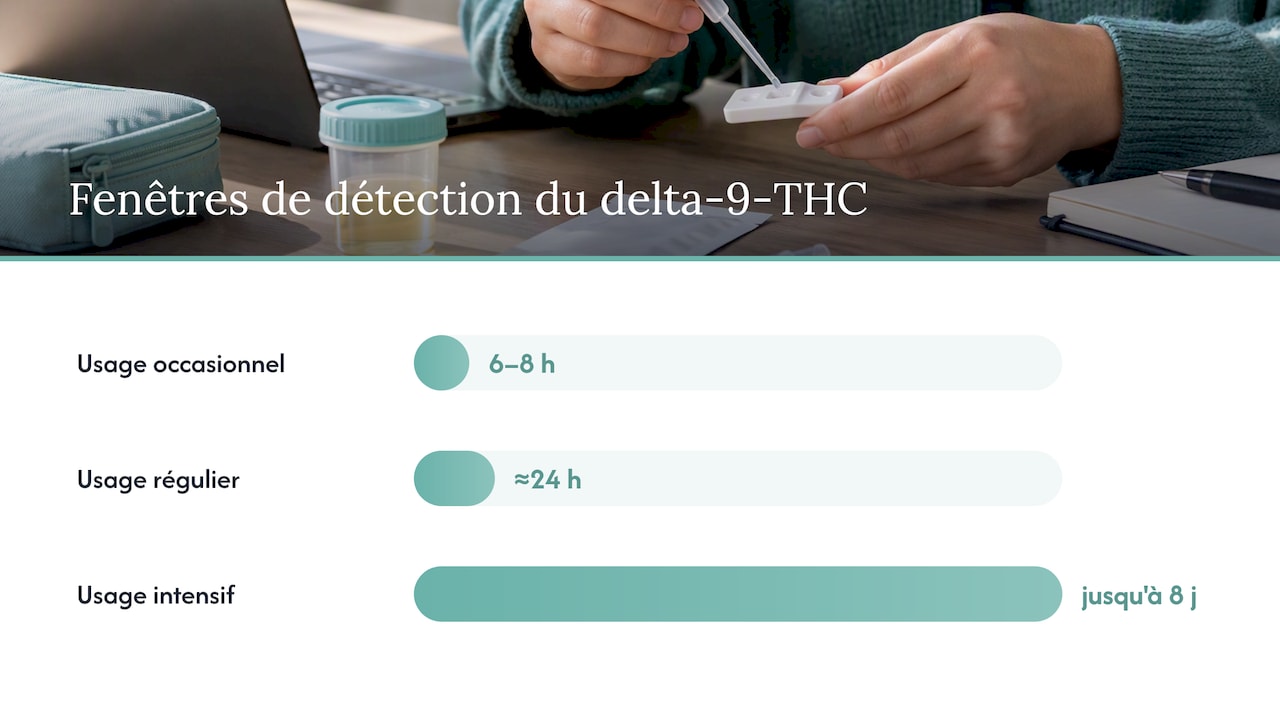
Screening tests—whether saliva, urine, or blood tests—do not detect CBD; they target delta-9-THC, the psychoactive compound in cannabis. Even a CBD product that fully complies with the legal threshold still contains a trace of THC, and this trace can be enough to trigger a positive result, according to Drogues Info Service.
The time it takes to detect the condition varies greatly depending on how often it is consumed:
- Occasional use: THC remains detectable for about 6 to 8 hours after consumption.
- Regular use: The detection window is approximately 24 hours.
- Heavy use: Some studies suggest that traces may still be detectable up to 8 days after quitting.
These timeframes, reported by Drogues Info Service, pertain to the presence of delta-9-THC, not that of CBD itself, which is not detected by these devices. Another point worth noting is that, in practice, it is impossible to prove that a detected trace of THC comes exclusively from a legal CBD product and not from conventional cannabis use, according to the same source. The test detects a molecule, not intent or origin. To explore this mechanism further, our article on CBD and saliva testing details the most common situations leading to unexpected positive results.
Effects of a puff of CBD: alertness, variability, and impact on work
This variability is precisely what concerns employers who are subject to safety obligations: a relaxing effect in one person may result in reduced responsiveness in another, without the user always being aware of it.
- The most commonly reported effects are muscle relaxation and a perceived reduction in stress.
- The intensity depends on the dosage, the method of inhalation, and each individual's sensitivity.
- An unexpected sedative effect can slow reflexes in a job that requires constant vigilance.
It is this uncertainty—rather than the substance itself—that justifies employers’ caution. A reasonable approach is to test the effects of a product outside of work hours, in order to observe one’s own reaction before considering using it at the office.
Reducing Risk: Product Selection, COA, Timing, and Best Practices
Since the tests target THC and not CBD, the best protection is to minimize the amount of THC in what you consume. CBD isolates, which contain no detectable THC, significantly reduce the risk of testing positive compared to full-spectrum products, which retain traces of THC even when they remain within the legal limit.
There are a few practical steps you can take to limit your exposure:
- Choose a CBD isolate or a product explicitly guaranteed to be THC-free for professions subject to drug testing.
- Always check the certificate of analysis (COA) provided by the seller, which indicates the product's actual composition.
- Avoid consuming any alcohol before starting a shift, allowing for a buffer of several hours depending on your usual frequency of use.
- Keep the purchase invoice and the corresponding COA, as these documents can serve as evidence of good faith in the event of an inspection, although they do not guarantee that you will not face penalties.
Checking a product’s quality isn’t just about THC: our guide to pesticides, heavy metals, and solvents in CBD explains how to interpret a COA in its entirety. For people who are regularly stopped at traffic stops, the article on CBD and driving rounds out this analysis with real-world examples.
Pro tip: Always keep the product’s certificate of analysis (COA) for at least three months after purchase, in case any questions arise during an inspection.
Perspective Pure CBD Extract: Compliance Evidence and Internal Resources
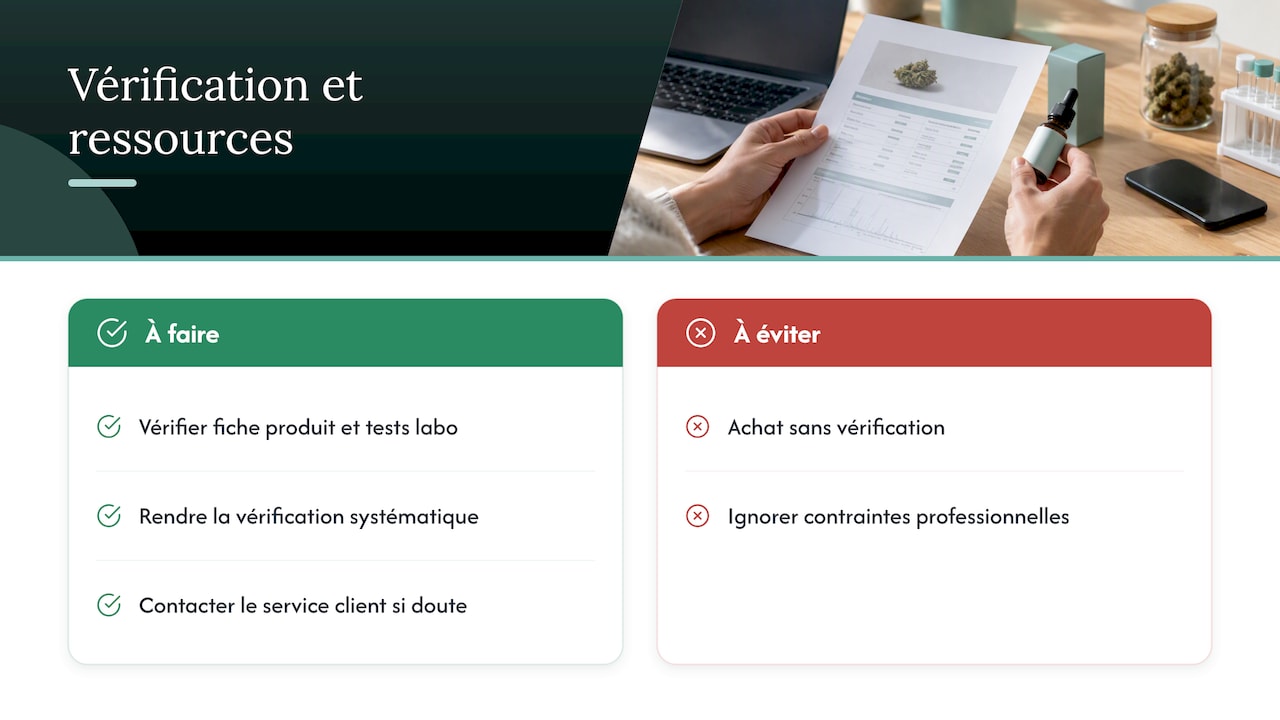
Transparency regarding the composition of a CBD product is not a marketing ploy; it is a necessity for anyone who wants to minimize the real risk of testing positive. Some online stores publish detailed product descriptions and lab test results for their product lines—information that every consumer should be able to verify before making a purchase. This habit of verifying information should become standard practice, especially for people working in industries subject to testing.
If you have any questions about a product’s exact composition or its compatibility with a specific occupational requirement, customer service remains the most direct point of contact for obtaining the necessary documentation before making a purchase.
— Steven
Customer Option: Choose Pure Extract CBD products suited to your occupational risk

There are several categories of lab-tested products, including flowers and resins, oils, cartridges, capsules, and CBD and CBG extracts. To ensure the products are suitable for a demanding professional environment, it is best to review the product descriptions and certificates of analysis before making a purchase; these are available on the complete catalog page.
- People who prefer to avoid inhalation can turn toCBD oil, a more discreet alternative for everyday use.
- If you have strict professional requirements, choose a product that is explicitly guaranteed to be THC-free rather than a full-spectrum product.
To explore our full product lineup and verify that each item meets our standards, visit the Pure Extract CBD store.
Sources
To verify this information on your own, here are a few official resources in France:
- Article L4121-1 of the Labor Code (Legifrance)
- CBD and Saliva Tests: Will a Positive Result Always Lead to Prosecution? — Drogues Info Service
This article is intended to provide general information and is not a substitute for the advice of a qualified attorney. Consult a qualified legal professional regarding your specific case before taking any action based on this content.
Frequently Asked Questions
Am I allowed to smoke CBD at work?
The law does not prohibit the use of CBD that complies with the 0.3% THC threshold, but an employer may prohibit it through its internal policies in accordance with its duty to ensure safety. It is therefore recommended that you check your company’s internal policies before using CBD in the workplace.
Will I test positive if I smoke CBD?
According to Drogues Info Service, a CBD product that complies with the legal threshold may contain a trace amount of THC sufficient to trigger a positive result on a drug test. The tests detect delta-9-THC, not CBD, and it is impossible to prove that the trace amount comes solely from a legal product.
What are the effects of a puff of CBD?
This variability can affect alertness in unpredictable ways, which is why caution is warranted in certain positions.
Is it legal to smoke CBD?
This legality pertains to the sale and consumption of the substance, but it does not prevent a positive result on a THC test.