
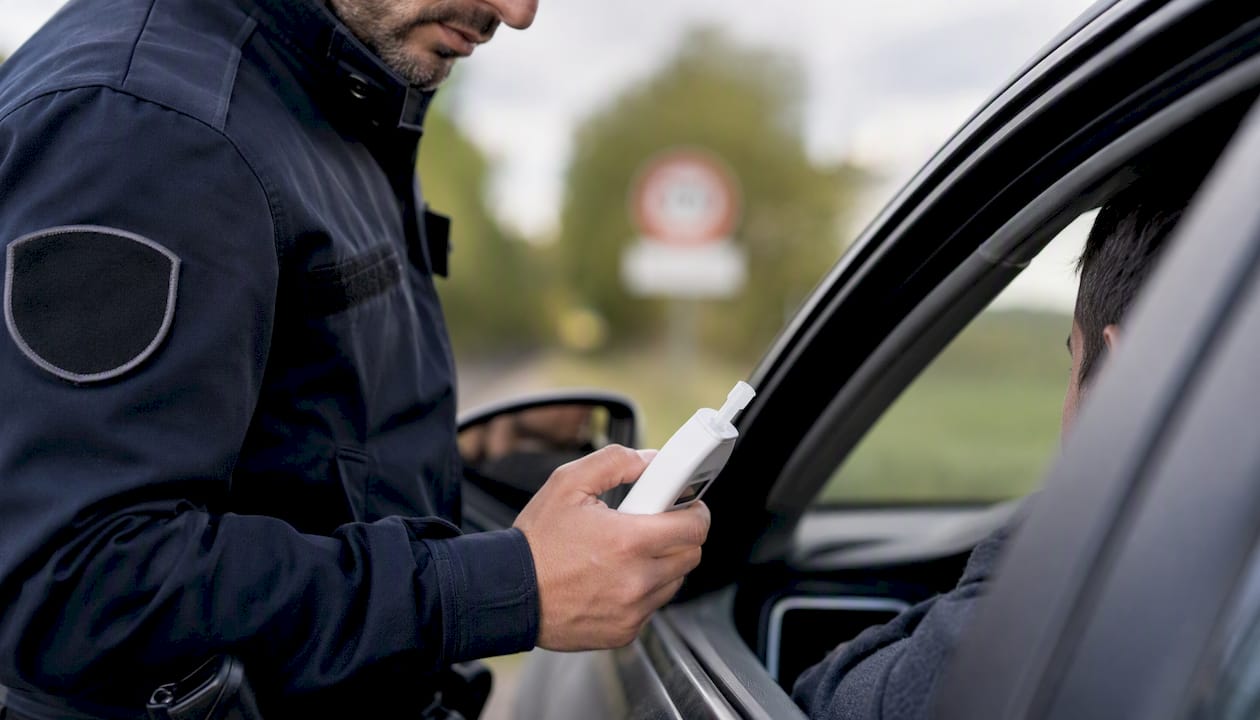
Yes, a roadside saliva test can detect THC after consuming CBD. A positive result occurs when the product consumed contains traces of tetrahydrocannabinol (THC)—even in minute amounts—or when cross-contamination occurred during manufacturing. The key distinction to understand is that the screening device used by the police and gendarmerie tests for the THC molecule in saliva without ever identifying its source. A legal CBD product and an illegal cannabis joint will both produce exactly the same positive result if THC is present.
The practical implications for the driver are immediate:
- Risk of having your license suspended on the spot upon the first positive test result, even before confirmation.
- Right to a second opinion: You may request a blood sample for laboratory analysis.
- Criminal penalties may apply even if the product consumed is legally sold in France.
👉 French law follows a zero-tolerance policy: the mere presence of THC in the body is sufficient to constitute an offense, regardless of whether the product that caused this presence was legal.
Key Points
A roadside saliva test may show a positive result for THC after consuming CBD if the product contains traces of THC, because the device detects the molecule without identifying its source, and French law enforces a zero-tolerance policy.
| Point | Details |
|---|---|
| The test detects THC, not CBD | The saliva test targets ∆9-THC; whether the product is legal or illegal has no effect on the result. |
| Variable detection window | From 4 to 12 hours for occasional use to several days for chronic use, according to SFTA toxicological data. |
| Zero Tolerance in France | Article L.235-1 of the Highway Code is sufficient to initiate legal proceedings as soon as THC is detected, regardless of whether the substance consumed was legal. |
| Second Opinion on Blood Test Results: Your Rights | Formally request a blood test during the checkup; it is the only effective technical means of contesting the results. |
| Pure-extract-cbd: COAs available for each batch | Check the lab results before purchasing, and choose 0% THC isolate formulations if you drive regularly. |
Table of Contents
- How the roadside saliva test works and what it actually detects
- Why Some CBD Products Can Cause a Positive Test Result
- What is the detection window for THC in saliva?
- What is the legal framework in France, and what happens during an inspection?
- What should you do right away if your saliva test comes back positive?
- What practical steps can you take to reduce risk before getting behind the wheel?
- How do you challenge a positive CBD-related saliva test?
- Saliva, Urine, or Blood Tests: What Are the Differences in THC Detection?
- How are THC analysis methods evolving in France?
- What medical or practical alternatives are available to avoid any legal risk?
- Transparency really makes a difference for drivers
- Laboratory-tested products for drivers who don't want to take any risks
- Sources
How the roadside saliva test works and what it actually detects
Law enforcement agencies use multidrug saliva tests capable of simultaneously detecting several substances: THC, cocaine, opioids, amphetamines, and benzodiazepines. For cannabis, the test targets exclusively delta-9-tetrahydrocannabinol (∆9-THC), the psychoactive compound in cannabis.
The result of a screening test is binary: positive or negative. No specific concentration is displayed on-site. The operational sensitivity of certain approved devices is reported to be around 15 ng/mL of THC in saliva, a threshold low enough to detect traces from a recently consumed full-spectrum CBD product.
These tests are characterized by three major technical limitations:
- They do not distinguish the source of the THC: legal CBD, illegal cannabis, or oral contamination all produce the same result.
- They do not measure the THC level in the blood or the driver's actual level of intoxication.
- They do not measure driving ability: a positive result does not prove impaired driving ability.
According to toxicologist Jean-Claude Alvarez, roadside tests do not distinguish the source of THC; the law requires that the substance be absent while driving, which puts CBD users at real risk, even if they are acting in good faith.
Why Some CBD Products Can Cause a Positive Test Result
Isolate, broad-spectrum, and full-spectrum: very different profiles
The chemical difference between CBD and THC is clear, but not all commercial products contain pure CBD. According to French and European regulations, a finished CBD product may legally contain up to 0.3% THC. This product limit is distinct from the legal limit for driving, which is zero.
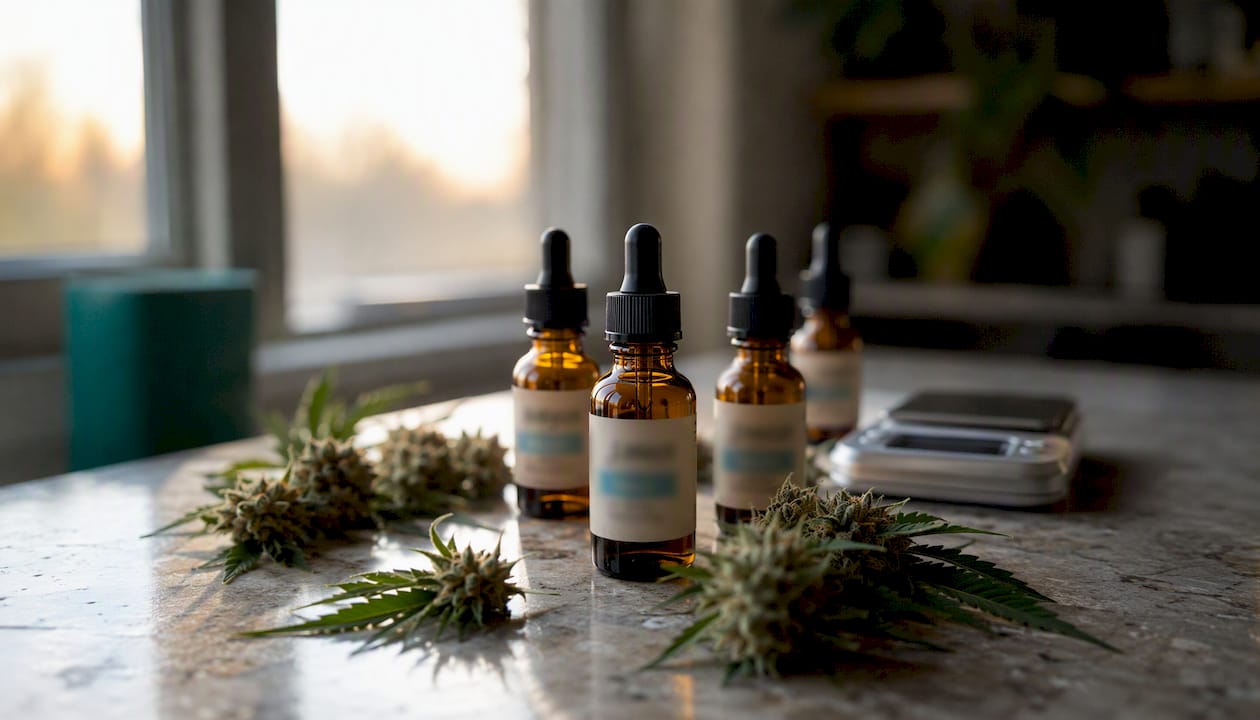
The following are high-risk behaviors before getting behind the wheel:
| Product Form | Relative risk | COA Checkpoints |
|---|---|---|
| Full-spectrum flowers and resins | High | ∆9-THC Concentration per Batch, HPLC Method |
| Full-spectrum oils | Moderate to high | THC concentration in mg/mL, date of analysis |
| Vapes and concentrated extracts | High | Complete cannabinoid profile, accredited laboratory |
| Broad-spectrum oils | Moderate | Absence of ∆9-THC confirmed by LC-MS |
| Pure CBD isolate | Low | Purity ≥ 99%, completely THC-free |
| Cosmetics and Isolat Capsules | Very low | Check the formulation (isolate vs. crude extract) |
Labeling issues pose an additional risk that is often underestimated. Market studies have consistently shown discrepancies between the stated THC content and the amount measured in a laboratory, sometimes to the consumer’s disadvantage. A certificate of analysis (COA) issued by an independent, accredited laboratory remains the only reliable guarantee.
Pro tip: To quickly review a COA, look for three key elements: (1) the ∆9-THC concentration expressed in mg/g or as a percentage, (2) the analytical method used (HPLC or LC-MS/MS are the industry standards), and (3) the date of analysis and the name of the accredited laboratory. A COA that is undated or does not specify the method used offers no guarantee.
What is the detection window for THC in saliva?
The pharmacology of CBD and THC shows that detection in saliva depends heavily on the route of administration and frequency of use. Toxicological data from the French Society of Analytical Toxicology (SFTA) indicate that detection windows vary widely depending on the user’s profile:
- Occasional user: Saliva testing may detect the substance 4 to 12 hours after use.
- Regular user: window extended to 24–72 hours.
- Chronic user: detectable traces for several days, sometimes longer than 72 hours.
Several factors prolong these time windows: a high dose; oral administration (oils, edibles) as opposed to inhalation; certain drug interactions that slow hepatic metabolism; and individual variability in cytochrome P450.
👉 Recommended conservative safety window: Unless you have a prior test confirming the absence of THC in your saliva, it is prudent to wait at least 72 hours after consuming any full-spectrum product before driving. For properly certified isolate products, the risk is very low, but caution is still advised.
What is the legal framework in France, and what happens during an inspection?
Applicable Laws and Regulations
Article L.235-1 of the Highway Code, supplemented by Articles R.235-3 and R.235-4, establishes the principle of zero tolerance: driving after using narcotics is an offense, and the presence of THC in the body is sufficient to establish such use. The Court of Cassation has upheld this strict interpretation: the legality of the substance consumed does not constitute a justifying factor.
The Step-by-Step Inspection Procedure
Official screening procedures are conducted as follows:
- Step 1: Roadside saliva screening test.
- Step 2: If the result is positive, a second saliva test is conducted for confirmation.
- Step 3: Immediate suspension of the driver's license is possible (72 hours).
- Step 4: Blood sample collection at the laboratory for confirmatory testing (you can specifically request this).
- Step 5: Forward the case to the district attorney's office if the confirmation is positive.
Penalties and Consequences
The penalties for driving under the influence of drugs are significant and include imprisonment and fines, in addition to license suspension or revocation, loss of points, and the requirement to complete a training course. The non-legal consequences can be just as severe: documented cases show that a positive test result has led to job terminations and the cancellation of auto insurance policies.
Your rights: You can formally request a second blood test, keep your documents (Certificate of Analysis, invoice, packaging), and contact a lawyer who specializes in traffic law.
What should you do right away if your saliva test comes back positive?
- Cooperate without making any incriminating statements. Answer questions about your identity, but avoid voluntarily providing details about your CBD use: any statement you make may be used in the proceedings.
- Formally request a second blood test. State your request aloud and make sure it is recorded in the minutes. It is your right and, in some cases, the only technical means of demonstrating a very low level or contamination.
- Make a note of the key details: the officers' names, the patrol unit number, the exact location, and the date and time of the inspection.
- Gather your evidence as soon as possible: the product packaging with the lot number, the invoice or purchase order, the COA for the relevant lot, and photos of the labeling. Keep everything.
- Contact a lawyer specializing in traffic law before responding to any summons. Specialized law firms have secured favorable rulings in technical challenges, particularly by demonstrating through blood tests that THC levels did not exceed the legal limit.
- Report the issue to your seller. If the product is at fault, the seller must be notified so that the batch can be checked for compliance.
Pro tip: Save a note on your phone that includes: the product name, its lot number, the COA URL, and your seller’s contact information. In the event of an inspection, you’ll have the most useful information on hand right away.
What practical steps can you take to reduce risk before getting behind the wheel?
- Choose CBD isolate products (0% THC) certified by an accredited independent laboratory. Isolate is the only form that structurally eliminates the risk associated with residual THC.
- Avoid flowers, resins, and full-spectrum oils in the hours or days before driving, taking into account the detection windows based on your frequency of use.
- Always check the COA before making a purchase: ∆9-THC content, analytical method, accredited laboratory, and recent date.
- Use a commercially available saliva self-test (threshold: 15 ng/mL) as a self-assessment tool before driving. These tests are not a substitute for the official procedure, but they allow you to estimate your status at the time of departure.
- Keep all your proofs of purchase and COAs in a digital folder that you can access from your phone.
Pro tip: If you’re unsure about your condition after consuming CBD, do not drive. Use an alternative form of transportation (carpooling, public transportation, taxi). No convenience is worth the risk of having your license revoked or facing criminal charges.
How do you challenge a positive CBD-related saliva test?
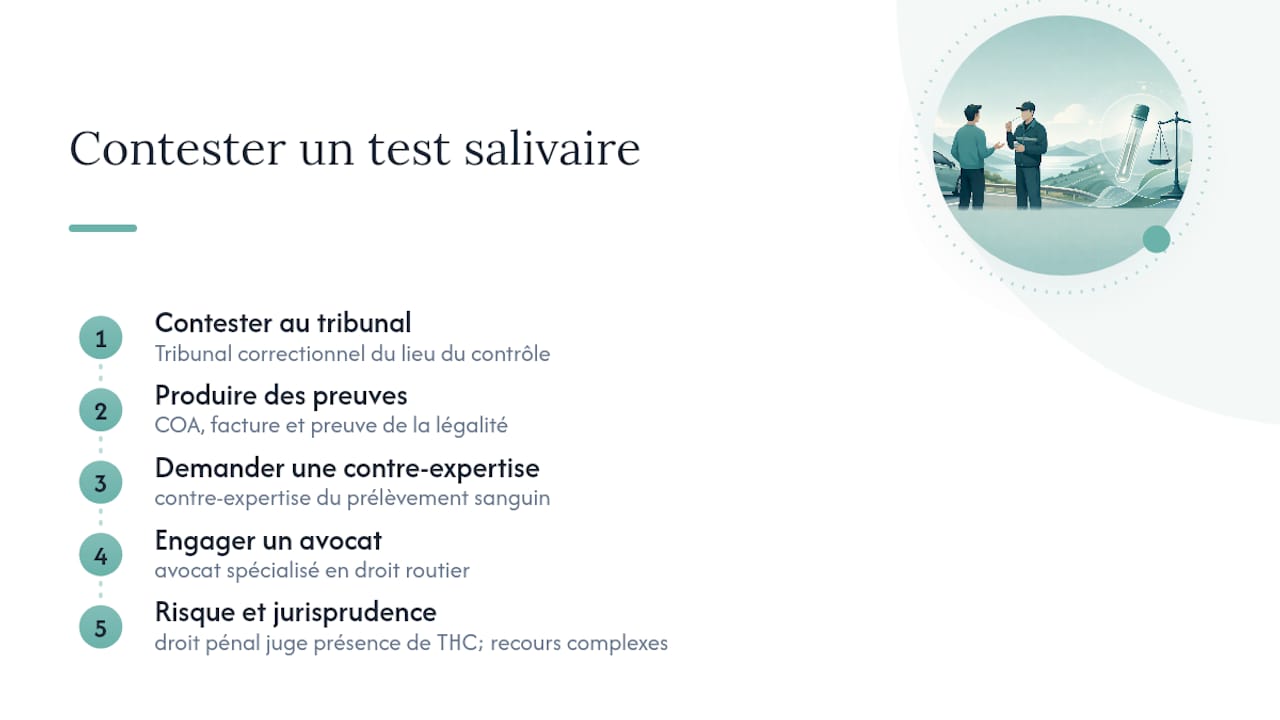
Challenging a positive saliva test requires a precise technical and legal strategy. The consumer’s good faith, even when supported by a COA, does not prevent immediate administrative measures. However, a blood retest may sometimes show a blood THC level below the threshold set by forensic experts, or reveal unintentional contamination.
The steps to take are as follows. First, file an appeal with the criminal court by submitting the COA for the batch consumed, the purchase invoice, and any evidence proving the product’s legality. Next, request an independent toxicological analysis of the preserved blood sample. Legal experts note that the legal framework remains unclear for CBD consumers: criminal law applies to the presence of THC, not to the legality of the product itself, which makes legal challenges complex but not impossible.
The primary point of contact is the criminal court with jurisdiction over the location where the stop occurred. A lawyer specializing in traffic law is essential to building a strong case. Some law firms have secured acquittals or reduced sentences by demonstrating the absence of psychoactive effects and the legality of the substance consumed, but such successes remain rare given the current state of case law.
Saliva, Urine, or Blood Tests: What Are the Differences in THC Detection?
The three types of tests do not have the same legal standing or the same detection window.
The saliva test is the only one used during traffic stops in France. Its result is binary during the screening phase and does not quantify the blood alcohol concentration.
Urine tests are not used in French traffic stops. Their detection window is much longer (up to 30 days for a chronic user), because they detect THC metabolites (THC-COOH) rather than the active compound itself. They have no direct legal standing for establishing driving under the influence.
The blood test is the gold standard for confirmation in France. Ordered after a positive saliva test or in the event of an accident, it measures the level of active THC and its metabolites in the blood. It is the only result that can be technically challenged in court, which is why requesting a blood draw is a fundamental right of the driver being tested.
How are THC analysis methods evolving in France?
Saliva-based screening devices have gradually improved in sensitivity and specificity since their introduction in France. The first generations of tests had significant false-positive rates, particularly with certain medications. The devices currently approved for roadside testing (listed by ministerial order) meet strict performance criteria, with an operational sensitivity of approximately 15 ng/mL for THC.
In the laboratory, confirmatory analyses use gas chromatography coupled with mass spectrometry (GC-MS) or liquid chromatography coupled with tandem mass spectrometry (LC-MS/MS). These methods allow for precise quantification and are recognized as forensic standards. While they are highly reliable scientifically, they do not determine the source of the detected THC: they merely confirm its presence and concentration, nothing more.
Research in forensic toxicology explores markers that can distinguish between recent use and past exposure or contamination, but these approaches have not yet been incorporated into French legal procedures.
What medical or practical alternatives are available to avoid any legal risk?
For drivers who use CBD for therapeutic or wellness purposes, there are several guidelines that help balance its use with legal certainty.
The first is to consult a doctor or pharmacist before starting CBD supplementation, particularly to assess potential drug interactions and possible side effects such as drowsiness, which can affect the ability to drive regardless of THC. The second is to choose certified CBD isolate products, whose cannabinoid profile structurally excludes THC. The third is to adjust your dosing schedule: taking it in the evening, after your last drive of the day, reduces your risk exposure.
For people using CBD as part of substance withdrawal or addiction treatment, the available data suggest that medical supervision remains the safest approach, both in terms of effectiveness and legal compliance while driving.
Transparency really makes a difference for drivers
The rise in legal challenges related to positive test results following CBD use highlights a structural problem: too many products are on the market without an accessible COA, without a traceable lot number, and without clear information about their actual THC content. A driver who buys full-spectrum oil without checking the COA is taking a risk that they may not always fully appreciate.
Analytical transparency is not a marketing ploy. It is a genuine safety measure for consumers who drive. A seller who publishes COAs by batch, recalls a product as soon as a non-conformity is detected, and clearly informs customers about the risks associated with driving is providing concrete protection. Conversely, a product without a COA or with a generic, undated COA exposes the buyer to a legal risk that they cannot anticipate.
Administrative inspections of CBD products in France show that there is significant variability between batches, even among sellers acting in good faith. Traceability by batch—rather than by product line—is the only relevant level of assurance for a driver.
Laboratory-tested products for drivers who don't want to take any risks
For drivers who use CBD regularly, the choice of product is the risk factor they can most directly control.

Pure-extract-cbd offers a range of products tested by independent laboratories, with COAs available by batch. Before making a purchase, you can review the product descriptions and check the associated test results to confirm the absence of THC. For drivers who want a no-compromise approach, the entire product line is available online, along with the corresponding test reports. Review the product descriptions, check the COAs, and make an informed choice.
Sources
The following resources provide further insight into each aspect discussed in this article:
- Legifrance
- Road Safety
- Legal, but Not Behind the Wheel: Why Lawsuits Related to CBD Use by Drivers Are on the Rise | TF1 Info
- Medisur
This article provides general information for educational purposes. It does not constitute legal or medical advice. If you test positive or have any doubts about your situation, consult an attorney who specializes in traffic law and verify the applicable laws through official sources.
This article is intended to provide general information and is not a substitute for the advice of a qualified attorney. Consult a qualified legal professional regarding your specific case before taking any action based on this content.



