

Reports of adverse effects related to CBD are the cornerstone of pharmacovigilance for cannabinoids, and their chronic underreporting now represents a health risk documented by the ANSM. Between 2017 and 2023, poison control centers recorded 58 cases of interactions between CBD and medications, including 4 serious cases identified by the pharmacovigilance network in 2021 and 2022. The ANSM itself acknowledges that this figure is “undoubtedly significantly underestimated.”
Pharmacovigilance refers to the system of continuous monitoring of adverse effects of health products after they have been placed on the market. As applied to CBD, this monitoring involves three complementary institutional stakeholders:
- The ANSM (French National Agency for Medicines and Health Products Safety): the central authority that collects reports, issues alerts, and updates recommendations.
- Regional Pharmacovigilance Centers (CRPVs ): a network of university hospitals that analyze cases reported at the regional level and provide clinical expertise.
- CEIP-A (Centers for the Assessment and Information on Drug Dependence and Addiction Surveillance): specialized in monitoring substances with abuse potential, including cannabinoids.
Every report submitted to this network is handled with strict respect for confidentiality and medical privacy. Patients, healthcare professionals, and organizations can submit reports without fear of public identification. Submitting a report does not constitute a complaint; it is a contribution to public safety, governed by specific legal obligations set forth in the Public Health Code.
Key figure: Since early 2024, several hundred cases of poisoning linked to products marketed as containing CBD have been reported to poison control centers and the CEIP-A, according to ANSES and ANSM.
How do you report a CBD-related adverse event in practice?
The portal signalement.social-sante.gouv.fr is the official channel for reporting any adverse event, whether by a healthcare professional or a consumer. The process is entirely online and accessible without needing to create an account.
Who can file a report, and what should be reported?
Anyone can report an adverse event: doctors, pharmacists, nurses, as well as patients and their loved ones. Healthcare professionals are required to report any suspected link between a healthcare product and an adverse event. Consumers, on the other hand, contribute voluntarily, and their input is valuable precisely because they describe situations that healthcare providers do not always observe.
A useful report includes:
- A detailed description of the symptom(s) observed (nature, intensity, duration).
- The CBD product(s) consumed (form, brand if known, estimated dosage).
- Medications taken at the same time, including over-the-counter medications.
- The time between consumption and the onset of symptoms.
- Changes following discontinuation of the product.
Processing of Reports by Vigilance Centers
Once submitted, the report is forwarded to the appropriate CRPV or CEIP-A, depending on the nature of the reported adverse event. These centers analyze the plausibility of the causal link, search the national database for similar cases, and report their findings to the ANSM. When multiple reports point to the same product or the same type of adverse event, the agency may issue an alert, order a recall, or revise its recommendations.
Pro tip: Don’t wait for absolute medical certainty to report a case. The ANSM explicitly recommends reporting as soon as a case is suspected: it is precisely the accumulation of early reports that makes it possible to detect weak signals before they turn into public health crises.
What side effects and drug interactions should you watch out for?
CBD is not a drug, but it acts as an active substance in its own right. The ANSM explicitly points out that its effects on the body extend beyond the benefits sought by consumers, and its interactions with other molecules can be clinically significant.
Reported Adverse Effects
The most commonly reported symptoms after taking CBD, either alone or in combination with medications, are:
- Nausea, diarrhea, vomiting.
- Drowsiness, fatigue, dizziness.
- Headaches, anxiety, acute anxiety attacks.
- In the most severe cases: tachycardia, hallucinations, suicidal thoughts, seizures, loss of consciousness.
These effects can occur regardless of the form in which it is consumed (oil, herbal tea, candy, vaping) and regardless of the duration of use, whether it lasts a few hours or several months.
Drug interactions: 17 affected drug classes
According to the ANSM, CBD interacts with at least 17 classes of medications. These include: analgesics, anticoagulants, antidiabetics, antibiotics, antifungals, antidepressants, antiepileptics, antipsychotics, hypnotics, benzodiazepines, and methadone. This list is not exhaustive: the agency notes that other interactions with drugs not yet identified remain possible.
The underlying mechanism is primarily enzymatic. CBD inhibits or induces certain cytochrome P450 enzymes, thereby altering the hepatic metabolism of many drugs, which can reduce their effectiveness or increase their side effects.
Key figure: Of the 58 cases of interactions recorded between 2017 and 2023, 4 were classified as serious by the CRPVs and CEIP-A—a figure that the ANSM considers to be very likely an underestimate.
For people on long-term medication, the recommendation is clear: inform your doctor of any CBD use—even if it’s occasional—and even if it involves over-the-counter products. If your medication suddenly seems less effective or causes unusual side effects after you start taking CBD, you should consult your doctor immediately. The side effects of CBD have been documented and warrant special attention in people taking multiple medications.
The European CBD Market: Why Is It Important to Be Vigilant About Product Ingredients?
The wide variety of CBD-based products available in Europe creates a particularly complex landscape for pharmacovigilance. Oils, resins, flowers, e-liquids, capsules, cosmetics: the range of forms is expanding, sources of supply vary, and oversight of actual composition remains inadequate across the market.

A label that doesn't always reflect reality
A study conducted in 2023 by the CEIPs in Lyon, Paris, and Montpellier, with support from Mildeca, found that 8 out of 10 CBD-based products contain a CBD concentration different from what is listed on the label. This discrepancy is significant: it means that consumers do not really know what they are ingesting.
The risks identified by the ANSM and ANSES fall into two categories:
- Presence of synthetic cannabinoids (HHC, HHC-O, H4-CBD, MDMB-PINACA, etc.) not listed on the label, which are classified as controlled substances and whose sale is prohibited.
- THC levels exceeding 0.3%, the legal threshold in France, may cause psychoactive effects and impair alertness, particularly among drivers and workers exposed to occupational hazards.
Rise in Poisonings and the Role of Reports in Detection
Since early 2024, ANSES and ANSM have issued warnings about a sharp increase in cases of poisoning linked to products marketed as CBD but containing banned substances. These cases, reported to poison control centers and CEIP-A, have made it possible to identify problematic batches and initiate recall procedures.
Reports play a role in identifying issues that market oversight alone cannot address. A consumer who reports an unexpected reaction after purchasing a product from a vending machine or an online platform provides information that testing laboratories can only obtain after the fact. Regulations governing legal cannabinoids are evolving precisely in response to these signals from the field.
For healthcare professionals treating patients with symptoms of poisoning after consuming CBD, reporting these cases to the CEIP-A is the most direct way to help detect these fraudulent products.
What role do healthcare professionals and consumers play in CBD pharmacovigilance?
Pharmacovigilance relies on a network of people. Without individual reports, signal detection algorithms have no data to analyze. That is why the ANSM clearly distinguishes between the obligations of healthcare professionals and the voluntary but valuable contributions of consumers.

Obligations and Best Practices for Healthcare Professionals
Doctors, pharmacists, and other healthcare professionals have a legal obligation to report any serious or unexpected adverse effects of which they become aware, whether related to a drug or an active substance such as CBD. In practical terms, this means:
- Systematically ask patients about their CBD use at every visit, including over-the-counter products.
- Report any suspicious symptoms that occur in connection with CBD use on the official portal, without waiting for confirmation of a causal link.
- Refer patients to their primary care physician or the emergency department if they have severe symptoms.
- Collaborate with the CRPVs and CEIP-A to monitor complex cases.
Reporting as an act of civic duty, not as a denunciation
For consumers, the process is different but just as useful. Reporting an adverse reaction is not a legal proceeding: it is an anonymized contribution to collective health surveillance. The ANSM guarantees respect for medical confidentiality and privacy for every report it receives.
However, several obstacles remain: a lack of awareness about the reporting portal, fear of being judged for using CBD, or simply the idea that “it’s not serious enough to report.” Yet even a mild but unexpected effect, when considered alongside other similar reports, can reveal a problem with the product’s composition or interactions that has not yet been documented.
- Consumers can file a report directly at signalement.social-sante.gouv.fr.
- Healthcare professionals have access to the same portal, which includes a section dedicated to their reporting requirements.
- The CRPVs and CEIP-As can be contacted directly for complex cases requiring specialized expertise.
Educating patients about these procedures is an integral part of the roles of pharmacists and primary care physicians. Informing a patient who uses CBD about the reporting portal empowers them to actively contribute to their own safety and that of others.
What does the ANSM say about CBD-drug interactions and the actual impact of adverse event reports?
The ANSM’s official position, updated in March 2025, is unambiguous: CBD is an active substance whose safety profile warrants rigorous monitoring, just like any other pharmacologically active compound. This position contrasts with the common perception that it is a “natural” and therefore harmless product.
Recent Data and the Issue of Underreporting
The 58 cases of interactions recorded between 2017 and 2023 likely represent only a very small fraction of the actual number. Several factors account for this structural underreporting:
- Consumers do not automatically associate their symptoms with their CBD use, especially if they have been using it for a long time or only occasionally.
- Healthcare professionals do not always think to ask their patients about CBD, which is still viewed as a harmless dietary supplement.
- The lack of a marketing authorization (MA) for most CBD products creates uncertainty regarding the reporting requirement.
However, every unreported case represents missing data in the national pharmacovigilance database. The ANSM can only update its recommendations or issue alerts about new interactions based on the cases that are actually reported to it. Reports therefore have a direct impact on regulations: it was precisely the accumulation of reported cases that led the agency to issue its alert on CBD-drug interactions and to revise the list of affected therapeutic classes.
CBD is not a drug, but it acts as an active ingredient
This distinction is fundamental to understanding the challenges of pharmacovigilance as it applies to CBD. A drug undergoes clinical trials, receives marketing authorization, and is subject to structured post-marketing surveillance. CBD, which is marketed as a dietary supplement or wellness product, falls outside this framework, making spontaneous reports all the more valuable in filling the information gap.
The ANSM reminds the public that drug interactions involving CBD can occur regardless of the form in which it is consumed and irrespective of the duration or frequency of use. This pharmacological reality warrants constant vigilance, not just in cases of heavy use.
Important Note: Reports submitted to the CRPV and CEIP-A have direct regulatory implications. They are entered into the European pharmacovigilance database (EudraVigilance) and may lead to decisions to withdraw products at the EU level, beyond the borders of France alone.
Pure-extract-cbd and Product Safety: A Requirement for Transparency
With the growing number of CBD products on the European market, choosing the right supplier is crucial for consumer safety. Pure-extract-cbd is committed to traceability and compliance standards that the market does not yet systematically require: each product undergoes independent laboratory testing to ensure that CBD and THC levels meet specifications and that no undeclared substances are present.
Given that 8 out of 10 products contain ingredients that differ from what is listed on their labels, this analytical transparency is not merely a secondary marketing point. It is the minimum requirement for consumers to be able to assess what they are consuming and, if necessary, provide reliable information when filing a report.
Discover the full range of products tested and certified by Pure-extract-cbd, or explore the CBD products with the highest consumer ratings to make an informed choice.
Key Points
Pharmacovigilance reports are the only mechanism that allows the ANSM to detect and prevent adverse effects associated with CBD in the general population, particularly given the documented structural underreporting.
| Point | Details |
|---|---|
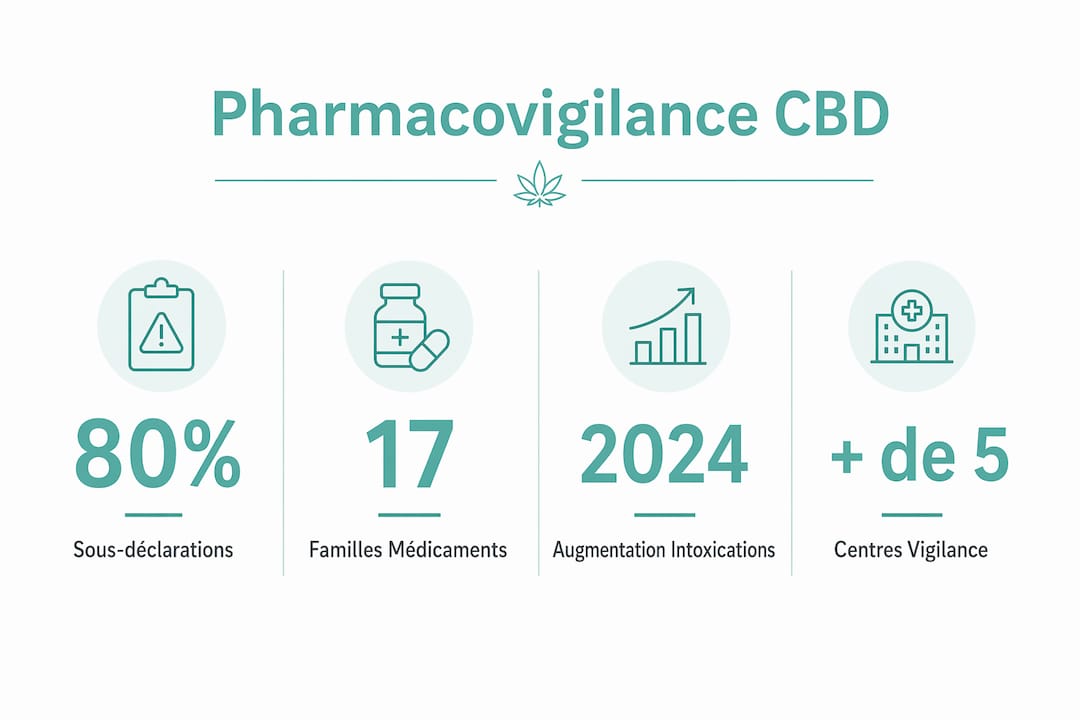
| Documented sub-statement | 58 cases of interactions were reported between 2017 and 2023, a figure that the ANSM considers to be significantly underestimated. |
| 17 drug classes involved | CBD interacts with at least 17 classes of medications, including anticoagulants, antiepileptics, and benzodiazepines. |
| Frequent non-compliant composition | 8 out of 10 CBD products have an actual concentration that differs from the one listed on the label. |
| Single Reporting Portal | Patients and healthcare professionals can report incidents via signalement.social-sante.gouv.fr, with confidentiality guaranteed. |
| Direct Regulatory Impact | Reports submitted to the CRPVs and CEIP-A inform the ANSM’s decisions and are incorporated into European pharmacovigilance databases. |



