The entourage effect refers to the proposed synergy between the cannabinoids, terpenes, and flavonoids in cannabis—an interaction that is thought to alter a product’s effects compared to those of an isolated compound. The mechanism is biochemically plausible and supported by preclinical data, but no large-scale human trials have yet confirmed its actual extent in humans.
In short:
- The entourage effect is a complex interaction between cannabinoids, terpenes, and flavonoids, the actual impact of which in humans has yet to be fully validated by large-scale clinical studies.
- The potential synergy could increase the efficacy of certain whole-plant extracts compared to isolated compounds, but the precise contribution of terpenes and flavonoids remains controversial in practice.
- Drug interactions resulting from metabolism by CYP450 enzymes—particularly with CBD—require special caution in patients taking medications with a narrow therapeutic index.
- Storage, extraction methods, and traceability through a certificate of analysis are essential to ensure that a cannabidiol product actually contains synergistic compounds.
- In the absence of conclusive evidence, it is advisable to exercise caution by choosing transparent products with a detailed terpene profile and high traceability.
Table of Contents
- Entourage Effect: The Interaction Between Cannabinoids, Terpenes, and Flavonoids
- What do the studies actually say about this cannabinoid synergy?
- Drug Interactions: The Risk That Marketing Slogans Fail to Mention
- Full-spectrum, broad-spectrum, or isolate: Which form preserves the synergy?
- How can you identify a product that truly preserves this synergy?
- How should we interpret the “entourage effect” today?
- Where to Find Tested CBD Products and How to Get Started with Confidence
- Sources
- Frequently Asked Questions
Entourage Effect: The Interaction Between Cannabinoids, Terpenes, and Flavonoids
To understand the entourage effect, we must first identify the key players in this anticipated synergy. THC, CBD, CBG, and CBN do not behave the same way in the body, even though they share a common origin in the hemp plant.
THC primarily acts on the CB1 receptors of the endocannabinoid system, which explains its psychoactive effect. CBD, on the other hand, modulates this same system more indirectly and interacts with other targets, such as serotonin receptors. CBG and CBN, which are present in smaller quantities in most extracts, round out this picture with receptor affinities that are still being studied—a topic we cover in detail in our article on CB1 affinity and the differences between THCP and THCA.
Terpenes add another layer to this equation. They are what give hemp its characteristic scent, but their role could extend far beyond just aroma:
- Myrcene, which is found in many strains, is thought to have a potentially sedative effect.
- Linalool, which is also found in lavender, is believed to have anxiolytic properties.
- Limonene, with its citrus scent, is sometimes said to have a mood-boosting effect.
- Beta-caryophyllene is distinguished by its ability to act directly as a CB2 receptor agonist, which makes it almost a cannabinoid in its own right.
The mechanisms proposed to explain a possible synergy are based on three main hypotheses: joint modulation of endocannabinoid system receptors, complementary action on non-cannabinoid receptors (serotonin, vanilloids), and possible inhibition or activation of enzymes that influence the rate at which the compounds take effect. The summary page on the entourage effect brings together these theoretical avenues, which remain, for now, working hypotheses rather than established facts.
Flavonoids, present in even smaller quantities, round out this molecular profile with antioxidant properties that have been documented primarily in vitro. Their contribution to the overall effect remains the least studied of the three families of compounds.
What do the studies actually say about this cannabinoid synergy?
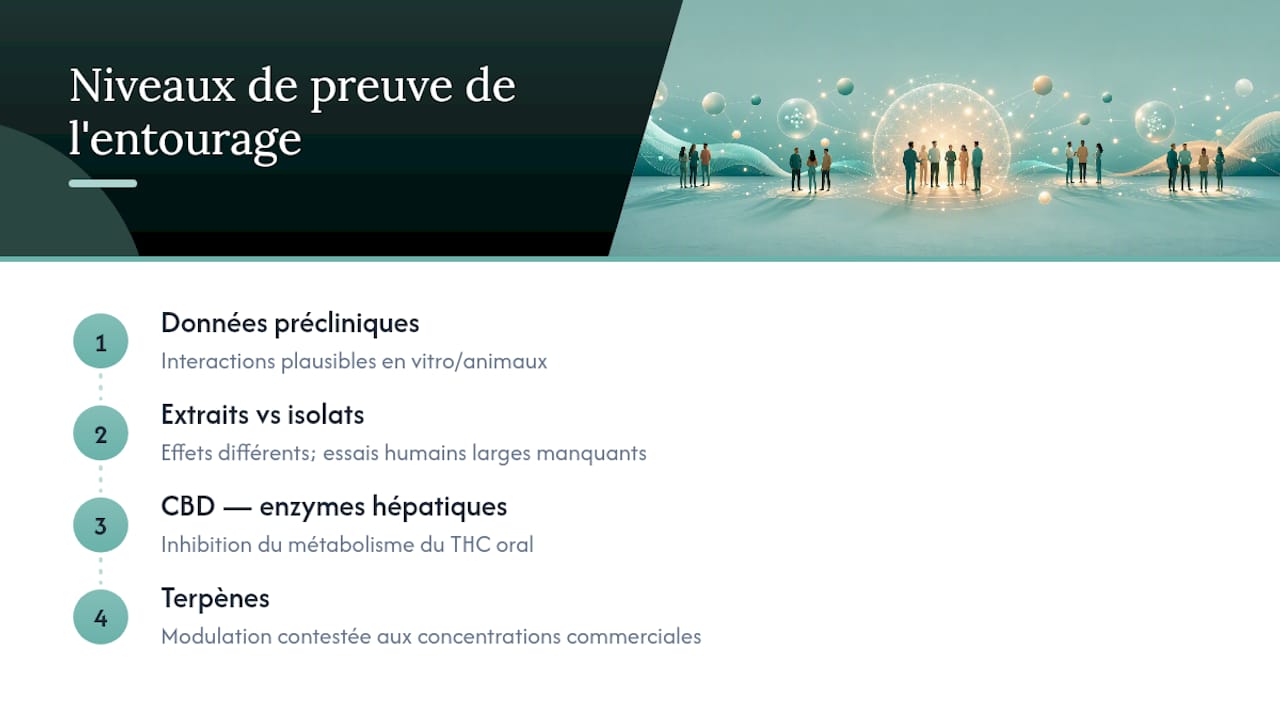
Preclinical data, obtained from animal models or in the laboratory (in vitro), generally support the existence of a genuine interaction between cannabis compounds. Several studies show that full-spectrum extracts produce different effects—sometimes more pronounced—than the same cannabinoids administered alone at equivalent doses.
The problem lies elsewhere: in humans, there is a lack of large-scale clinical trials that directly compare full-spectrum extracts with isolates. An analysis of cannabinoid interactions highlights that, despite documented cases of pharmacological interactions, there is a lack of sufficiently large comparative trials to determine the true extent of the entourage effect in humans.
What we know with a reasonable degree of confidence: CBD can inhibit certain liver enzymes responsible for metabolizing THC, which increases the plasma concentration of THC and its active metabolite, 11-OH-THC, particularly when administered orally. This phenomenon is a concrete and measurable example of an interaction between two cannabinoids, even though it does not, on its own, prove the existence of a generalized beneficial synergy involving terpenes and flavonoids.
The role of terpenes is the subject of even more heated debate. A review of cannabinoid drug interactions notes that while terpenes do contribute to the aroma and possess pharmacological properties when isolated, their actual ability to significantly modulate the effects of THC or CBD—at the concentrations actually found in commercial products—remains widely disputed within the scientific community.
This caution does not invalidate the hypothesis of the “entourage effect.” Rather, it calls for a more nuanced view: the concept describes a plausible biochemical phenomenon that has been partially demonstrated in the laboratory, but its clinical significance in humans—at actual doses in a commercial product—remains to be quantified through better-controlled trials.
Drug Interactions: The Risk That Marketing Slogans Fail to Mention
One of the most common blind spots in discussions about the entourage effect concerns its downside: the risk of interactions with ongoing medication. Cannabinoids—primarily THC and CBD—are metabolized by several liver enzymes in the cytochrome P450 family, including CYP3A4, CYP2C9, and CYP2C19. These same enzymes process a significant portion of commonly prescribed medications, which opens the door to significant pharmacokinetic interactions.
A systematic review published in *Frontiers in Pharmacology* documents cases in which cannabinoids have altered the pharmacokinetics of drugs with a narrow therapeutic index, with clinical consequences observed in certain case series. The drug classes most commonly affected include:
- Anticoagulants such as warfarin, the effects of which may be enhanced.
- Immunosuppressants such as tacrolimus, used after an organ transplant.
- Certain antiepileptic drugs, including valproate.
- Drugs metabolized by the same enzymatic pathways, with a risk of overdose or underdose.
Because of this enzyme inhibition, there is a real risk of drug interactions, particularly for people taking medications with a narrow therapeutic index—that is, medications for which even a slight deviation in dosage can have serious consequences. A prior medical consultation is not an unnecessary precaution in this context, but rather an essential step in itself.
Pro tip: Before taking any CBD, if you are on medication, tell your doctor or pharmacist, and always start with the lowest possible dose, even if that means increasing it gradually under medical supervision.
Warning signs include unusual drowsiness, atypical bleeding in a person taking anticoagulants, or any perceived change in the effectiveness of a chronic treatment after starting CBD. It is important to be aware of the possible side effects of CBD before starting treatment, especially for older adults or those taking multiple medications—populations in whom the cumulative risk of interactions automatically increases with the number of treatments taken concurrently.
Full-spectrum, broad-spectrum, or isolate: Which form preserves the synergy?
The choice of product form directly determines whether or not synergies between compounds are possible.
Full-spectrum products retain the plant’s entire natural profile: secondary cannabinoids, terpenes, flavonoids, and trace amounts of THC within European legal limits. Broad-spectrum products fall somewhere in between: they retain terpenes and secondary cannabinoids but remove THC, which meets the needs of people who are subject to workplace drug testing or who are simply cautious about this compound.
| Format | Preserved compounds | THC present | Expected halo effect |
|---|---|---|---|
| Isolate | CBD alone | No | Absent by definition |
| Broad spectrum | Secondary cannabinoids, terpenes | No (or undetectable traces) | Partial, without THC content |
| Full spectrum | Complete Plant Profile | Yes | Potentially the most comprehensive |
The extraction method directly influences the quality of this profile. Supercritical CO2 extraction, considered the cleanest method, better preserves volatile terpenes than methods using harsh chemical solvents, which can degrade these heat-sensitive molecules. The choice between full-spectrum, broad-spectrum, and isolate therefore depends as much on your personal circumstances (drug testing, THC sensitivity) as it does on your intended use.
How the product is stored also matters: prolonged exposure to light or heat breaks down terpenes faster than the cannabinoids themselves, which can weaken the synergy claimed on the label even if the CBD concentration remains stable.
How can you identify a product that truly preserves this synergy?
A well-designed certificate of analysis (COA) remains the most reliable tool for verifying what a product actually contains, beyond the claims printed on the packaging. Here’s how to do it in practice:
- Ask for the COA before making a purchase, or make sure it’s directly accessible on the product page—ideally via a QR code or a direct link.
- Check to see if there is a detailed terpene profile, not just the CBD content: a complete COA lists each identified terpene along with its concentration.
- Verify that there are no contaminants: heavy metals, pesticides, mold, and residual solvents must be below the limits of detection.
- Identify the analytical method used—typically liquid or gas chromatography—as well as the laboratory's detection limits.
- Start with a low dose, regardless of the form you choose, and gradually increase it while monitoring your reaction over several days.
Pro tip: A COA that lacks a recent date, an identifiable lab name, or details on terpenes isn’t a true sign of transparency; it’s often a generic document that’s reused from one batch to the next.
If you are taking medication, this buying guide is never a substitute for medical advice: please refer to the section on interactions and CYP450 enzymes before making any decisions.
How a supplier actually documents its compliance
The “halo effect” theory is only as valuable as the product it applies to. Our approach is based on a commitment to traceability—with verifiable commitments rather than mere promises:
- Analysis certificates are available for each batch, detailing cannabinoids and terpenes.
- Products grown in accordance with European regulations.
- A product line that includes a variety of product shapes, allowing you to choose the right size.
- Informative resources on side effects and drug interactions.
This approach does not claim to resolve the scientific debate over the exact extent of the halo effect. It simply gives consumers the means to verify what they are buying, which remains the best defense against the exaggerated claims circulating in this market.
How should we interpret the “entourage effect” today?
Marketing for CBD has widely embraced the entourage effect as a selling point, sometimes even before science has been able to confirm it. The synergy between cannabinoids and terpenes remains a credible hypothesis, supported by solid preclinical data, but it has not yet been validated by large-scale comparative human trials.
My position is simple: prioritize traceability over ready-made claims. A product that provides a detailed COA, a complete terpene profile, and a documented extraction method deserves your trust more than packaging that makes numerous promises. For people taking medication, caution is non-negotiable: consult a healthcare professional before starting, regardless of the product’s reputation.
— Steven
Where to Find Tested CBD Products and How to Get Started with Confidence
Want to test the synergy effect for yourself without having to navigate blindly through different brands? We offer a product line designed to preserve this synergy, with certificates of analysis available for each product and compliance with European standards.

For a first-time try that preserves the full terpene profile, 5% broad-spectrum CBD/CBG oils offer a synergistic effect with no traces of THC—a suitable option if you’re subject to workplace drug testing. Flower enthusiasts can opt for Northern Light small buds, whose terpene profile remains intact thanks to careful extraction and preservation. In any case, keep your certificate of analysis handy, start with the lowest recommended dose, and if you’re taking medication, consult your doctor before use: this content is for informational purposes only and is not a substitute for medical advice. To explore our full product line, the complete product page is the easiest place to start.
Sources
To gain a deeper understanding of the mechanisms discussed in this article, several primary sources are worth consulting directly:
- PubMed — Drug Interactions and Cannabinoids
- Systematic Review of Drug-Drug Interactions Involving Delta-9-THC, Cannabidiol, and Cannabis — Frontiers in Pharmacology (2024)
- Drug Interactions with Cannabinoids — PMC
- Wikipedia — Halo effect
Frequently Asked Questions
Who should avoid taking CBD?
People taking medications with a narrow therapeutic index (anticoagulants, immunosuppressants, certain antiepileptic drugs) should consult a doctor before taking this product, due to the risk of interactions involving CYP450 enzymes. Pregnant or breastfeeding women should also refrain from taking this product as a precaution, due to insufficient safety data.
What are the effects of smoking a joint?
Smoking a joint quickly exposes you to the effects of THC (euphoria, altered perception, and sometimes anxiety) combined with those of other compounds present in the raw flower, including terpenes and secondary cannabinoids.
What is the effect of a sativa strain?
Sativa strains are traditionally associated with a more stimulating and energizing effect than indica strains, which are known to be more sedative. However, this distinction remains a matter of debate, as the cannabinoid and terpene profile of each plant has a greater influence on the perceived effect than botanical classification alone.
What are the effects of the different cannabinoids?
THC produces a pronounced psychoactive effect via CB1 receptors; CBD, on the other hand, promotes relaxation without causing intoxication; while CBG and CBN remain less well-documented but are attracting growing interest for their unique properties. Their combined action—at the heart of the entourage effect theory—is thought to make a difference compared to taking them in isolation, according to the mechanisms proposed in the literature.