

If there is any doubt about the legality of a CBD product in France, the rule is simple and unambiguous: immediately halt sales and quarantine the affected inventory. Since May 15, 2026, the DGAL (General Directorate for Food, under the Ministry of Agriculture) has banned the sale of all food products containing cannabidiol (CBD) on French territory. Any uncertainty regarding a product’s classification—whether it is food or not—is sufficient to trigger the recall procedure. Waiting for administrative confirmation before taking action exposes the seller to immediate penalties.
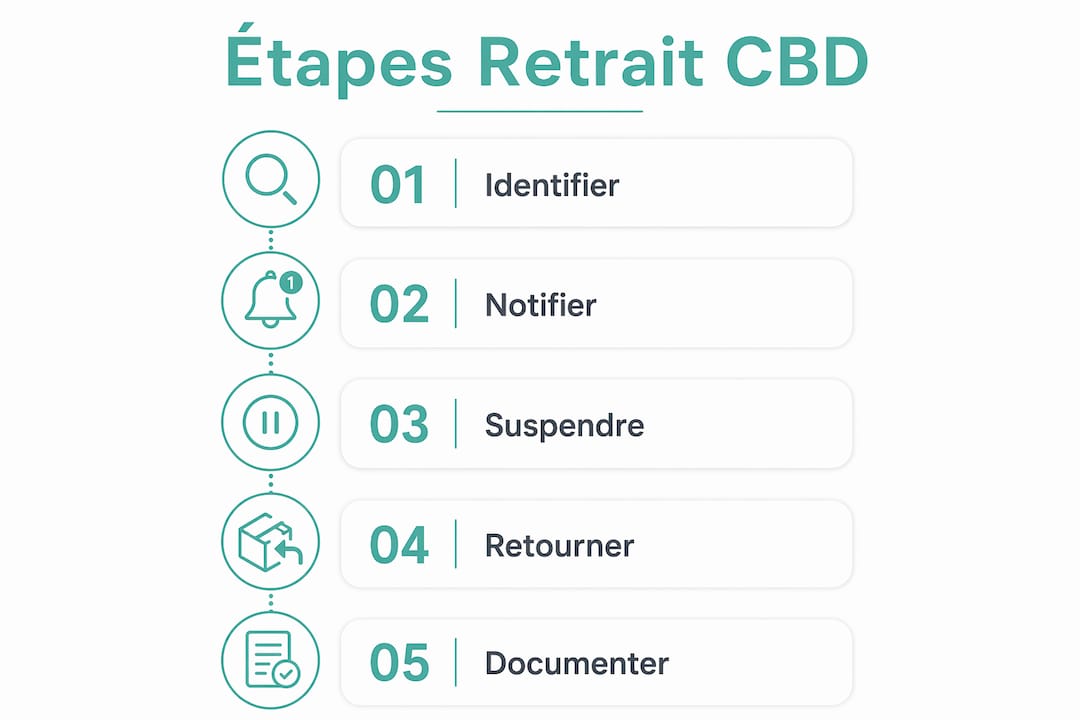
The policy for recalling CBD products in the event of legal uncertainty is based on three pillars: halting sales, notifying the relevant authorities, and retaining all documentary evidence. Pure-extract-cbd systematically applies this procedure to every product whose regulatory status changes.
Urgent actions to be taken in the days following detection:
- Suspend all sales of the product in question (both online and in physical stores)
- Physically isolate quarantined lots and clearly label them (date, reason, person in charge)
- Gather the certificates of analysis (COA), supplier invoices, and delivery slips
- Notify the DGCCRF via SignalConso or contact the DDPP/DDCSPP in your department
- Contact the DGAL regarding the affected food products
- Notify distributors and resellers in writing (via email with a read receipt)
Useful Contacts:
- DGAL: through the Ministry of Agriculture (agriculture.gouv.fr)
- DGCCRF: via SignalConso (signal.conso.gouv.fr) or your local DDPP office
- Consumer Recall: How to Report a Public Recall If Consumers Have Already Received the Product
Withdrawing a product without notifying the relevant authorities is not sufficient to demonstrate good faith. Documentary traceability—emails sent, acknowledgments of receipt, quarantine records—is your first line of defense in the event of an audit.
Table of Contents
- What is the legal framework governing CBD products in France in 2026?
- Which CBD products are subject to the recall, and which ones are exempt?
- How to Withdraw a CBD Product Step by Step in Case of Legal Uncertainty?
- How can one objectively assess a legal uncertainty regarding a CBD product?
- What are the seller's obligations, and what penalties apply if the item is not picked up?
- What templates and tools should be used to carry out a compliant withdrawal?
- How does Pure-extract-cbd implement its return policy in practice?
- Key Points
- What Salespeople Really Underestimate About a CBD Withdrawal
- Pure-extract-cbd: Compliant products with COAs available to resellers
- Official Sources and Useful Resources for Administrative Follow-Up
What is the legal framework governing CBD products in France in 2026?
The legal basis for the withdrawal rests on two interrelated texts. Regulation (EU) 2015/2283 on novel foods requires prior authorization for any food that was not consumed to a significant extent in the European Union prior to May 15, 1997. CBD extract falls into this category. However, to date, no Novel Food authorization has been granted for CBD as a food ingredient at the European level, asthe EFSA has not concluded that cannabidiol is safe in foods intended for human consumption.
On this basis, the DGAL issued a directive in May 2026 requiring the immediate recall of all food products containing CBD. At the same time, the Ministry of Agriculture announced the expansion of inspections by the departmental anti-fraud operational committees (CODAF).
Regulatory bodies and their respective roles:
- DGAL: the competent authority for food products; issues recall orders and coordinates on-site inspections
- DGCCRF: monitors fair trade practices and product safety; authorizes the DDPP/DDCSPP to conduct inspections
- EFSA: the European agency responsible for the scientific assessment of the safety of novel foods, including CBD
- Council of State: Its 2022–2026 case law has gradually established a framework for the status of CBD products, confirming the primacy of European “Novel Food” law over national commercial practices
The DGAL directive of May 15, 2026, leaves no room for ambiguity regarding food products: the absence of a Novel Food authorization automatically makes the product’s sale illegal, regardless of its THC content or quality.
Which CBD products are subject to the recall, and which ones are exempt?
The distinction between affected products and exempt products is practical: it determines what you must remove immediately and what you can continue to sell.
Products subject to mandatory recall (food products containing CBD):
- CBD Gummies and Candy
- Sublingual oils marketed as dietary supplements or food products
- Oral capsules and tablets
- Chocolates, cookies, and other CBD-infused foods
- CBD-Infused Beverages
- Herbal teas made from hemp flowering tops intended for dietary consumption
Products not subject to the food ban:
- CBD cosmetics (creams, balms, serums): permitted provided that applicable cosmetic regulations are followed
- Products intended for vaporization (CBD e-liquids): permitted subject to THC concentration limits
- Hemp seeds and seed oils intended for food use: permitted under strict THC content requirements
- Dried CBD flowers sold for non-edible use: separate status; to be verified based on the declared use
Product classification checklist to be used at the point of sale:
- Is the product marketed as intended for ingestion (oral, sublingual, or as part of a meal)?
- Does the label list CBD as an active ingredient in a food product?
- Does the product make any nutrition or health claims related to CBD?
- Is the intended use for food, according to the manufacturer's statement?
If the answer to any of these questions is “yes,” the product is subject to recall.
Pro tip: CBD oil sold with the label “dietary supplement” or “for oral consumption” is considered a food product under regulatory law, even if it is packaged in a pharmaceutical-style bottle. However, the same oil sold as a cosmetic for topical use, without any dietary claims, falls under cosmetics law and is not covered by the DGAL directive of May 15, 2026. The distinction is based on the stated use and labeling, not on the chemical formulation.

How to Withdraw a CBD Product Step by Step in Case of Legal Uncertainty?
The operational procedure is carried out in time-stamped phases. Each step must be documented at the time it is performed, not afterward.
Phase 1 — Immediate Actions (Day 0, within 24 hours):
- Suspend all sales of the affected product across all channels (website, brick-and-mortar store, marketplaces)
- Identify the affected lots by reference number, lot number, and expiration date
- Physically isolate the quarantined inventory with a label indicating: date of isolation, reason (“legal uncertainty regarding CBD”), and the name of the person in charge
- Gather all available COAs, supplier invoices, delivery slips, and photos of the labeling
Phase 2 — Notification and complete isolation (in the following days):
- Notify the DGCCRF via SignalConso or contact the DDPP/DDCSPP in your department directly
- Notify in writing all distributors and resellers to whom the product was shipped (via email with a read receipt)
- Request that distributors return unsold inventory
- If end consumers have received the product, initiate the recall process on RappelConso
Phase 3 — Analysis and Decision (during the second week):
- Send a representative sample of the batch to an accredited laboratory (using HPLC or GC/MS) to confirm the cannabinoid profile and THC content
- Interpreting the results: If THC exceeds 0.3% or if CBD is present in a food product without Novel Food authorization, confirm its permanent withdrawal
- Decide on the disposition of inventory: destruction with a destruction slip, return to the supplier with a return slip, or hold until an administrative decision is made
Phase 4 — Closing the alert (after verification and archiving):
- File all supporting documents (emails, COAs, invoices, acknowledgments of receipt) in a dedicated folder and retain them for at least five years
- Prepare an internal recall report detailing the actions taken, the quantities involved, and the corrective measures implemented
- Update the list of suppliers and the contract terms to prevent the product from being reintroduced
Pro tip: For laboratory analyses, choose a COFRAC-accredited (French Accreditation Committee) laboratory that uses the HPLC method. Results obtained by non-accredited laboratories are not enforceable against the authorities and do not constitute admissible evidence in the event of a DGCCRF inspection.
Documents to be included with the administrative notice:
- Complete product information sheet (name, ingredients, intended use)
- Certificate of Analysis (COA) for the relevant lot (dated, signed, with laboratory reference)
- Supplier Invoices and Delivery Slips
- Photos of the front and back labels
- List of distributors and quantities delivered
How can one objectively assess a legal uncertainty regarding a CBD product?
"Reasonable doubt" is not a subjective concept. Several technical criteria make it possible to assess it objectively and determine whether the withdrawal procedure should be initiated.
Verification of the Certificate of Analysis (COA):
- Is the COA less than 12 months old, and does it correspond to the lot number of the product in stock?
- Is the testing laboratory accredited (COFRAC or a European equivalent)?
- Is the analytical method specified (HPLC, GC/MS)?
- Le taux de THC est-il quantifié (et non simplement mentionné « < 0,3 % » sans valeur numérique) ?
- Is the full cannabinoid profile provided (at least CBD, THC, CBG, CBN, and THCV)?
Warning signs on a COA (to be treated as an immediate legal concern):
- No lot number or sample reference number
- Preliminary results (THC not quantified or omitted from the report)
- Laboratory that cannot be identified or lacks verifiable accreditation
- Generic COA not specific to the marketed lot
- Date more than 12 months ago without renewal
Labeling elements that raise legal doubts:
- Explicit mention of CBD as an ingredient in a food product
- Health or nutrition claims not authorized under Regulation (EC) No. 1924/2006
- Absence of required legal disclosures (name of the person responsible for placing the product on the market, country of origin, list of ingredients)
- Intended use described as “for ingestion,” “to be swallowed,” or “dietary supplement”
Furthermore, an incomplete cannabinoid profile can cause problems beyond the food sector: traffic stops may reveal a residual THC level that is problematic even for products marketed as compliant.
Pro tip: When multiple red flags are present simultaneously (incomplete COA + food claim + non-accredited laboratory), do not attempt to confirm compliance before taking action: initiate a preventive recall immediately and use the analytical phase to document the decision, not to justify it after the fact.

What are the seller's obligations, and what penalties apply if the item is not picked up?
The seller’s legal obligations in the event of legal uncertainty regarding a CBD product are specific and non-negotiable. Failure to comply with them may result in cumulative administrative, civil, and criminal penalties.
Immediate operational requirements:
- Suspension of sales across all distribution channels
- Written notification to all downstream distributors and resellers
- Physical quarantine of batches with documented traceability
- Public Statement on RappelConso if End Consumers Have Received the Product
- Retention of evidence: emails, return slips, destruction records, photos
- Refunds for Consumers Who Have Returned the Product
Potential penalties for failure to withdraw:
- Prefectural Orders for Temporary Closure or Suspension of Operations
- Seizure and administrative destruction of inventory at the operator's expense
- Administrative fines imposed by the DGCCRF
- Criminal Prosecution of a Manager in Cases of Recidivism or Deliberate Endangerment
- Registration in the DGCCRF Inspection Registry and Its Impact on Future Inspections
The seller’s obligations under consumer law apply regardless of good faith: ignorance of the regulations is not a grounds for exemption.
Documenting each step—emails sent, acknowledgments of receipt, return slips, and destruction records—makes it easier to negotiate with the authorities and demonstrates good faith, a mitigating factor recognized during inspections. Document traceability is your best legal protection.
What templates and tools should be used to carry out a compliant withdrawal?
Table of Required Internal Fields to Retain
| Field | Expected Content |
|---|---|
| Product Reference | Product Name and EAN Code |
| Lot Number | As indicated on the packaging and the COA |
| Quantity in stock | Isolated cases in quarantine on Day 0 |
| Date of isolation | Date and time of quarantine |
| Reason for withdrawal | Description of the legal uncertainty (e.g., “CBD food product without Novel Food authorization”) |
| Associate COA | Reference, date, laboratory, THC results |
| Notified Distributors | Names, dates of mailing, acknowledgments of receipt |
| Out of stock | Destruction / Return to Supplier / Awaiting Decision |
| Proof of Destruction | Signed invoice or service provider certificate |
| Internal Manager | Name and title of the signatory |
Summary Operational Checklist:
- Documented suspension of sales (back-office screenshot, internal email)
- Quarantine label affixed to each lot
- COAs collected and verified (date, accreditation, lot number)
- SignalConso or DDPP notification sent with acknowledgment of receipt
- Distributors were notified by email with a list of the affected lots
- Consumer Recall Reported if End Consumers Are Affected
- Archived destruction slip or supplier return form
Notification template for authorities (required information):
Email Subject: “Notice of Preventive Recall — [Product Name] — Lot [XXX]”
Message body: operator identification (company name, SIRET number, contact information), product description (name, lot, quantity), reason for recall (legal concerns, CBD food classification), actions already taken (suspension date, quarantine, distributors notified), attachments (Certificate of Analysis, invoice, labeling).
Sample message for distributors:
Subject: “Preventive Recall — [Product Name] — Action Required”
Body: Request for an immediate suspension of sales, identification of the affected lots, instructions for return or quarantine, and contact information for the quality manager in case of questions.
Pro tip: Use a shared registry (spreadsheet or document management tool) accessible to the entire quality team to centralize evidence in real time. An incomplete recall file discovered during a DGCCRF inspection is treated as a noncompliance, even if the required actions were carried out.
How does Pure-extract-cbd implement its return policy in practice?
Pure-extract-cbd has structured its recall workflow around four sequential steps, which can be triggered as soon as a potential legal issue is identified by the quality team or a supplier.
Internal Operational Workflow:
- Identification: Weekly regulatory monitoring of publications by the DGAL, DGCCRF, and the Official Journal; any change in an ingredient’s status triggers a review of the product portfolio
- Isolation: Immediate suspension of the affected items on the site and physical quarantine of inventory with time-stamped labeling
- Third-party analysis: A sample is routinely sent to a COFRAC-accredited laboratory to confirm the cannabinoid profile before any final decision is made
- Notification and Follow-Up: Forwarding the complete file to the relevant authorities and providing transparent communication to customers who ordered the affected product
The COAs for each product code are accessible and updated with each new batch. Traceability logs (batch numbers, test dates, results) are stored in an internal document management system with restricted access limited to quality managers and senior management.
Operational lessons learned from implementation:
- Training sales staff on classification criteria (food vs. non-food) reduces the time it takes to identify a potential legal issue
- Contractual provisions with suppliers that include a requirement to provide notice in the event of a change in formulation or regulatory status serve as an effective safety net
- Segmenting inventory by regulatory category (food / cosmetics / aerosols) facilitates targeted removal without disrupting overall operations
For operators, taking proactive measures—such as including COAs with every delivery, conducting regular supplier audits, and including contractual provisions on regulatory liability—significantly reduces the risk of forced recalls and the associated business losses.
Pro tip: Schedule a monthly “quality check-in” with your suppliers to obtain updated COAs before inventory goes on sale. A COA received after the product has been placed on the shelves does not protect against an inspection that may have taken place in the meantime.
Key Points
The DGAL directive of May 15, 2026, requires the immediate withdrawal of all food products containing CBD in France, with no grace period or exceptions based on product quality.
| Point | Details |
|---|---|
| Key Date for Withdrawal | The DGAL directive dated May 15, 2026, requires the immediate withdrawal of all food products containing CBD. |
| Exempt Products | Cosmetics, e-liquids for vaping, and hemp seed oils remain permitted under certain conditions. |
| Documentary Priority | Keep emails, COAs, return slips, and destruction records on file to demonstrate good faith in the event of an audit. |
| Mandatory Notification | Any recall affecting end consumers must be publicly reported on RappelConso. |
| Pure CBD Extract | Implements a structured recall workflow with accessible COA documentation, COFRAC analyses, and transparent communication with customers. |
What Salespeople Really Underestimate About a CBD Withdrawal
Most guides on the recall of CBD products stop at listing the administrative steps. What they don’t address is the time factor: the time between when a seller becomes aware of a legal concern and when they take action is often the variable that determines the outcome of an inspection.
The authorities do not merely penalize product non-compliance. They also evaluate the operator’s responsiveness. A seller who suspends sales within hours of becoming aware of a problem, who notifies the DGCCRF even before receiving the test results, and who keeps a record of every written communication is in a radically different position from one who waits for confirmation from the laboratory before taking action. Good faith is demonstrated by timestamps, not by intentions.
The other blind spot concerns staff training. A quality manager may know the procedure inside and out, but if the in-store salesperson or the online order manager doesn’t know how to identify an incomplete COA or a problematic food claim, the red flag is never flagged. Investing in a short in-house training session, with concrete examples of compliant and non-compliant labeling, is far more valuable than a sophisticated recall protocol that no one ever consults.
Finally, the segmentation of inventory by regulatory category is underutilized. Physically separating food products from cosmetics and aerosol products upon receipt allows for a targeted recall without bringing the entire operation to a standstill. It is a simple, low-cost preventive measure that can make the difference between a 48-hour interruption and a shutdown lasting several weeks.
Pure-extract-cbd: Compliant products with COAs available to resellers
Pure-extract-cbd offers retailers and distributors a range of non-food CBD products—flowers, resins, e-liquids—accompanied by accessible certificates of analysis for each product and each batch. Each product is analyzed by an accredited third-party laboratory, with results available before the product goes on sale: quantified THC levels, complete cannabinoid profile, and specified analytical method.
For retailers looking to secure their supply following the DGAL directive of May 15, 2026, Pure-extract-cbd offers immediate transparency regarding documentation: COAs are available directly on the product pages, with no prior request required. If there are any questions about a specific product, customer service will answer compliance-related questions and direct customers to the appropriate legal resources.
For example, check out the Northern Light Small Buds or the BZ1 to see the structure of the COAs provided. To view the entire catalog of compliant products, visit pure-extract-cbd.com.
This article is provided for general informational purposes only. For any specific situation, consult a legal professional or the relevant authorities (DGAL, DGCCRF) to verify the rules that apply to your business.
Official Sources and Useful Resources for Administrative Follow-Up
Official links to keep:
- DGAL / Ministry of Agriculture: Withdrawal Directive of May 15, 2026 — Reference text on the ban on CBD-containing food products and the scope of the withdrawal
- Legifrance: legifrance.gouv.fr — consolidated laws and regulations applicable in France
- Regulation (EU) 2015/2283: eur-lex.europa.eu — full text of the Novel Food Regulation, the legal basis for the ban
- EFSA: efsa.europa.eu — scientific opinion on the provisional safety level of CBD as a novel food
- RappelConso: rappel.conso.gouv.fr — a platform for reporting public recalls and viewing existing CBD recall records
- Ministry of the Economy (RappelConso): economie.gouv.fr — Reporting Requirements for Recalls by Operators
- SignalConso (DGCCRF): signal.conso.gouv.fr — an online reporting platform for notifying the DGCCRF of compliance issues
- Alert Management Guide (Hérault Prefecture): herault.gouv.fr — detailed procedure for managing food alerts for operators
- Novel Food Catalog (European Commission): ec.europa.eu — verification of an ingredient’s Novel Food status prior to market authorization
| Resource | Primary use |
|---|---|
| DGAL / agriculture.gouv.fr | Withdrawal Guidelines, Official Documents, DDPP Contacts |
| SignalConso | Online Reporting of a Suspicion or Withdrawal to the DGCCRF |
| Consumer Alert | Public disclosure is required if end consumers are affected |
| Legifrance | Viewing Consolidated Regulatory Texts |
| EFSA / eur-lex.europa.eu | Legal Basis for Novel Foods and Scientific Opinions |
| Prefectural Guide (Hérault) | Alert Management Procedure and Documentation Requirements |
Final tip: Keep a physical or digital file dedicated to each withdrawal, with a chronological index of the actions taken. In the event of an audit, the ability to present a well-organized file in less than 30 minutes is the strongest indication of the operator’s good faith.



