

THCV is not THC: its shorter side chain alters its interaction with CB1 receptors, which explains its generally less intoxicating effect profile at low doses. Some data also suggest it may be beneficial for regulating appetite and blood sugar levels. For users seeking to minimize intoxication, THCV is worth considering, provided they exercise caution regarding dosage and verify that products meet regulatory standards.
In short:
- THCV has a short, three-carbon side chain, which alters its interaction with CB1 receptors and limits its intoxicating effects.
- At low doses, THCV acts as a partial CB1 antagonist, which can reduce the psychoactive effects of THC when the two are consumed together.
- The typical therapeutic dose for metabolism or appetite is generally less than 5 mg, while higher doses can cause effects similar to those of THC.
- The risk of testing positive for THC in urine tests remains high after ingesting THCV alone, even in the absence of reported THC use.
- French law is based primarily on the Δ9-THC content, which means that a THCV-based product’s compliance depends on its THC content, not on the presence of THCV.
Table of Contents
- A Summary Comparison of Key Differences
- Structure and Biosynthesis: Why the C3 Pathway Changes Everything
- Interaction with endocannabinoid receptors (CB1 and CB2)
- Reported effects and observed human dosages
- Clinical Research and Findings on Diabetes, Obesity, and Attention
- Safety, Screening, and Legal Framework: What You Need to Know Before Use
- How to Evaluate a THCV Product Before Buying It
- Steven's Perspective: Between Scientific Promise and Necessary Caution
- Where to Find Tested and Compliant Products
- Frequently Asked Questions
- Sources
A Summary Comparison of Key Differences
Before getting into the chemical and pharmacological details, here’s what specifically sets the two molecules apart and what that means for informed use.
Structurally, THCV and THC are not the same molecule: their side chains differ, and this difference affects their entire pharmacology. THC acts as a full agonist at CB1 receptors, producing the classic intoxication associated with cannabis. THCV, on the other hand, tends to act as an antagonist or a partial agonist at these same receptors depending on the dose, resulting in subjective effects that are often milder.
The practical implications of this difference can be summarized as follows:
- Chemistry: THCV has a three-carbon propyl side chain, whereas THC has a five-carbon pentyl side chain, which alters their respective molecular formulas.
- Pharmacology: THC fully activates CB1 receptors, while THCV modulates them in a more complex manner, exhibiting antagonistic behavior at low doses.
- Effects experienced: THC causes a pronounced psychoactive high, while THCV is associated with a possible reduction in appetite and a feeling of clarity at moderate doses.
- Safety and Legality: Both cannabinoids can cause positive results on urine tests, and their regulatory status depends on the THC levels measured in the final product.
This distinction carries significant weight in practice. A consumer who chooses a THCV-based product in the hope of avoiding any risk of testing positive is taking a risky gamble, since several clinical trials have observed positive results in urine tests following THCV administration. Caution is therefore warranted both from a legal standpoint and in the workplace, particularly for professions subject to drug testing.
Nevertheless, the two molecules share a common origin: they both derive from precursors found in hemp, before specific enzymes direct their synthesis down one pathway or the other. It is precisely this biochemical branching that explains why two cannabinoids that appear so similar produce such different effects.
Structure and Biosynthesis: Why the C3 Pathway Changes Everything
The difference between THCV and THC begins at the molecular level, long before any interaction with the human body. THC has the formula C21H30O2, while THCV is C19H26O2: two carbon atoms and four hydrogen atoms separate the two molecules. This difference stems from a different side chain attached to the cannabinoid core shared by both substances.
THC has a pentyl chain, consisting of five carbon atoms. THCV, on the other hand, has a propyl chain with only three carbon atoms. This reduction in length is not merely a cosmetic detail: it alters the molecule’s three-dimensional shape and, consequently, its ability to bind to receptors in the endocannabinoid system. The longer a side chain is, the stronger the affinity for the CB1 receptor tends to be and the more complete the activation; a shorter chain alters this balance.
This distinction has its origins in plant biosynthesis. Hemp produces a common precursor, CBGA (cannabigerolic acid), from which most known cannabinoids are derived. However, certain varieties of hemp, known as varinic varieties, produce instead a short-chain version of this precursor: CBGVA (cannabigerovarinic acid). It is this early divergence at the precursor level that determines the entire subsequent synthesis pathway.
CBGVA is then converted by specific enzymes into THCVA, tetrahydrocannabivarinic acid, which is the exact equivalent of THCA but for the varinic lineage. As with THC, it is decarboxylation—that is, the removal of a carboxyl group through the effects of heat or time—that converts THCVA into active THCV. Without this step, whether it occurs during drying, prolonged storage, or combustion, THCVA remains a non-psychoactive form that is inactive at CB1 receptors.
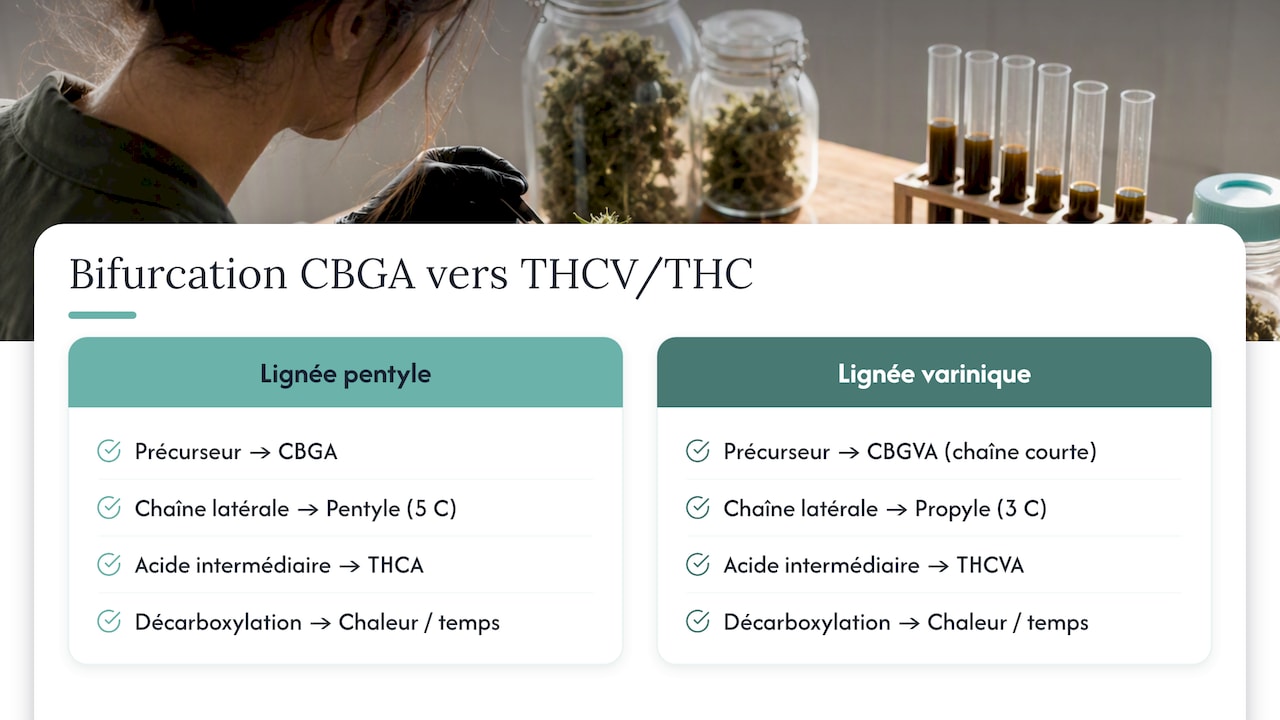
This similarity in mechanism explains why THCV and THC share commonalities despite their distinct effects: both originate from an inactive acid form, both require decarboxylation, and both ultimately interact with the same endocannabinoid system. What the side chain changes is the precise nature of this interaction, a point detailed in the following section. Hemp strains capable of producing THCV in significant quantities remain rare and require specific genetic selection, which partly explains the still-limited availability of this cannabinoid on the market.
Interaction with endocannabinoid receptors (CB1 and CB2)
The endocannabinoid system relies primarily on two types of receptors: CB1, which is concentrated in the central nervous system, and CB2, which is more prevalent in immune tissues. The typical intoxication associated with cannabis stems almost exclusively from the activation of CB1 by THC, which acts as a full agonist at this receptor: the molecule binds to the receptor and triggers a signaling cascade that produces the psychoactive effects that are either sought after or feared, depending on the context.
THCV exhibits a more nuanced behavior. Several research studies reported in a scientific journal dedicated to distinguishing between THCV and THC describe a biphasic pharmacological activity: at low doses, THCV tends to act as an antagonist at the CB1 receptor, partially blocking the receptor’s access to other activating molecules. At higher doses, however, this same compound can exhibit partial agonist activity, bringing its effects closer to those of THC.
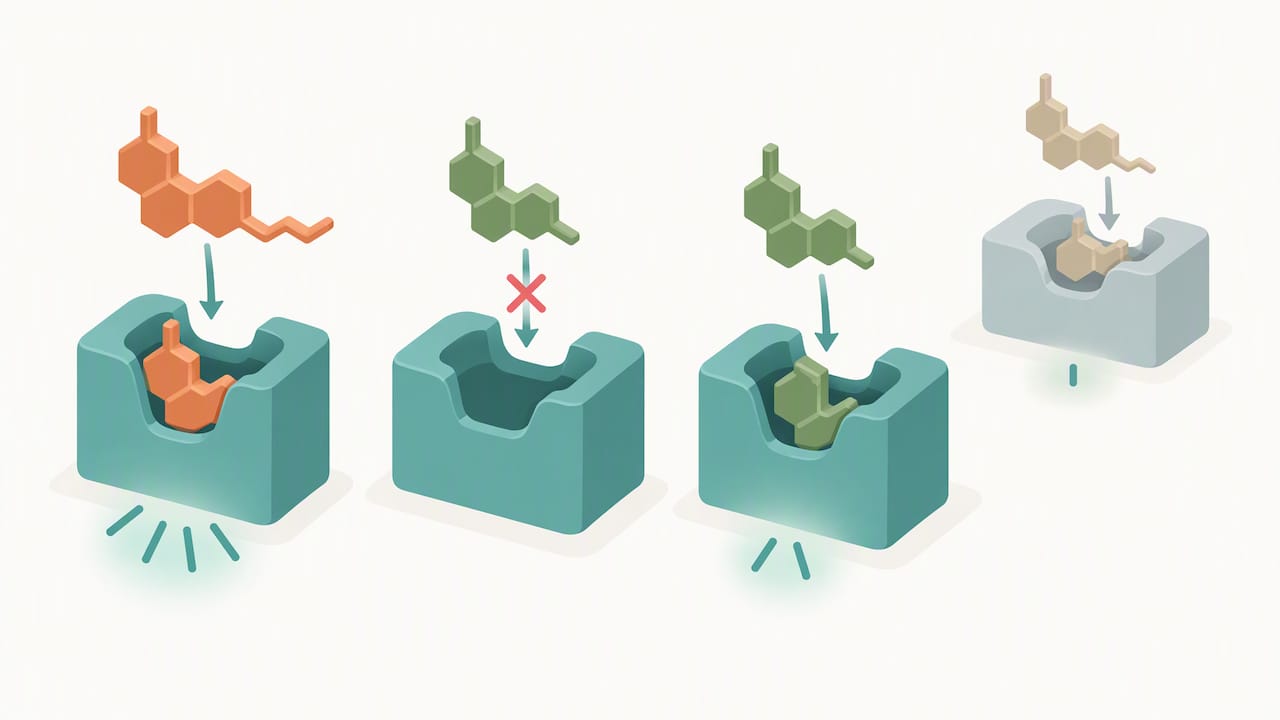
This duality has a direct and often-cited consequence: when consumed alongside THC, THCV can mitigate some of THC’s intoxicating effects by occupying some of the CB1 receptors without fully activating them. This is one of the reasons why some products combine the two cannabinoids in specific ratios, with the aim of modulating the intensity of the experience rather than eliminating it.
THCV also exhibits activity at CB2 receptors, although the published data are less detailed than those for CB1. This interaction may contribute to effects that are not directly related to psychoactivity, an area that researchers continue to explore without a clear consensus having yet emerged.
The potential therapeutic implications of this biphasic profile are still under investigation. A compound capable of antagonizing CB1 at low doses is of theoretical interest for approaches aimed at limiting certain metabolic effects associated with excessive activation of this receptor, without preventing the benefits associated with other pathways of the endocannabinoid system. This hypothesis underpins some of the clinical trials discussed below, particularly those focusing on blood glucose levels. However, it is important to bear in mind that this biphasic mechanism is highly dose-dependent, which makes it difficult to predict effects across different products if their THCV content is not clearly established.
Reported effects and observed human dosages
The question of dose-dependent effects consistently arises whenever THCV is discussed, and the available data allow us to answer it with some precision, even though the volume of data remains limited.
The most recent clinical trials have explored a wide range of doses. A two-phase dose-response study of Δ8-THCV tested doses ranging from 12.5 mg to 200 mg administered orally. The results show that most of these doses did not produce the subjective effects typically associated with THC, but at very high doses, signs comparable to THC-like intoxication were observed in some participants. This observation confirms the biphasic behavior mentioned above: at moderate doses, the effect remains subtle, but beyond a certain threshold, the molecule’s profile becomes similar to that of THC.
At the other end of the spectrum, clinical protocols focused on metabolic effects use much lower doses. The 2016 pilot trial on type 2 diabetes, detailed in the following section, used only 5 mg of THCV twice daily, for a daily total of 10 mg. This difference in scale—from a few milligrams to target a metabolic effect to several dozen or even over a hundred milligrams to observe an effect comparable to that of THC—clearly illustrates why dosage remains the most critical variable in the THCV experience.
The most commonly reported effects at low to moderate doses include a possible suppression of appetite, a sense of mental clarity, and, in some users, a perceived boost in energy at intermediate doses, according to available data. However, these observations remain qualitative and vary from person to person; the available studies do not yet allow for the establishment of a universal dose-response curve for these subjective sensations.
This pharmacological reality explains why the vast majority of commercial THCV products contain less than 5 mg per serving. Manufacturers seek above all to offer a mild and predictable experience, staying well below the thresholds at which THC-like effects have been reported in laboratory studies. For consumers, this means that a standard commercial product is generally nothing like the experimental protocols involving 100 or 200 mg, and that the caution recommended in studies does not apply in the same way to a capsule containing 2 or 3 mg.
Clinical Research and Findings on Diabetes, Obesity, and Attention
Human evidence regarding THCV remains limited in number, but several recent studies provide concrete evidence of its metabolic potential and safety at various doses.
The most frequently cited study remainsthe randomized pilot trial published in 2016, which involved 62 people with type 2 diabetes over a 13-week period. Participants who received 5 mg of THCV twice daily showed a reduction in fasting blood glucose levels as well as an improvement in the function of pancreatic β-cells, which are responsible for insulin production. This is one of the few controlled trials to have specifically isolated THCV—rather than mixtures of cannabinoids—to observe a measurable metabolic effect.
More recently, a 90-day trial combining THCV and CBD in the form of transdermal patches linked a daily dose of 16 mg of THCV (along with 20 mg of CBD) to statistically significant weight loss among participants. However, the same study highlighted an important concern: a majority of the urine tests conducted on the participants came back positive for THC, even though no THC use had been reported, raising a practical concern for anyone subject to regular drug testing.
The dose-response study on Δ8-THCV mentioned earlier rounds out this picture by focusing on safety and cognitive indicators. The researchers observed that most of the doses tested, up to about 50 mg, were well tolerated without any marked THC-like effects, while noting positive signs in certain parameters related to attention. Above 100 mg, however, subjective effects comparable to those of THC emerged, confirming that the safety margin is closely dependent on the dose.
These three studies share common methodological limitations:
- The cohorts remain relatively small, ranging from 18 to 62 participants depending on the study, which limits the statistical power of the findings.
- Protocols sometimes use different isomers of THCV—Δ8 or Δ9—whose effect profiles are not necessarily interchangeable.
- None of these studies has yet been replicated on a large scale, which means these results cannot be considered definitive.
These caveats do not invalidate the value of the available data, but they do call for a cautious interpretation. THCV shows real potential in terms of metabolism, as documented by controlled trials, but the research remains at the pilot stage and requires larger-scale trials before firm conclusions can be drawn regarding its widespread therapeutic use.
Safety, Screening, and Legal Framework: What You Need to Know Before Use
Beyond its effects, THCV raises two practical questions that every informed user should be able to answer: What are the risks regarding drug testing, and where does the legal line lie?
The most well-documented finding concerns urine tests. Several recent clinical trials report positive results for THC metabolites following administration of THCV alone, with no THC use reported by the participants. In the dose-response study on Δ8-THCV, positive urine screenings occurred after the active treatment condition, and the 90-day study using mucosal patches observed the same phenomenon in a majority of participants. This finding is consistent enough across studies to warrant serious attention, particularly for professions subject to regular testing.
In terms of adverse effects, the available clinical trials generally report good tolerability at the doses tested, with adverse effects that are most often mild. However, some protocols have noted, in a limited number of cases, elevations in liver transaminases—a marker of liver function that should be monitored when higher doses are used over an extended period. This observation reinforces the importance of cautious and gradual use rather than starting with a high dose.
From a regulatory standpoint, the status of THCV—like that of many minor cannabinoids—depends primarily on the THC levels measured in the final product rather than on a ban specifically targeting the molecule itself. The French authorities’ stance on certain cannabinoids illustrates this logic: a product’s legal compliance depends on its total Δ9-THC content, not simply on whether or not it contains THCV. For more information on this framework, our page on cannabinoids classified as narcotics in France details the applicable thresholds and classifications.
This reliance on measured thresholds explains why two products that both list “THCV” on their labels may have different legal statuses depending on their residual THC content—a point that ties directly into the issue of documentary verification discussed below.
How to Evaluate a THCV Product Before Buying It
Given these uncertainties regarding dosage and the legal framework, reviewing product information becomes the most important step before purchasing any product containing THCV.
- Request the Certificate of Analysis (COA): This document, issued by an independent laboratory, must specify the exact concentrations of each cannabinoid present in the product.
- Check the total Δ9-THC level: this value must remain below the applicable regulatory thresholds, since it is this value—and not the presence of THCV—that determines legal compliance.
- Verifying the hemp origin: A legal product must come from industrial hemp varieties that are grown and extracted in compliance with regulations—never from unregulated cannabis.
- Ensure that the analyses are conducted by a third-party laboratory: a test performed by the manufacturer itself does not offer the same guarantee of impartiality as an independent external analysis.
- Start with a low dose and keep a journal of the effects you experience, noting the time you took it, the amount, and how you felt over several days.
Pro tip: Keep a copy of the certificate of analysis and your proof of purchase for several months: in the event of an unexpected positive test result, these documents will help trace the source of the result.
For those who are new to hemp cannabinoids and are looking for practical guidance on how to use them, our guide to using CBD oil offers advice on gradual dosing that applies to most hemp extracts, including THCV.
Steven's Perspective: Between Scientific Promise and Necessary Caution
THCV is a good example of the tension inherent in minor cannabinoids: distinct and promising mechanisms of action, but a body of human evidence that is still too limited to speak of established results. Studies on blood sugar and weight deserve attention, not certainty.
What seems to me to be the most overlooked aspect in discussions about THCV is the risk of testing positive. Many users choose this cannabinoid thinking they can avoid any THC-related test results, even though several clinical trials show the opposite. A reliable certificate of analysis, traceable origin, and a gradual approach to dosing remain, given the current state of knowledge, the only reasonable guarantees a user can expect.
— Steven
Where to Find Tested and Compliant Products
Given these traceability requirements, choosing a supplier that clearly documents its test results makes all the difference. At Pure Extract CBD, each product listing includes lab reports that allow you to verify the product’s exact composition before making a purchase—a commitment to transparency that we apply across our entire catalog.

Our concrete commitments to informed use:
- Extracts and flowers derived from organic hemp, with test results available for each product.
- Discreet packaging.
- Customer service is available to answer your questions about a product's ingredients or compliance.
We always recommend reviewing the available lab reports before placing an order, especially for less common cannabinoids. To explore our entire selection, check out our complete product catalog.
This article is intended to provide general information and is not a substitute for the advice of a qualified healthcare professional. Consult a qualified healthcare professional about your specific situation before taking any action based on this content.
Frequently Asked Questions
What are the effects of THCV?
THCV is primarily associated with a possible reduction in appetite and a sense of mental clarity at moderate doses, unlike THC, which causes a pronounced psychoactive high. Recent clinical trials show that these effects remain mild up to about 50 mg, but become more similar to those of THC at higher doses, between 100 and 200 mg.
Is THCV legal in France?
The legality of a product containing THCV depends primarily on its total Δ9-THC content, which must remain below the thresholds set by French regulations, rather than on a ban specifically targeting THCV. Our page on cannabinoids classified as narcotics details these applicable thresholds.
What is the difference between THCP and THCV?
THCP and THCV are two distinct cannabinoids that share only their membership in the tetrahydrocannabinoid family. THCV has a short side chain and is generally considered to have a less intoxicating profile, while THCP is subject to specific regulations, which are detailed in our article on the legal status of THCP in France.
What is the best substitute for THC?
There is no universal substitute for THC, as each cannabinoid has its own pharmacological profile. THCV is among the options being studied for use in situations where reduced intoxication at low doses is desired, but the choice depends on the desired effects and should always be based on products whose composition has been verified through laboratory analysis.
Can THCV cause a drug test to come back positive?
Yes, several clinical trials have reported positive results on urine tests for THC following administration of THCV alone, without any reported THC use. This risk warrants particular caution for individuals who undergo regular drug testing.
Sources
- Randomized pilot study (2016) — THCV and glycemic control
- A Two-Phase, Dose-Ranging Study of Oral Δ8-THCV (2023)
- 90-Day THCV/CBD Mucoadhesive Strip Trial (2024)
- Tetrahydrocannabivarin Is Not Tetrahydrocannabinol (PMC)


