Indica or sativa: The label gives you a general idea, but it’s the chemical profile that determines the actual effect. For the evening, look for a product with a myrcene-dominant profile and high CBD. For daytime use, opt for a limonene- or pinene-dominant profile.
In short:
- The indica or sativa classification is unreliable for predicting effects, since the majority of modern cultivars are hybrids with defining terpene profiles.
- A profile rich in myrcene promotes relaxation at night, while limonene and pinene are better suited for daytime use and provide an energizing effect.
- It is essential to review a complete certificate of analysis—including CBD and THC levels and a list of terpenes—rather than relying solely on the label.
- The cultivation method influences the flower's aromatic richness and the stability of its profile, with indoor cultivation offering more precise control than outdoor cultivation.
- To make an informed choice, you should try different varieties in small amounts while comparing the onset and nature of the effects depending on the method of consumption.
Table of Contents
- CBD Indica and Sativa Flowers: Physical and Genetic Differences
- Understanding the Chemical Profile: CBD, THC, Ratio, and Terpenes
- What effects can you expect based on your use: sleep, anxiety, pain, or concentration?
- How to Choose CBD Flower Before Buying: The Checklist
- Four Iconic Varieties and Their Usage Profiles
- Check the quality and transparency before buying
- Where do the terms "indica" and "sativa" come from?
- How the cultivation method affects cannabinoids and terpenes
- Cultivation Methods Specific to Indica and Sativa Strains
- Harvesting and drying: steps that affect the final result
- Dosage and consumption methods tailored to each flower type
- Risks and Precautions Based on the Type of Flower Consumed
- My Method for Narrowing Down Your Choice of Flowers
- Where to Buy Tested and Compliant CBD Flowers
- Sources
- Frequently Asked Questions
CBD Indica and Sativa Flowers: Physical and Genetic Differences
An indica plant is generally recognizable by its stocky shape, broad leaves, and dense, compact buds. A sativa plant grows taller, with fine foliage and more airy buds. These morphological traits are useful for a grower, but they reveal almost nothing about how you’ll feel when you consume the dried flower.
The flowering period also differs significantly between the two strains: Sativas often take longer than Indicas to reach harvest, which directly affects the available quantities and, at times, the price per gram on the market.
The problem is that virtually all of the cultivars sold today are hybrids. This limitation of botanical classification is, in fact, confirmed by the most recent analyses on the subject, which show that the indica/sativa distinction is not sufficient to predict effects; the terpene profile remains a much better indicator.
To summarize visual cues without relying on them blindly:
- Dense, compact buds; broad leaves: an Indica-type visual profile.
- Airy buds, delicate foliage: a sativa-like appearance.
- Most Sativa strains have a longer flowering period, which affects their availability in stores.
- Almost universal hybridization: the variety name is merely an indication of a general trend.
Understanding the Chemical Profile: CBD, THC, Ratio, and Terpenes
The CBD:THC ratio (for example, 20:1) summarizes the balance between the two molecules in a single number. But it is the terpenes that truly refine the nature of the effect experienced.
Four terpenes consistently appear in laboratory analyses and are worth remembering:
- Myrcene: has sedative and muscle-relaxing effects; it is the predominant component in most sleep-focused blends.
- Limonene: has a invigorating and stress-relieving effect, combined with a sense of mental clarity.
- Pinen: has a mild stimulating effect and is often sought after to aid concentration during the day.
- Beta-caryophyllene: has a soothing effect on physical tension and is frequently cited for its relief of diffuse pain.
Pro tip: When looking at a COA, don’t just focus on the CBD percentage. Check the terpenes chart: the top three listed in order of concentration tell the real story of the effect, much more so than the “indica” or “sativa” label on the packaging.
The complete chemical profile—including both cannabinoids and terpenes— accounts for 60 to 80 percent of the effects experienced, far more than simple botanical classification. A reliable COA must include at least three pieces of information: the CBD content, the THC content, and details on the dominant terpenes along with their respective concentrations. Without these three clear pieces of information, it’s best to move on to the next product.
What effects can you expect based on your use: sleep, anxiety, pain, or concentration?
The choice of a flower depends less on its genetic origin than on when you plan to consume it and the desired effect.
When it comes to sleep, the most reliable approach is still a strain with a myrcene-dominant profile combined with a high CBD content, rather than simply one labeled “Indica.” When vaping, aim to take a dose 45 to 60 minutes before bedtime so that the peak of absorption coincides with falling asleep, without risking residual drowsiness upon waking.
For daytime anxiety, hybrid strains rich in pinene, with a good balance of CBD, often allow you to remain functional without causing drowsiness. For pain and inflammation, look for a combination of high levels of beta-caryophyllene and CBD: this terpene helps relieve physical tension without causing mental fogginess.
The method of consumption also affects the timing of the effect:
- Inhalation provides a quick sensation, which is helpful for adjusting the dose in real time.
- The infusion produces a milder, more gradual effect, but the onset is delayed by 45 minutes to 2 hours.
- Gradually increasing the dose, a few milligrams at a time, remains the safest way to determine your personal threshold.
Our article on the effects of CBD on sleep provides more details on this approach to timing and dosage.
How to Choose CBD Flower Before Buying: The Checklist
Before making any purchase, a few simple checks can help you avoid unpleasant surprises and ensure that the product meets your expectations.
- Check the COA: CBD content, THC content, complete terpene profile, and the harvest or analysis date for the batch.
- Check the growing method: indoor growing generally offers more precise control and superior aromatic quality, while outdoor growing offers more affordable prices with different flavors; greenhouse growing falls somewhere in between.
- Verify the contaminant test results: Pesticides and heavy metals must be included in an independent laboratory report, separate from the standard cannabinoid analysis.
- Compare the price per gram, taking into account the packaging, the actual net weight, and the freshness of the batch.
- Try a small amount before buying a large quantity, and make a note of your observations (time until effect, intensity, duration).
The compliance of a CBD flower rests on three concrete pillars: a THC content below 0.3%, a variety listed in the European catalog, and a verifiable lab certificate. These three elements distinguish a reputable seller from an opportunistic one. To learn more about the legal thresholds applicable in France, our article on the differences between CBD and THC details the complete regulatory framework.
Four Iconic Varieties and Their Usage Profiles
Certain cultivars appear regularly in specialized catalogs because their chemical profile is well documented and consistent from one batch to the next.
| Variety | CBD:THC Ratio | Dominant terpenes | Main effect |
|---|---|---|---|
| Charlotte's Web | 20:1 | Pinen, limonene | Daytime Concentration |
| ACDC | 20:1 | Myrcene, beta-caryophyllene | Relaxation and Sleep |
| Cannatonic | 1:1 | Myrcene, pinene | Moderate balance |
| Harlequin | 5:2 | Myrcene, pinene, caryophyllene | Anxiety and mild relaxation |
This table is not a substitute for reviewing the COA for your specific batch. The availability of these varieties varies by harvest, and the same cultivar may exhibit a significantly different terpene profile depending on the terroir and growing conditions from one season to the next. The name serves as a guide, not a guarantee. Our page dedicated to the best CBD flowers details other comparable profiles.
Check the quality and transparency before buying
A reputable seller provides analysis certificates for each batch, not just an overall average per variety. Pure-extract-cbd publishes educational guides and offers a range of flowers, resins, and oils, each accompanied by its respective lab test results, which can be viewed directly on the product pages.
If you want to learn more about the chemical profile before making a purchase, our practical guide to the effects of CBD flowers explains how to read a lab report line by line, terpene by terpene.
Where do the terms "indica" and "sativa" come from?
The distinction dates back to the 18th century, when botanists began classifying hemp based on its morphology and region of origin. Cannabis indica referred to stocky plants native to Central Asia, adapted to mountainous climates with short daylight cycles. Cannabis sativa encompassed slender plants from equatorial regions, accustomed to long growing seasons.
This botanical classification subsequently evolved, within the popular culture surrounding recreational cannabis, into a simplified dichotomy between “relaxing” and “stimulating” effects. The problem is that this association has never had a solid chemical basis: it was built on empirical observations of a few cultivars, not on a systematic study of terpenes.
With the intensive selection of recent decades and the proliferation of crossbreeding, the genetic boundary has become blurred. Today, a cultivar labeled “sativa” may very well contain more sedative myrcene than a neighboring “indica.” The label retains historical and commercial value—useful for roughly categorizing a product in a catalog—but it has lost its function as a reliable predictor of effects.
How the cultivation method affects cannabinoids and terpenes
The growing location and method often have a greater impact on a flower’s final profile than genetics. Indoor cultivation allows for precise control of light, humidity, and temperature, which generally results in a more consistent terpene concentration from one batch to the next.
Greenhouse cultivation combines natural light with protection from the elements, often offering a favorable balance between aromatic quality and production costs. Outdoor cultivation depends entirely on seasonal conditions: it produces more variable profiles but generally more affordable prices, with aromatic notes that are sometimes earthier or more complex.
Water stress, light exposure, and even soil composition affect a plant’s terpene production, regardless of its underlying genetics. This is why two bags of the same variety, harvested in different seasons, may have significantly different COAs. The harvest date listed on the certificate of analysis is therefore just as important as the cultivar name.
Cultivation Methods Specific to Indica and Sativa Strains
Indica-type plants, which are more compact and fast-flowering, are well-suited for indoor cultivation with tight spacing: their limited vertical growth allows for maximum plant density under the same illuminated area. This compactness also makes training easier and reduces the need for staking.
Sativa-type plants, which are taller and have a longer flowering cycle, require more vertical space and lighting management suited to their spreading growth pattern. Outdoors, this growth pattern is well-suited to long, warm seasons, which explains why sativas have historically been associated with equatorial climates.
Hybrid cultivars, which make up the majority of the market, require a balance of factors: moderate spacing, pruning to control height, and photoperiod control to trigger flowering at the desired time. In all cases, the cultivation method is secondary to the rigor of the final quality control process, which alone guarantees the conformity of the finished product.
Harvesting and drying: steps that affect the final result
The timing of the harvest is almost as important as the plant’s genetics. The optimal window is when most of the trichomes change from a transparent appearance to a milky or even amber one: it is at this stage that the balance between cannabinoids and terpenes reaches its peak. Harvesting too early results in a flower that is underdeveloped in terms of cannabinoids; harvesting too late allows the terpenes to degrade through oxidation.
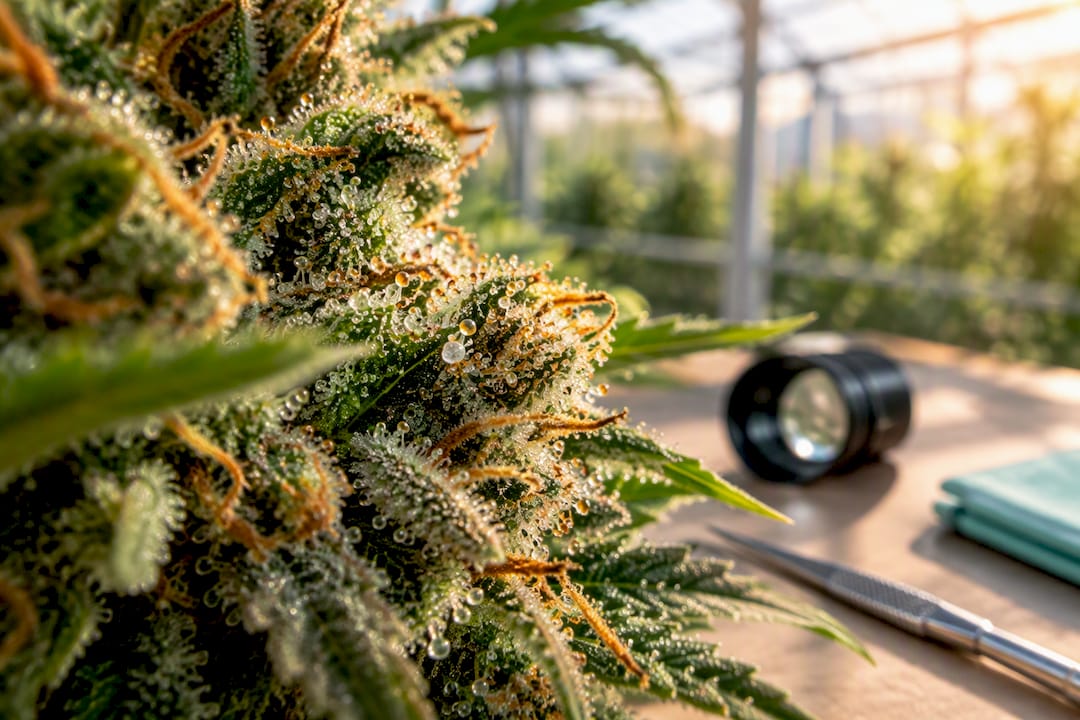
Serious producers often harvest early in the morning, before the heat causes some of the volatile terpenes to evaporate. This simple precaution, which is almost imperceptible to the end consumer, has a direct impact on the aromatic richness of the finished product.
Drying follows a similar principle: if done too quickly, it locks in unpleasant chlorophyll-based aromas; if done too slowly, it exposes the flowers to mold. The recommended practice is slow curing, spread out over two to three weeks, at a temperature of 18 to 20°C and a relative humidity of 30 to 40%. This gradual curing allows the terpenes to stabilize and develops a more rounded aroma. Once dried, the flowers are best stored in an airtight jar, away from light, to slow their degradation over time.
Dosage and consumption methods tailored to each flower type
There is no one-size-fits-all dose: the right amount depends on your individual sensitivity, the CBD concentration listed on the COA, and your chosen method of consumption. The safest approach is to start low and increase gradually, in increments of a few milligrams.
For a myrcene-dominant flower intended for evening use, a moderate dose via vaporizer, taken about 45 to 60 minutes before bedtime, generally helps synchronize the effect with falling asleep without causing a heavy feeling upon waking. For daytime use with a pinene or limonene profile, it’s best to divide the dose into small amounts spread throughout the day rather than taking a single high dose.
The infusion is suitable for those seeking a gentler, more gradual effect, with a longer onset than when vaporizing. Vaporization is still preferable when you want to adjust the dose in real time, by directly observing your body’s reaction before taking another inhalation. In both cases, keeping a log of the amounts and the effects you experience helps you find your own comfort threshold—much more effectively than a generic recommendation on the packaging.
Risks and Precautions Based on the Type of Flower Consumed
No CBD flower—whether indica, sativa, or hybrid—is free from precautions for use. Strains rich in myrcene, which are sought after for their sedative effects, can cause significant drowsiness in sensitive individuals: avoid driving or operating machinery for several hours after consumption.
On the other hand, profiles rich in energy and focus—which are often high in limonene or pinene—can exacerbate preexisting nervousness in anxious individuals, which runs counter to the desired effect. That’s why choosing based on terpenes is more important than choosing based on the label: a poorly chosen hybrid can produce the opposite effect of what’s expected.
CBD can also interact with certain medications, particularly those metabolized by the liver via cytochrome P450, a family of enzymes also involved in many common treatments. Anyone undergoing regular medical treatment, or who is pregnant or breastfeeding, should seek the advice of a healthcare professional before consuming CBD flowers, regardless of their specific profile. Finally, only flowers with a THC content below 0.3% remain legal in France: above this threshold, even a trace of psychoactivity can lead to unwanted side effects, such as temporary anxiety or dizziness.
My Method for Narrowing Down Your Choice of Flowers
The best way to test this is through personal experience: buy small amounts of two or three different terpene profiles, and keep a simple journal noting the time of consumption, the dose, and the effects you experience over a two-hour period. Also compare vaporizing and steeping the same terpene profile: the onset time and intensity vary significantly, which helps you understand how your body metabolizes each terpene.
After several years of tracking changes in quality standards in the CBD industry, I remain convinced that a reader who learns how to interpret a COA makes faster progress than a reader who memorizes strain names.
— Steven
Where to Buy Tested and Compliant CBD Flowers
A selection of flowers and resins is available, each accompanied by certificates of analysis that include CBD and THC levels and the terpene profile for each batch.

Before placing your first order, opt for a small trial size rather than a large package: this gives you time to check the COA upon receipt and assess the actual effect on your own body, without committing to a large quantity. The product page for Northern Light flowers in small buds is a good example of this trial size, with its analysis data displayed directly on the page. To explore the entire catalog and compare the available profiles, the CBD flowers and resins page remains the most comprehensive starting point.
Sources
To learn more about reading certificates of analysis and legal thresholds, check out our article on the differences between CBD and THC. For information on contaminants to watch for in a COA, our guide on pesticides and heavy metals details each parameter to check before making a purchase.
- CBD Flower Strains: Effects and Characteristics — TerraHerba
- CBD Flowers: Growing, Harvesting, and Storage — Kokopelli
- Indica Sativa: Understanding CBD Flowers — CBD-Insiders
Frequently Asked Questions
What is the most potent CBD flower?
Potency isn’t measured solely by the listed CBD content, but by the balance of cannabinoids and terpenes indicated on the COA. Strains like Charlotte’s Web or ACDC have a CBD:THC ratio of 20:1, which is considered high, but the intensity you experience also depends on your own tolerance.
What is the difference between Indica CBD and Sativa CBD?
The difference lies primarily in the plant’s morphology and its historical place of origin, not in a guaranteed effect. The terpene profile is a better predictor of the perceived effect than simply labeling a strain as indica or sativa, particularly because most current cultivars are hybrids.
Which CBD flower should you choose for sciatica?
For diffuse pain such as sciatica, a profile rich in beta-caryophyllene combined with high levels of CBD is an interesting avenue to explore. However, it is essential to consult a healthcare professional before using CBD as a supplement in the management of chronic pain.
What effects do people experience when using CBD flowers?
The method of consumption—whether vaporization or infusion—also affects the speed and intensity of the effect felt.